
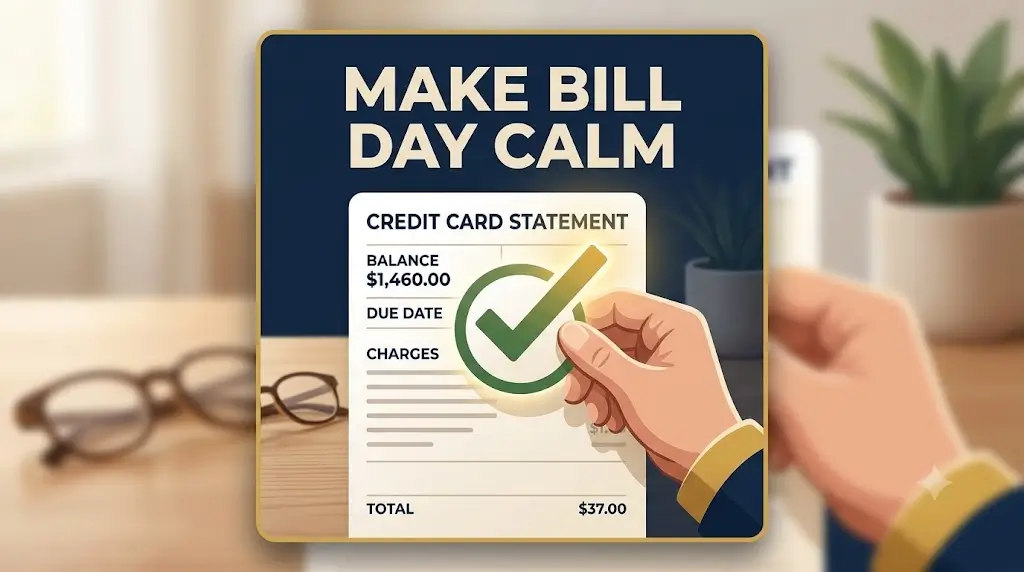
Senior money safety guide
How Seniors Can Read Credit Card Statements More Safely
Without Turning Bill Day Into a Panic Room
A credit card statement can feel like a narrow hallway with too many doors: due date, balance, interest, fees, strange merchant names, tiny charges, and that one line item that looks familiar but somehow not quite right. For many older adults, the danger is not “bad math.” The danger is rushed reading, hidden subscriptions, spoofed phone numbers, and small surprises that quietly become expensive.
This guide turns statement review into a calm monthly routine. It is built for seniors who want more independence, caregivers who want to help without hovering, and adult children who need a respectful system that catches mistakes before they become late fees, fraud claims, or family tension.
The goal is not to memorize banking rules. The goal is to use the same simple path every month: read the right numbers first, mark what is known, isolate what needs checking, and document every action. Think of it as a money seatbelt: unglamorous, repeatable, and quietly heroic.
Spot trouble faster
Use a 10-minute scan to catch missed payments, odd merchants, small test charges, and fees.
Protect independence
Create a routine that lets caregivers support without taking over the whole wallet.
Know when to escalate
Learn when to call the card issuer, write a dispute, report identity theft, or seek help.
Best first move: read the due date before the balance, because one missed date can make a small problem grow teeth. 🔎
Snapshot
This article is for US seniors, caregivers, and adult children who want a safer way to review credit card statements, spot fraud or billing errors, avoid late fees, and decide when to ask for professional or official help. By the end, you will have a monthly checklist, a safer paper-or-digital setup, and a one-page statement review sheet you can use today.
Table of Contents

Before You Act: What This Guide Can and Cannot Do
This guide gives general financial education for safer credit card statement reading. It is not legal advice, tax advice, debt counseling, identity theft recovery advice, or a substitute for guidance from a qualified professional.
Credit card problems can range from harmless confusion to active fraud. A strange-looking merchant name might be a grocery delivery app. It might also be a test charge from someone who has your card number. The safer habit is to slow down, document what you see, and contact the card issuer through a trusted channel.
For possible fraud, use the phone number on the back of the card, the issuer’s official app, or the official website you already know. Do not trust phone numbers in surprise texts, emails, pop-ups, voicemail messages, or search ads. Scammers adore urgency because urgency turns smart people into button-clicking squirrels.
Key takeaway
If money may be at risk, separate the task into two tracks: protect the account first, then investigate the paperwork. A calm call to the card issuer is often safer than trying to solve everything through a merchant, search result, or incoming message.
Use Written Records, Not Memory
A billing dispute is not the place to rely on “I think I called last Tuesday.” Keep a notebook, folder, or one-page sheet with dates, names, phone numbers, confirmation numbers, and the exact charge you asked about.
When a dispute must be sent in writing, keep a copy of the letter and supporting documents. Send copies, not originals. For seniors with low vision, a large-print version of the dispute log can reduce errors and fatigue.
Know the Difference Between Suspicious and Confusing
Some statement lines are confusing because the merchant processor uses a different name. For example, a restaurant may show up under the parent company, a parking app may display as a payment platform, and an online order may appear under a warehouse or marketplace name.
Suspicious is different. Multiple unfamiliar charges, small repeated charges, overseas transactions you did not make, a card used after being lost, or charges that appear after a suspicious phone call deserve fast attention.
Who This Is For, and Who Should Get Extra Help
This article is for everyday statement review: monthly bills, recurring subscriptions, unfamiliar merchants, late fees, missing payments, and basic fraud concerns. It is especially useful for seniors who want a steady routine and adult children who want to help without turning every bill into a family board meeting.
It is not enough for severe debt, lawsuits, active identity theft, coercion, or elder financial exploitation. Those situations may require the card issuer, a credit counselor, legal aid, Adult Protective Services, law enforcement, or identity theft recovery resources.
For Seniors Who Want a Monthly Money Seatbelt
A monthly routine removes guesswork. Same chair, same folder, same pen, same checklist. The repetition matters because many statement problems are not dramatic at first. They arrive wearing slippers: a $7.99 trial, a $14.95 service fee, a small merchant name that keeps returning.
Seniors who use reading glasses, magnifiers, or large-print tools may also benefit from adjusting the physical setup. If statement print feels cramped, see this related guide on choosing the best font size for seniors for safer everyday reading.
For Adult Children Helping Without Taking Over
The best support protects both safety and dignity. Instead of grabbing the statement and “fixing” everything, sit beside the senior and use shared language: known, question, action taken. That keeps the senior involved and reduces the feeling of being audited by one’s own child.
A caregiver can help by reading merchant names aloud, enlarging digital statements, filing dispute records, or making a call together on speakerphone. The senior should still hear what is being said and understand the next step whenever possible.
When a Free DIY Routine Is Not Enough
A free checklist is enough when the issue is routine: organizing statements, finding subscriptions, setting reminders, and reviewing known charges. Paid help or professional guidance may be worth considering when there are repeated missed payments, complex debt, legal notices, tax issues, suspected exploitation, or identity theft.
Before paying anyone for help, ask exactly what they will do, what they will not do, how they protect private information, whether they are licensed if licensing is relevant, and how fees are charged. A gentle rule: never hire someone who makes you feel rushed before they make you feel informed.
| Situation | Free DIY May Be Enough | Consider Paid or Professional Help |
|---|---|---|
| Monthly statement review | Use a printed checklist and large-print notes. | Consider bookkeeping help if bills are consistently missed. |
| One unfamiliar charge | Call the card issuer and document the response. | Escalate if the charge is part of a pattern or involves identity theft. |
| Recurring subscriptions | Cancel unused services and monitor the next statement. | Consider help if many accounts, apps, or passwords are involved. |
| Caregiver concerns | Use shared review sheets and two-person visibility. | Seek legal or protective help if control, pressure, or fear is present. |
The 10-Minute Statement Scan That Catches Most Problems
The safest way to read a credit card statement is not from top to bottom. It is from risk to detail. Start with the parts that can cost money quickly, then move into the purchase list.
Here is the monthly scan that works well for seniors, caregivers, and anyone whose kitchen table is already carrying three medical papers, a grocery list, and one mysterious receipt from February.
The safer statement flow
1. Date
Read the due date before the balance.
2. Payment
Confirm the last payment posted.
3. Numbers
Check balance, minimum, interest, and fees.
4. Charges
Mark known, question, and recurring items.
5. Action
Call, cancel, dispute, or file the statement.
Start With the Due Date, Not the Balance
The balance gets attention because it is the big number. The due date deserves first place because it controls late fees, interest, credit score stress, and family worry.
Circle the due date. Then ask: “Is the payment already scheduled, mailed, or still waiting?” This single question prevents many expensive accidents.
Check the Minimum Payment Trap
The minimum payment keeps the account current, but it does not mean the bill is inexpensive. If a senior is carrying a balance, the statement may show interest charges that keep appearing even when payments are being made.
For seniors on fixed income, the minimum payment can feel like a lifeline. It may be necessary sometimes. But it should be read as a warning light, not a full plan. If balances are growing month after month, it may be time to compare nonprofit credit counseling, budgeting help, or a conversation with a trusted financial professional.
Match Payments Before Reading Purchases
Find the section that lists payments and credits. Confirm that the last payment appears, the amount is correct, and the date makes sense.
If a mailed check, online bill pay, or bank transfer is missing, do not assume it will fix itself. Mark it as “action needed,” then check the bank account, bill pay service, or issuer records.
Circle Anything That Feels Almost Familiar
Not every questionable charge screams. Some whisper. A merchant may look almost right, the date may be close, or the amount may be small enough to ignore.
Use a circle, not a verdict. A circled charge simply means “check this.” That keeps the mood calm and prevents family conversations from becoming miniature courtroom dramas.
Key takeaway
The best credit card statement checklist for seniors starts with timing, then payments, then costs, then purchases. Reading purchases first is tempting, but dates and missing payments can cause faster damage.

The Three Numbers Seniors Should Read First
A statement may contain many numbers, but three deserve a bright mental sticky note: statement balance, minimum payment, and interest charge. Read these before judging whether the card is “fine.”
Statement Balance: What the Card Wants Paid
The statement balance is usually the amount owed at the end of that billing cycle. Paying the full statement balance by the due date often helps avoid new interest on purchases, depending on the account terms and whether a previous balance was carried.
For seniors who use autopay, compare the autopay setting to the statement balance. Some accounts are set to pay only the minimum. Others pay the full statement balance. That tiny setting can change the whole financial weather.
Minimum Payment: What Keeps the Account Current
The minimum payment is the smallest amount required to avoid being late. It is not a sign that the account is healthy, affordable, or paid down in a reasonable time.
If a senior can only pay the minimum for several months, that is not a moral failure. It is a planning signal. Review income, medical costs, subscriptions, and high-interest balances before the situation hardens into a debt maze.
Interest Charge: The Quiet Leak in the Boat
Interest is easy to skip because it is not a purchase. But interest tells you whether old debt is still riding along in the cart.
If interest appears unexpectedly, check whether a previous balance was carried, a payment was late, a promotional period ended, or a cash advance occurred. One surprise interest charge is a question. Repeated interest charges are a pattern.
| Statement Number | What It Means | Question to Ask |
|---|---|---|
| Statement balance | The amount owed for that statement cycle. | Can this be paid in full by the due date? |
| Minimum payment | The smallest required payment to stay current. | Is this becoming the default every month? |
| Interest charge | The cost of carrying a balance or certain transactions. | Why did interest appear, and can it be reduced next month? |
| Fees | Extra charges such as late, cash advance, or returned payment fees. | Was this avoidable, mistaken, or a sign of a bigger issue? |
Show me the nerdy details
Credit card billing rules can involve several timelines. In general, consumers should act quickly when disputing billing errors, and official consumer guidance emphasizes written notices for preserving certain rights. Card issuers also have response timelines after receiving a proper written dispute. Fraud, billing errors, merchant disputes, and identity theft are not always handled the same way, so it helps to label the problem accurately: “I do not recognize this charge,” “I was charged the wrong amount,” “I canceled this subscription,” “I never received the item,” or “My card may have been used without permission.” Clear labels help the issuer route the problem correctly.
Suspicious Charges: The Pause-Before-Panic Method
A suspicious charge should be handled quickly, but not wildly. The safest rhythm is pause, verify, contact the issuer, document, and monitor.
Panic invites bad clicks. A calm system gives the senior and caregiver a shared script.
Merchant Names Can Look Strange, Even When Legitimate
Before assuming fraud, check receipts, calendars, delivery apps, pharmacy orders, online accounts, and family purchases made with permission. A charge may show a billing processor instead of the store name.
Still unsure? Call the card issuer. Avoid searching random phone numbers attached to the merchant name. Search results can be messy, sponsored, outdated, or manipulated.
When a Small Test Charge Is Not Small
Small charges matter. A fraudster may test a card with a tiny amount before larger charges follow. Recurring charges under $20 can also slip past review for months because they feel too small to deserve attention.
The rule is simple: small unknown charges do not get a free pass. Mark them, check them, and watch the next statement.
Call the Card, Not the Merchant, for Possible Fraud
If a charge may be fraudulent, contact the card issuer first through the number on the card, the official statement, or the official app. The issuer can review the account, block the card if needed, and explain next steps.
For a billing error with a known merchant, you may also need to gather receipts, cancellation confirmations, delivery records, or written correspondence. Keep copies in the statement folder.
Suspicious charge mini-script
“I am reviewing my statement. I do not recognize a charge from [merchant name] on [date] for [amount]. I am calling the number on my card. Can you help me confirm whether this is legitimate, and tell me what steps I should take if it is not?”
Write down the date, time, representative name or ID if provided, and any case or confirmation number.
Unsafe Statement Habits That Invite Trouble
Unsafe statement habits are usually ordinary habits under pressure. Reading while tired. Paying before checking. Tossing papers into a pile. Sharing a login code because a caller sounds official.
None of these means a senior is careless. It means the system needs guardrails.
Do Not Read Statements While Rushed or Tired
Credit card statements require attention, especially when print is small or vision is strained. Choose a time of day when energy is better. Use strong, glare-free lighting. Keep reading glasses or a magnifier nearby.
For readers managing aging eyes, a dedicated setup can help. This guide on a reading glasses setup for seniors pairs naturally with a monthly statement routine.
Do Not Share Login Codes With Anyone Who Calls You
A real bank or card issuer may use verification steps when you contact them. But an unexpected caller asking for a one-time passcode, remote access, a full card number, or online banking password is a serious red flag.
Use this sentence and repeat it without apology: “I do not give codes on incoming calls. I will call the number on my card.” Then hang up.
Do Not Toss Statements Without Shredding Key Pages
Paper statements can reveal names, addresses, partial account numbers, merchant patterns, and payment details. Keep current statements in a labeled folder. Shred older pages you no longer need, especially pages with account information.
A simple filing system is often safer than a perfect one. If paper piles are already becoming a fog machine, this guide on how to organize digital files for seniors can help build a calmer system for statements, receipts, and confirmations.
| Common Mistake | Why It Is Risky | Safer Alternative |
|---|---|---|
| Only checking the total balance | Misses interest, fees, and unknown merchants. | Scan due date, payment, fees, interest, then purchases. |
| Ignoring small charges | Can hide subscriptions or test charges. | Circle every unknown charge, even under $10. |
| Paying first, investigating later | May delay action on errors or fraud. | Pay known amounts on time, but mark disputed items clearly. |
| Calling numbers from texts | May connect to scammers. | Use the number on the card or official statement. |
| Leaving statements in open piles | Raises privacy and missed-deadline risk. | Use one folder labeled by month. |
The Recurring Charge Audit Most Families Skip
Recurring charges are the attic boxes of personal finance. Everyone knows they exist. No one wants to open them. But for seniors on a fixed income, subscriptions can quietly drain money from the month before anyone notices.
The safest routine is to audit recurring charges every three months, not just once a year.
Find Streaming, App, Pharmacy, and Membership Charges
Look for charges that repeat monthly, quarterly, or annually. These may include streaming services, app subscriptions, cloud storage, delivery memberships, gym memberships, pharmacy auto-refills, magazine renewals, antivirus tools, and donation plans.
Write each recurring charge on a separate list. Include the merchant, amount, billing date, and whether the senior still uses it.
Ask: Do I Still Use This?
The best question is not “Is this cheap?” It is “Would I sign up for this again today?”
A $9.99 charge is not just $9.99 if it repeats all year, duplicates another service, or belongs to an account no one can access. The small-charge problem is rarely small. It is small enough to sneak.
Put Canceled Subscriptions on a Watch List
After canceling, do not celebrate too early. Keep the charge on a watch list for the next two statements. Some services bill one final cycle. Others fail to cancel cleanly. A few reappear like weeds with a receipt printer.
Save cancellation emails, confirmation numbers, screenshots, or mailed letters in the statement folder.
Key takeaway
A recurring charge audit is one of the best free ways to avoid wasting money. Review subscriptions every three months, cancel what no longer serves the senior, and confirm the cancellation on the next statement.
| Setup | Best For | Cost Level | What to Watch |
|---|---|---|---|
| Good: Paper checklist | Seniors who prefer printed statements and simple routines. | Low | Needs safe storage and shredding. |
| Better: Paper checklist plus account alerts | Families who want reminders without full account control. | Low to moderate | Too many alerts can create noise. |
| Best: Checklist, alerts, password manager, and trusted contact plan | Seniors with multiple cards, online accounts, or caregiver support. | Moderate | Compare privacy, ease of use, fees, and support before paying. |
Fees, Interest, and Paper vs Digital Setup
Some statement risks are loud, such as an unknown $400 charge. Others are quiet: a late fee, cash advance fee, interest charge, or paperless statement that no one remembers to open.
The safest setup is the one the senior will actually use every month.
Late Fees Are a Calendar Problem, Not a Character Flaw
A late fee does not mean someone is irresponsible. It often means the reminder system failed. Fix the system before blaming the person.
Options include calendar reminders, autopay for at least the minimum, a bill-pay day twice a month, a caregiver reminder, or a paper folder placed in the same visible location. Compare options based on reliability, not cleverness.
Cash Advance Fees Deserve a Conversation
A cash advance fee can signal confusion, emergency borrowing, scam pressure, or a misunderstanding about how the card works. It deserves a calm conversation, not a lecture.
Ask: “Was this intentional?” “Did someone ask you to get cash?” “Was there an emergency?” “Do we need a safer emergency fund plan?”
Paper Statements Help Memory, Digital Statements Help Speed
Paper statements can be easier to read, mark, and file. They also create privacy risk if left around, lost, or thrown away without shredding.
Digital statements can be faster, easier to search, and useful for alerts. They also require secure passwords, scam resistance, and comfort with apps or websites. For many seniors, a hybrid system works best: paper for review, digital for alerts and fast fraud response.
If the senior also uses checks or written payment notes, this related article on large-print check register alternatives may help create a safer paper trail.
| Statement Setup | Strength | Risk | Best Safety Upgrade |
|---|---|---|---|
| Paper only | Easy to mark, familiar, memory-friendly. | Can be lost, delayed, or exposed. | Use one folder, shred old pages, add phone alerts. |
| Digital only | Fast access, searchable, good for alerts. | Password and scam risks. | Use strong passwords and never share login codes. |
| Hybrid | Combines visibility with speed. | Needs a clear routine. | Review paper monthly and use digital alerts for unusual activity. |
When to Seek Help Immediately
Some statement problems should not wait for next month’s review. The right response depends on the problem, but speed and documentation matter.
Use the following red flags as a practical escalation checklist.
- The senior does not recognize multiple charges.
- A caller asked for card numbers, login codes, gift cards, cash, wire transfers, crypto, or remote access.
- A payment is missing, reversed, or posted incorrectly.
- The card was lost or stolen.
- A caregiver, family member, or helper controls the card and refuses to share information.
- The senior seems afraid, secretive, pressured, or confused after contact with someone asking for money.
- New cards, loans, accounts, or statements appear unexpectedly.
Possible Fraud: Contact the Card Issuer First
Use the number on the back of the card. Ask whether the card should be locked, replaced, or monitored. Follow the issuer’s instructions and write them down.
If identity theft may be involved, use official identity theft recovery resources. Avoid paid “fix everything” services until you understand what they do, what they charge, and whether free official steps are enough for the situation.
Possible Elder Financial Exploitation: Do Not Handle It Alone
If a senior may be pressured, manipulated, isolated, or controlled by someone with access to money, the issue may be bigger than a credit card statement. In that case, consider contacting the card issuer, a trusted professional, local Adult Protective Services, legal aid, or law enforcement depending on the circumstances.
The most important thing is not to argue the senior into silence. Keep the tone steady. Focus on safety, records, and support.
Real-world example: The Charge That Looked Like a Pharmacy
Margaret, 78, noticed a $19.95 charge that looked vaguely medical. She almost ignored it because she had picked up prescriptions that week.
Her daughter did not grab the statement or start scolding. She asked, “Should we put this in the question column?” They checked the pharmacy receipt. No match.
They called the number on the back of the card. The issuer found two more small charges from the same billing source and helped secure the account.
The lesson was not “Margaret should have known.” The lesson was that a respectful system caught what memory alone might have missed.
Key takeaway
Escalate quickly when there are multiple unknown charges, scam contact, missing payments, lost cards, identity theft signs, or pressure from a person who controls access to money.
Build a Safer Monthly Review Ritual
A ritual sounds fancy, but this one can be plain as toast: one chair, one folder, one pen, one checklist. The magic is not in the supplies. It is in using them every month.
Same Chair, Same Folder, Same Pen
Choose a well-lit place with minimal glare and fewer distractions. Keep the card statement, receipts, reading glasses, magnifier, pen, and review sheet together.
If multiple cards are used, review one card at a time. Mixing statements is how small errors put on tap shoes.
Use Two Colors: Known and Check
Use one color for known charges and another for charges that need checking. If color is difficult to see, use symbols instead: a check mark for known and a circle for question.
Keep the system simple enough to use even on a tired day.
Keep Receipts for One Billing Cycle
Keep receipts until the next statement has been reviewed. After matching them, shred or discard safely unless needed for taxes, warranties, medical records, reimbursement, or disputes.
For digital receipts, create one monthly folder or email label. The goal is not museum-grade archiving. It is finding the receipt before everyone loses patience.
Add a Trusted Second Look Without Losing Independence
A trusted second look can be monthly, quarterly, or only when a question appears. The senior can choose what level of help feels respectful.
Use a shared script: “I am not here to take over. I am here to help check the question marks.” That sentence alone can soften the whole room.
Monthly statement review checklist
- Circle the due date.
- Confirm the payment amount and payment date.
- Read the statement balance, minimum payment, interest, and fees.
- Mark every known purchase.
- Circle every unknown or almost-familiar purchase.
- List recurring charges and ask whether each is still used.
- Call the card issuer for possible fraud or unclear account issues.
- Write down every action taken.
- File the statement and review sheet together.

FAQ
How often should seniors review credit card statements?
Seniors should review each credit card statement every month, even if autopay is turned on. Autopay can help prevent late payments, but it does not catch unfamiliar charges, fees, subscription renewals, or missing credits.
What should a senior check first on a credit card statement?
Check the due date first, then confirm the last payment posted correctly. After that, review the statement balance, minimum payment, interest charges, fees, unfamiliar merchants, and recurring charges.
What should I do if my parent does not recognize a charge?
Ask calmly whether there may be a receipt, delivery order, pharmacy purchase, subscription, or family-authorized purchase. If the charge remains unclear or may be fraud, call the number on the back of the card and document the conversation.
Is it safer for seniors to use paper or online statements?
Neither is automatically safer. Paper statements can support memory and marking, but they need secure storage and shredding. Online statements allow faster access and alerts, but require safer passwords and scam awareness. Many seniors do best with a hybrid setup.
How can seniors spot recurring subscriptions they forgot about?
Look for charges that repeat monthly, quarterly, or annually. List the merchant, amount, and date. Ask whether the service is still used and whether there is a cancellation confirmation. Watch the next two statements after canceling.
Should seniors pay the bill before disputing a charge?
Do not ignore the due date while investigating. Pay attention to the issuer’s instructions, pay undisputed amounts on time when appropriate, and document any disputed charge carefully. For billing errors, written dispute steps may matter, so act quickly and keep copies.
What records should seniors keep after reporting a billing error?
Keep the statement, a copy of any written dispute, receipts, cancellation confirmations, screenshots, letters, dates of calls, representative names or IDs if provided, and confirmation or case numbers. Store them together until the issue is resolved.
How can caregivers help without taking financial control?
Use a shared checklist, read small print aloud, help organize records, and call the issuer together if needed. Keep the senior involved in decisions unless there is a legal arrangement or safety concern that requires a different approach.
Your 15-Minute Next Step: Make the Statement Review Sheet
The safest system begins with one page. Not an app. Not a binder thick enough to stun a raccoon. One page.
Take the most recent credit card statement and create three columns: Known, Question, and Action Taken. At the top, write the card issuer’s phone number from the back of the card. Add the statement closing date, payment due date, and minimum payment.
Then review only one statement. Mark known charges. Circle questions. Choose one action: call the issuer, check a receipt, cancel a subscription, schedule a payment, or file the statement.
One-page review sheet template
Card issuer phone number: ____________________
Due date: __________ Payment posted: Yes / No Statement balance: __________
Charges matched to receipts, memory, or approved use.
Charges to verify before filing the statement.
Calls, cancellations, dispute letters, dates, and case numbers.
A safer credit card statement routine does not have to feel like a finance exam. It can feel like setting a cup on a coaster: small, ordinary, and protective. Month by month, the ritual builds a quiet fence around money, memory, and independence.
Last reviewed: 2026-07