

Organize your questions and next steps, then save your worksheet.
Summary and next steps
Prepare an eye appointment around symptoms, medical history and everyday function. Ask which conditions are being monitored and when to return.
- Bring medicines, previous treatment and a short symptom note.
- Choose the two daily tasks you most want to discuss.
- Record findings, next steps and the follow-up date.
Editorial maintenance: October 24, 2026. Summary layout, related links and technical metadata updated. This is not a full clinical review.
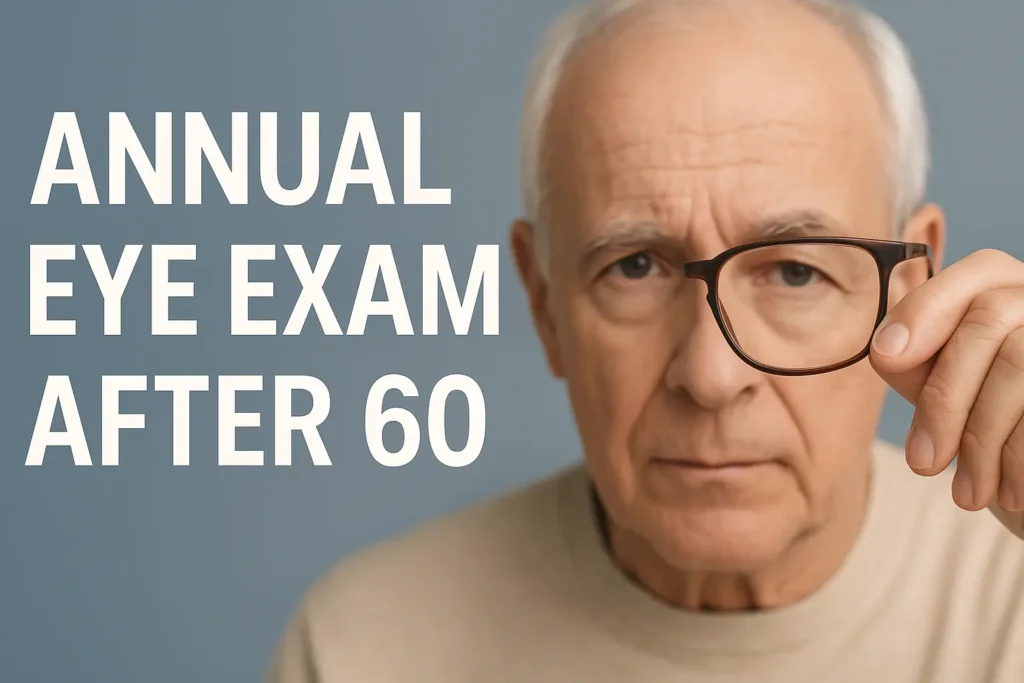
Preparing for an eye examination after 60
By the time you hit your 60s, your calendar starts filling up with all kinds of glamorous events: fasting blood tests, mysterious scans, and the ever-popular “just a quick follow-up” (that somehow eats half your day). So yeah—adding an annual eye exam might feel like one more thing you’ll get to eventually.
Eye conditions become more common with age, and some have no early symptoms. Clear vision alone cannot rule out disease; a comprehensive examination and an individual follow-up plan matter.
This checklist is an educational preparation guide, not a report of the author’s personal diagnosis.
It is easy to postpone a routine appointment when everyday vision seems unchanged. Screening can identify changes before they interfere with reading or driving.
Ask your clinician which conditions are being monitored, what has changed, and when to return. The answers depend on your examination and medical history.
Use this guide to prepare your questions and practical information before the appointment.
The checklist covers:
- 11 practical questions to discuss with your eye doctor
- A 60-second history checklist to prepare for your eye examination
- Money-saving tips for Medicare and insurance (yes, there’s a smarter way to do this)
- And a simple prep list so you walk into your next appointment ready—not reactive
The whole thing takes under 15 minutes to go through today. But it could help protect years of vision down the line.
Bring questions about everyday tasks that matter to you, such as reading labels, driving or recognizing faces.
60-Second History Checklist Before Your Eye Exam
Check the statements that apply and share them with your clinician. Do not add the boxes to diagnose disease, assign a risk category, or determine insurance eligibility.
- I’m 65 or older.
- I have diabetes (type 1 or 2).
- I’ve been told I have high blood pressure or high cholesterol.
- A parent or sibling has glaucoma, macular degeneration, or severe vision loss.
- I smoke, or I quit within the last 15 years.
- I take medications that can affect the eyes (steroids, some heart or arthritis meds, or GLP-1 drugs for diabetes/weight).
- I’ve noticed new floaters, flashes of light, dark curtains, or sudden blurry spots in the last month.
Any new urgent symptom overrides this checklist: sudden vision loss, a curtain, new flashes with floaters, or severe eye pain with nausea needs immediate eye or emergency care. New distortion or a new blind spot needs prompt clinical advice.
For routine care: ask which examination interval fits your findings and history. A checklist count cannot establish a safe waiting period.
No checked boxes does not rule out eye disease. Keep your recommended examination schedule even when you see well.
Apply in 60 seconds: Save the relevant history and symptom onset dates for your clinician. Do not wait for the appointment if an urgent symptom appears.
Use the history checklist to start a focused conversation. Bring a medication list and ask how your findings affect monitoring.
Why annual eye exams matter after 60 (and why “I see fine” isn’t enough)
Here’s the uncomfortable reality: the four leading causes of blindness in older adults—cataract, glaucoma, age-related macular degeneration, and diabetic retinopathy—tend to start quietly. By the time you notice a big change, damage is often permanent.
Vision loss can affect reading, mobility, driving and independence. Screening recommendations and your personal findings are more useful for scheduling care than applying a population statistic to yourself.
The CDC recommends dilated examinations every 1–2 years for adults over 60; people with diabetes or high blood pressure should ask their doctor about frequency and often need annual examinations. Existing eye disease can require closer follow-up.
Ask whether previous scans or examination notes are available for comparison. A change over time can help the clinician explain what needs monitoring.
“Eye disease is rude. It shows up early, stays quiet, and sends the bill years later.”
- Silent eye diseases are common after 60.
- Annual exams catch problems long before symptoms explode.
- It’s far cheaper to monitor than to repair damage.
Apply in 60 seconds: Open your calendar app and block a 2-hour window this month labeled “Annual eye exam.”
What to bring to your ophthalmology appointment
Showing up prepared can turn a rushed 10-minute visit into a powerful strategy session about your eyesight. Think of this as your “coverage tiers + medical history” bundle.
1. Your current glasses, contact lens info, and old prescriptions
- Bring your most recent pair of glasses—even if you “never wear them.”
- If you use contacts, bring the box or a photo of the label.
- If you have old prescriptions, toss them in your bag; trend lines matter.
2. A simple medication list
Include:
- All prescription meds, especially for diabetes, blood pressure, cholesterol, arthritis, or mental health.
- Any steroid pills, inhalers, or eye drops.
- Over-the-counter supplements you take “for eyes” (lutein, AREDS formulas, omega-3s).
Some medications subtly change eye pressure, blood flow, or the lens over time. Your ophthalmologist can’t connect the dots if they don’t know what you’re taking.
3. Insurance & coverage details (especially Medicare)
- Your Medicare card and any Medicare Advantage or Medigap cards.
- Any vision plan card (often bundled with retiree benefits or employer coverage).
- A note of your plan type and whether you’ve met your Part B deductible this year.
For 2026, the Medicare Part B deductible is $283. For many covered services, 20% of the approved amount applies after the deductible, with possible additional facility costs. Routine vision care and covered medical eye services have different rules.
Bring your coverage cards and ask the clinic how the examination and any additional tests will be billed. A medical billing category does not by itself guarantee coverage.
- Bring the physical cards, not just a fuzzy photo.
- Include eye vitamins and over-the-counter meds.
- Keep everything in a labeled envelope near your keys.
Apply in 60 seconds: Grab a spare envelope, label it “Eye Exam Kit,” and drop your latest glasses prescription into it right now.
11 Practical Questions to Ask Your Ophthalmologist
Here are eleven questions to adapt to your medical history, examination findings and everyday visual needs.
Question 1 – “How do my eyes today compare with last year?”
Don’t settle for “looks fine.” Ask for specifics:
- Has my prescription changed more than you’d expect for my age?
- Any changes in eye pressure, optic nerve shape, or retinal scans?
- Is the trend stable, improving, or slipping?
This turns a random snapshot into a trajectory. You want your doctor thinking in terms of years, not days.
Question 2 – “Are you seeing any early signs of cataracts, glaucoma, or macular degeneration?”
These are the big three for seniors. In the US, they’re among the leading causes of vision loss after 60. Ask:
- If yes, what stage are we at, and what’s our plan?
- If no, what specific things are you checking to be sure?
Illustrative example: If a clinician identifies a small cataract, ask which activities to monitor, when to return, and how treatment decisions are made. This example does not describe a verified patient outcome or a fixed surgical timeline.
Question 3 – “Which findings affect my risk, and what follow-up do I need?”
This is a sobering question, but a powerful one. You want your ophthalmologist to integrate:
- Diabetes, blood pressure, cholesterol, smoking history.
- Family history of glaucoma, AMD, or retinal detachment.
- Medications that affect blood vessels or inflammation.
Ask which findings or risk factors matter for your eyes and what actions follow. An exact five-year prediction of sudden vision loss may not be possible; risk categories do not replace symptom triage.
- Trend over time matters more than one-day results.
- Name specific diseases: cataracts, glaucoma, AMD.
- Always connect findings back to your daily life.
Apply in 60 seconds: On your phone, create a note titled “Eye Exam Questions” and add Questions 1–3 right now.
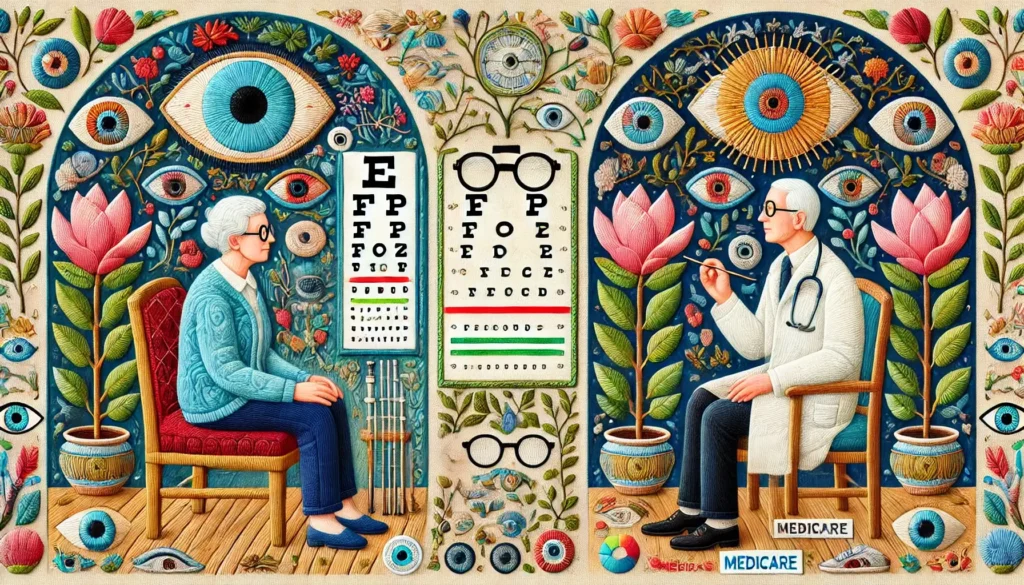
Question 4 – “Which tests today are essential, and which are optional add-ons?”
Modern eye clinics can feel like a menu: retinal photos, wide-field scans, extra imaging that isn’t always fully covered. Ask plainly:
- Which tests are medically necessary for someone my age and risk level?
- Which ones are optional, and what happens if we skip them this year?
- Roughly what will each test cost under my coverage?
This isn’t being difficult—it’s protecting your out-of-pocket budget while still getting the right screening.
Question 5 – “How often should I be seen based on my actual risks, not just my age?”
For some low-risk seniors, a check every 1–2 years might be enough. But with diabetes, glaucoma suspicion, or early macular changes, every 6–12 months (or even more often) may make sense. Ask your doctor to be specific—and write it down.
Question 6 – “What symptoms should make me call you the same day, versus wait a week, versus go to the ER?”
This may be the most important question on this page. Clear triage rules can be life-saving for your vision:
- Same day or ER: sudden curtain over vision, a shower of floaters, bright flashes, eye trauma, severe pain, or halos with nausea.
- Contact promptly for triage: new distortion in straight lines, one eye suddenly worse than the other, new blind spots.
- At next visit: mild blur that improves with blinking, minor dryness, occasional floaters you’ve had for years.
Question 7 – “If you had my eyes, what would you be most worried about?”
This question cuts through rehearsed explanations. You’re asking for your doctor’s gut clinical concern. Often you’ll hear something like, “Honestly, I’m watching your pressure creep up,” or “You have just enough macular change that I want you on a specific supplement and diet pattern.”
Question 8 – “Could any of my medications be affecting my eyes?”
Ask this every year, especially if you’ve started:
- New diabetes drugs (including GLP-1 medications like semaglutide).
- New blood pressure or cholesterol meds.
- Long-term steroids or immune-modulating drugs.
Eye doctors and primary-care doctors sometimes work in parallel; this question forces them to cross paths—through you.
Question 9 – “How will today’s visit be coded—routine or medical—and what should I expect to pay?”
This is where deductibles, premiums, and coverage tiers sneak in. In the US:
- Routine vision exams are often covered by separate vision plans or Medicare Advantage extras.
- Medical eye exams (for cataracts, glaucoma, diabetes, AMD) run through Medicare Part B or private insurance, with deductibles and coinsurance.
Knowing the code type before you leave the office helps you understand your eventual bill and decide whether to bundle tests into the same visit.
Question 10 – “Do I need referrals or prior authorization for any follow-up tests or treatments?”
If your ophthalmologist recommends OCT scans, laser treatment, or injections, you want to know:
- Will my plan require prior authorization or special approval?
- Do I need a referral from my primary doctor?
- Is there a specific billing code or “fee schedule” I should ask my plan about?
This question alone can save hours of phone calls and surprise denials later.
Question 11 – “What one change at home would protect my eyesight the most this year?”
Sometimes the most powerful fix isn’t in the exam room; it’s in your kitchen, your cigarette pack, or your walking shoes. Recent research shows that patterns like the Mediterranean diet and consistent exercise are linked with lower risk of age-related macular degeneration and healthier retinal blood flow as we age.
Ask for one specific change—not ten. For example:
- “Stop smoking; your eyes will thank you faster than your lungs.”
- “Add leafy greens and oily fish twice a week.”
- “Check your blood sugar and blood pressure goals with your primary doctor.”
Show me the nerdy details
Behind each of these questions is a long evidence trail—clinical statements from the American Academy of Ophthalmology, CDC data on vision impairment and falls, Medicare coverage policies for diabetic retinopathy and glaucoma, and nutrition and exercise studies linking cardiovascular health to retinal health. You don’t need to memorize those documents. You just need questions that gently force your doctor to connect that science back to your individual eyes, your coverage, and your next 12 months.
Cost, coverage, and Medicare: how to avoid surprise bills in 2026 (US)
Let’s talk money for a moment. Eye care lives at the intersection of premiums, deductibles, copays, and coverage tiers. You don’t have to become an insurance specialist, but a simple mental map can protect your wallet.
Mini fee & coverage table (example for 2026, US)
| Scenario | How it’s usually billed | What you might owe* |
|---|---|---|
| Annual diabetic eye exam | Medicare Part B medical exam | Counts toward the $283 Part B deductible, then ~20% coinsurance |
| Glaucoma screening for high-risk patient | Medicare Part B preventive screening | Often covered annually; you may still face deductible/coinsurance |
| “Routine” eye exam & new glasses | Vision plan or Medicare Advantage extra | Copay plus any costs beyond the plan’s allowance or fee schedule |
*These are general examples, not guarantees. Always confirm your own coverage and current fee schedule with your plan.
Apply in 60 seconds: Call the number on your insurance card and ask, “How is an annual eye exam for diabetes or glaucoma billed under my plan, and what’s my current deductible and coinsurance?” Save this table and confirm the current fee on your provider’s official page.
Medicare Part B typically covers an annual eye exam for diabetic retinopathy if you have diabetes, and yearly glaucoma screening if you’re considered high-risk. After you meet the Part B deductible, you usually pay 20% of the Medicare-approved amount, and Medicare covers the rest. Private Medicare Advantage plans, Medigap, and vision plans layer on top of that with their own copays, limits, and coverage tiers.
Three questions to ask your insurer before your exam:
- “Is my visit covered as preventive, routine vision, or medical?”
- “What is my current Part B deductible and coinsurance for eye exams in 2026?”
- “Are there any prior authorization rules or network restrictions for eye clinics?”
- Learn whether your exam hits your Part B deductible.
- Ask about coinsurance and copay amounts in advance.
- Write the answers on your “Eye Exam Kit” envelope.
Apply in 60 seconds: Flip your insurance card over, find the member services number, and jot it in your phone as “Eye coverage questions.”
Infographic: Your senior eye exam at a glance
3 Phases of an Annual Eye Exam After 60
1. Before the visit
- Complete the 60-second history checklist.
- Pack your Eye Exam Kit (glasses, meds, cards).
- List your top 3 questions (from the 11 above).
2. During the visit
- Ask how today compares to last year.
- Confirm which diseases they are screening for.
- Clarify visit type: routine vs medical.
3. After the visit
- Note your next recommended exam date.
- Write down “red flag” symptoms to watch for.
- Set a reminder to recheck coverage next year.
Print or screenshot this infographic and keep it with your glasses case.
How to use your results in the next 15 minutes
When you walk out of the clinic, the hard part is not remembering a dozen acronyms; it’s turning the visit into simple next steps you’ll actually follow.
Decision card: What to do with your exam results
- If everything is stable: Add your next exam to your calendar and keep your current habits (plus one upgrade like diet or walking).
- If there are early changes (mild cataract, “glaucoma suspect,” dry AMD): Ask for a one-page summary and schedule the recommended follow-up before you leave.
- If you need treatment (injections, laser, surgery): Clarify timelines, prior authorization steps, and which coverage tier applies.
Apply in 60 seconds: Before you leave the waiting room, write three things: 1) diagnosis or status, 2) follow-up timing, 3) symptoms that should trigger an urgent call. Save this table and confirm the current fee on your provider’s official page.
If you’re in the United States, this is also the moment to line up your coverage. Many seniors juggle Original Medicare, Medicare Advantage, Medigap, and separate vision plans. Each has its own rules about deductibles, fee schedules, and which clinics are “in network.” Try to do one simple thing within 24 hours of your exam: call your plan and confirm how today’s visit will show up on your bill.
If you live outside the US, your system may be different—national health coverage, private insurance, or a mix. The same principle still holds: know the cost band before you commit to multiple extra tests or private procedures. Ask your clinic if they have a printed or online fee schedule and whether public or supplemental coverage applies to your specific exam and diagnoses.
- Turn technical results into a simple three-line summary.
- Book your follow-up while you’re still at the desk.
- Confirm how the visit will be billed within 24 hours.
Apply in 60 seconds: Create a “Vision” note on your phone and paste your three-line summary there after each exam.
FAQ
1. How often should seniors get an eye exam?
Most experts recommend that adults 65 and older get a comprehensive eye exam every 1–2 years, and annually if you have risk factors like diabetes, high blood pressure, or a family history of glaucoma or macular degeneration. Some high-risk patients may need checks every 6–12 months. Ask your ophthalmologist to give you a specific interval based on your own eyes—not just your birth year.
60-second action: Ask your doctor, “How often do you want to see me, and why?” Then put that date into your calendar before you leave.
2. What’s the difference between an ophthalmologist and an optometrist for seniors?
Both examine eyes and prescribe glasses, but ophthalmologists are medical doctors (MD or DO) who can perform surgery and manage complex eye diseases. Optometrists (OD) are eye-care professionals who focus on vision correction and many aspects of eye health. For seniors, especially those with diabetes, glaucoma, cataracts, or macular degeneration, having an ophthalmologist involved is wise—often in partnership with an optometrist who fine-tunes your lenses.
60-second action: If you currently see only an optometrist and you’re over 65 with chronic conditions, call and ask if they recommend you also establish care with an ophthalmologist.
3. Does Medicare cover my annual eye exam?
Original Medicare Part B generally does not cover routine eye exams just for glasses. However, it does cover annual eye exams for people with diabetes to check for diabetic retinopathy, and yearly glaucoma screenings for certain high-risk groups. After your Part B deductible is met, you usually pay 20% of the approved amount while Medicare pays 80%. Some Medicare Advantage plans and vision plans add coverage for routine exams and eyewear.
60-second action: Call your plan and ask, “Is my next eye exam considered routine or medical, and what will my approximate out-of-pocket cost be?”
4. What symptoms mean I should seek immediate eye care?
Call your eye doctor or emergency services right away if you notice:
- A sudden curtain or shadow over your vision.
- A burst of new floaters and flashes of light.
- Severe eye pain, redness, and nausea.
- A sudden, dramatic drop in vision in one or both eyes.
These can signal retinal detachment, acute glaucoma, or other emergencies where hours matter.
60-second action: Store your eye clinic’s urgent-care number in your phone under “Eye Emergency” so you’re not hunting for it in a crisis.
5. I feel fine and see well—do I really need all this?
This is the trap many of us fall into. Eye diseases often advance long before you notice blurry letters. In some conditions, like glaucoma, you can lose chunks of side vision without realizing it until damage is severe. Regular exams, especially after 60, are less about today’s clarity and more about protecting your future independence, mobility, and ability to recognize the faces you love.
60-second action: If you haven’t had a full eye exam in the last 1–2 years, pick up your phone and make the appointment before you close this page.
Optional video: Open the video on YouTube (external site).
Optional video: Open the video on YouTube (external site).
Conclusion: Future-you will be grateful
If this feels like a lot, remember: you don’t need to become an eye specialist. You just need to show up prepared, ask a handful of smart questions, and make one or two concrete moves after each visit.
A useful appointment ends with an understandable diagnosis or monitoring plan, a follow-up interval and clear instructions about new symptoms. Writing these down can make the next steps easier.
In the next 15 minutes, you can:
- Book your next eye exam if you’re overdue.
- Create your “Eye Exam Kit” envelope and drop your glasses prescription into it.
- Copy the 11 questions into a note on your phone so they’re ready at the clinic.
Your eyesight is how you read your grandchild’s face, navigate new streets, and keep doing the everyday things that make life feel like your life. An annual eye exam, plus 11 honest questions, is a small price to pay to keep that view clear for as long as possible.
- Schedule the exam.
- Ask the questions.
- Write down the plan.
Apply in 60 seconds: Before you close this page, set a reminder titled “Protect my eyes” for tomorrow morning, and add one action from this checklist as the note.
Last updated: October 15, 2026. Urgent-symptom guidance, screening preparation and U.S. Medicare costs were reviewed. This guide is educational; your clinician determines your examination schedule, and your insurer confirms coverage.
PUT THIS GUIDE TO WORK · INTERACTIVE WORKSHEET
Build an eye-examination question card
Use this worksheet alongside the article: Annual Eye Exam Checklist for Seniors: 11 Questions to Ask Your Ophthalmologist. Use the fields provided to organize your notes and next actions, then save your worksheet.
Your entries stay in this page and are cleared when you reload. No account is needed. Saved files are downloaded only to your device.
This card organizes a discussion or task. It does not provide diagnosis, treatment, medication timing, driving clearance, or professional approval. Copy clinical instructions exactly and ask the professional about uncertainty.
How to use your result
Save the worksheet before leaving this page. Recheck any quote, date, or instruction with the relevant provider, pharmacist, manufacturer, or official organization. A completed checklist means you recorded the steps, not that an outcome is guaranteed.
Worksheet added October 20, 2026. Read the article above for context and its stated review scope.