
If you have Original Medicare and are choosing where to have cataract surgery, the facility can make a noticeable difference to your out-of-pocket cost. For routine cataract surgery represented by CPT 66984, Medicare’s 2026 national averages show an estimated patient cost of $343 at an ambulatory surgical center (ASC) versus $563 at a hospital outpatient department.
That is a difference of about $220 per eye. The Medicare-approved total is also substantially different: $1,717 at an ASC compared with $2,819 in a hospital outpatient department. These are national averages, not quotes for a particular surgeon or ZIP code.
Both settings generally use the same Medicare Part B cost-sharing framework. After the Part B deductible applies, you normally pay 20% of the Medicare-approved amount for the facility and the doctor. The reason the hospital estimate is higher is primarily the larger hospital facility payment, not a different coinsurance percentage. Medicare explains this coverage structure on its cataract surgery coverage page.
Table of Contents
2026 Medicare cataract surgery cost: ASC vs hospital
Medicare’s Procedure Price Lookup provides the following 2026 national averages for CPT 66984, a commonly used code for routine cataract removal with implantation of an intraocular lens.
| 2026 national average | Ambulatory surgical center | Hospital outpatient department |
|---|---|---|
| Medicare-approved total | $1,717 | $2,819 |
| Doctor fee | $462 | $462 |
| Facility fee | $1,255 | $2,357 |
| Medicare pays | $1,374 | $2,256 |
| Patient pays, average | $343 | $563 |
Source: Medicare’s 2026 Procedure Price Lookup for CPT 66984. The figures are national averages based on Medicare’s 2026 payments and copayments and can vary by location and individual circumstances.
On these national averages, the hospital outpatient patient share is about $220 higher, or roughly 64% above the ASC amount. Almost all of the difference comes from the facility side: the listed doctor fee is $462 in either setting, while the facility amount is $1,255 at the ASC and $2,357 at the hospital outpatient department.
Why does the hospital cost more if the surgery is similar?
Medicare pays hospital outpatient departments and freestanding ambulatory surgical centers under different payment systems. The building in which the procedure takes place therefore affects the Medicare-approved facility amount.
This distinction matters because your Part B coinsurance is tied to the Medicare-approved amount. A 20% share of a larger facility payment produces a larger bill even when the surgeon’s professional payment is unchanged.
CMS updates the hospital outpatient and ASC payment systems each year. For 2026, CMS finalized updated payment rates for both settings under the Hospital Outpatient Prospective Payment System and ASC Payment System.
That does not mean a hospital outpatient department is an inappropriate place for cataract surgery. The appropriate setting depends on the patient’s medical needs, the surgeon’s recommendation, available facilities and other clinical considerations. Cost should be considered alongside clinical suitability, not used as the sole reason to change a medically appropriate surgical plan.
What does Medicare actually make you pay?
For covered cataract surgery performed in either a hospital outpatient setting or an ambulatory surgical center, Medicare states that after the Part B deductible is met, the beneficiary generally pays 20% of the Medicare-approved amount to both the facility and the doctor performing the surgery.
The annual Medicare Part B deductible is $283 in 2026. CMS increased it from $257 in 2025. If you have already satisfied the deductible through other Part B care earlier in the year, it should not be charged again simply because you are having cataract surgery.
If you have not met the deductible, however, your actual responsibility can be higher than the $343 or $563 national-average coinsurance figures shown in Medicare’s procedure comparison. The deductible is applied before Medicare begins paying its usual share. You can read the official 2026 deductible figures in the CMS 2026 Medicare Parts A and B cost announcement.
If you want a broader explanation of these moving pieces, this site also has a separate guide to Medicare cataract surgery cost in 2026.
The $343 and $563 estimates may not be your final bill
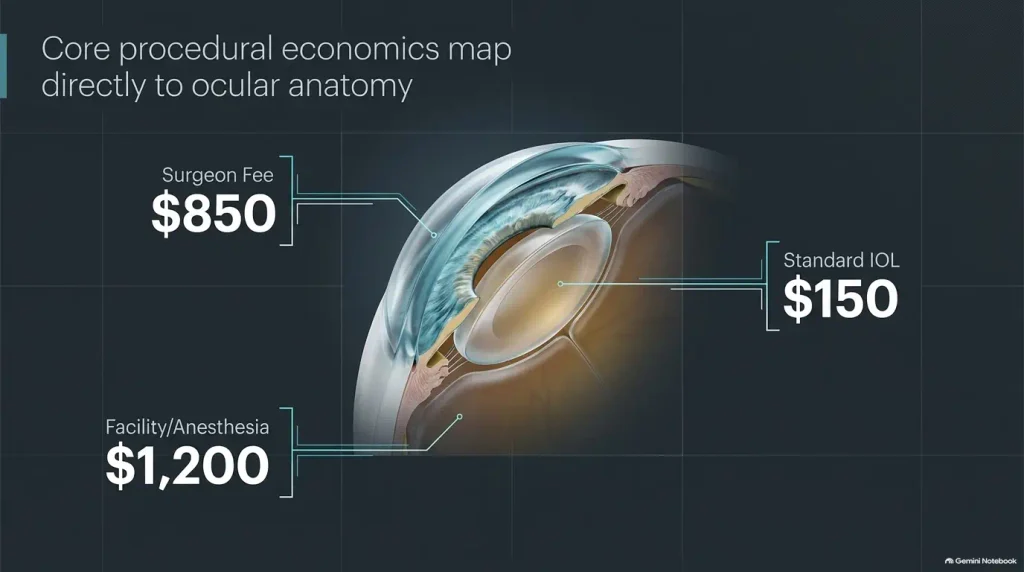
The Medicare comparison is extremely useful, but cataract surgery can generate expenses beyond the basic surgeon-and-facility estimate. Medicare itself warns that more than one doctor or additional services may be involved.
Anesthesia can create additional cost-sharing
Outpatient anesthesia associated with a covered surgery is generally covered under Part B. After the deductible, Medicare says you generally pay 20% of the Medicare-approved anesthesia amount, and additional facility cost-sharing may apply. See Medicare’s anesthesia coverage guidance when reviewing an estimate.
Elective upgrades can change the calculation
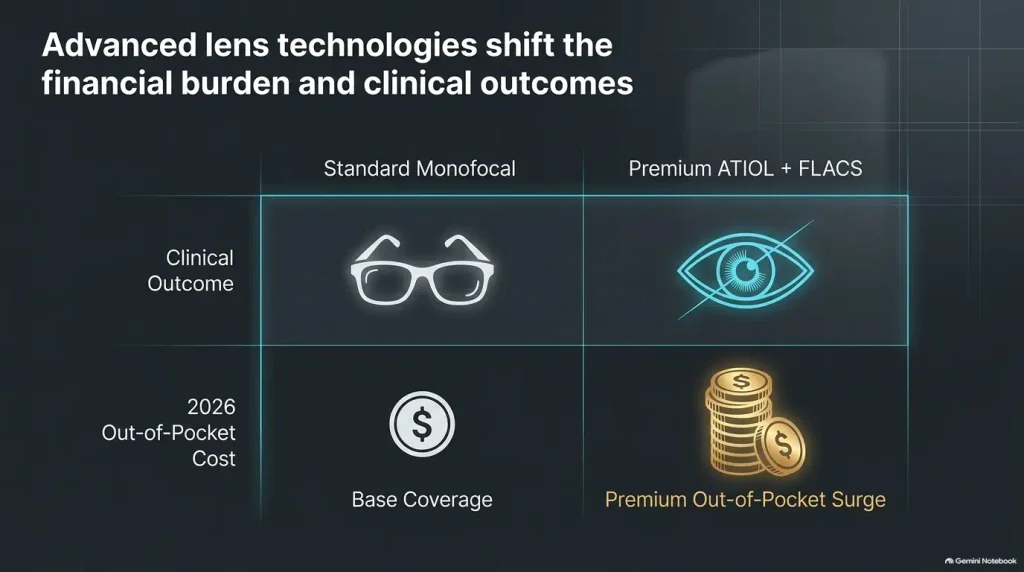
The comparison above is most useful as a benchmark for standard Medicare-covered cataract surgery. If your ophthalmologist offers an upgraded lens, refractive correction or another elective service beyond Medicare-covered benefits, ask exactly which portion Medicare covers and which portion you would pay yourself.
Do not assume that a package price labeled “cataract surgery” represents the same set of services as Medicare’s CPT 66984 comparison. Ask the surgical practice to separate covered services from optional non-covered charges in writing before scheduling.
Post-surgery glasses are a separate Medicare benefit
Medicare does not ordinarily cover routine eyeglasses, but Part B covers one pair of conventional eyeglasses with standard frames, or one set of contact lenses, after each covered cataract surgery that implants an intraocular lens. For more detail, see the site’s guide to Medicare cataract surgery glasses coverage.
ASC vs hospital outpatient cost at a glance
| Question | ASC | Hospital outpatient |
|---|---|---|
| 2026 CPT 66984 national-average patient share | $343 | $563 |
| 2026 national-average facility fee | $1,255 | $2,357 |
| Doctor fee in Medicare comparison | $462 | $462 |
| Part B deductible applies? | Yes | Yes |
| Typical Part B coinsurance framework after deductible | 20% | 20% |
In Medicare’s national comparison, therefore, the ASC has the lower published cost for CPT 66984. That is a price comparison, not a determination that one setting is medically preferable for a particular patient.
What if you need cataract surgery in both eyes?
Cataract surgery is commonly performed separately on each eye. If the same national averages applied to two separate routine surgeries and the Part B deductible had already been met, doubling Medicare’s published patient-share figures would produce an illustrative total of about $686 at an ASC versus $1,126 at a hospital outpatient department.
Do not treat those figures as a guaranteed two-eye quote. The surgeries may occur on different dates, your remaining deductible can change, local Medicare payment adjustments may differ from the national average, and additional services can be billed.
How to get a more accurate cataract surgery estimate
The fastest way to turn Medicare’s national average into something useful for your own surgery is to collect a few specific pieces of information from the ophthalmologist and facility.
- Ask for the exact CPT or HCPCS code expected to be billed. Routine cataract surgery is often represented by CPT 66984, while a more complex procedure may use a different code.
- Confirm whether the location is a freestanding Medicare-certified ambulatory surgical center or a hospital outpatient department.
- Ask the surgeon’s billing office for your estimated Medicare-approved professional cost and estimated patient responsibility.
- Ask the facility separately for its estimated Medicare-approved facility amount and your expected share.
- Ask whether anesthesia will be billed separately and, if so, by whom.
- Ask for every optional or non-covered charge, including elective lens or refractive upgrades, to be identified separately.
- Check how much of your 2026 Part B deductible remains.
- If you have Medigap or other secondary coverage, ask how it coordinates with the Part B coinsurance.
Medicare specifically advises patients considering outpatient surgery to compare the ASC and hospital outpatient settings when both are appropriate. Its general surgery cost guidance also recommends asking the doctor and facility what you will owe and checking how other insurance will contribute.
What changes if you have Medicare Advantage?
The $343 and $563 figures are most useful for someone evaluating costs under Original Medicare. Medicare Advantage plans set their own member cost-sharing within Medicare rules, and your cost can depend on the plan’s network, copayment or coinsurance structure and other plan requirements.
If you have Medicare Advantage, ask the plan about both the surgeon and the facility before relying on the Original Medicare comparison. Specifically ask what you would owe for outpatient cataract surgery at each proposed location and whether the surgeon, facility and any anesthesia provider are in network.
When might the lower-cost surgery center not be the deciding factor?
A lower national-average Medicare payment does not automatically make an ASC the appropriate setting for every person. Your ophthalmologist or other clinicians may recommend a particular facility because of your individual medical circumstances or the resources needed for your procedure.
If the doctor recommends a hospital outpatient department when an ASC is available, a useful question is: “Is there a medical or procedural reason you want my surgery performed at the hospital rather than the surgery center?” The answer can help you distinguish a clinical recommendation from a choice that is primarily logistical.
A simple way to compare two quotes
Suppose Facility A is an ASC and Facility B is a hospital outpatient department. Do not compare only the number printed at the top of each estimate. Put the charges into the same buckets:
- Surgeon or professional amount.
- Facility amount.
- Anesthesia or other professional services.
- Remaining Part B deductible.
- Expected 20% Part B coinsurance.
- Non-covered or elective upgrades.
- Amount expected to be paid by Medigap or another secondary insurer.
This prevents a deceptively cheap-looking quote that includes only the surgery center fee from being compared with a hospital estimate that includes several additional components.
Frequently asked questions
Is cataract surgery cheaper at a surgery center with Medicare?
For routine cataract surgery under CPT 66984, Medicare’s 2026 national averages are lower in an ambulatory surgical center. The published patient share is $343 at an ASC versus $563 at a hospital outpatient department. Local rates and your individual coverage can produce a different result.
Why is the hospital estimate about $220 higher?
The Medicare comparison lists the same $462 doctor fee in both settings. The larger difference is the facility payment: $1,255 at the ASC versus $2,357 at the hospital outpatient department.
Does the $343 ASC estimate include the 2026 Part B deductible?
Medicare describes cataract surgery cost-sharing as applying after the Part B deductible. The Procedure Price Lookup patient-share figure reflects Medicare’s national-average cost-sharing for the procedure, so someone who still owes some or all of the $283 annual 2026 Part B deductible can have additional responsibility. Check your current deductible status rather than simply adding a fixed amount to every estimate.
Can I choose an ASC just to save money?
You can ask whether an ASC is an available option, but the surgical setting also needs to be medically appropriate. Discuss the options with your ophthalmologist and confirm that the facility participates in Medicare or, for Medicare Advantage, that it meets your plan’s network requirements.
Bottom line
For a routine cataract procedure represented by CPT 66984, Medicare’s 2026 national averages show a clear site-of-service cost difference: approximately $343 out of pocket at an ambulatory surgical center versus $563 at a hospital outpatient department under the published Original Medicare comparison.
The $220 difference is driven primarily by the higher hospital facility payment. But your final bill can also depend on your remaining Part B deductible, geographic payment adjustments, anesthesia, additional services, supplemental insurance and elective non-covered options.
Before scheduling, ask for the procedure code and written estimates from both the surgeon and the facility. If both settings are medically appropriate, comparing the Medicare-approved facility amounts is far more useful than comparing advertised package prices.