


Estimate your covered Original Medicare cataract surgery cost by applying the remaining deductible first, then 20% coinsurance to the covered approved amount left after it. That includes cost-sharing for the surgeon and the facility. In 2026, the annual Part B deductible is $283. Supplemental insurance may reduce your share, while noncovered lens upgrades can add separate charges.
This guide helps you turn an itemized quote into a per-eye patient estimate. For national payment figures rather than your own calculation, see Medicare’s published cataract surgery payments and how to read them.
There is no single nationwide patient price. Your surgical setting, approved charges, remaining deductible, lens choice, and insurance determine the estimate. This guide covers U.S. Medicare, primarily outpatient surgery under Original Medicare, with separate guidance for Medicare Advantage.
Table of Contents

What Medicare covers—and why you still receive a bill
Medicare Part B can cover cataract removal with implantation of a conventional intraocular lens, or IOL, when applicable coverage requirements are met. An IOL is the artificial lens placed inside the eye. Your surgeon should confirm that the planned procedure meets the coverage rules that apply to you.
For covered surgery in an ambulatory surgical center or hospital outpatient department, Medicare’s cataract surgery guidance states that you pay 20% of the approved amount to both the facility and the doctor after meeting the deductible. A quote from just one billing office may therefore be incomplete.
Ask whether the clinicians accept Medicare assignment. This means accepting Medicare’s approved amount as full payment for the covered service, with your applicable deductible and coinsurance still due. “We take Medicare” is less specific than confirming assignment for your care.

How to calculate your estimated out-of-pocket cost
Start with the Medicare-approved amounts, not the provider’s advertised cash price. Medicare lists the 2026 Part B deductible as $283, payable once per calendar year. If earlier covered care has already satisfied it, do not add it again.
For covered charges subject to the deductible and 20% coinsurance, a simplified estimate is: remaining deductible + 20% of the approved amount left after that deductible. This assumes the approved total exceeds the remaining deductible and that providers accept assignment. Calculate noncovered extras separately.
Illustration: a $2,500 approved total for one eye
The following figures are hypothetical arithmetic examples, not national averages or provider quotes. Assume $2,500 in covered approved charges, all subject to the same deductible and coinsurance rules, with no supplemental insurance.
| Deductible remaining | Calculation | Your estimated share |
|---|---|---|
| $0 | 20% × $2,500 | $500.00 |
| $100 | $100 + 20% × $2,400 | $580.00 |
| $283 | $283 + 20% × $2,217 | $726.40 |
Adding $283 to 20% of the entire $2,500 would overstate this example because it charges coinsurance on the deductible portion too. These examples exclude premiums, noncovered upgrades, pharmacy purchases, and any services outside the assumed approved total.
If both eyes need surgery, request an estimate for each eye. The Part B deductible does not restart for the second eye in the same calendar year. If the procedures fall in different calendar years, a new annual deductible may apply; discuss timing with your surgeon based on your care needs.
Check what the surgical estimate includes
A useful estimate identifies each billing party and separates covered cost-sharing from patient-pay extras. Ask the office to complete these details rather than relying on a single package price.
| Cost component | Question to ask |
|---|---|
| Surgeon | Does this include the surgeon’s full estimated patient share? |
| Facility | Is there a separate surgery-center or hospital bill? |
| Anesthesia | Will another clinician bill separately, and is that estimate included? |
| Lens and optional services | Which charges are covered, and which are entirely patient-pay? |
| Testing and follow-up | What is included, and what might be billed separately? |
| Prescriptions | Which medicines will I buy separately, and what will my drug coverage pay? |
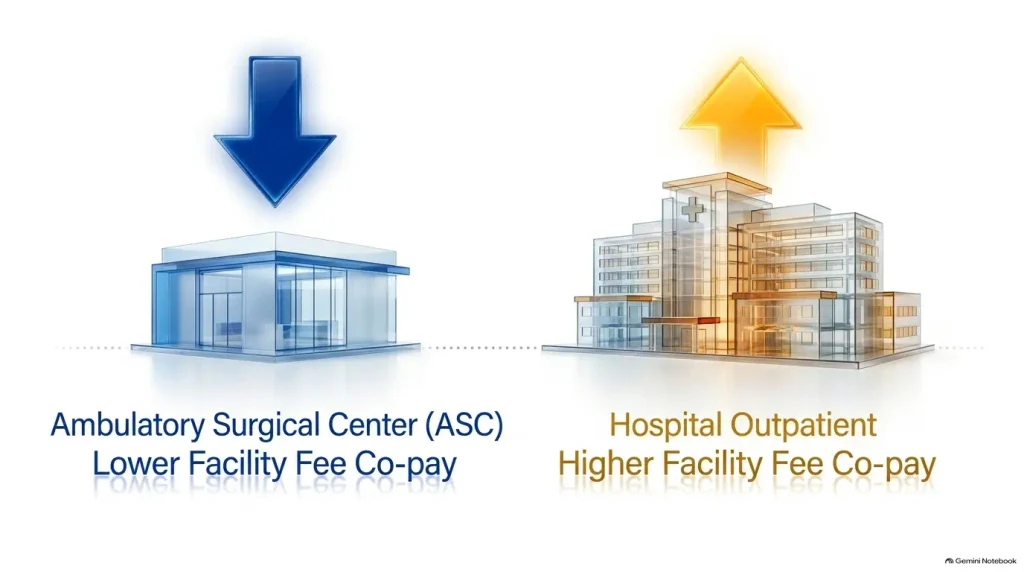
The facility matters. If your surgeon offers more than one medically appropriate location, request comparable estimates for an ambulatory surgical center and a hospital outpatient department. Keep the planned procedure and lens choice consistent when comparing them.
Medicare’s surgery cost guidance recommends checking the setting, other insurance, deductible status, and the cost of care afterward. Having surgery in a hospital building does not by itself mean you are an inpatient; confirm your status before applying Part A or Part B rules.
Premium lenses and laser packages can change the total
Medicare’s covered conventional lens benefit does not mean every lens option is fully covered. Choosing a lens that also corrects presbyopia or preexisting astigmatism can leave you responsible for the additional noncovered functionality and related eligible additional services. The covered cataract procedure can still be paid under Medicare’s rules.
Laser-assisted surgery needs a precise explanation. CMS guidance on laser-assisted cataract surgery says coverage and payment for cataract removal and conventional lens insertion do not change simply because a laser is used. Using a laser for steps already included in covered conventional-lens surgery does not, by itself, justify an extra patient charge.
If offered a premium package, request an itemized explanation of its noncovered components and a separate estimate for the covered conventional-lens option. Then ask the surgeon what the upgrade is expected to achieve for your particular eyes. A higher price alone does not establish that it is the appropriate choice.
How Medigap and Medicare Advantage affect your share
Original Medicare with Medigap
Medigap helps pay certain Original Medicare out-of-pocket costs, such as coinsurance and some deductibles, depending on the policy. Your actual payment may therefore be lower than the examples above. Ask your insurer which surgery charges it will cover; do not assume an optional lens upgrade is included.
Medicare Advantage
Medicare Advantage plans must cover medically necessary services covered by Original Medicare, but cost-sharing and access rules can differ. Use your plan’s surgical benefit rather than automatically applying the Original Medicare 20% calculation.
Confirm the surgeon, facility, and anesthesia provider’s network status; any referral or prior authorization requirement; and the copayment or coinsurance for each part of care. Ask whether your remaining annual out-of-pocket limit affects the estimate. A routine vision allowance does not tell you what cataract surgery will cost, and Medigap cannot cover Medicare Advantage cost-sharing.
Budget separately for glasses after surgery
Part B covers one pair of eyeglasses with standard frames, or one set of contact lenses, after each cataract surgery that implants an IOL. Under Medicare’s postoperative eyewear rules, you generally pay 20% of the approved amount after the deductible, plus additional costs for upgraded frames. The supplier must participate in Medicare.
Do not assume this exception makes every glasses-related service covered. Medicare generally excludes routine eye exams for prescription glasses. Ask about any separate prescription-measurement charge; our guide to Medicare refraction coverage explains that distinction.
Get a written estimate before choosing paid extras
Ask the billing office: “Please give me a per-eye estimate showing the surgeon, facility, anesthesia, my remaining deductible, and any noncovered services. Please also show what I would owe with the covered conventional lens and how my other insurance changes that amount.”
If the covered patient share is difficult to afford, check Medicare Savings Programs through your state. The Qualified Medicare Beneficiary program helps with covered Medicare cost-sharing and protects eligible beneficiaries from being billed for those deductibles, coinsurance, and copayments. Other programs provide different help, so confirm which applies.
The estimate you need is the amount you are expected to pay for the specific operation, lens, location, and coverage you have. Keep that written breakdown and clarify any unexplained package charge before agreeing to optional services.
Editorial update: October 27, 2026. Scope clarified as a personal estimate guide; deductible-first arithmetic and the linked CMS 2026 deductible source checked. Hypothetical examples are not provider quotes. Independently prepared by a non-clinician; no clinical review is claimed.