

Organize your questions and next steps, then save your worksheet.
Summary and next steps
Medicare refraction coverage differs between Original Medicare and Medicare Advantage. See what may be covered, what costs extra, and what to ask first.
Editorial maintenance: October 24, 2026. Summary layout, related links and technical metadata updated. This is not a full clinical review.

Does Medicare Cover Refraction During an Eye Exam?
Why the Exam May Be Covered but the Prescription Test Is Not
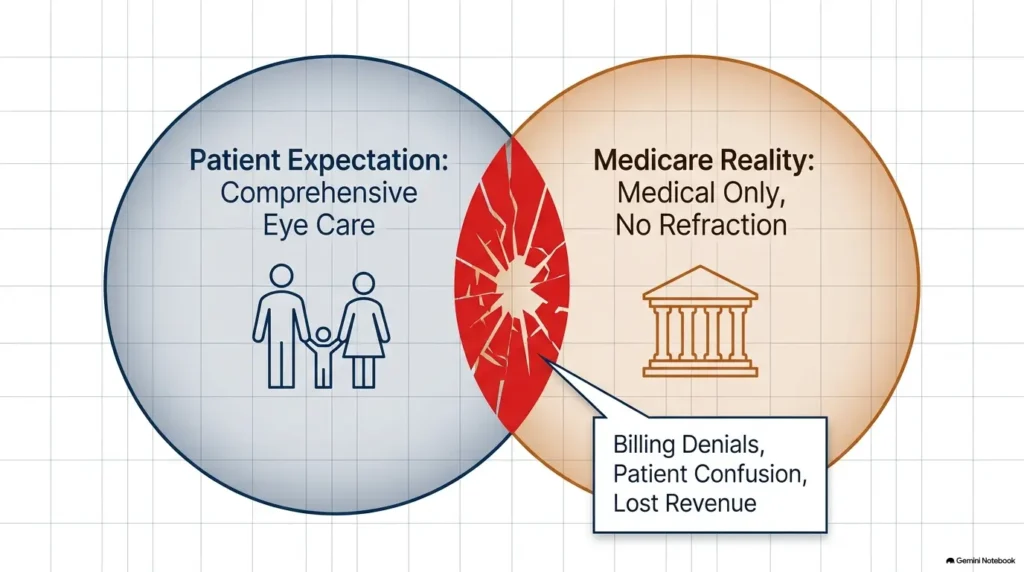
You can have a Medicare-covered eye appointment, sit through the familiar “Which looks clearer, one or two?” test, and still leave with a separate refraction charge. That bill is confusing until you know Medicare treats the medical eye examination and the measurement used to prescribe glasses as different services.
With Original Medicare, refraction is generally not covered, even when the medical portion of the eye visit qualifies for Part B coverage. Medicare Advantage is different because an individual plan may add routine vision benefits that include an eye exam, refraction, or an eyewear allowance.
The useful question, therefore, is not simply “Does Medicare cover my eye exam?” It is “Which parts of this appointment are medical, which are routine vision services, and which charges will I be responsible for?” This guide gives you a practical way to find out before the bill arrives.
Best first move: ask the eye office whether refraction is a separate patient-pay charge before the appointment. 👓
Snapshot
Who this is for: people with Original Medicare or Medicare Advantage who are preparing for an eye exam or questioning a refraction charge. What it solves: the common situation in which Medicare covers part of an eye visit but not the prescription measurement. What you will leave with: a simple way to verify coverage, compare likely charges, and decide whether paying for refraction makes sense for your current vision needs.
Before You Act
This article explains Medicare coverage and practical billing questions. It cannot determine whether an eye test is medically appropriate for you or whether a specific claim will be paid. Your eye professional determines what clinical evaluation you need, while Medicare or your Medicare Advantage plan determines coverage under its rules. If you develop sudden vision loss, many new floaters, flashes of light, or a curtain-like shadow in your vision, seek prompt eye care rather than delaying because of a coverage question. The National Eye Institute identifies these as possible retinal-detachment warning signs requiring immediate evaluation.
Table of Contents

The Short Answer: Original Medicare Usually Does Not Cover Refraction
Original Medicare does not generally cover eye refraction, including refraction performed to determine or change a prescription for glasses or contact lenses. CMS guidance goes further: Medicare’s coverage manual excludes eye refractions regardless of the practitioner performing them or the reason the refraction is performed. A separate medical eye examination may still qualify for coverage when it is connected to diagnosing or treating an eye disease or other covered medical condition.
This is why the sentence “Medicare covered my eye exam” does not necessarily mean every service performed during the appointment is covered.
| Situation | Original Medicare treatment | What to verify |
|---|---|---|
| Visit mainly to get a new glasses prescription | Routine refraction is generally not covered | Ask for the self-pay refraction charge |
| Medical eye exam for disease, symptoms, or treatment | The qualifying medical portion may be covered | Ask whether refraction is billed separately |
| Diabetic retinopathy eye exam | Part B covers qualifying exams for eligible beneficiaries | Do not assume the prescription refraction is included |
| Medicare Advantage with vision benefits | Plan-specific | Check network, frequency, copay, and whether refraction is included |
Key takeaway: think of the appointment as a basket containing several services. Medicare may pay for the medical items in the basket while leaving the refraction charge with you.
Medicare’s official routine eye exam page is worth checking before your appointment because it states the basic exclusion plainly: review Medicare’s routine eye exam coverage.
Why Refraction Can Be Separate From a Covered Eye Exam
A refraction answers a prescription question
Refraction is the part of an eye examination used to determine the focusing correction that gives you the clearest vision. It is often the test involving a phoropter and questions such as whether one lens choice looks clearer than another.
The result can be used to prescribe glasses or contact lenses, or to see whether a change in prescription improves measured vision.
A medical eye exam answers a health question
A medical examination may be evaluating glaucoma, cataracts, diabetic eye disease, macular degeneration, inflammation, an injury, sudden vision changes, or another condition requiring diagnosis or treatment.
Those services operate under medical-benefit rules. Medicare Part B covers medically necessary doctor and other health care provider services when Medicare requirements are met. Certain specific eye benefits also have their own rules, including diabetic retinopathy exams and glaucoma screenings.
The same appointment can contain both
This is the billing wrinkle that catches people.
You might visit an ophthalmologist because you have cataracts. The physician’s examination and medically necessary testing may qualify for Medicare coverage. During the same appointment, the office may also perform refraction to determine whether a new glasses prescription improves your vision.
The first service can potentially be covered while the refraction remains a separate noncovered service under Original Medicare.
Show me the nerdy details
CMS’s Medicare Benefit Policy Manual, Chapter 16, Section 90 separates excluded refractive services from physician services performed in connection with eye disease. It states that eye refractions are excluded from Medicare coverage regardless of the practitioner or purpose. The same section explains that the exclusion does not remove coverage from otherwise eligible physician services performed in connection with conditions such as glaucoma or cataracts.
The practical result is service-by-service billing. The fact that a doctor needs refractive information during a medical visit does not automatically convert the refraction itself into a covered Original Medicare benefit.
Covered Medical Eye Exam vs. Noncovered Refraction: Use This Test
If the terminology on the phone starts sounding like alphabet soup, reduce the appointment to three questions.
The Eye-Visit Coverage Map
New prescription, disease follow-up, new symptom, diabetes, cataract, or another reason?
A medical condition may create a covered Part B service.
Ask whether it appears as a separate patient-pay service.
Original Medicare and Medicare Advantage handle routine vision differently.
Get the amount or plan benefit before agreeing when possible.
What you can do now
Tell the office the actual reason for your appointment. Bring your Medicare or Medicare Advantage information and current glasses. Ask specifically whether refraction will be performed and whether it is included in your coverage.
What the eye professional decides
Your ophthalmologist or optometrist decides which clinical tests are useful for evaluating your vision and eye health. A test being noncovered does not automatically mean it is unnecessary.
What Medicare or your plan decides
The payer determines whether the service qualifies under your benefit rules. That distinction matters because the doctor can recommend a service that Medicare does not pay for.
If preparing for eye appointments tends to become a paper chase, use this site’s eye doctor visit checklist for seniors to organize medications, current glasses, questions, and coverage information before you leave home.
What You May Pay When Refraction Is Not Covered
There is no single national Medicare patient price for a noncovered refraction. Because Original Medicare does not pay for the excluded service, the office’s patient-pay charge matters more than a Medicare-approved amount.
That is why searching for a universal “Medicare refraction copay” can send you down the wrong hallway. Your actual cost may depend on the practice, your additional coverage, and whether you have a Medicare Advantage vision benefit.
| Cost question | Ask this before the visit | Why it matters |
|---|---|---|
| Refraction charge | “What is your self-pay charge for refraction?” | Original Medicare generally does not set a payable benefit for it |
| Medical exam | “Are you billing the visit to Medicare as a medical eye exam?” | The covered portion may be processed separately |
| Medicare Advantage | “Is refraction included in my routine vision benefit?” | Plan rules may differ from Original Medicare |
| Network | “Are you in network for my vision benefit, not just my medical benefit?” | Medical and vision networks may not always match |
| Eyewear | “Does my plan have a lens or frame allowance?” | The exam, refraction, and glasses can have separate benefit limits |
Money-saving distinction: do not compare the total office bill with what Medicare covers as though the visit were one indivisible service. Ask for the medical exam, refraction, imaging, tests, and eyewear charges separately.
What about the 20% Part B coinsurance?
For many covered Part B services, beneficiaries pay 20% of the Medicare-approved amount after meeting the applicable Part B deductible, although other costs can apply. For example, Medicare currently describes this cost structure for qualifying diabetic retinopathy exams and glaucoma screenings. That cost-sharing formula applies to covered services, not to a refraction that Original Medicare excludes.
Will Medigap pay the refraction charge?
Do not assume so. Medigap is primarily designed to help with your share of costs in Original Medicare, such as certain deductibles, coinsurance, and copayments. Medicare.gov also notes that Medigap policies generally do not cover routine vision care or glasses.
The 10-Minute Refraction Check Before Your Appointment
This is the highest-value step in the article because it can turn a surprise bill into a known choice.
- Check your card. Are you using Original Medicare or a Medicare Advantage plan?
- Name the reason for the visit. Is it mainly a prescription update, or are you being evaluated for symptoms or an eye condition?
- Call the office. Ask, “Will you perform a refraction during my appointment?”
- Ask the key billing question. “Is refraction billed separately from the medical eye exam?”
- Ask for the charge. If it is patient-pay, request the amount before the service.
- If you have Medicare Advantage, call the plan. Ask whether refraction is included in your routine vision benefit and whether this provider is in the required network.
- Write the answers down. Record the date, office or plan representative, and what you were told.
A simple phone script
“I have Medicare. I understand the medical eye exam and refraction may be billed separately. Will you be doing a refraction, what will I owe for it, and do you need to check a separate vision benefit?”
If you expect the conversation with the eye doctor to focus on glasses rather than disease management, the questions to ask an eye doctor about reading glasses can help you make the prescription discussion more useful.
When Paying for Refraction May Still Be Worth It
“Not covered” and “not useful” are completely different ideas.
A refraction may have practical value when you genuinely need to know whether a different prescription improves your vision. The better decision is to ask what problem the test is expected to solve before deciding whether to pay for it.
| Your situation | Free or low-cost check first | When refraction becomes more useful |
|---|---|---|
| Small print is difficult only in dim light | Improve task lighting, reduce glare, enlarge text | Difficulty continues across normal reading conditions |
| Current glasses seem weaker | Clean lenses, compare another known pair, test normal reading distance | Multiple everyday tasks remain blurry |
| Distance signs or television are less clear | Confirm it is not a dirty lens or temporary glare problem | Persistent distance blur suggests prescription assessment may be useful |
| You want new glasses | Check whether your current prescription is still acceptable to the provider | A current prescription is needed or your vision has changed |
| Vision changed suddenly | Do not treat this as a glasses-shopping problem | Seek clinical evaluation promptly |
Before you buy new glasses
If the problem is mainly reading comfort, first test the actual environment: lighting, glare, working distance, text size, and whether your existing glasses are appropriate for the task. A pair that works beautifully at 16 inches can feel useless across a kitchen counter.
For a practical home test, see the guide to building a senior-friendly reading station. If vision remains difficult despite a good setup, the case for an updated prescription or medical evaluation becomes clearer.
Example scenario: A covered medical visit with an uncovered refraction
Illustrative example: A Medicare beneficiary returns to an ophthalmologist for monitoring of a known cataract. The physician evaluates the cataract and checks whether it is affecting daily activities. That medical evaluation may qualify under Medicare rules if coverage requirements are met.
During the appointment, the office also performs refraction to determine whether changing the glasses prescription could improve vision enough to postpone a new pair or help distinguish refractive blur from cataract-related blur.
The beneficiary later notices two types of charges. Medicare processes the covered medical service according to Part B rules, while the office charges the refraction directly to the patient.
Nothing necessarily went wrong. The confusion came from expecting an appointment to have a single coverage status when Medicare actually evaluates individual services.
Can Medicare Advantage Cover Refraction?
Possibly. Medicare Advantage plans must provide Medicare-covered Part A and Part B benefits, and many plans also offer extra benefits that Original Medicare does not provide. Vision benefits can be among those extras. Medicare’s current guidance specifically notes that some Medicare Advantage plans may cover routine eye exams and other vision services.
The word “vision,” however, is not enough. You need to know exactly how your plan defines the benefit.
Five questions to ask your plan
- Does my plan cover a routine eye exam?
- Is refraction included in that exam or billed separately?
- How often can I use the routine vision benefit?
- Must I use a particular vision network?
- Do I have a separate allowance for frames, lenses, or contacts?
A provider can participate with your Medicare medical benefit while having different status under a plan’s supplemental vision network. Ask about both when you make the appointment.
Comparing Original Medicare and Medicare Advantage? Use Medicare’s own comparison page to verify how extra benefits differ before relying on a vision-office estimate.
Compare Medicare coverage optionsKey takeaway: with Medicare Advantage, never stop at “vision included.” Verify the exact service, provider network, frequency limit, and patient cost.
What Changes After Cataract Surgery?
Cataract surgery creates one of Medicare’s better-known exceptions to its usual lack of routine eyewear coverage.
Medicare Part B covers one pair of eyeglasses with standard frames, or one set of contact lenses, after each covered cataract surgery that implants an intraocular lens, subject to Medicare’s supplier and cost-sharing requirements.
That does not turn routine refraction into a general Original Medicare benefit. CMS’s policy manual separately excludes refractive procedures. In other words, the post-cataract eyewear benefit and the measurement used to determine your prescription are different coverage questions.
| After cataract surgery | What Medicare may cover | What still needs checking |
|---|---|---|
| Postoperative medical care | Covered according to applicable surgical and Part B rules | How follow-up services are billed |
| Standard corrective eyewear | One qualifying pair after each cataract surgery with IOL implantation | Participating supplier and upgrades |
| Refraction | Not automatically covered by Original Medicare | Whether the practice charges separately |
| Premium frame or lens features | Additional charges may apply | Which upgrades are patient-pay |
You can review the official rules on Medicare coverage for eyeglasses and contact lenses after cataract surgery.
If you are unsure whether blur is more consistent with ordinary near-focus changes or cataracts, the site’s guide to presbyopia vs. cataracts explains the functional differences without treating either as a self-diagnosis.
What to Do If You Already Received a Refraction Bill
A separate refraction bill is not automatically a billing error. Before disputing it, identify exactly what happened.
Step 1: Ask for an itemized statement
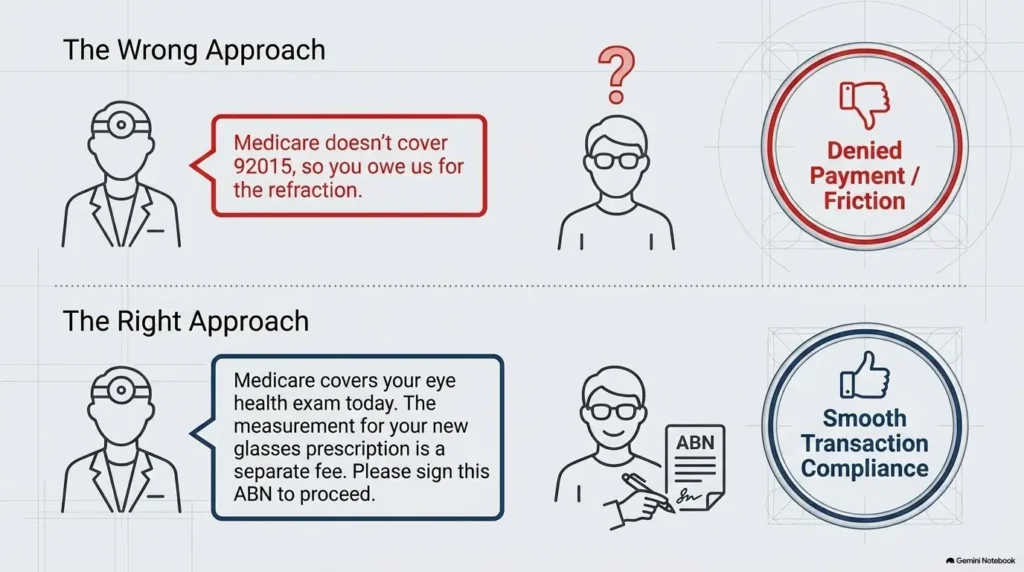
Look for the medical examination, refraction, diagnostic testing, imaging, and any eyewear services as separate items. A refraction may appear as a clearly labeled line item and is commonly associated with CPT code 92015.
Step 2: Compare it with your Medicare notice or plan explanation
With Original Medicare, check your Medicare Summary Notice when available. With Medicare Advantage, review the plan’s Explanation of Benefits and any separate vision-benefit information.
If Medicare paperwork is difficult to decode, use this site’s guide to reading Medicare notices for seniors before calling the billing office.
Step 3: Match the problem to the right next step
Still seeing a charge? Use this branch.
If the charge is clearly for refraction under Original Medicare:
Ask whether the amount matches the office’s disclosed patient-pay fee.
If you have a Medicare Advantage vision benefit:
Call the plan and ask whether the service should have been submitted through its vision network.
If the disputed charge is actually for the medical exam:
Ask the billing office why it was denied and whether the claim information should be reviewed.
If the amount differs from what you were quoted:
Ask the practice to review the estimate or disclosure you received before the service.
Avoid spending an hour arguing that a refraction “must be covered because the doctor needed it.” Under Original Medicare, CMS specifically treats refractive procedures as excluded. Focus your effort on whether the charge is correctly identified, whether another vision benefit applies, and whether the amount matches what the practice told you.
Frequently Asked Questions
Does Medicare cover refraction if I have glaucoma?
Original Medicare can cover qualifying glaucoma-related services and, for eligible high-risk beneficiaries, glaucoma screening under specific rules. That does not generally make refraction a covered Original Medicare service. The medical examination and refraction can be billed differently.
Does Medicare cover refraction for people with diabetes?
Part B covers qualifying eye exams for diabetic retinopathy for eligible beneficiaries, currently once a year under Medicare’s stated benefit rules. Refraction for a glasses or contact-lens prescription remains a separate coverage issue. Medicare describes the diabetic eye benefit on its official diabetic eye exam coverage page.
Is dilation the same thing as refraction?
No. Dilation widens the pupil so the eye professional can examine structures inside the eye. Refraction measures the focusing correction needed for clearer vision. A visit can involve either, both, or neither depending on its purpose.
Does Medicare pay for refraction after cataract surgery?
Do not confuse Medicare’s post-cataract eyeglasses benefit with coverage of the refraction itself. Medicare may cover qualifying standard corrective lenses after cataract surgery with an implanted intraocular lens, while CMS separately excludes refractive procedures under Original Medicare.
Can I refuse refraction if Medicare does not cover it?
You can ask why the clinician recommends it, whether it is necessary for the purpose of your visit, what it costs, and what would change if you postpone it. Do not assume that a noncovered test has no clinical value. Make the decision after discussing its purpose with the eye professional.
What if my reading glasses still do not work after a new prescription?
Prescription strength is only one possible source of difficulty. Working distance, astigmatism, glare, lens design, cataracts, dry eye, and other eye conditions can affect reading comfort. If an apparently appropriate pair remains ineffective, the guide to why reading glasses stop working can help you organize the next questions to bring to your eye professional.
Optional video: Open the video on YouTube (external site).
The One Check Worth Doing Today
If you have an eye appointment coming up, spend ten to fifteen minutes separating the medical exam from the refraction before you go.
- Confirm whether you have Original Medicare or Medicare Advantage.
- Write down the reason for the eye visit.
- Call the office and ask whether refraction is separate.
- Get the patient charge if Original Medicare will not cover it.
- If you have Medicare Advantage, verify the routine vision benefit and network directly with the plan.
That small distinction resolves most of the mystery. A Medicare-covered eye visit does not necessarily make every test inside that visit covered, and a noncovered refraction does not mean the medical examination was denied.
The decision principle to remember: first identify what the test is for, then identify who pays for that specific service. Coverage becomes much easier to understand once the appointment is no longer treated as a single bill-shaped object.
Last reviewed: 2026-09
PUT THIS GUIDE TO WORK · INTERACTIVE WORKSHEET
Separate the refraction charge
Use this worksheet alongside the article: Does Medicare Cover Refraction During an Eye Exam? Why the Exam May Be Covered but the Prescription Test Is Not. Use the fields provided to organize your notes and next actions, then save your worksheet.
Your entries stay in this page and are cleared when you reload. No account is needed. Saved files are downloaded only to your device.
This worksheet does not establish coverage or eligibility. Use the Part B model only after the provider confirms a covered service and accepts assignment. It uses deductible applied + 20% of the remaining approved amount + extra charges. Medigap, Medicaid, other insurance, facility charges, excess charges, and plan-specific rules are not modeled. A plan quote is entered directly rather than applying the Part B formula.
Verify Medicare’s current costs and assignment rules · Worksheet rules checked October 20, 2026.
How to use your result
Save the worksheet before leaving this page. Recheck any quote, date, or instruction with the relevant provider, pharmacist, manufacturer, or official organization. A completed checklist means you recorded the steps, not that an outcome is guaranteed.
Worksheet added October 20, 2026. Read the article above for context and its stated review scope.