

Organize your questions and next steps, then save your worksheet.
Summary and next steps
Same-day and separate-date cataract operations have different practical and clinical considerations. A comparison table cannot determine suitability for either approach.
- Ask how each eye’s findings affect the proposed schedule.
- Discuss lens measurements, safeguards and support during recovery.
- Request separate estimates and transport plans for the options offered.
Editorial maintenance: October 24, 2026. Summary layout, related links and technical metadata updated. This is not a full clinical review.

You’re in the ophthalmologist’s chair, blinking away the sting of those dilation drops, wondering how something so tiny can burn like betrayal. The doctor is talking options—cataract surgery, one eye or both—and suddenly, it feels less like a medical decision and more like a cosmic coin toss.
Do you go slow and steady with one eye at a time? Or do you rip off the proverbial Band-Aid and get both done in one go? It’s not exactly a “choose your own adventure” you ever wanted, but here we are.
Immediate sequential bilateral cataract surgery (ISBCS) means operating on both eyes on the same day as two separate procedures. Delayed sequential surgery uses separate dates. Both approaches have benefits and limitations; suitability depends on each eye, the planned lens, surgical safeguards, and support during recovery.
Neither approach guarantees glasses-free vision, a fixed recovery time, or a lower bill. Discuss the clinical tradeoffs first, then ask your insurer and clinic for itemized estimates for each proposed schedule.
The decision should reflect your individual eye health and measurements as well as these practical issues:
- Your tolerance for temporary visual weirdness. (Can you handle one HD eye and one foggy VHS eye for a while?)
- Your wallet. (Because some insurance plans treat ISBCS like a suspicious BOGO sale.)
- Your home support system. (A.K.A. do you have someone to drive you, make you soup, and stop you from bumping into the coffee table?)
In this guide, I won’t just rattle off dry medical pros and cons. Instead, I’ll walk you through 9 surprising truths about timing your surgery—what recovery really feels like, when it gets awkward, and which option might quietly be the best for you.
Give me 15 minutes, and I’ll help you go into that next appointment not just informed, but armed with the right questions—and maybe even a gut feeling you can trust.
Ready? Let’s see clearly—before you actually can.
1. The “Drunken Sailor” Effect (Anisometropia)
Some people notice a temporary imbalance between eyes after first-eye surgery. Anisometropia means a difference in refractive prescription between the eyes; it is not inevitable and is not the same as planned monovision.
Imagine wearing a high-heel shoe on your left foot and a flat sneaker on your right. Now try to walk a straight line. That is what your brain experiences when one eye is fixed (clear, bright, perhaps 20/20) and the other is still looking through a cloudy, yellowed cataract. This imbalance can cause significant depth perception issues, dizziness, and even nausea.
A large prescription difference or unequal clarity may make depth judgments uncomfortable. Ask your team how your existing prescription and the proposed lens target could affect the interval between operations.
Potential benefit of a shorter interval: Less time with unequal clarity or prescriptions. It does not guarantee normal binocular vision within a fixed number of days.
Managing the interval: Ask your optometrist or surgeon about a safe temporary glasses or contact-lens plan. Do not remove a spectacle lens or drive through blur without professional advice.
- A prescription difference may affect comfort and depth judgments between operations.
- Use extra care on stairs or uneven ground if vision feels unbalanced.
- Planned monovision and temporary prescription imbalance are different issues.
Apply in 60 seconds: Ask your surgeon specifically: “Given my prescription, how severe will my imbalance be between surgeries?”
2. The Cost of One Trip vs. Two
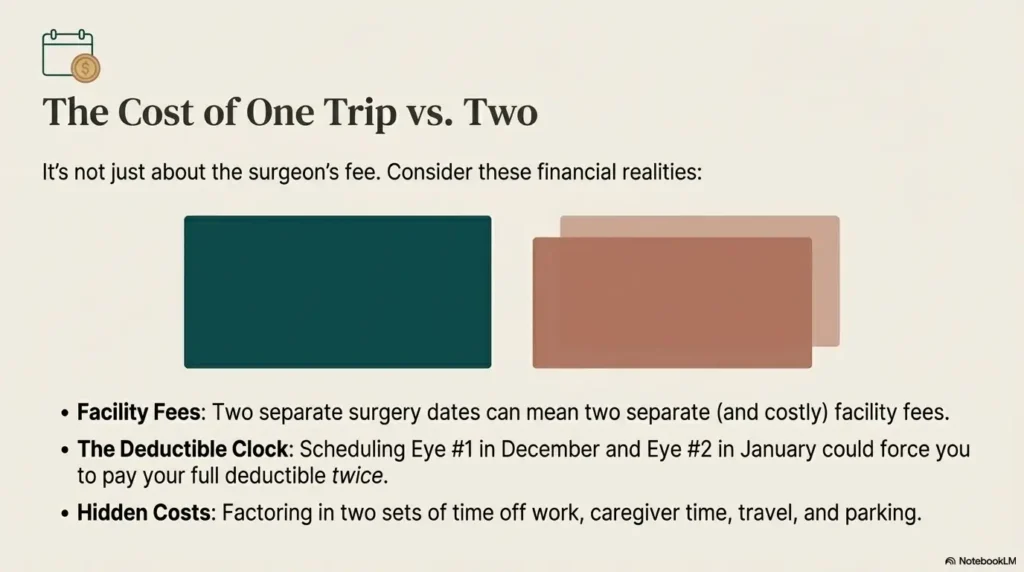
Let’s talk money. Medical billing is confusing, but cataract surgery involves specific distinct costs: the surgeon’s fee, the anesthesia fee, and the facility fee (ambulatory surgery center or hospital).
In the United States, Medicare and private insurance policies often have specific rules about facility fees. If you have two separate surgery dates, you are technically occupying the operating room twice, requiring two setups, two nursing teams, and two recovery room slots. Consequently, you (or your insurer) are often billed two facility fees.
Why this matters for your wallet: Insurer payment rules do not directly establish your patient bill. Ask for the approved or negotiated amounts, deductible, copays, coinsurance, and any noncovered charges for each proposed schedule. Same-day treatment does not automatically remove second-eye charges.
Medicare Advantage copays and network rules vary by plan. Under Original Medicare, eligible covered cataract services generally involve the remaining Part B deductible and 20% of approved amounts. Include travel, parking, and caregiver time when comparing practical costs.
Cost questions for your own plan
Before you book, pull out your insurance card and run this quick check.
💰 Insurance and clinic questions
Ask your insurance provider these 3 questions:
- Is there a separate facility copay for each date of service? (If YES, doing both same-day or very close might not save the copay, but check if the second creates a new deductible event.)
- Does my deductible reset on January 1st? (Crucial if you are scheduling Eye 1 in December and Eye 2 in January.)
- Is anesthesia billed per time unit or per procedure? (Simultaneous surgery uses one anesthesia session, potentially lowering costs.)
Action: Request written estimates for both schedules and confirm what each includes. A package offer or possible saving is not a reason to choose a clinically unsuitable schedule.
3. Recovery: Two Weeks of Downtime or One?
Ask your surgical team for written restrictions on lifting, bending, swimming, exercise, eye protection, and work. The restrictions and their duration depend on your procedure and recovery.
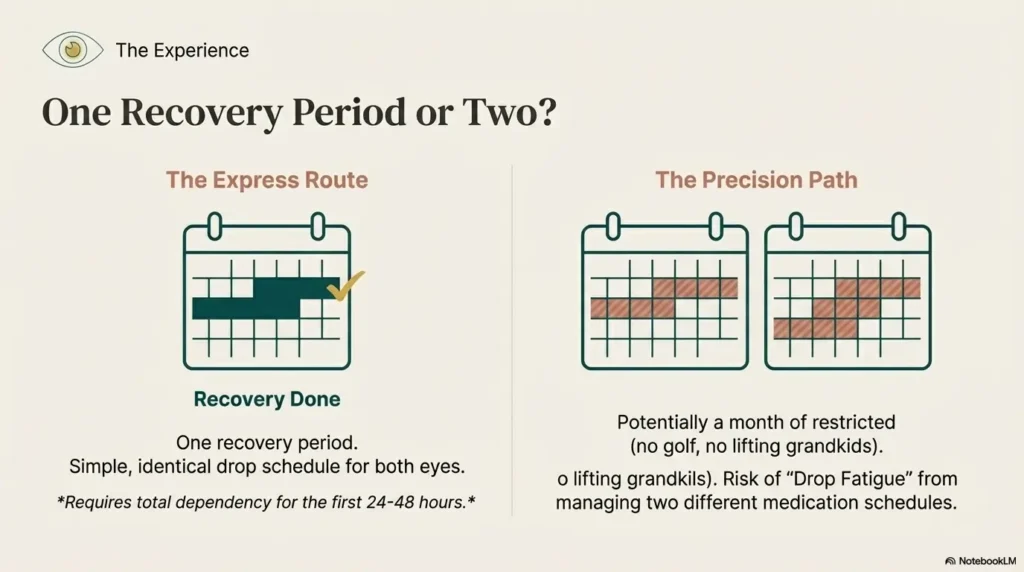
Separate dates: Recovery periods may overlap or be spaced apart, depending on the interval and the first eye’s progress. The second operation is a separate recovery; there is no universal one-month schedule.
Same day: The recovery periods overlap, which may simplify logistics. Both eyes can need care at once, and you still need follow-up and activity restrictions until your team advises otherwise.
You are not automatically “legally blind” after same-day surgery. Early blur and assistance needs vary. Arrange transport and discuss help with drops, meals, mobility, and other tasks in advance, particularly if you live alone.
Show me the nerdy details on visual recovery
Recovery varies between patients. Same-day surgery avoids an interval between operations, but it cannot guarantee a particular day for restored depth perception, return to work, or safe driving. Ask how your cornea, retina, and other eye conditions may affect recovery.
4. The “Second Chance” Lens Adjustment
This is the strongest argument against doing both eyes at the same time, and it is the reason many conservative surgeons refuse to perform simultaneous surgeries.
Cataract surgery replaces the cloudy lens with an intraocular lens (IOL). Biometry helps estimate lens power, but refractive outcomes are not guaranteed; accuracy varies with the eye and prior surgery.
Potential benefit of waiting: Once the first eye has healed enough to assess its refractive result, that information may help refine the second-eye lens calculation. It does not change the lens already implanted or guarantee a perfect result.
Same-day surgery cannot use the first eye’s healed refractive result to choose the second lens. Discuss the possibility of residual refractive error and glasses with either approach, including if considering premium lenses.
Question to ask: “Would my previous LASIK, measurements, or other eye conditions make first-eye feedback useful before choosing the second lens?”
5. The Infection Argument (Endophthalmitis)
We have to address the elephant in the operating room. The most feared complication of cataract surgery is Endophthalmitis—a severe infection inside the eye that can lead to blindness.
Endophthalmitis is uncommon but serious. Infection affecting both eyes after same-day surgery is a concern to discuss during consent; unsupported “one in millions” figures cannot establish your personal risk.
Safety protocols: Royal College guidance calls for complete aseptic separation of the two operations, including separately sterilized instrument sets and measures to reduce shared contamination. Ask what safeguards the clinic uses and when the second operation would be deferred.
Strict safeguards reduce risk but cannot eliminate it. Delaying the second operation allows time to observe the first eye’s recovery; neither schedule is free of complications. Seek immediate eye care for severe or persistent pain, sudden vision loss, new flashes or floaters, or a curtain over vision.
6. Can You Drive with One Good Eye?
Driving requirements vary by jurisdiction and licence type. You must also be able to drive safely and meet your surgeon’s postoperative advice; one clear eye or a fixed number of hours is not automatic clearance.
Separate dates: Your ability to drive between operations depends on vision in both eyes, any prescription imbalance, recovery, and local rules. Arrange alternative transport until cleared rather than assuming next-day driving.
Same day: Arrange a ride home and transport for follow-up. Do not use a 48- or 72-hour countdown as permission to drive; your surgical team should advise when vision and recovery allow it.
If transport is difficult, plan help and deliveries before either schedule. Practical convenience should support a clinically appropriate choice, not replace the eye assessment.
7. Battling “Drop Fatigue”
Recovery isn’t just about sitting on the couch; it is about drops. Antibiotic drops, steroid drops, NSAID drops. You might be putting drops in your eye 4 times a day for 4 weeks.
When you stagger surgeries, you enter a confusing matrix of medication schedules. “Okay, the Right Eye is on week 3 (1 drop a day), but the Left Eye is on week 1 (4 drops a day).”
Same-day surgery may make some schedules easier to track, but each eye’s prescription can differ or change. Follow the written instructions for each eye rather than assuming identical drops or tapering.
- Staggered surgery requires tracking two different schedules.
- Same-day surgery does not guarantee identical prescriptions for both eyes.
- Tip: If staggering, use two different colored alarms on your phone.
Apply in 60 seconds: Download a “Medication Reminder” app or draw a simple chart with two columns (L and R) before your first surgery date.
8. The Deductible Clock is Ticking
The plan’s benefit year can affect cost sharing. Meeting a deductible does not remove all coinsurance or noncovered charges, so verify the actual terms rather than treating later surgery as free.
If operations fall in different benefit years, the remaining deductible may change. Confirm the reset date and your own amounts. Do not rush or postpone an operation solely to fit a financial deadline; discuss safe timing with your surgeon.
Original Medicare has no annual medical out-of-pocket maximum. Medicare Advantage and other plans have their own limits and cost-sharing rules. Ask your plan how the proposed dates affect you.

9. Why Your Surgeon Might Say No
A surgeon may recommend separate dates because of eye-specific risks, uncertain measurements, the need to assess first-eye recovery, or the service’s ability to provide bilateral safeguards and postoperative care. Ask for the clinical reasoning rather than assuming the decision is driven by habit or income.
- Clinical considerations: Discuss the cornea, retina, glaucoma, previous surgery, measurements, and any anticipated surgical difficulty.
- Service considerations: Ask whether the facility offers same-day surgery with appropriate separation of procedures and postoperative support. Confirm coverage separately.
If your surgeon insists on waiting, ask them why. Is it a safety concern specific to your eye (e.g., dense cataracts, corneal issues), or is it just policy?
Visual Comparison: Simultaneous vs. Delayed

To help you visualize the decision, here is a direct comparison of the typical patient experience.
| Feature | Immediate Sequential (Same Day) | Delayed Sequential (Separate Dates) |
|---|---|---|
| Total Recovery Time | Recovery varies; both eyes recover during the same period | Recovery varies with the interval and each eye |
| Depth Perception | No fixed time for binocular recovery | Temporary imbalance may occur between procedures |
| Prescription Accuracy | Relies on initial calculation | Can be adjusted for 2nd eye |
| Infection Risk | Extremely low, but simultaneous risk exists | Each operation has risks; the first can be assessed before the second |
| Convenience | One date; help may be needed for both eyes | Two procedure dates and recovery plans |
FAQ
Q: Is doing both eyes at once more painful? A: Not typically. The anesthesia (numbing drops or light sedation) works the same way. You might feel a bit more “sand in the eye” sensation afterward simply because both eyes are irritated, not just one. Plan to sleep a lot the first day.
Q: Does Medicare cover same-day surgery? A: Medicare covers eligible medically necessary cataract surgery, but confirm the proposed bilateral services, provider, facility, and patient charges with your clinic and plan. Coverage does not automatically mean zero cost.
Q: How soon can I bend over after surgery? A: Follow your team’s written restrictions on bending and lifting. There is no universal 3–7-day clearance; ask when your usual work and household activities are safe.
Q: What if I have glaucoma or retinal disease? A: These conditions can affect surgical risk, expected vision, and follow-up. They do not by themselves establish eligibility for either schedule; ask how the findings in each eye affect the recommendation.
Q: Can I wear my old glasses while waiting for the second operation? A: The prescription may no longer suit the operated eye. Ask your surgeon or optometrist for a temporary plan; do not remove a lens yourself or accept unsafe blur.
Optional video: Open the video on YouTube (external site).
The Verdict: Balance Caution with Convenience
The right schedule is a shared decision based on each eye, your lens goals, the available safeguards, and recovery support. Ask whether same-day surgery is appropriate in your case and what would change the recommendation.
Separate dates may allow assessment of the first eye before the second procedure; same-day surgery can reduce repeat visits and the interval of unequal vision. Neither approach guarantees better vision, fewer complications, or lower patient costs for everyone.
Your eyes have to last you the rest of your life. Whether you fix them Tuesday and Wednesday, or Tuesday and next month, the goal is clear vision.
Next step: Ask your surgeon about clinical suitability and help during recovery, then obtain itemized estimates and confirm your own deductible and cost sharing with your insurer.
Updated October 15, 2026. Corrected claims about early blindness, driving clearance, recovery time, lens calculations, infection risk, and cost savings. Sources: NICE cataract recommendations, Royal College bilateral-surgery guidance, National Eye Institute, and Medicare. Educational information; discuss an individual plan with your ophthalmologist.
PUT THIS GUIDE TO WORK · INTERACTIVE WORKSHEET
Compare surgery-timing questions with the surgeon
Use this worksheet alongside the article: Cataract Surgery One Eye or Both? 9 Surprising Pros, Cons and Recovery Tips. Use the fields provided to organize your notes and next actions, then save your worksheet.
Your entries stay in this page and are cleared when you reload. No account is needed. Saved files are downloaded only to your device.
This card organizes a discussion or task. It does not provide diagnosis, treatment, medication timing, driving clearance, or professional approval. Copy clinical instructions exactly and ask the professional about uncertainty.
How to use your result
Save the worksheet before leaving this page. Recheck any quote, date, or instruction with the relevant provider, pharmacist, manufacturer, or official organization. A completed checklist means you recorded the steps, not that an outcome is guaranteed.
Worksheet added October 20, 2026. Read the article above for context and its stated review scope.