
Organize your questions and next steps, then save your worksheet.
Summary and next steps
Ask the retina team to explain the visit, treatment and aftercare for your eye. Use a planning checklist to reduce uncertainty, not to choose a drug or interval yourself.
- Ask what happens during the entire appointment.
- Confirm transport and any support you need.
- Obtain readable aftercare and urgent contact instructions.
Editorial maintenance: October 24, 2026. Summary layout, related links and technical metadata updated. This is not a full clinical review.

The scariest part of your first anti-VEGF injection for wet AMD is usually not the needle.
It’s the altitude drop from diagnosis to “we should treat this now.” You’re expected to nod, sign, and stay calm while your brain quietly plays a disaster montage.
Wet AMD is a form of age-related macular degeneration where abnormal blood vessels grow under the retina and leak fluid or blood, threatening central vision. Anti-VEGF medicines block the signals that drive that leakage, aiming to stabilize sight and slow further damage.
The modern friction is real: you’re short on time, flooded with drug names like Eylea, Lucentis, Vabysmo, and Avastin, and suddenly hearing about OCT scans, visit intervals, and coverage tiers. Keep guessing or delaying, and you risk losing weeks you can’t get back.
This post gives you a clean, chair-to-walk-out timeline, honest sensory details, red-flag symptoms, and a simple cost/coverage plan that fits real life—not perfect life. It’s built around the practical method that calms fear fastest: turn the unknown into steps you can predict and repeat.
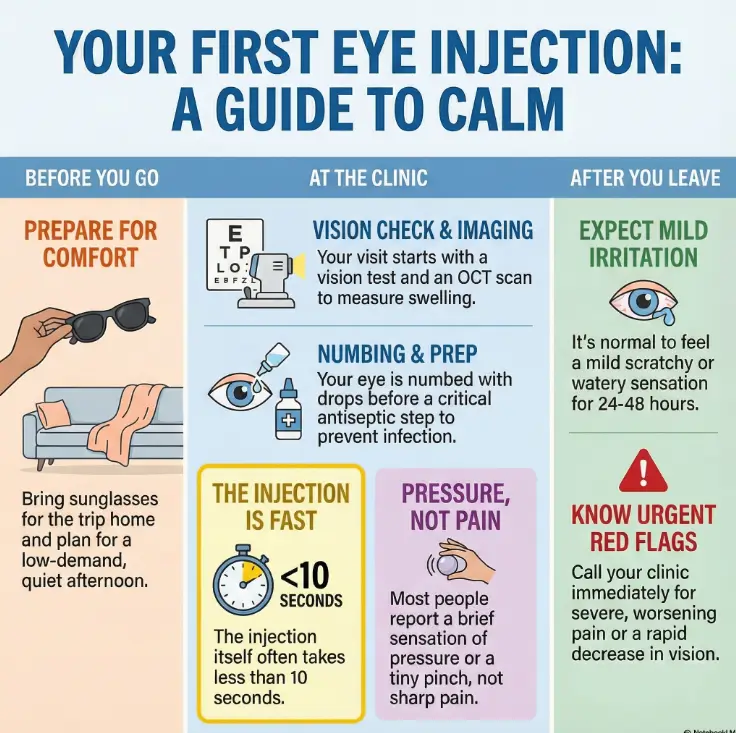
Why the first injection feels uniquely scary
The fear isn’t just about the needle. It’s about the word “eye,” the speed of the decision, and the quiet grief of realizing your vision now needs maintenance like a high-value instrument. If you’re here, you’re likely juggling two pressures: protect your sight and don’t get rushed into a plan you don’t understand. That tension can make even a normal consent form feel like a hostile document.
- Most injections take seconds once the eye is numb.
- The appointment often lasts 30–90 minutes due to prep and checks.
- The goal is stabilization first, not instant perfection.
- Learn the timeline
- Know the red flags
- Prepare one question list
Apply in 60 seconds: Write down your top 3 worries and bring them on paper.
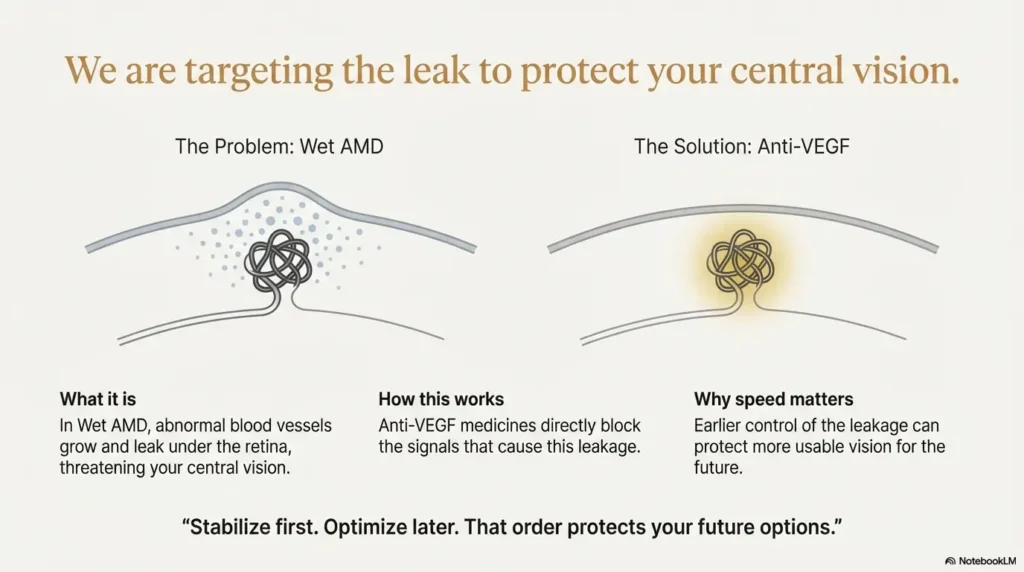
What wet AMD means in plain English (and why speed matters)
Wet AMD is when abnormal blood vessels grow under the retina and leak fluid or blood, which can distort central vision. Anti-VEGF medicines are designed to slow or stop that leakage by blocking signals that drive those vessels. Translation: the treatment isn’t a vague “maybe.” It directly targets the mechanism causing the urgent damage.
The first few weeks after diagnosis can feel like a sprint you didn’t train for. But the urgency has a rationale: earlier control of swelling and bleeding can protect more usable vision. The exact schedule is individualized, but a common early pattern is more frequent injections followed by spacing out as the eye stabilizes. If you want the “what does a typical plan look like?” answer in one place, see this guide to a wet AMD injection schedule.
Two calmer truths to hold: you’re not failing because you’re scared; and you do not need to memorize ophthalmology to make a good choice. You need a workable plan, a clinician you trust, and a way to track how your vision responds.
Pull-quote: “Stabilize first. Optimize later. That order protects your future options.”
Your appointment timeline: check-in to walk-out
Here’s the realistic flow most people experience on day one. The exact sequence varies by clinic and country, but the spine of the visit is consistent.
- Check-in and vision test (5–15 minutes).
- Imaging such as OCT to measure swelling (10–20 minutes).
- Doctor review and confirmation of the plan (5–10 minutes).
- Numbing and antiseptic prep (5–10 minutes).
- Injection (often under 10 seconds).
- Brief post-check and instructions (5–10 minutes).
If you’re time-poor, ask the front desk for an estimate of total visit time. Many clinics can also tell you whether you’ll need a driver. Some people feel fine to leave alone; others prefer a ride because their eye may be watery, light-sensitive, or mildly sore.
Show me the nerdy details
Anti-VEGF drugs are delivered into the vitreous cavity. The antiseptic step—often using povidone-iodine—is one of the most important safety measures to reduce infection risk. The needle path is chosen to avoid sensitive structures, and the injection site is typically a few millimeters from the corneal edge.
What the injection feels like: honest sensory details
Let’s be plain but not dramatic. Most people report pressure more than pain. The numbing drops do heavy lifting. You may feel a brief push, a tiny pinch, or a strange awareness of “something happening” rather than sharp pain.
What surprises people most is not the injection—it’s the prep. The eyelid holder can feel odd. The antiseptic can sting. And your eye may tear like it’s auditioning for a sad movie. That’s normal.
- A mild scratchy sensation afterward can last 24–48 hours.
- Small floaters or bubbles can appear briefly.
- Light sensitivity is common the first day.
- Prep is the longest part
- The injection itself is fast
- Expect watery, gritty feelings after
Apply in 60 seconds: Decide now to focus on slow breathing during the antiseptic step.
Safety and side effects: what demands a call today
Anti-VEGF injections are common worldwide, and serious complications are uncommon—but “uncommon” is not the same as “ignored.” Knowing your red flags is part of being a confident adult in the clinic, not a nervous bystander.
Contact your retina clinic promptly for new or worsening pain, light sensitivity, redness, reduced vision or increasing floaters after an injection. Severe pain, sudden vision loss, flashes or a curtain/shadow need immediate eye assessment. Do not wait for several symptoms to occur together or assume the risk ends after a few days. If the clinic cannot be reached urgently, use an emergency eye service.
- Severe, worsening pain that doesn’t ease.
- Rapidly decreasing vision.
- New or increasing redness, with or without discharge.
- New flashes, increased floaters or dark spots, or a curtain-like shadow.
Mild surface irritation can occur, but worsening discomfort or a new vision change should not be self-classified as normal recovery. Follow the clinic’s written aftercare instructions and contact them when uncertain.
If you’re the person who worries you’ll “bother the clinic,” hear this once: they would rather you call early and be reassured than wait and regret it.
Cost, coverage, and quote prep
This section is short on sparkle and long on usefulness. Prices and coverage vary by drug, country, and insurer. In many systems, anti-VEGF therapy is treated as a medically necessary service when wet AMD is documented with imaging and clinical notes. If you want a fuller breakdown of typical price drivers, visit frequency, and what shapes out-of-pocket expectations, this AMD treatment cost guide can help you frame the conversation.
If you’re in the United States, these injections are commonly covered under Medicare Part B when criteria are met, with patient cost-sharing that can be reduced by supplemental coverage. Medicare Advantage plans may use prior authorization, step therapy, or preferred drug lists depending on the plan design. Private insurance often mirrors similar structures. If Eylea is the first agent on your radar, this breakdown of Medicare coverage for Eylea injections can save you a round of confusing phone calls.
If you’re not in the U.S., your public system may cover standard agents with specific rules about switching, spacing, or required follow-up imaging. The same story repeats globally: documentation unlocks coverage.
Quote-prep list (what to gather before comparing)
- Your diagnosis wording (wet AMD, choroidal neovascularization).
- Recent OCT or imaging summary if available.
- The drug name suggested (e.g., Eylea, Lucentis, Vabysmo, Avastin).
- The proposed schedule for the first 3 months.
- Clinic billing contact and location.
Neutral next step: Save this list and ask for a written estimate that includes drug name and procedure code used by the clinic.
A 60-second eligibility checklist before you pay
This isn’t legal advice—just a practical structure that prevents expensive surprises. Use it whether you have national insurance, private coverage, or a hybrid plan.
Eligibility checklist
- Yes/No: Is wet AMD explicitly documented in your chart?
- Yes/No: Did your clinician reference OCT or angiography findings?
- Yes/No: Is the recommended drug on your plan’s covered or preferred list?
- Yes/No: Do you need prior authorization for specialty injectables?
- Yes/No: Do you have a cap, deductible, or coinsurance that resets in the new year?
Neutral next step: Screenshot your plan’s benefits page and confirm the current coverage rules with the insurer’s official support line.
- Diagnosis wording matters
- Imaging supports necessity
- Drug lists guide approvals
Apply in 60 seconds: Ask your clinic, “What exact drug and schedule are you billing for?”
Decision card: choosing between common anti-VEGF options
Your specialist may discuss Eylea, Lucentis, Vabysmo, Avastin or other anti-VEGF options. Avastin use in the eye is off-label in the United States. Each medicine has specific dosing and safety considerations; suitability depends on your eye, response and clinical assessment, as well as practical access.
- When A makes sense: A drug covered as preferred on your plan with a schedule your life can handle.
- When B makes sense: A drug your doctor recommends if your imaging shows incomplete response to the first option.
- Time trade-off: Some regimens may reduce visit frequency after stabilization.
- Cost trade-off: Coverage tier and prior authorization can outweigh list price in what you actually pay.
Neutral next step: Compare coverage tiers with this year’s deductible before you commit to a multi-month schedule.
Coverage questions for the exact drug and plan
- Original Medicare Part B: Ask whether the exact treatment is covered and confirm approved amounts and assignment; a Part D tier chart does not determine Part B cost-sharing.
- Medicare Advantage or commercial coverage: Check the actual medical-benefit drug policy, authorization and patient charges.
- Other coverage: Ask how supplemental benefits apply. There is no universal five-tier map for these injections.
Next step: Request a written estimate for the exact product and setting, including the drug, injection procedure, imaging, visits and your remaining deductible.
How to calm the fear with a simple pre-shot plan
Fear management doesn’t need incense and a life coach. It needs a plan you can run in a waiting room with a phone that’s on 12% battery.
- 48 hours before: Confirm appointment time, transportation, and any medication instructions.
- Morning of: Eat something light; dehydration and low blood sugar can amplify anxiety.
- In the chair: Request a step-by-step narration if that helps you feel in control.
One tiny trick that works surprisingly well: give your fear a job. Instead of “please go away,” say, “help me remember my two questions.” That flips anxiety into usefulness.
Two questions that save time and reduce mental fog:
- “What outcome are we aiming for in the next 8–12 weeks?”
- “What would make us adjust the drug or interval?”
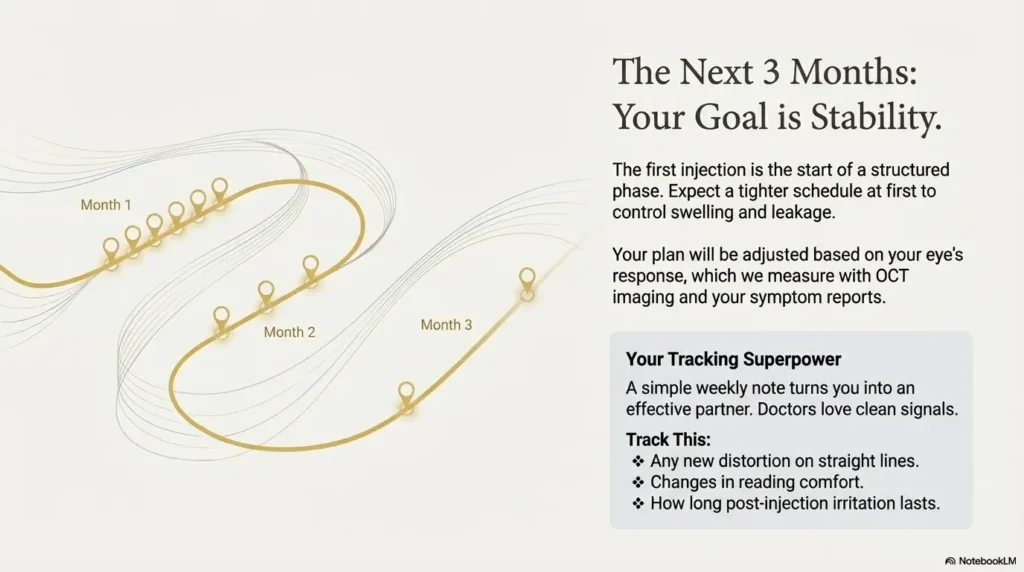
What to expect over the next 3 months
The first injection is often the start of a structured phase. Many clinicians begin with a tighter schedule to control leakage and swelling, then reassess using imaging and symptom reports. Your plan might be monthly early on, or adjusted based on response.
This is where tracking becomes your superpower. You don’t need a spreadsheet worthy of a CFO. Follow the home-monitoring frequency your retina team recommends, often daily. Keep a note of changes, but report new symptoms promptly rather than waiting for the next appointment:
- Any new distortion on straight lines.
- Changes in reading comfort.
- New central blur or color dulling.
- How long post-injection irritation lasts.
Bring that pattern to your follow-ups. Doctors love clean signals. Clear notes can help the clinician understand changes; they do not replace urgent contact for a new symptom. If you’d like a ready-to-use format you can print or share with family, this printable symptom diary for seniors fits neatly into the same tracking habit.
- Expect a structured first phase
- Monitor as advised and report new changes promptly
- Let imaging guide adjustments
Apply in 60 seconds: Ask how often to check each eye at home and whom to call for new distortion or a central blur.
Mini calculator: your visit burden in real life
This isn’t about money—it’s about your calendar, your energy, and your support system.
- Input 1: Your one-way travel time (minutes)
- Input 2: Expected clinic time per visit (minutes)
- Input 3: Visits per month in the first phase
Quick output: Total monthly time = (travel x 2 + clinic) x visits.
Neutral next step: Use this estimate to plan work coverage or family support for the first 8–12 weeks.
Smoothing the experience: what you can control
There are small, surprisingly powerful ways to make the first round easier.
- Bring sunglasses for the walk out.
- Skip eye makeup that day to reduce irritation risk.
- Plan a low-demand afternoon if you can—no heroic errands.
- Ask about lubricating drops if dryness is an issue.
Your questions that signal a high-quality clinic
You don’t need to be tough. You need to be clear. These questions are short and respectful, and they quietly communicate that you’re a serious partner in care.
- “What changes would make you shorten or lengthen my interval?”
- “What symptoms should trigger an urgent call?”
- “Which drug is preferred by my coverage, and is it clinically appropriate for me?”
- “Will we use OCT every visit, or at set checkpoints?”
That last one alone can save you confusion and a handful of unnecessary worry spirals. If you’re building a broader prevention rhythm around this diagnosis, it’s worth revisiting how often seniors should get dilated eye exams so your long-term schedule stays calm and realistic.
Infographic: your first-injection calm map
- Bring sunglasses
- Write 3 questions
- Plan a quiet afternoon
- Vision check
- OCT imaging
- Numbing + antiseptic
- Usually seconds
- Pressure > pain
- Stay on slow breathing
- Expect mild grit
- Watch red flags
- Monitor as advised; report new changes promptly
Message: Replace the scary unknown with a predictable sequence.
FAQ
Will the injection hurt?
Most people feel brief pressure or a tiny pinch after numbing drops. The antiseptic and eyelid holder can feel stranger than the injection itself. Apply in 60 seconds: Ask your clinician to narrate each step so your brain stays oriented.
How long does the whole appointment take?
Many first visits run 30–90 minutes because imaging, prep, and review take time. The injection step is usually very short. Apply in 60 seconds: Call the clinic and ask for an estimated total visit time so you can plan transport.
What side effects are normal?
Mild watering or grittiness may occur after the preparation. Ask the clinic which symptoms are expected for your eye. Increasing pain, redness, light sensitivity, floaters or reduced vision need prompt advice; sudden vision loss or a curtain needs immediate assessment. Save the urgent contact number before treatment.
What symptoms mean I should call urgently?
New or worsening pain, redness, light sensitivity, reduced vision or increasing floaters warrant prompt contact. Severe pain, sudden vision loss, flashes or a curtain/shadow require immediate eye assessment. Do not wait for discharge or several symptoms together.
How many injections will I need?
It varies. Many plans start with a more frequent phase to stabilize leakage, then adjust the interval based on response. Apply in 60 seconds: Ask, “What’s our 8–12 week goal and how will we measure it?”
Is one drug better than another?
Different agents can be appropriate depending on response, safety profile, and coverage rules. The best choice is the one that fits your eye’s clinical needs and your ability to sustain the schedule. Apply in 60 seconds: Ask for two clinically reasonable options and compare expected out-of-pocket and visit frequency.
How do I handle costs if coverage is complicated?
Start with diagnosis documentation and the proposed drug name. Ask about prior authorization and whether a preferred agent is medically appropriate for you. Apply in 60 seconds: Request a written estimate listing the drug and your expected cost-sharing range.
Optional video: Open the video on YouTube (external site).
Conclusion: your next 15 minutes
That early fear you felt at the top of this article had a job: to demand clarity. Now you have it. You know the rough timeline, what the injection usually feels like, which symptoms are truly urgent, and how to protect your wallet and calendar without turning your care into a bureaucratic marathon.
Your next 15-minute move: open a note on your phone and copy these three lines:
- “My 8–12 week goal is: ______.”
- “My urgent signs: new or worsening pain, redness, light sensitivity, floaters or vision changes; severe pain, sudden vision loss, flashes or a curtain need immediate assessment.”
- “Please confirm drug name, expected schedule, and billing estimate.”
Bring that to your appointment. You won’t feel fearless. But you will feel equipped—and that is often the difference between a scary first injection and a sustainable plan that protects your sight and your sanity. If this diagnosis has you wondering whether your symptoms are “just aging” or something that deserves faster care, you might also find Is it just getting older? serious eye disease a reassuring companion read.
Updated October 15, 2026. Clarified urgent symptoms, home monitoring and plan-specific coverage questions. Sources: ASRS injection guidance and Medicare AMD coverage. Follow your retina team’s individual treatment and aftercare instructions.
PUT THIS GUIDE TO WORK · INTERACTIVE WORKSHEET
Prepare for a first retinal injection discussion
Use this worksheet alongside the article: First Anti-VEGF Eye Injection for Wet AMD: What to Expect & How to Calm the Fear. Use the fields provided to organize your notes and next actions, then save your worksheet.
Your entries stay in this page and are cleared when you reload. No account is needed. Saved files are downloaded only to your device.
This card organizes a discussion or task. It does not provide diagnosis, treatment, medication timing, driving clearance, or professional approval. Copy clinical instructions exactly and ask the professional about uncertainty.
How to use your result
Save the worksheet before leaving this page. Recheck any quote, date, or instruction with the relevant provider, pharmacist, manufacturer, or official organization. A completed checklist means you recorded the steps, not that an outcome is guaranteed.
Worksheet added October 20, 2026. Read the article above for context and its stated review scope.