

Organize your questions and next steps, then save your worksheet.
Summary and next steps
A diary can organize a description between appointments. It cannot diagnose a condition or set a safe waiting period for new symptoms.
- Seek advice first if a new concerning change is occurring.
- Record onset, affected eye and the task that changed.
- Bring a concise dated record to the appointment.
Editorial maintenance: October 24, 2026. Summary layout, related links and technical metadata updated. This is not a full clinical review.
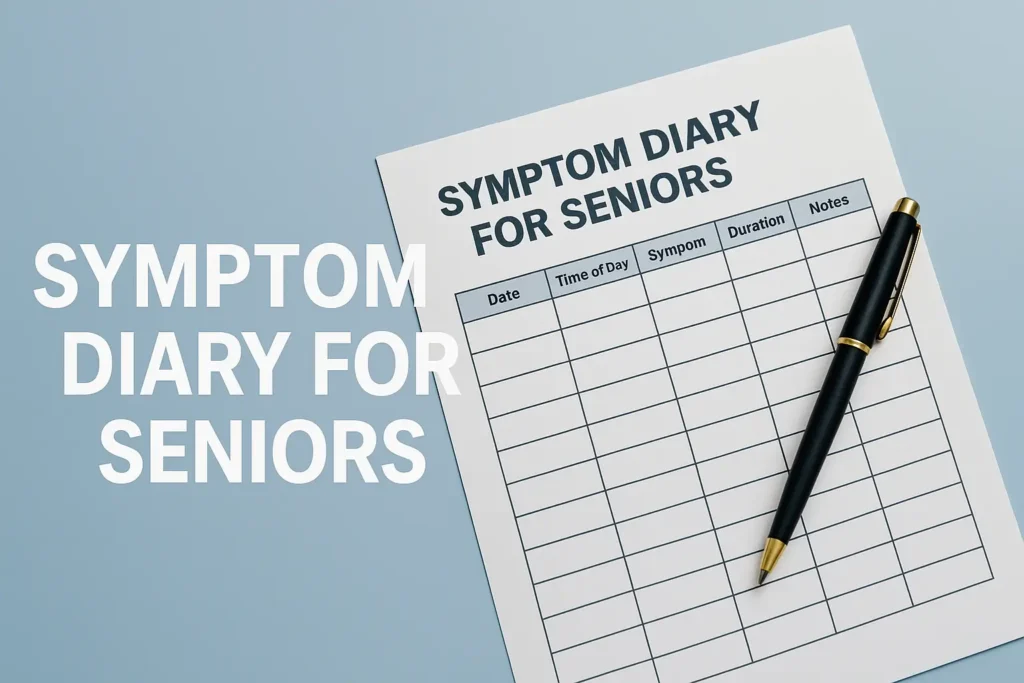
A printable vision diary can help you describe symptoms between appointments. It cannot diagnose disease or decide how long to wait. New distortion or a gray patch needs prompt clinical advice; sudden vision loss, a curtain, flashes with new floaters, or severe eye pain with nausea needs immediate care.
Do not wait six weeks, until a page is full, or until symptoms recur before seeking advice about a new concerning change. Recording onset can help the clinic, but the call comes first.
A diary is a place for the person’s own words. Ask what changed and when, without assuming that reluctance to discuss a symptom means it is harmless.
This guide explains a simple weekly record, seven details to note and how to discuss them at an appointment. Family scenarios are educational illustrations, not verified patient outcomes or evidence that a diary saves vision.
You’ll also learn how to use this little tool during real appointments, how to get your parent (sort of) on board, and how to do a 60-second check-in right now—before the next “It’s nothing, really” turns into an avoidable emergency.
Table of Contents
Why a printable vision symptom diary matters more than you think
Vision loss in older adults is common, but that doesn’t make it inevitable or untreatable. In richer countries, millions of people over 65 live with vision impairment that could often be slowed, treated, or even prevented with earlier detection. The catch? Early changes are usually subtle and easy to shrug off.
A diary can turn a vague recollection into dated notes about symptoms, the affected eye and the activity. Bring relevant entries to the appointment, but do not collect weeks of records before reporting a new concerning change.
When you write things down:
- You notice changes sooner (because “once in a while” might actually be “three times this week”).
- Your parent has something to lean on when their memory blanks in the exam room.
- The doctor can prioritize testing, referrals, and treatment based on real patterns, not fuzzy recollections.
For example, a note such as “letters look pale today” records a specific concern. Label examples as examples, and record the person’s actual words rather than copying a suggested symptom.
- Write down what you see, not what you fear.
- Look for patterns: time of day, which eye, which activity.
- Bring the diary to every eye appointment.
Apply in 60 seconds: Grab any sheet of paper and write today’s date, “Right eye,” “Left eye,” and one sentence about how things looked today.
Who should use this diary (and who probably doesn’t need it yet)
Not every older adult needs a printed symptom diary. Some are already seeing an eye specialist regularly, have stable conditions, and remember everything. Others are walking around insisting they “just need better lighting” while holding the newspaper three inches from their nose.
Think of this diary as a low-tech safety net for seniors who are:
- Noticing new or changing vision symptoms.
- Losing track of which day something happened.
- Juggling multiple conditions like diabetes, glaucoma risk, or macular degeneration.
- Being politely ignored when they tell busy doctors, “It’s been weird lately.”
Here’s a quick way to decide if it’s worth starting.
Eligibility checklist: Who should start a printable vision diary today?
Answer “yes” or “no” for your mom (or older loved one):
- Age 60+ and no eye exam in the last 12–24 months.
- Has diabetes, high blood pressure, or a strong family history of glaucoma or macular degeneration.
- Recently said something like “the lines are wavy,” “colors look dull,” or “the print keeps blurring.”
- Has tripped, misjudged steps, or missed curbs more than once in the last 3 months.
- Gets headaches or eye strain after reading or screen time.
A diary may be useful whenever it helps you communicate. You do not need two checked boxes, and the count does not establish disease risk.
New symptoms need clinical advice on their own. Do not use four checked boxes to choose a waiting period of several weeks.
Save or print this checklist and confirm any specific recommendations with your eye care provider.
Use the questions as notes for your clinician, not as an eligibility test or a retrospective explanation for a diagnosis.

How Dated Notes Help a Clinical Conversation
An appointment question such as “When did this begin?” can be difficult to answer from memory. A dated note provides a starting point for that conversation.
If the onset is uncertain, write “not sure” rather than inventing a date. Include when the change was first noticed and whether it is happening now.
That’s the quiet trap many seniors fall into:
- Symptoms drift in slowly.
- They normalize them (“Everyone’s eyes get tired”).
- By the time they’re worried enough to see someone, the timeline is a blur.
A simple page can have columns for date and time, the affected eye, the symptom and the activity. No special notebook is needed.
A symptom timeline can help a clinician ask focused questions and choose tests. It cannot establish that an imagined delay was safe or prove that vision was saved.
“Your mom doesn’t have to remember perfectly—her diary can remember for her.”
- Start the diary before the next appointment.
- Ask your parent to jot notes in their own words.
- Keep the paper where they already sit: by the TV, favorite chair, or bedside.
Apply in 60 seconds: Put a pen and notebook where your mom usually reads or watches TV and label the top of the page “Vision Today.”
How to set up your printable symptom diary step-by-step
You don’t need a designer, an app, or a subscription. You need one printable page and a pen. Think “checklist meets calendar,” not “art project.” If it’s too pretty, your parent will be afraid to “mess it up.”
Here’s a simple weekly layout you can copy into Word, Google Docs, or any basic editor and print:
| Date | Time of day | Right eye | Left eye | Activity (reading, TV, walking, driving) | Light (dim / normal / bright) | Headache / pain (Y/N) | Notes |
|---|---|---|---|---|---|---|---|
| Print 2–3 copies and keep them in the same place every week. | |||||||
Ask whether the person prefers a short paper form, a voice note or help from a caregiver. Choose a format that is comfortable to use.
Tips that make seniors more likely to use the diary:
- Use big fonts. 14–16 pt, clear sans-serif. No delicate cursive.
- Keep it one page. If it feels endless, they’ll avoid it.
- Allow “messy.” Scribbles, arrows, and “not sure which eye” are still better than silence.
- Add a weekly “big picture” box: “Overall this week my vision felt…” with options: same / slightly worse / much worse.
Show me the nerdy details
Paper avoids passwords; a digital note may be easier to enlarge, dictate or share through the clinic’s approved channel. Try the person’s preferred format rather than assuming one method works for everyone.
- One page per week is ideal.
- Big fonts beat beautiful fonts.
- “Good enough” entries beat perfection.
Apply in 60 seconds: Open any word processor, create a simple 8-column table like the one above, and print 3 copies.
What to Track: 7 Useful Details for Your Vision Diary
These seven details can help explain symptoms. They are recording prompts, not a diagnostic checklist or a substitute for prompt triage.
Lesson 1 – Track which eye is worse, even if you’re not 100% sure
Record right eye, left eye, both, or “not sure.” Do not guess which eye is affected or infer a diagnosis from the difference.
Lesson 2 – Time of day matters more than you’d think
Record the time and activity, such as reading or watching television. A repeated time of day does not identify the cause.
Lesson 3 – Activities reveal hidden problems
A senior who only notices trouble when reading small print is different from one who gets lost walking to the bathroom at night. A diary that distinguishes “reading, walking, stairs, driving, TV” turns random complaints into diagnostic clues.
Lesson 4 – Don’t skip the “weird one-off” days
Include a brief description of a new or unusual symptom in the person’s own words. Do not dismiss a concern because it has happened only once.
Lesson 5 – Add how you felt, not just what you saw
Words like “dizzy,” “uneasy,” or “afraid of falling” are clinically useful. They also give the doctor a sense of urgency that “a bit blurry” doesn’t.
Lesson 6 – Track headaches, eye pain, and halos
Headaches behind the eyes, pain when moving the eye, or halos around lights can be important. The diary gives them a place to live instead of being lost in “Oh, I get headaches sometimes.”
Lesson 7 – Mark the “first time I noticed this” as clearly as possible
When did “normal” change? A star, a colored pen, or a highlighted row around that first “something is off” entry can be priceless later.
Illustrative example: If the middle of a page suddenly looks like a gray cloud, note when it began and contact an eye clinician promptly. Do not wait until Monday or for a second entry. Sudden loss of vision or a curtain requires immediate eye or emergency care.
60-Second Appointment Notes Tool
Use these fields to organize a clinical conversation. They cannot classify your concern as low, calculate risk, or recommend waiting weeks or months.
This tool is for planning, not diagnosis. When in doubt, err on the side of calling your eye doctor.
Save this block and confirm timing with your own provider, especially if you have diabetes or known eye disease.
Eye Exam Coverage After 65: Questions to Confirm
A printable diary is free. The eye exam that follows? Not so much—and cost is one big reason seniors delay care. In the United States, routine eye exams for glasses are often not covered by original Medicare, which means many people over 65 pay the full amount for those visits.
On the other hand, certain medically necessary eye services—like glaucoma screening for high-risk groups or exams for diabetic retinopathy—are covered under Medicare Part B, typically at 80% after the deductible, leaving patients with about 20% of the approved amount as coinsurance. That gap can still feel painful if money is tight, but it’s much cheaper than emergency care and potential long-term disability costs.
Medicare Advantage and separate vision plans may offer routine vision benefits. Medigap generally helps with covered Original Medicare cost-sharing rather than adding routine vision coverage. A diary can explain symptoms, but it does not change eligibility or guarantee payment.
Eye Exam Billing Questions to Confirm
| Service type | Estimate to request | Who often pays | Notes |
|---|---|---|---|
| Routine eye exam for glasses | Clinic’s written self-pay price | Patient (original Medicare usually doesn’t cover) | May be discounted via vision plans or retail chains. |
| Medically necessary exam (sudden change, disease follow-up) | Clinic-dependent, often higher than routine exams | Medicare Part B / insurer + patient coinsurance | Documentation of symptoms helps justify medical necessity. |
| Glaucoma screening (high-risk groups) | Varies by provider | Often 80% covered by Part B after deductible | Available yearly for qualifying high-risk patients under Part B. |
| Diabetic eye exam | Varies; often bundled with other care | Frequently covered annually under Part B | Strongly recommended every year for people with diabetes. |
Request a dated estimate for the actual services and your plan, including deductible, coinsurance, copays and possible facility charges. This table is not a fee survey.
Save this table and confirm the current fee and coverage rules on your provider’s and insurer’s official pages.
Medicare Screening and Evaluation of New Symptoms Are Different
Medicare Part B has a glaucoma-screening benefit for eligible people once every 12 months. Evaluation of a sudden vision change is a clinical problem and may involve different services and billing. Seek urgent care when needed; do not treat the screening benefit as a reason to wait or as a promise of payment.
Show me the nerdy details
Ask for an estimate of the actual services and applicable cost-sharing. A diary is not evidence of a particular fee, future cost saving or insurance entitlement.
- Check what your parent’s plan covers before booking.
- Use the diary to explain why the visit is medically necessary.
- Ask the clinic for an itemized quote with codes if money is tight.
Apply in 60 seconds: Call the number on your parent’s insurance card and ask, “How is a medically necessary eye exam billed under this plan for someone over 65 with new symptoms?”
Red-flag symptoms: when “wait and see” is dangerous
Not every blurry moment is an emergency. But some are. One quiet benefit of keeping a diary is that it trains everyone—parent, caregiver, doctor—to distinguish “log it and watch” from “drop everything and call.”
Red-flag symptoms that deserve immediate attention:
- Sudden loss of vision in one or both eyes.
- A curtain or shadow moving across the field of vision.
- Sudden flashes of light or a shower of new floaters.
- Severe eye pain, especially with nausea or vomiting.
- Sudden, dramatic change in central vision (faces or words distorted).
If any of these appear, you don’t wait for the diary to fill. You use the diary to explain exactly what changed and when.
Decision card: watch at home, call today, or seek urgent care?
| Situation | Action | Timing |
|---|---|---|
| Mild, occasional blur with reading; no pain; diary shows no rapid change. | Keep logging symptoms and follow your existing eye exam schedule. | Bring diary to next routine visit. |
| New or worsening blur, especially in one eye; more frequent diary entries. | Call eye clinic, describe diary entries, ask for earlier appointment. | Contact the clinic promptly for triage; do not choose a waiting period from this table. |
| Sudden vision loss, flashes, curtain effect, or severe eye pain. | Seek emergency or urgent eye care; use the diary to give exact timing. | Immediately; do not wait to finish the diary. |
Save this card and adjust it with your eye doctor’s specific guidance for your parent’s diagnoses.
If you’re outside the US—say, in a country with a national health service—the decision card still applies, even if the phone numbers and pathways differ. In the UK, for example, older adults may qualify for free eye tests, while in South Korea or other countries you may go directly to an eye hospital or specialist clinic. The diary travels well across borders, even when coverage rules don’t.
How to use the diary at eye appointments without wasting time
You’ve done the work. You printed the diary, your mom filled it out, you’ve circled the worrying bits. Now you’re in the exam room, and the clock is ticking. How do you use all this without derailing the appointment?
You can adapt this suggested wording for an appointment:
- Hand the diary to the nurse or doctor and say, “We tracked her vision for the last four weeks. The worst days are starred.”
- Point to one or two representative entries: “Here, the lines looked wavy; here, the center was gray.”
- Then stop talking. Let the professional ask follow-up questions.
Illustrative appointment wording: Report the onset and current symptoms directly; the example does not mean that waiting to gather a pattern is safe.
- Without diary: “It’s been off for a while.”
- With diary: “These wavy lines began today; I called for advice and recorded when they started and which eye was affected.”
That level of detail helps the doctor decide whether to order imaging, adjust medication, refer to a specialist, or simply watch and repeat the exam later.
You can also gently ask:
- “Would it help if we keep this kind of weekly diary between visits?”
- “Is there anything specific you’d like us to track for the next month?”
Some clinics will even suggest small changes to your template—like adding a blood sugar column for someone with diabetic retinopathy or a “fall or near-fall” column if balance is becoming an issue.
- Lead with the scariest or most frequent symptom.
- Show, don’t monologue—let the doctor skim.
- Leave the diary with the clinic if they ask to scan it.
Apply in 60 seconds: Clip this week’s diary page to your parent’s appointment card or calendar so it actually makes it into the exam room.
Helping a reluctant parent stick with the diary
Keeping a diary should be a choice, not a test of cooperation. Ask what makes the task difficult and offer help without pressure.
Options to make the record easier to use:
- Frame it as a favor to the doctor, not a homework assignment. “It’ll make their job easier.”
- Keep it tiny. One or two entries a day is enough.
- Pair it with a pleasant ritual. “Fill this out while your tea cools.”
- Offer help with an entry. Ask permission to write down the person’s own description and check that you have recorded it accurately.
Keep the discussion practical: what changed, what help is wanted, and what the clinic needs to know. Avoid promising better vision in return for completing a form.
For caregivers who are exhausted (which is almost all of us), remember:
- You’re not aiming for a perfect scientific record.
- Even a partially filled diary is better than none.
- If your parent can’t or won’t write, you can be their “scribe” for a few weeks.
Show me the nerdy details
Behavior researchers often talk about “friction.” Every point of friction (finding the paper, finding a pen, deciding what to write) reduces the odds of follow-through. By keeping the diary in one spot, using checkboxes where possible, and attaching it to an existing routine, you remove friction and increase consistency—without nagging or guilt.
- Attach it to a daily ritual.
- Celebrate effort, not perfection.
- Offer to be the scribe when they’re worn out.
Apply in 60 seconds: Ask your mom, “When is the easiest time of day for you to jot one line about your eyes?” Then build the habit around that time, not yours.

Digital vs printable diary: which one actually gets used?
There are excellent apps and digital trackers for vision and health. But for many older adults, the winning solution is still…paper. No passwords. No software updates. No “I forgot which app it was in.”
That said, a hybrid approach can work:
- Printable diary for daily notes.
- Photos of key pages on your phone to share via patient portals or telehealth.
- Optional spreadsheet if you enjoy looking for trends over months (caregivers who love charts, I see you).
In countries with strong digital health systems, you might even be able to upload diary snapshots directly to your parent’s medical record or email them ahead of the visit. The key is always the same: use the tool that your parent will actually use consistently for at least a few weeks.
If you’re caring for someone in South Korea, the US, or another country with complex insurance rules, remember that written symptom timelines can support referrals, prior authorizations, and coverage decisions. A well-kept diary won’t replace formal documentation, but it can make those conversations more efficient and less stressful.
You can also cross-link your tracking with other resources, like a family history article or checklists about age-related eye disease, if you’re building a full “vision binder” at home.
Infographic: your weekly vision diary flow in 5 minutes

Weekly Vision Diary Flow (5-Minute Routine)
1. Daily check (30 seconds)
Once a day, ask: “How did my eyes behave today?” Jot one line in the diary.
2. Weekly review (3 minutes)
Circle bad days, star anything new or scary, and mark if the week felt better, same, or worse.
3. Decision check (1 minute)
Look at your circles and stars. Use your clinician’s instructions; call promptly about new concerning symptoms instead of waiting for the weekly review.
4. Appointment prep (1 minute)
Clip the latest pages together, add a sticky note with your top 2 questions, and bring them to the visit.
FAQ
Q1. How often should my mom get a dilated eye exam if she’s over 65?
Most major eye organizations recommend that adults 65 and older have a comprehensive, dilated eye exam every 1–2 years, even if they don’t notice symptoms. If she has diabetes, known eye disease, or strong family history, yearly—or even more frequent—visits may be recommended.
60-second action: Call her eye clinic and ask, “Given her age and conditions, how often do you want to see her?” Then write that answer at the top of the diary.
Q2. What if the diary looks stable?
A stable record can be a useful baseline, but it cannot rule out silent eye disease or replace a recommended examination. Keep the clinical plan and report any new concerning change promptly.
60-second action: Save the notes and confirm your next examination date.
Q3. Can this diary help with insurance or Medicare coverage decisions?
It can’t replace formal documentation, but it can help your doctor justify medically necessary exams, tests, or referrals by showing a clear timeline of symptoms. That, in turn, can support coverage under benefits like Medicare Part B when certain criteria are met.
60-second action: Before the next visit, highlight any entries that show sudden or worsening symptoms and tell the doctor, “These are the days that worried us most.”
Q4. What if my parent has early memory issues or dementia?
A diary can still help, but you’ll probably take a bigger role. Instead of expecting them to write everything, you can observe and jot notes yourself—especially changes in walking, bumping into objects, or trouble recognizing faces. Vision impairment and dementia are closely linked in older adults, so keeping an eye (and a pen) on both is worth the effort.
60-second action: Add a simple row labeled “Falls, stumbles, or near-misses” to the weekly diary and mark any incidents.
Q5. Is it ever “too late” to start a symptom diary?
It’s never too late to start paying attention. Even a week or two of notes before an upcoming appointment can be helpful. If your parent already has a diagnosis—like glaucoma, cataracts, or macular degeneration—the diary can help track how well treatment and daily life are going, not just whether the condition has a name.
60-second action: Choose the date of the next appointment and write it at the top of a fresh diary page titled “Lead-up to visit.”
Q6. Should we use separate diaries for each eye disease (like diabetes, glaucoma, cataracts)?
Usually, one well-designed diary is enough. You can add simple tags or color codes for specific conditions (for example, a blue dot for diabetes-related notes, a green dot for glaucoma concerns). More than one diary often means none of them get filled.
60-second action: Agree on one template and add a small legend at the bottom: “Blue dot = diabetes,” “Green dot = glaucoma,” and so on.
Optional video: Open the video on YouTube (external site).
Conclusion: your next 15 minutes
A diary can improve the clarity of a conversation; it cannot guarantee a better medical outcome. Use it alongside the examination, treatment and monitoring plan recommended by the eye care team.
In the next 15 minutes, you can:
- Print a simple weekly diary page.
- Fill out today’s line with your mom (or for her).
- Record a brief symptom timeline and contact the clinic promptly about a new change; emergency symptoms need immediate care.
You don’t have to become an expert in eye disease overnight. You just have to capture what’s really happening, one line at a time, so that when your parent finally sits in that bright exam chair and hears, “So, tell me what’s been going on,” they’re not answering from memory—they’re answering from evidence.
Last updated: October 15, 2026. Diary limitations, symptom urgency, the appointment tool and Medicare distinctions were reviewed. Sources: NEI retinal detachment, Medicare glaucoma screening, and Medigap coverage.
For deeper dives, you may also want to read about family history of eye disease, how often seniors should get dilated eye exams, and the real blindness risk after 70.
You’ve already done something powerful by reading this far: you’ve decided your parent’s sight is worth tracking. Now give that decision a home on paper—and let the ink do some of the worrying for you.
Use the diary in the format your eye care team finds useful, and keep routine and urgent contact numbers with it.
PUT THIS GUIDE TO WORK · INTERACTIVE WORKSHEET
Create a printable vision-observation record
Use this worksheet alongside the article: Printable Symptom Diary for Seniors: 7 Details to Track Between Eye Visits. Use the fields provided to organize your notes and next actions, then save your worksheet.
Your entries stay in this page and are cleared when you reload. No account is needed. Saved files are downloaded only to your device.
This card organizes a discussion or task. It does not provide diagnosis, treatment, medication timing, driving clearance, or professional approval. Copy clinical instructions exactly and ask the professional about uncertainty.
How to use your result
Save the worksheet before leaving this page. Recheck any quote, date, or instruction with the relevant provider, pharmacist, manufacturer, or official organization. A completed checklist means you recorded the steps, not that an outcome is guaranteed.
Worksheet added October 20, 2026. Read the article above for context and its stated review scope.