

Summary and next steps
Understand Medicare cataract surgery coverage, 2026 out-of-pocket costs, lens upgrades, and the rules for glasses after surgery.
Editorial maintenance: October 24, 2026. Summary layout, related links and technical metadata updated. This is not a full clinical review.

Medicare can cover medically necessary cataract surgery, including a conventional intraocular lens, but coverage does not mean the procedure is free. For outpatient treatment, Part B is the main benefit to check. Your costs depend on your coverage, the surgical setting, and any optional services you choose. Medicare’s cataract surgery guidance also notes that coverage can depend on where you live.
This guide explains U.S. Medicare coverage, with 2026 deductible information. Start by separating three questions: Is the surgery covered? What is your share of covered charges? Which extras would you pay for yourself?
Table of Contents
When cataract surgery becomes a medical need
Cataract surgery removes the eye’s cloudy natural lens and usually replaces it with an artificial lens called an intraocular lens, or IOL. According to the National Eye Institute, a doctor may recommend surgery when vision problems interfere with activities such as reading or driving. Surgery may also help a doctor examine or treat another condition at the back of the eye.
Those are clinical reasons to discuss surgery, not automatic insurance approval. Ask your surgeon’s office which Medicare coverage criteria apply to your case and whether the documentation supports them. Describe specific difficulties honestly—for example, trouble reading medication labels or seeing road signs—rather than trying to match an assumed eligibility threshold.
A covered lens and an optional upgrade are different charges
A conventional IOL falls within Medicare’s cataract surgery benefit when coverage requirements are met. A lens with additional features can create a separate patient expense.
CMS distinguishes the covered lens-replacement function from noncovered features that correct presbyopia, the age-related loss of near focusing ability, or pre-existing astigmatism. Choosing one of these lenses does not automatically make the entire cataract operation noncovered. The extra lens cost and services attributable to the noncovered function can be your responsibility. See the CMS rulings on presbyopia-correcting lenses and astigmatism-correcting lenses.
Before agreeing to an upgrade, request two itemized estimates: one for the covered conventional option and one for the proposed alternative. Ask what each additional charge buys, whether it is optional, and whether the price is per eye. If a quote includes a “laser package,” request the individual services and their coverage status; the package name alone does not explain the bill.

What you may pay under Original Medicare
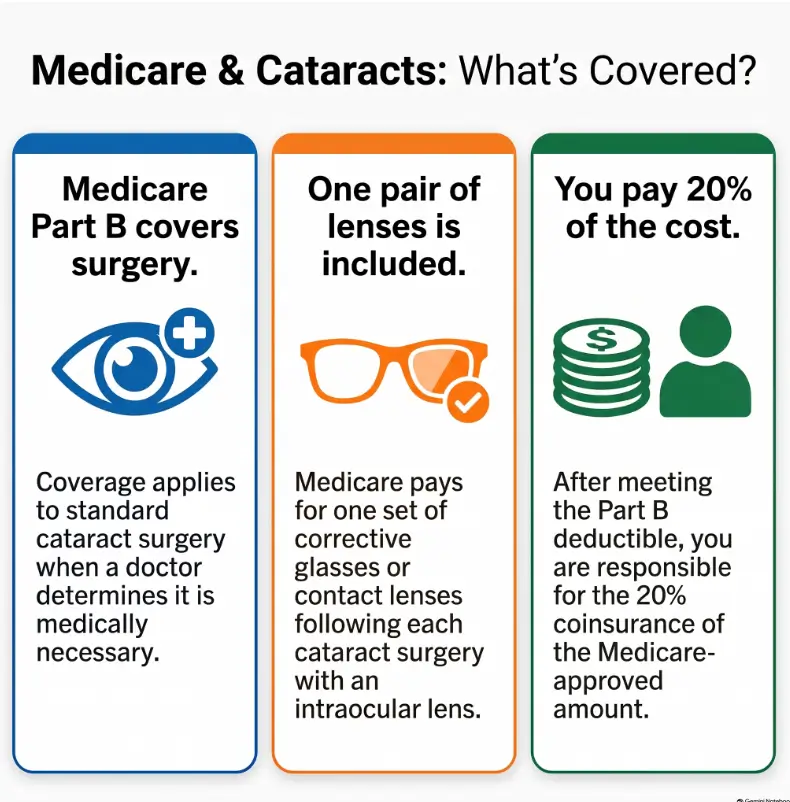
The 2026 Part B deductible is $283, paid once per calendar year. After it is met, you generally owe 20% of the Medicare-approved amount for covered physician services when the provider accepts assignment. That means the provider accepts the approved amount as full payment for the covered service.
The surgical location matters, too. A hospital outpatient department can charge a hospital copayment in addition to the physician’s cost-sharing. Do not assume a surgeon’s estimate includes the facility or every other provider involved. Medicare recommends asking both the doctor and facility about surgery and aftercare costs.
A simple deductible example
Suppose a covered physician service has a Medicare-approved amount of $1,000, and you have the full $283 deductible remaining. Assume assignment is accepted, 20% coinsurance applies after the deductible, and you have no supplemental coverage.
Your share would be $283 + 20% × ($1,000 − $283) = $426.40. If your deductible were already met, your share of that same service would be $200.
This is a hypothetical calculation, not a cataract surgery price or total episode estimate. It excludes facility charges, separately billed services, prescriptions, and upgrades. The lesson is that the deductible comes out of the eligible amount before coinsurance is calculated; it is not simply added to 20% of that same full amount.
If both eyes need surgery, request an estimate for each operation. The annual deductible does not restart for the second eye in the same calendar year, although a new year brings a new deductible. For a closer look at estimating the separate bills, see our Medicare cataract surgery cost guide.
How Medicare Advantage and Medigap change the picture
Medicare Advantage provides Part A and Part B benefits through a private plan. Use your plan’s cataract surgery cost-sharing rather than assuming the Original Medicare example applies.
Check the surgeon and facility against your exact plan’s network, and ask whether a referral or prior authorization is required. Requirements vary by plan type, as Medicare’s plan comparison explains. A practice saying “we accept Medicare” does not answer whether it participates in your particular Advantage plan.
Medigap works differently: it supplements Original Medicare and may pay some of your share of Medicare-covered services, depending on the policy. It should not be assumed to pay for a noncovered lens upgrade. Check your policy before treating an estimate as your final expense. Medicare’s cost overview explains this distinction.

The limited benefit for glasses after surgery
Original Medicare usually does not cover ordinary eyeglasses or contact lenses. There is an exception: Part B covers one pair of glasses with standard frames, or one set of contact lenses, after each cataract surgery that implants an IOL.
After the Part B deductible, you pay 20% of the approved amount for the covered corrective lenses, plus any additional cost for upgraded frames. The supplier must participate in Medicare. Confirm this before ordering; a prescription alone does not establish that the optical shop can provide the Medicare benefit. These conditions appear in Medicare’s eyewear coverage guidance.
If you have an Advantage plan, ask how to obtain the postoperative eyewear benefit and which supplier to use. Keep that question separate from any extra routine vision allowance your plan advertises.
Optional video: Open the video on YouTube (external site).
Get a written estimate you can actually use
Before scheduling, give the billing office your current insurance details and ask it to separate the estimate into these categories:
- Covered medical care: the surgeon, facility, anesthesia, testing, and follow-up services included in the estimate.
- Your insurance share: the remaining deductible and applicable copayments or coinsurance.
- Optional or noncovered items: the exact lens upgrade and any related additional services.
- Costs to confirm separately: prescriptions, postoperative eyewear, and any providers whose fees are missing.
Ask for a written explanation if a charge remains unclear, particularly whether it is for covered treatment or an optional feature. For Advantage coverage, confirm the answer with the plan as well as the practice.
The most useful question is: “What would I owe for the covered conventional option, and exactly how would my bill change if I chose this upgrade?” That gives you a concrete financial comparison to discuss alongside your surgeon’s clinical recommendation.