


Low-Vision Medication Safety Guide
Pill Bottle Labeling System for Seniors
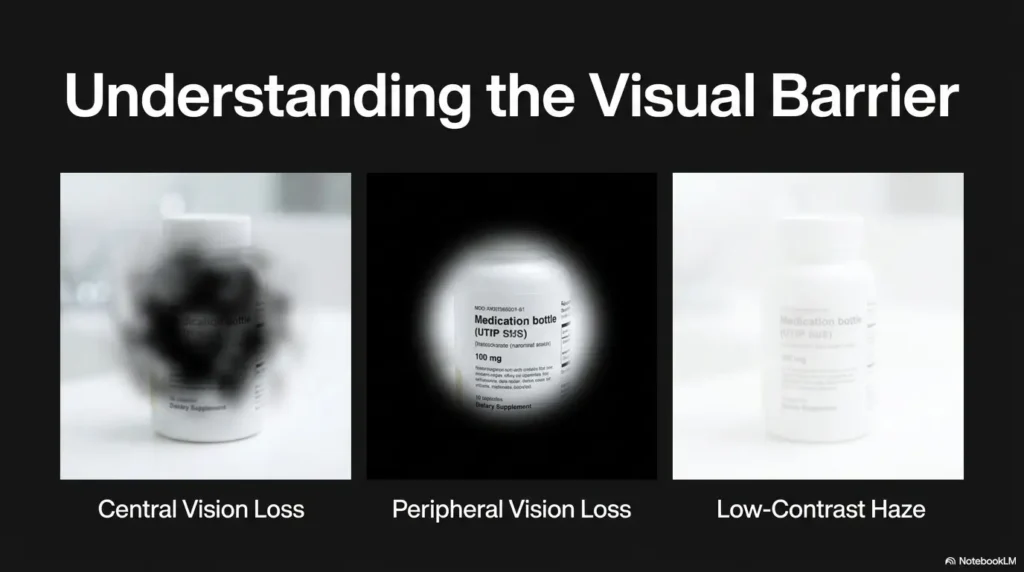
Who Cannot Read Small Print
A pill bottle can be small enough to fit in one hand and still contain a baffling amount of information. The drug name curls around the bottle, warning stickers compete for attention, and the most important instruction may be printed in letters that disappear under kitchen light.
For a senior with low vision, this is not merely inconvenient. A misread strength, a duplicate dose, or confusion between two similar containers can turn an ordinary morning routine into a medical emergency. The answer is not a rainbow of homemade stickers or one enormous word pasted across every bottle.
A safer system keeps the pharmacy label intact, makes critical information readable within seconds, and adds consistent visual or tactile cues that survive refills and caregiver handoffs. This guide shows how to build that system, test it in the senior’s real medication area, and recognize when labels alone are no longer enough.
See the essentials
Make the medication name, strength, dose, and timing easier to identify.
Prevent silent errors
Build refill checks and dose records into the labeling routine.
Choose support wisely
Compare large print, tactile cues, audible labels, organizers, and pharmacy packaging.
The safest label is not the cleverest one. It is the one that still works on refill day. 💊
Snapshot
Who this is for: Seniors with low vision, family caregivers, and adult children managing several medications. What it solves: Tiny print, similar bottles, inconsistent cues, and uncertainty after refills. What you can do next: Build and test a two-layer labeling system without covering the pharmacy label.
Table of Contents
Before You Act
This guide offers general medication-organization information, not individual medical or pharmacy advice. A household label should clarify the original pharmacy label, never cover or contradict it. Confirm questions about doses, missed medicines, pill splitting, crushing, storage, organizers, or changed instructions with a pharmacist or prescriber.

Before You Add a Sticker: Protect the Source of Truth
The pharmacy label must remain readable
A homemade label is a navigation aid. It is not a replacement prescription label.
The original container may carry the patient’s name, medication name, strength, directions, prescription number, refill information, prescriber, pharmacy contact details, warning stickers, and discard instructions. A large sticker that covers any of these details can solve one visibility problem while creating three new ones.
Place supplementary information beside an unobstructed section of the pharmacy label, on a removable bottle sleeve, or on a matching large-print card stored with the bottle. Avoid writing directly over printed directions, even when the new wording appears identical.
Do not repackage medication by default
Moving tablets into an unmarked container removes immediate access to their identity and instructions. Combining two prescriptions in one bottle is especially risky because tablets can look similar, strengths may change, and the original warnings become separated from the medicine.
Some weekly organizers are useful, but they should be introduced only after each medication has been reviewed. Certain medicines have special storage requirements, and some should remain in protective packaging. Ask the pharmacist before transferring anything.
Key takeaway
Add information around the pharmacy label, not over it. When the household system and the pharmacy instructions disagree, stop and call the pharmacy.
Start with a current medication list
Before labeling bottles, compare every active prescription, over-the-counter medicine, vitamin, and supplement with a current medication list. A large sticker cannot make an outdated list safe.
The list should include the complete medication name, strength, dose, timing, purpose, prescriber, and any special instructions. A printable one-page medication list template can help caregivers keep the same information available at home, at appointments, and during an emergency.
- Mark current prescriptions as active.
- Place uncertain bottles in a separate review area.
- Remove discontinued bottles from the active medication station.
- Check expiration or discard dates.
- Confirm duplicate generic and brand names with a pharmacist.
Who Labeling Can Help, and Who Needs More Support
Good candidates for a visual system
A consistent large-print system can work well for a senior who cannot comfortably read standard pharmacy print but can still understand the medication routine once the information is accessible.
Typical users include people with presbyopia, reduced contrast sensitivity, cataracts, macular changes, or difficulty focusing on curved labels. They may need brighter task lighting or magnification, yet remain able to match a bottle with a written schedule and record a dose reliably.
- The senior recognizes medication names or purposes.
- The prescription schedule is reasonably stable.
- Bottles can be opened and handled safely.
- The person can follow a repeated checking routine.
- A caregiver periodically reviews refills and changes.
When labels are not enough
Low vision and memory loss are different problems. Larger lettering may help someone see “TAKE 1 TABLET,” but it cannot confirm whether that tablet was already taken thirty minutes ago.
Labeling alone may be insufficient when the senior frequently forgets doses, cannot identify medication purposes, uses old instructions, becomes confused by schedule changes, or cannot explain what a bottle contains. These signs call for a broader medication-management review.
| Observed difficulty | Likely need | Option to discuss |
|---|---|---|
| Cannot read standard print | Visual access | Large-print or duplicate labels |
| Cannot see any printed information reliably | Nonvisual access | Audible or Braille labeling |
| Forgets whether a dose was taken | Dose tracking | Organizer, log, or dispenser record |
| Cannot manage frequent prescription changes | Ongoing supervision | Caregiver administration or pharmacy packaging |
| Cannot open or orient the bottle | Dexterity support | Accessible cap, packaging review, or caregiver help |
Two caregivers, one dangerous gap
When several people help, the system must show not only what should be taken, but what has already happened. Spoken handoffs such as “I think Mom took the evening pills” are fragile. Use a shared paper log, a checked organizer compartment, or another record that is updated immediately after administration.
Choose one person to maintain the master medication list and one agreed method for recording doses. The more helpers involved, the more boringly consistent the routine should become.
The Two-Layer Label: What Must Be Visible First?
Layer one: the five-second check
The first layer contains the information needed to prevent an immediate selection error. It should be readable with minimal bottle rotation and without deciphering a paragraph of instructions.
- Patient name
- Complete medication name
- Strength
- Dose amount
- Time or trigger, such as morning, bedtime, or with a meal
Do not shorten the medication name to “heart pill,” “water pill,” or “BP.” Several medicines may serve similar purposes, and the same medication may be prescribed in more than one strength.
Layer two: the reference information
The second layer remains available for verification and questions. It includes the pharmacy’s full directions, warnings, refill number, prescriber, expiration or discard information, and contact details.
The senior may not read this layer during every routine dose. A caregiver or pharmacist still needs unobstructed access to it when something changes.
Give every cue a permanent home
Searching an entire bottle wastes attention. A fixed physical map reduces that hunt.
The Five-Part Bottle Map
1. Front
Medication name, strength, and purpose.
2. Upper band
Morning, midday, evening, or bedtime.
3. Side
Dose amount and essential directions.
4. Cap or neck
One stable tactile cue, when needed.
5. Back
Original pharmacy label and warnings.
Use the same map on every bottle. A timing band that appears near the cap on one container should not wander to the bottom on the next.
Key takeaway
The first layer helps the senior choose correctly. The second layer preserves the full instructions needed to verify that choice.
Bigger Print Is Not Enough: Design for Real Eyes
Contrast, spacing, and glare matter
Large letters can remain unreadable when printed on glossy tape, wrapped tightly around a curved bottle, or crowded against other text. Medication labels are viewed under ordinary household conditions, not beneath perfect showroom lighting.
- Use a plain sans-serif typeface.
- Choose black text on a matte white or pale background.
- Keep medication names in mixed case rather than long capitalized blocks.
- Place one main instruction on each line.
- Leave generous space between the drug name, strength, and directions.
- Avoid condensed lettering and decorative fonts.
- Do not wrap essential words around the far side of the bottle.
There is no universal best font size for every senior. The usable size depends on remaining vision, contrast sensitivity, viewing distance, lighting, bottle shape, and the amount of information that must fit.
For a deeper look at readable typography, see this guide to the best font size for seniors.
Write instructions as actions
Short, direct wording is easier to scan than compressed pharmacy shorthand. The household cue should mirror the confirmed pharmacy directions without changing their meaning.
| Harder to scan | Clearer household cue |
|---|---|
| 1 tab qhs | TAKE 1 TABLET AT BEDTIME |
| BID with meals | TAKE 1 TABLET WITH BREAKFAST TAKE 1 TABLET WITH DINNER |
| PRN pain | TAKE ONLY AS DIRECTED FOR PAIN CHECK PHARMACY LABEL FIRST |
| Use as directed | ASK PHARMACIST TO EXPLAIN THE DIRECTIONS |
Do not translate “as needed” into a fixed schedule. Do not invent a maximum daily amount. Any detail not clearly understood should be clarified with the pharmacist before the helper label is created.
Run a real-world visibility test
- Place the bottle in its normal storage position.
- Use the lighting normally available at medication time.
- Ask the senior to approach and hold the bottle as usual.
- Confirm the patient name, medication name, strength, and timing.
- Check whether the bottle must be rotated repeatedly.
- Ask the senior to explain what the cue means in their own words.
A label passes only when the senior can identify the medication without guessing. Squinting harder is not a safety strategy.
Show me the nerdy details
Readability depends on more than character height. Low contrast reduces the visible edge of each letter, glare creates a bright veil across glossy surfaces, and bottle curvature changes the viewing angle across a single word.
A practical label therefore uses high luminance contrast, matte material, generous line spacing, limited wording, and a flat viewing area whenever possible. A duplicate large-print card can outperform an oversized wraparound sticker because the card remains flat and can hold complete information without hiding the pharmacy label.
Color and Tactile Cues: Useful Reinforcement, Risky Shortcuts
Use color for categories, not identities
Color can help a reader find the right group of bottles quickly. It becomes unreliable when each medication receives its own shade and the user must memorize a private rainbow dictionary.
A simpler system might use yellow for morning, blue for evening, and a boldly outlined white label for medicines taken only under specific instructions. Every band must also include readable words or a distinct symbol.
| Cue | Useful role | Important limit |
|---|---|---|
| Color band | Groups bottles by broad timing | Must be paired with words or symbols |
| Large symbol | Adds fast visual recognition | Meaning must remain simple and stable |
| Raised dots | Provides a tactile category | Dots should not represent a long sequence of medicines |
| Patterned tape | Separates categories without relying on shade | Texture must remain easy to distinguish |
| Different label shapes | Supports visual and tactile recognition | Should not cover pharmacy information |
Make the system survive poor light
Pastel shades that look distinct in daylight may merge into one pale blur at bedtime. Red and green can also be difficult for some people to distinguish.
Pair each color with a second channel. A morning bottle could carry the word “MORNING” and one raised dot. An evening bottle could carry “EVENING” and two raised dots. The tactile pattern remains a category cue, not proof of the drug’s identity.
For placement examples, review this guide to pill bottle tactile label placement.
Keep the code small
Limit the household code to a few categories that remain unchanged. A system with twelve colors, six symbols, and four tactile patterns requires its own instruction manual. That is a warning sign, not an achievement.
Key takeaway
Color, symbols, and texture may narrow the search. The written or audible medication name and strength must still confirm the final choice.
Pharmacy Accessibility Options Worth Requesting
Ask for large print first
The best first upgrade may come from the pharmacy rather than a home label maker. The U.S. Food and Drug Administration advises older adults who have difficulty reading medicine labels to ask whether their pharmacist can print prescription labels in larger type.
Ask whether the accessibility preference can be added to the patient profile. Confirm it again when changing pharmacies, using a temporary location, or receiving mail-order prescriptions.
“The patient cannot safely read the standard print. Can you provide a large-print label or duplicate label with the medication name, strength, and directions especially prominent?”
Compare audible, Braille, and duplicate formats
For severe vision loss, large print may not provide dependable access. Ask the pharmacy what accessible formats are available at that location.
- Large-print duplicate labels: A flat, readable copy matched to the bottle.
- Audible labels: Technology that reads prescription information aloud.
- Braille labels: Useful for readers who use Braille confidently.
- Tactile identifiers: Physical markers paired with verified medication information.
- Electronic text: Information accessed through a compatible phone, scanner, tag, or reader.
The U.S. Access Board describes best practices for audible, Braille, large-print, and electronic prescription-label access. Availability varies, so compare what the pharmacy offers, how refills are matched, whether equipment is required, and what support is provided when the prescription changes.
Questions to ask before paying for a tool or service
Paid equipment may be worthwhile when it provides reliable nonvisual access or reduces caregiver workload. First confirm what the pharmacy supplies at no charge and whether the solution works with every refill.
- Does the pharmacy provide large-print labels for free?
- Can the preference be saved in the patient profile?
- Who programs or verifies an audible label?
- Will the system work with bottles of different sizes?
- Is a smartphone, reader, subscription, or separate device required?
- What happens when a prescription is replaced or discontinued?
- Can another caregiver access the same information?
- Is technical support available through the pharmacy?
| Setup level | What it may include | Best suited to | What to verify |
|---|---|---|---|
| Good | Pharmacy large print, matte household timing cue, medication list | Stable routine with moderate low vision | Readability at home and consistency on refills |
| Better | Large-print duplicate card, limited color and tactile categories, dose log | Several medicines or occasional caregiver support | Shared instructions and one record of completed doses |
| Best support | Audible or Braille access, pharmacy packaging, supervised administration, or dispenser record | Severe vision loss, complex schedules, or memory concerns | Professional review, refill workflow, training, and backup plan |
A simple visual system is often enough for a stable routine. Premium technology earns its place when it removes a real access barrier, not merely because it has more buttons and a shinier box.
Original Bottles vs Pill Organizers: Choose by Medication
Keep original containers as the reference
The original bottle connects the medicine with its name, strength, instructions, refill history, warnings, and pharmacy. Even when a weekly organizer is used, the labeled original containers should remain available for verification.
Store them in a secure, dry location appropriate for the medication. Bathrooms may expose medicines to moisture and heat. Follow any specific storage instructions on the label or provided by the pharmacist.
Review each medicine before using an organizer
A pill organizer can make a schedule visible and show whether a compartment is empty. It also separates tablets from the immediate pharmacy instructions, so the filling process must be controlled carefully.
- Create or update the complete medication list.
- Ask whether each medicine may be placed in an organizer.
- Choose one designated person to fill it.
- Work in a quiet, well-lit area without conversation or television.
- Handle one bottle at a time.
- Compare every compartment with the written schedule.
- Return each bottle to its assigned location before opening the next.
- Store the completed organizer securely.
DIY organization vs pharmacy-prepared packaging
| Option | Advantages | Tradeoffs | May fit when |
|---|---|---|---|
| Labeled original bottles | Full pharmacy information stays with each medicine | Does not show whether a dose was taken | The routine is simple and vision is the main barrier |
| Home-filled organizer | Shows scheduled compartments and can reduce bottle handling | Filling errors are possible; tablets lose immediate label access | One trained person fills it consistently |
| Pharmacy-prepared dose packaging | May organize doses by date and time | Availability, cost, packaging accessibility, and change procedures vary | The schedule is complex or caregivers need clearer handoffs |
| Automated dispenser | May provide reminders and a dose record | Setup, cost, maintenance, and medication compatibility require review | Missed or repeated doses remain a concern |
Before buying an automated dispenser, ask who loads it, how prescription changes are handled, whether it records missed doses, what happens during a power or internet outage, and whether the senior can retrieve the medicine safely.
Key takeaway
Bottles answer “What is this?” Organizers and dose records answer “Was it taken?” Many households need both questions answered.
The Refill Reset and One-Minute Dose Check
Refills can break a good system
A refill may arrive in a taller bottle with a different cap, label orientation, tablet color, manufacturer, or printed wording. The medication may be correct, yet the familiar household cues no longer line up.
Treat every refill as a small reset rather than sliding it into the cabinet unopened.
The refill reset routine
- Check the patient name.
- Compare the complete medication name and strength with the current list.
- Read the directions aloud.
- Look for new warning stickers or changed wording.
- Ask about an unexpected change in pill appearance.
- Apply household cues in their usual positions.
- Remove the empty bottle from the active medication area.
- Update the medication list if the prescription changed.
Similar-looking tablets are not proof that two medicines are the same. Different-looking tablets are not proof that the refill is wrong. Either situation can justify a pharmacy check. This guide to similar-looking pills explains why appearance should trigger verification rather than assumption.
Short Story: The Blue Band That Moved
Elaine’s daughter marked every evening prescription with a blue band near the cap. Elaine could not read the smallest print, but she knew where to find the large medication name and how to match it with her bedtime schedule.
One refill arrived in a narrow bottle. A helpful relative placed the blue tape near the bottom because it fit better there. The medicine was correct, yet Elaine hesitated. The bottle did not feel like an evening bottle anymore.
That hesitation prevented a guess. They called the pharmacy, confirmed the prescription, and rebuilt the label in its usual location using a narrower band.
The lesson was not that blue tape is magical. It was that consistency carries meaning. When a refill changes the bottle, the family must consciously restore the map rather than improvising a new one.
Read, match, confirm, record
Use the same four-step ritual before each dose:
- Read: Say the patient name, medication name, and strength aloud.
- Match: Compare the bottle with the current medication list or schedule.
- Confirm: Check the dose, timing, and any food instructions.
- Record: Mark the dose immediately after it is taken or administered.
A large-print medication schedule can make this ritual easier, especially when timing instructions must be shared among caregivers.
The One-Minute Verification Loop
1. Read
Patient, medicine, strength.
2. Match
Current list or schedule.
3. Confirm
Dose, time, instructions.
4. Record
Document it immediately.
Labeling Mistakes That Can Create New Errors
Covering or contradicting the pharmacy label
Do not cover the medication name, strength, directions, warnings, refill number, pharmacy contact details, or discard information. Do not “simplify” instructions until the pharmacist has confirmed your interpretation.
Relying on pill appearance
Manufacturers and tablet appearances may change. Pill color and shape can support a question, but should not settle it. When something looks unfamiliar, compare the label and call the pharmacist.
Changing the code between refills
A morning medicine should not change from a yellow band to a green square simply because the yellow tape ran out. Pause the relabeling process until the established material is available, or intentionally revise every affected cue with the senior and caregivers.
Building the system around memory
A clear label identifies a bottle. It does not show whether today’s dose has already been swallowed. Pair the label with a dose log, dated organizer compartment, pharmacy package, or dispenser record.
| Common mistake | Safer alternative |
|---|---|
| Label says only “heart” | Use the complete medication name, strength, and confirmed purpose |
| Every medicine has a unique color | Use a few timing categories paired with text |
| Old and new strengths sit together | Separate active, uncertain, and discontinued medicines |
| Caregivers rely on verbal handoffs | Use one shared, immediate dose record |
| New refill goes straight into storage | Complete the refill reset before use |
| Large sticker covers warnings | Use a side cue or duplicate large-print card |
Key takeaway
A household system should reduce decisions, not create another code to remember. Familiar placement, plain words, and immediate dose records beat decorative complexity.
When to Stop and Get Professional Help
Call the pharmacist before guessing
Pause the dose and seek case-specific guidance when:
- The pharmacy label and medication list conflict.
- A refill has an unfamiliar strength or changed directions.
- Two bottles appear to contain the same medicine.
- The pill looks different from the previous refill.
- A new warning sticker is unclear.
- The senior cannot identify which bottle is being used.
- No one can determine whether a dose was already taken.
- A dose was missed and the next step is uncertain.
- The patient wants to split, crush, chew, or open a dosage form.
- New dizziness, confusion, unusual sleepiness, weakness, or another concerning symptom appears.
Do not automatically double the next dose after a missed medicine. The correct response depends on the specific drug, timing, dose, and patient.
A prepared low-vision pharmacy help script can make these conversations easier when a senior or caregiver feels rushed at the counter.
Possible double dose or overdose
For a possible medication error, double dose, or overdose in the United States, contact Poison Control promptly at 1-800-222-1222 or use its online guidance. Do not wait for symptoms before seeking advice.
Call 911 immediately if the person collapses, has a seizure, has trouble breathing, or cannot be awakened.
Remove discontinued medicines safely
Keeping discontinued bottles beside active prescriptions increases the chance of selecting an old strength or outdated treatment. Move them to a secure area marked “Do Not Use, Awaiting Disposal.”
For most unused or expired medicines, an authorized take-back location or mail-back option is preferred. Follow any drug-specific disposal instructions and use current FDA guidance rather than assuming every medicine belongs in the trash or toilet.

Frequently Asked Questions
Can a pharmacy print prescription labels in larger type?
Many pharmacies can provide large-print labels, duplicate labels, or another accessible format, but services vary by location. Ask whether the preference can be saved in the patient profile. Check every refill because bottle size, label layout, and availability may change.
What font size works best for a senior’s pill bottle label?
There is no single size that works for everyone. Test the label using the senior’s normal viewing distance, lighting, glasses, and bottle-handling position. High contrast, matte material, short lines, and generous spacing may matter as much as the nominal font size.
Is it safe to put homemade labels on prescription bottles?
A supplementary label may help when it does not cover, alter, replace, or contradict pharmacy information. Keep the complete medication name, strength, directions, warnings, and pharmacy details visible.
Should every medication have a different color?
Usually not. Color is easier to manage when it represents a few stable categories, such as morning or evening. Pair every color with readable words, symbols, or tactile cues. Never use color as the only proof of medication identity.
Are pill organizers safer than labeled bottles?
They solve different problems. A labeled bottle preserves medication identity and pharmacy instructions. An organizer may help show scheduled doses and whether a compartment is empty. Ask the pharmacist whether each medicine may be transferred, and retain the original containers for reference.
Can a senior request an easy-open prescription cap?
Ask the pharmacy what cap options are available. Easy-open caps may help with arthritis or limited hand strength, but storage must account for children, pets, confused adults, and visitors who could access the medicine.
What is the best system for severe vision loss?
Large print may be insufficient. Compare audible labels, Braille, tactile identifiers, accessible electronic text, pharmacy-prepared packaging, and caregiver administration. The best choice is the one the senior can use reliably and that remains connected to verified pharmacy information.
How often should the labeling system be reviewed?
Review it after every refill, medication change, hospital discharge, pharmacy change, new caregiver, vision change, or medication error. Also perform a complete bottle audit at regular intervals to remove expired, discontinued, duplicate, and uncertain medicines.
Your Next Step: A 15-Minute Bottle Audit
Do not redesign the entire medicine cabinet tonight. Start with the medicines likely to be used during the next seven days.
- Place all active bottles on a clear, well-lit table.
- Compare each bottle with the current medication list.
- Move expired, discontinued, duplicate, or uncertain bottles to a separate secure area.
- Check that the pharmacy label remains fully visible.
- Create one large-print cue showing the complete medication name, strength, and confirmed timing.
- Position that cue consistently on each bottle.
- Add no more than one simple color, symbol, or tactile category when needed.
- Test every bottle in the senior’s normal medication area.
- Call the pharmacist about anything that does not match.
- Photograph the completed arrangement for caregiver reference.
The goal is not a perfect-looking cabinet. It is a routine in which the senior or caregiver can find the correct bottle, verify the instructions, and record the dose without improvising.
Once the first week works reliably, expand the same physical map and verification ritual to the remaining medications. Keep it plain, keep it consistent, and let every refill earn its place before entering the active medication area.
One calm rule to remember
When the label, bottle, pill, schedule, or caregiver record feels unfamiliar, stop before taking the medicine. A two-minute pharmacy call is cheaper than a confident guess.
Last reviewed: 2026-09