

Low-Vision Medication Safety Guide
How to Organize Prescription Bottles
for Seniors with Low Near Vision
A row of amber bottles can look orderly from across the room and become a blur of tiny print at arm’s length. For a senior with low near vision, the problem is not simply clutter. It is the moment when two similar bottles compete for trust, the label cannot be read quickly, and memory is asked to do work that the system should be doing.
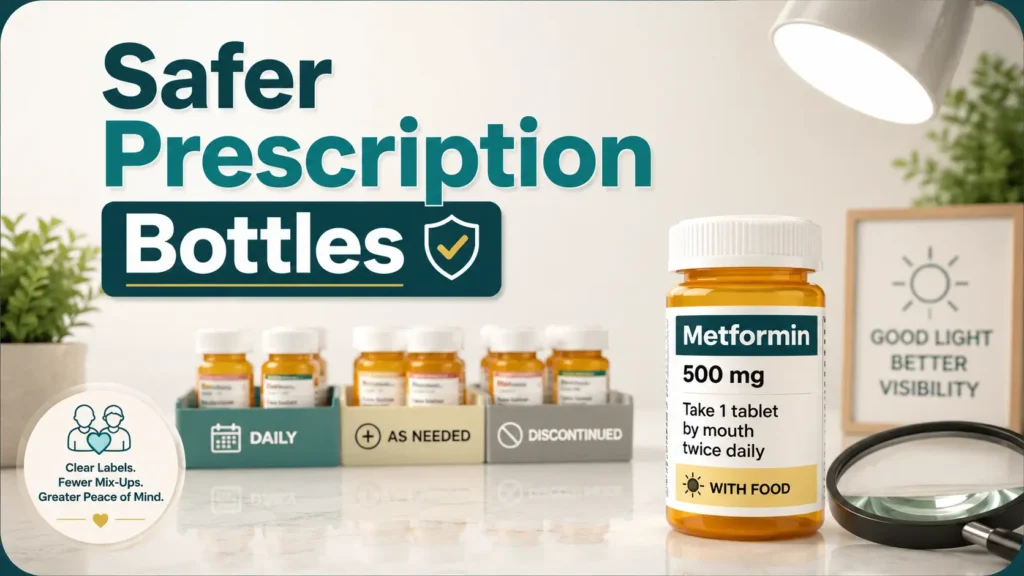
The safest home setup begins before any stickers, bins, or gadgets appear. It starts with accessible pharmacy labels, a verified medication list, one stable storage location, and clear separation between daily, as-needed, and discontinued prescriptions. Homemade cues can help, but they should behave like road signs, not replacement instructions.
This guide shows caregivers and older adults how to build a bottle-based system that remains readable after refills, understandable during fatigue, and easy to audit when something changes. The aim is not a photogenic medicine cabinet. The aim is fewer moments of hesitation and a clearer path to the correct bottle.
A good system reduces guessing before the cap ever turns. 🔎
Snapshot
Who it is for: U.S. seniors with low near vision and the family members who help them. What it solves: bottle mix-ups, label-reading strain, refill confusion, and unsafe storage drift. What you can do next: build a three-zone medication station, test five bottles, and have a pharmacist review the finished setup.
Table of Contents
Before You Act
This article offers a home-organization framework, not personalized medical advice or permission to change a prescription. Keep medicines in their original labeled containers unless a pharmacist or prescriber gives different instructions. Do not alter doses, timing, tablet splitting, storage conditions, or discontinued status based on this guide. When the label, medication list, pill appearance, or senior’s understanding does not match, pause and ask a pharmacist before the next dose.

Who This Bottle System Helps, and Who Needs More Support
A bottle-based system can work well for an older adult who can still recognize large print, strong contrast, fixed positions, or a small number of tactile markers. It is especially practical when prescriptions are stable and a caregiver can verify the setup after each refill.
Low near vision, however, rarely arrives alone. Arthritis may make caps hard to open. Hearing loss may make spoken instructions incomplete. Fatigue can shrink attention late in the day. Mild memory changes can turn a clever color code into a private language nobody quite remembers.
A practical fit for low near vision, not total guesswork
- The senior can identify at least two dependable cues, such as large text plus fixed position.
- The medication schedule is reasonably stable from week to week.
- The person understands what each current prescription is for.
- A family member, nurse, pharmacist, or other responsible helper can review changes.
- The senior can handle the bottle and cap safely, or an approved easy-open closure is available.
Signs independent bottle management may be unsafe
- Recent missed, repeated, or incorrect doses
- Frequent confusion about the day, time, medication name, or purpose
- Inability to recognize a medicine even with accessible labels
- Several dosing times, tapers, alternating schedules, or frequent prescription changes
- Tremor, weakness, numbness, or pain that makes bottle handling unreliable
- Two households, multiple caregivers, or several pharmacies with no shared medication list
Key takeaway: Independence is not measured by whether someone can open a bottle alone. It is measured by whether the correct medicine can be identified, verified, taken as directed, and recorded consistently.
The five-question readiness check
| Question | Safer sign | Warning sign |
|---|---|---|
| Can the senior name the medicine? | Reads or confirms the large-print name | Relies on bottle color or pill shape alone |
| Can the senior explain when it is taken? | Matches the verified schedule | Uses vague memory such as “the little white one at some point” |
| Can the senior find it without prompting? | Uses a stable position and secondary cue | Searches several bins or opens multiple bottles |
| Can the senior notice a refill change? | Stops and asks when packaging differs | Assumes every change is harmless |
| Can the senior recover after interruption? | Uses a written check-off method | Cannot tell whether a dose was already taken |
One warning sign does not automatically remove independence, but it does mean the system needs another safeguard. That may be a larger label, caregiver check-in, pharmacy-prepared packaging, an audible label, or supervised administration.
Start with the Pharmacy, Not the Kitchen Table
The pharmacy label is the primary source of truth on the bottle. Before adding tape, stickers, rubber bands, or handwritten notes, ask what accessible prescription-label options the pharmacy can provide. Availability varies, so the useful question is not “Do you have something for poor eyesight?” but “Which large-print, audible, Braille, high-contrast, or duplicate-label options can you provide for every refill?”
The U.S. Access Board describes accessible prescription information in audible, Braille, and large-print formats. A pharmacy may provide these directly, use a companion device or smartphone system, or offer another arrangement. Ask how the service works, whether it follows the prescription through automatic refills, and what happens if the medication is filled at another location.
Ask for accessibility options before adding homemade labels
- Large-print duplicate labels or enlarged auxiliary information
- High-contrast print with the most important directions easy to locate
- Audible labels that read prescription information aloud
- Braille labels for a person who reads Braille
- Easy-open caps when appropriate and when child-resistance needs have been considered
- Refill synchronization to reduce scattered pickup dates
- A note in the pharmacy profile describing accessibility needs
Use the low-vision pharmacy help script before calling or visiting. A prepared request prevents the conversation from dissolving into “bigger would be nice” and helps staff document the exact format needed.
Request plain-language directions that match the verified plan
Directions such as “take twice daily” can be difficult to translate into a home routine. Ask the pharmacist or prescriber whether the schedule can be expressed in specific, approved terms, such as morning and evening, and whether food, spacing, or bedtime requirements matter. Never invent times merely because they fit the bins.
A separate large-print medication schedule can list the familiar medicine name, strength, purpose, prescribed timing, and special directions. Keep it current and place a copy near the medication station, not hidden in a paperwork drawer three rooms away.
Build a pharmacy profile that survives refills
Ask pharmacy staff to document the senior’s preferred label format, cap type, language, counseling needs, and contact person. Confirm whether the note appears automatically on new prescriptions, transferred prescriptions, and mail-order fills. A system is only dependable when the next bottle arrives speaking the same visual language as the last one.

The One-Location Rule That Prevents Bottle Drift
Prescription bottles tend to wander. One remains near the breakfast mug, another follows a purse, and a third sits beside the recliner because it was taken during a television program. By Friday, the “system” has become a small archaeological dig.
Choose one primary medication station for routine bottles. Travel doses or bedside medicines may require a separate approved plan, but casual migration should not be the default. A fixed home makes absence visible and reduces the chance that an old refill and a new refill will sit side by side.
Choose a dry, well-lit medication station
- Away from shower steam, sinks, stoves, radiators, and direct sun
- Out of reach of children, visitors, and pets
- Stable enough that bottles will not be knocked behind appliances
- Close to the senior’s normal routine without blocking a walkway
- Brightly and evenly lit, with glare controlled
- Large enough for separate zones without stacking bottles
Storage directions vary by medicine. Some prescriptions need refrigeration or special protection from light or moisture. Follow the pharmacy label and pharmacist’s instructions rather than forcing every medicine into one room for aesthetic consistency.
Give every bottle a permanent parking space
A shallow divided tray, drawer organizer, or set of open-front bins usually works better than a deep basket. The senior should be able to see or feel each position without moving six other bottles. Leave a small gap between groups, and avoid storing bottles in two rows where the back row disappears.
Position can be a strong secondary cue: first slot for the morning blood-pressure medicine, second slot for another verified morning prescription, and a physically separate area for bedtime. Position must never replace reading or checking the label, but it can reduce the search field.
Why the bathroom cabinet is often the wrong default
Bathrooms often combine humidity, uneven lighting, mirrored glare, and an impressive collection of similar-looking containers. Toothpaste, skin cream, supplements, and prescriptions may share one shelf. That is neatness with crossed wires.
A hallway cabinet, bedroom drawer, or kitchen-adjacent station may be safer if it meets the medicine’s storage requirements and household safety needs. The best location is the place where the senior can consistently identify, reach, verify, and return each bottle.
Short Story: The Bottle That Kept Moving
Elaine’s father insisted he kept his prescriptions “right where they belong.” He was not wrong. The trouble was that “where they belong” changed with the hour.
His morning bottle lived beside the toaster until breakfast ended. Then it moved to a jacket pocket for errands. At night, it sometimes appeared on the bathroom shelf next to an older refill. Each location made sense in the moment, but the trail left no clear answer when Elaine asked whether the dose had been taken.
They replaced the wandering routine with one divided tray near the breakfast area, a large-print check-off sheet, and a small travel plan approved by the pharmacist. The improvement was not dramatic furniture or expensive technology. It was the quiet relief of finding the same bottle in the same place every morning.
The lesson was simple: convenience changes minute by minute. Safety needs an address.
Organize by Dosing Moment, Not Bottle Size
Alphabetical order is tidy, and sorting by bottle height creates a pleasing skyline. Neither necessarily matches how the senior takes medicine. The home system should follow the verified dosing routine while preserving clear identification of every bottle.
Create pharmacist-verified dosing zones
Use morning, midday, evening, and bedtime zones only when those categories match the prescribed directions. Some medicines must be separated from food, supplements, antacids, or other prescriptions. Others may be taken at a particular interval. Ask before translating instructions into household categories.
- Write the current medication list from pharmacy and prescriber information.
- Ask a pharmacist to confirm each medicine’s timing and special directions.
- Place only verified current bottles into the matching physical zones.
- Add a large-print schedule beside the station.
- Test whether the senior can locate and name each bottle without hints.
Separate scheduled and as-needed medicines
An as-needed medicine can be dangerous when it looks like part of the daily sequence. Give it a separate bin or drawer section labeled in large print with its purpose, dose limit, and pharmacist-approved precautions. Include it on the medication list, but do not let it visually blend into the morning or evening row.
This separation matters for pain, nausea, allergy, sleep, anxiety, constipation, and other occasional-use prescriptions. “Not every day” does not mean “not important.” It means the decision to take it may require an extra check.
Keep the schedule attached to the routine
A medication schedule should be readable from the senior’s normal seated or standing position. Include the medication name, strength, purpose, timing, and special notes. Leave room to record a refill change or pharmacist clarification, but do not overwrite old information until the current plan has been confirmed.
The safer bottle workflow
Build Labels, Color, and Tactile Cues That Work Together
Secondary cues are useful when they narrow the search and support the pharmacy label. They become risky when they act as a private code that authorizes a dose without checking the medicine name and directions.
Put the medicine name first and make it unmistakable
A supplemental large-print label should emphasize the familiar medicine name and, when needed, the strength. Use high contrast, plain type, generous spacing, and a matte surface that does not throw glare into the reader’s eyes. Place the added label in the same approved location on every bottle.
Never cover the prescription number, patient name, original directions, warnings, expiration information, pharmacy details, barcode, or other required information. The guide on what to do when medication labels are too small for seniors explains how to ask for a safer pharmacy-based solution before improvising.
Use color as reinforcement, never as the only identifier
Color can help a person scan the station, but color perception may change with eye disease, lighting, glare, and contrast. Stickers fade. Similar shades merge. A red dot may mean “morning” to one person and “danger” to another.
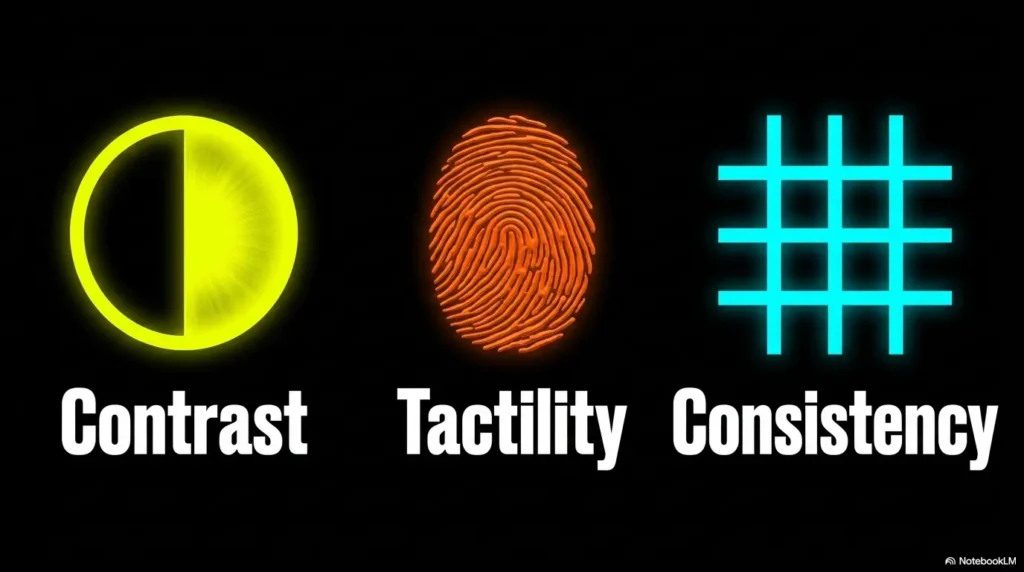
Pair color with a second cue: large text, a simple symbol, a tactile marker, or a fixed position. Keep the color vocabulary small. Three clearly different colors are usually easier to learn than eight nuanced shades with ambitious job descriptions.
Keep tactile cues simple enough to remember
Raised dots, textured tape, or bands can identify a dosing group or help distinguish two look-alike bottles. A practical system might use one raised dot for morning, two for evening, and no tactile marker for the as-needed zone because that zone is physically separate.
Do not assign a unique texture to every prescription unless the senior can reliably learn and retain the code. Review safe tactile label placement on pill bottles so markers do not cover instructions, interfere with cap operation, or migrate between bottles.
Test at the senior’s normal reading distance
Do not test labels under a bright craft lamp while holding the bottle three inches from a caregiver’s eyes. Ask the senior to sit or stand where medicines are normally handled, use usual glasses or a magnifier, and read the label under ordinary lighting.
- Can the medicine name be found within a few seconds?
- Is the print readable without rotating the bottle repeatedly?
- Does glare obscure part of the text?
- Can the senior distinguish similar names and strengths?
- Can the person use the cue after a short interruption?
- Does the cue still make sense when the bottle is returned to the tray?
Key takeaway: A secondary cue should answer “Which bottle should I inspect?” It should never answer “Take this without checking.”
Show me the nerdy details
A robust identification system uses redundant cues. In plain English, the same decision is supported in more than one way. The bottle’s original label provides the formal prescription information. Large print improves visual access. Fixed position narrows the search. A tactile marker supports identification when print is difficult. The medication list provides a separate cross-check. If any one cue fails, the others can expose the mismatch. The system becomes weaker when several cues depend on the same fragile assumption, such as color alone under poor lighting.
Current, As-Needed, and Discontinued: Three Zones That Must Never Merge
The most important organizing decision may be what does not remain in the daily-use area. Old prescriptions, duplicate refill bottles, and occasional medicines can turn a clear station into a hall of mirrors.
Keep current daily prescriptions in the primary zone
Only bottles confirmed on the current medication list should occupy the main routine area. Include prescription medicines, and make sure the separate medication list also captures over-the-counter drugs, vitamins, and supplements that health professionals need to know about.
A one-page medication list template can make review easier during appointments, pharmacy calls, and emergencies. Keep the version date visible so an old list does not masquerade as the current one.
Move as-needed medicines into a marked secondary zone
Use a clearly labeled area with enough room to keep bottles separate. The accessible medication list should state why the medicine is used, the prescribed amount, the maximum permitted use, and any instructions about food, driving, alcohol, or combining it with other medicines. Ask a pharmacist to review the wording.
Quarantine refills and stopped bottles
A new refill should wait in a temporary verification area until it has been compared with the medication list and given the same accessible cues as the active bottle. A discontinued bottle should leave the active station promptly after the change is confirmed.
Do not keep a stopped prescription nearby “just in case.” Use a drug take-back option when available, following current FDA guidance and any specific disposal instructions from the pharmacist or prescriber. Protect personal information on empty packaging before disposal.
Good, Better, Best Medication-Organization Options
The best medication-organization system for a senior with low near vision is not automatically the most expensive. A low-cost tray and pharmacy-provided large-print labels may be enough for a person with stable prescriptions and reliable cognition. A more complex schedule may justify audible labels, synchronized refills, pharmacy packaging, home health support, or another professional service.
| Setup level | What it may include | Best fit | What to verify before paying |
|---|---|---|---|
| Good: Simple DIY support | Divided tray, strong lighting, pharmacy large-print labels, large-print schedule, a few tactile markers | Stable medicines, good memory, reliable self-checking | Markers do not cover labels; storage meets pharmacy instructions; senior passes the five-bottle test |
| Better: Accessible pharmacy system | Audible or Braille labels, duplicate large-print information, refill synchronization, documented accessibility profile | Print remains hard to read or refills create repeated confusion | Which locations support it, whether it applies to every refill, device or phone requirements, fees if any |
| Best: Managed medication support | Pharmacy-prepared adherence packaging when appropriate, automatic dispensing support, caregiver administration, nursing or occupational therapy input | Complex schedules, cognitive change, repeated errors, poor dexterity, frequent medication changes | Who fills and verifies it, how changes are handled, backup plan, training, ongoing cost, emergency access |
When a free or low-cost DIY setup may be enough
Choose the simpler route when the senior can read or reliably access the medicine name, understands the schedule, handles bottles safely, and has few medication changes. Spend first on the basics: good lighting, an uncluttered tray, large print, a current list, and time with the pharmacist.
When paid tools or services may be worth considering
Consider additional support when label reading remains unreliable, several caregivers share responsibility, doses are missed after interruptions, or the schedule includes multiple daily times. Paid technology should reduce a specific failure, not merely add beeps, apps, and charging cables to an already crowded routine.
Questions to ask before buying a medication tool
- Does it identify the medication, or only remind the user that some medication is due?
- Can the senior operate it with current vision, hearing, and dexterity?
- What happens during a power, battery, internet, or phone failure?
- How are prescription changes entered and verified?
- Can more than one caregiver see the same information without creating duplicate records?
- Does the service work with the senior’s pharmacy and insurance arrangement?
- What is the full ongoing cost, including supplies, subscriptions, delivery, or replacement parts?
- Is there a return period or trial that allows a realistic home test?
For magnification, lighting, audio, and tactile options beyond the medication station, compare practical low-vision tools for seniors by the task they solve. A tool earns its place when the senior uses it correctly on an ordinary Tuesday, not only during a polished demonstration.
Key takeaway: Buy support for the failure you can name. If the problem is unreadable labels, a reminder alarm alone is not the answer.
The Refill-Day Reset Most Families Forget
A system can work perfectly for thirty days and fail in thirty seconds when a new bottle enters the station. The label layout may change. The cap may be different. The pill may come from another manufacturer. The refill may overlap with tablets remaining in the old bottle.
Compare every new bottle with the current list
- Confirm the patient name.
- Match the medicine name and strength.
- Compare the directions and intended purpose.
- Check the prescriber and pharmacy information.
- Review warnings and storage instructions.
- Notice the pill’s appearance without using appearance as the sole identifier.
- Ask how to handle tablets remaining in the older bottle.
- Update the medication list and review date when needed.
Expect packaging and pill changes, but verify surprises
A different bottle, label arrangement, tablet color, or pill shape does not automatically mean the prescription is wrong. It does mean the senior should stop and verify the change rather than relying on memory. Unexpected differences deserve a pharmacist call before the medicine joins the active station.
This is especially important with similar-looking pills, where appearance can create false confidence. Names, strengths, directions, and pharmacy confirmation matter more than the familiar silhouette of a tablet.
Rebuild accessibility cues before the refill enters circulation
Add the approved large-print label, tactile marker, colored reinforcement, or fixed-position assignment before the new bottle enters the daily zone. Do not leave an unmarked refill beside an active bottle with the promise that someone will “fix it later.” Later is where duplicate bottles develop excellent camouflage.
Record who verified the refill and when
| Date | Medication | What changed | Verified with | Initials |
|---|---|---|---|---|
| YYYY-MM-DD | Name and strength | New label, pill appearance, directions, or no change | Pharmacist, prescriber, or current list | Caregiver or senior |
Key takeaway: A refill is not routine until it has been identified, compared, relabeled for accessibility, and placed in the correct zone.
Common Mistakes That Make a Neat System Dangerous
Some medication setups photograph beautifully and perform badly. The following mistakes remove safeguards, blur current and old information, or ask memory to carry too much weight.
| Common mistake | Why it is risky | Safer alternative |
|---|---|---|
| Pouring several prescriptions into one bottle | Removes identification and complicates emergencies, refills, travel, and poison-control calls | Keep each prescription in its original labeled container unless a qualified professional provides another plan |
| Covering the pharmacy label | Hides directions, warnings, prescription details, or expiration information | Place supplemental labels in a consistent open area approved by the pharmacist |
| Using cap color or bottle shape as the identifier | Packaging may change between refills | Confirm the printed or audible medicine name and strength |
| Leaving a refill beside an unfinished bottle | Creates a duplicate-dose risk | Use a temporary verification zone and ask how to handle remaining tablets |
| Keeping discontinued medicines nearby | Stopped prescriptions can reenter the routine by mistake | Remove them from the active station and use approved disposal guidance |
| Reorganizing without the senior present | Breaks learned spatial cues and ownership of the routine | Build and test the system together |
| Adding too many colors, symbols, and textures | Creates another code that must be remembered | Use a few redundant cues with plain meanings |
Do not transfer medicines casually
Moving prescriptions into decorative jars, unlabeled cups, or mixed containers removes important information. Even a pill organizer should be used only as part of a verified plan, with a dependable filling process and a way to identify every medicine if a question arises.
Do not build the system around memory
“I know this one” is not a durable label. Manufacturers, pharmacies, strengths, and instructions can change. The system should make the correct choice visible and checkable even when the senior is tired, interrupted, or wearing the wrong pair of glasses.
Do not ignore the rest of the medication picture
Prescription bottles are only part of the story. Over-the-counter medicines, vitamins, supplements, eye drops, inhalers, creams, injections, and medicines stored in the refrigerator may interact with the routine. Review the broader risks described in polypharmacy and vision problems, and keep all current products on the shared list.
When to Get Help Before the Next Dose
Organization should reduce uncertainty, not conceal it. When something does not match, stopping to verify is a successful use of the system.
Contact the pharmacist promptly for mismatches
- The pill appearance changes unexpectedly.
- The label directions differ from the current medication list.
- Two bottles appear to contain the same prescription or strength.
- The senior cannot confidently identify a medicine.
- The label is blurred, torn, partly missing, or covered.
- A new prescription does not fit the existing dosing zones.
- The senior has trouble opening the cap or handling the bottle.
- A medicine was left in heat, moisture, freezing conditions, or another questionable environment.
Get urgent guidance after a possible dosing error
If the senior may have taken the wrong medicine, repeated a dose, taken too much, or developed unusual symptoms after a prescription, seek professional guidance promptly. In the United States, Poison Control offers free, confidential help online and by phone. Do not wait for symptoms to become dramatic before asking what to do.
Call emergency services for severe warning signs
Call 911 for collapse, seizure, trouble breathing, inability to awaken the person, loss of consciousness, or other rapidly worsening symptoms. Bring the medication bottles and current medication list if it is safe to do so, because clear identification can help responders.
Key takeaway: A possible medication error is not the time to tidy the evidence. Keep the bottles, note what may have been taken and when, and contact the appropriate professional promptly.
Frequently Asked Questions
Should prescription bottles be alphabetized?
Alphabetical order can help with a large collection, but it often does not match the dosing routine. For many seniors with low near vision, pharmacist-verified morning, midday, evening, and bedtime zones are easier to use. Keep as-needed medicines separate and make sure every bottle remains clearly identifiable.
Can I put large labels on pill bottles?
A supplemental large-print label may help, but it must not cover the original pharmacy label, warnings, barcode, prescription number, expiration information, or cap mechanism. Ask the pharmacy for accessible labels first and have staff review where any secondary label should be placed.
Is color coding safe for seniors with poor vision?
Color can reinforce a system, but it should not be the only identifier. Pair color with large text, a tactile cue, a symbol, or a fixed location. Test the colors under the lighting the senior actually uses, and limit the number of meanings.
Where should seniors store prescription bottles?
Use a dry, stable, well-lit place away from heat, moisture, direct sunlight, children, and pets, while following each medicine’s storage directions. The bathroom is often a poor choice because of humidity, glare, and clutter. Some medicines require refrigeration or special storage.
What about weekly pill organizers?
A weekly organizer may help some people, but it creates a new filling and verification task. It is not a cure for unreadable labels or confusion about what each medicine is. Ask a pharmacist whether the medicines are suitable for the proposed organizer and who should fill and check it.
How often should the bottle system be reviewed?
Review it after every new prescription, refill, dose change, hospital visit, emergency-department visit, specialist appointment, or change in the senior’s vision, memory, hearing, or dexterity. A brief monthly audit is also useful even when nothing obvious has changed.
Run a Five-Bottle Safety Test in 15 Minutes
You do not need to reorganize the entire medicine cabinet tonight. Start with the five bottles used most often. Place them in the proposed station, add only the verified cues, and ask the senior to complete the following test without coaching.
- Locate each medicine when given its name.
- Read or access the name and strength.
- State the prescribed dosing period using the current schedule.
- Return the bottle to its permanent position.
- Explain what to do if the bottle, label, or pill looks different after a refill.
Watch the pauses. A hesitation is useful information. Note unreadable text, confusing colors, bottles that swap places, glare, difficult caps, and any point where the senior guesses. Correct the system, then repeat the test on another day.
Finally, take the medication list, photographs of the setup, or the physical bottles to the pharmacist. Ask whether labels remain visible, dosing zones match the current prescriptions, storage is appropriate, and the added cues could be misunderstood. The strongest system is not the one with the most labels. It is the one that still makes sense after the lights dim, the phone rings, and refill day changes the bottle.
Your 15-minute next step
Choose five bottles, create three clear zones, and run the test with the senior today. Write down every hesitation rather than correcting it in the moment. That small pause is where tomorrow’s safer system begins.
Last reviewed: 2026-09