
Organize your questions and next steps, then save your worksheet.
Summary and next steps
Preservative-free describes a formulation, not a guarantee against contamination or irritation. Compare the actual label and package with a pharmacist.
- Confirm that the product is an appropriate lubricant for your situation.
- Try opening, aiming and closing the package without touching the tip.
- Follow that product’s storage and discard instructions.
Editorial maintenance: October 24, 2026. Summary layout, related links and technical metadata updated. This is not a full clinical review.
Preservative-free artificial tears may suit frequent users or people sensitive to preservatives, but they are not automatically safer for every senior. The right choice also depends on the cause of symptoms, the product label and whether you can open, aim, squeeze and close the container without touching the tip.
This US-focused guide covers OTC lubricating drops, not prescription glaucoma, antibiotic or post-surgical medicines. Educational information; source review October 15, 2026.
When should you consider preservative-free drops?
Preservatives help protect many multi-dose drops against microbial contamination. Some people find preserved artificial tears irritating, especially with frequent use. Preservative-free means the product lacks preservatives; it does not promise freedom from allergy, stinging, contamination or a recall.
The Mayo Clinic guidance on artificial tears says preservative-free options are generally recommended when tears are used more than four times daily, or for moderate to very dry eyes. Treat frequent dosing as a reason to ask about your formulation and symptoms, not a universal prescription for everyone to use a particular drop or dose.
Read “lubricant eye drops” or “artificial tears” on the label. Redness-relief products and contact-lens rewetting solutions are not interchangeable with every dry-eye treatment. Do not replace or stop a prescribed medicine because an OTC bottle says preservative-free. If similar containers are causing confusion, see our guide to keeping prescribed eye drops and artificial tears clearly identified.
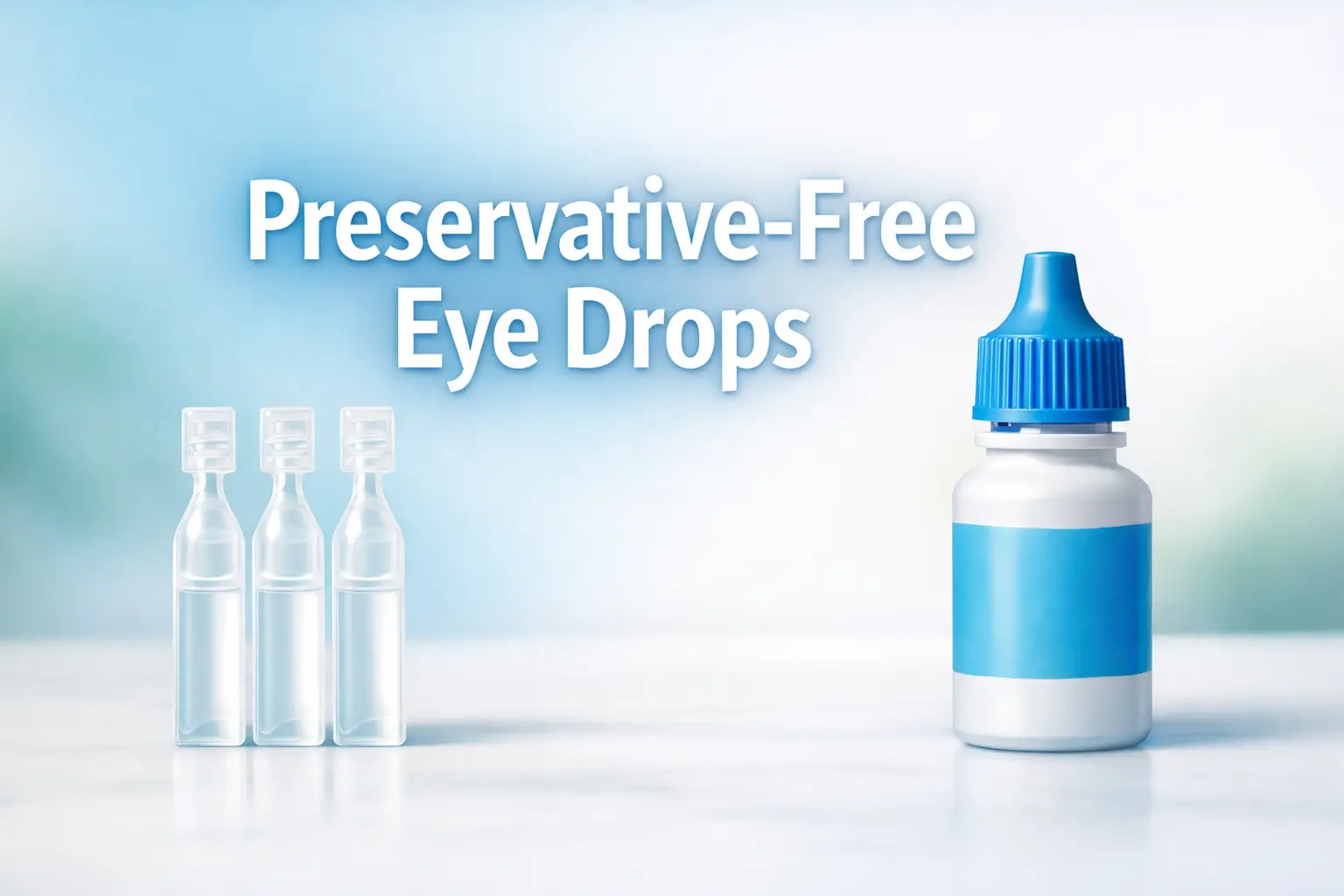
Single-use vial or preservative-free multi-dose bottle?
- Single-use vial: check that you can twist it open and direct the tip safely. If labelled single use, discard after use even when liquid remains; do not recap it for another session. Follow the exact package directions.
- Preservative-free multi-dose bottle: follow its own opening, priming, squeezing, recapping and discard instructions. A special container does not make the tip immune to contamination.
- Preserved bottle: may be tolerated for occasional use. Ask a pharmacist or eye clinician if it stings, you need repeated doses, or you use several eye medicines.
There is no reliable handling winner for every older adult. Bring the package to a pharmacist and ask for a demonstration. If arthritis, tremor or reduced vision makes aiming difficult, ask whether a compatible aid or a caregiver would help. Do not decant drops into another bottle or enlarge the opening.
Use the label to set hygiene and discard rules
The FDA’s eye-drop safety advice stresses handwashing and avoiding contact between the tip and eyes, fingers, clothes or other surfaces. Do not share a container. Check the seal, expiry date and current recall information for the exact product and lot.
Write the opening date on a multi-dose bottle if its instructions specify a period after opening. Do not assume every bottle lasts 28 or 90 days. Follow the earlier applicable limit on its label. If the tip touches a surface or you are unsure whether a container is contaminated, ask a pharmacist about replacement rather than trying to sterilise it yourself.
For contact lenses, follow the specific drop and lens instructions; “preservative-free” does not establish compatibility. With several eye medicines, ask the prescriber or pharmacist about order and spacing. After surgery, follow the surgeon’s regimen.
What about gels and ointments?
Thicker lubricating gels and ointments can temporarily blur vision. Some people prefer ointment near bedtime, but the label and your care plan should determine use. Do not drive or do tasks requiring clear vision while your sight is blurred. New or persistent changes in vision should be assessed rather than assumed to be a normal product effect.
Compare usable doses, not the size of the bottle
Handling and mandatory discarding affect cost. Hypothetical example: a $15 box containing 30 single-use vials costs $0.50 per vial. If the product instructions and your care plan require opening three vials daily, the cost is $1.50 a day. This is an invented calculation, not a recommended dose or a product price.
For a bottle, estimate the amount you can actually use before its discard date. Do not assume a fixed number of drops per millilitre or reuse single-use leftovers to make the calculation cheaper. Ask the pharmacist to compare suitable packages if waste or grip strength is a problem.
Do not use a seven-day trial to decide whether care is needed
Keep a short record of the product, dose times, discomfort, blurred vision and handling difficulties. It can help your clinician; it does not diagnose dry eye or prove the drops are safe.
Follow the exact product’s stop-use warnings. For example, an artificial-tear label on DailyMed directs users to stop and ask a doctor for pain, vision changes, continued redness or irritation, or symptoms that worsen or persist beyond 72 hours. This example is a preserved product, included to illustrate a warning, not to recommend it. Do not wait 72 hours when symptoms already require urgent care.
The NIH explains that treatment depends on the cause. Persistent symptoms may need an examination rather than another bottle. Before your next purchase, take your current drops and medicine list to a pharmacist or eye professional and resolve the packaging, dosing and follow-up questions together.
PUT THIS GUIDE TO WORK · INTERACTIVE WORKSHEET
Compare two confirmed eye-drop supply quotes
Use this worksheet alongside the article: Preservative-Free Eye Drops for Seniors: Vials vs Bottles. Use the fields provided to organize your notes and next actions, then save your worksheet.
Your entries stay in this page and are cleared when you reload. No account is needed. Saved files are downloaded only to your device.
Formula: patient package price × verified packages + other charges. Prices should already reflect confirmed benefits; do not subtract them again. Package size, formulation, usability, suitability, label handling, discard rules, and sterility remain separate questions. Do not reduce prescribed care or extend a product’s use to lower the displayed cost.
How to use your result
Save the worksheet before leaving this page. Recheck any quote, date, or instruction with the relevant provider, pharmacist, manufacturer, or official organization. A completed checklist means you recorded the steps, not that an outcome is guaranteed.
Worksheet added October 20, 2026. Read the article above for context and its stated review scope.