

Organize your questions and next steps, then save your worksheet.
Summary and next steps
Check both the printed expiration date and the opening limit for your exact product. Keep the opening record readable, and ask the pharmacist about unclear dates, storage problems or a replacement supply.
- I have matched the instructions to the exact product and container.
- I have recorded the opening day and the applicable discard deadline without covering the original label.
- I know whom to contact if the date, storage history or replacement supply is uncertain.
Editorial maintenance: October 24, 2026. Summary layout, related links and technical metadata updated. This is not a full clinical review.
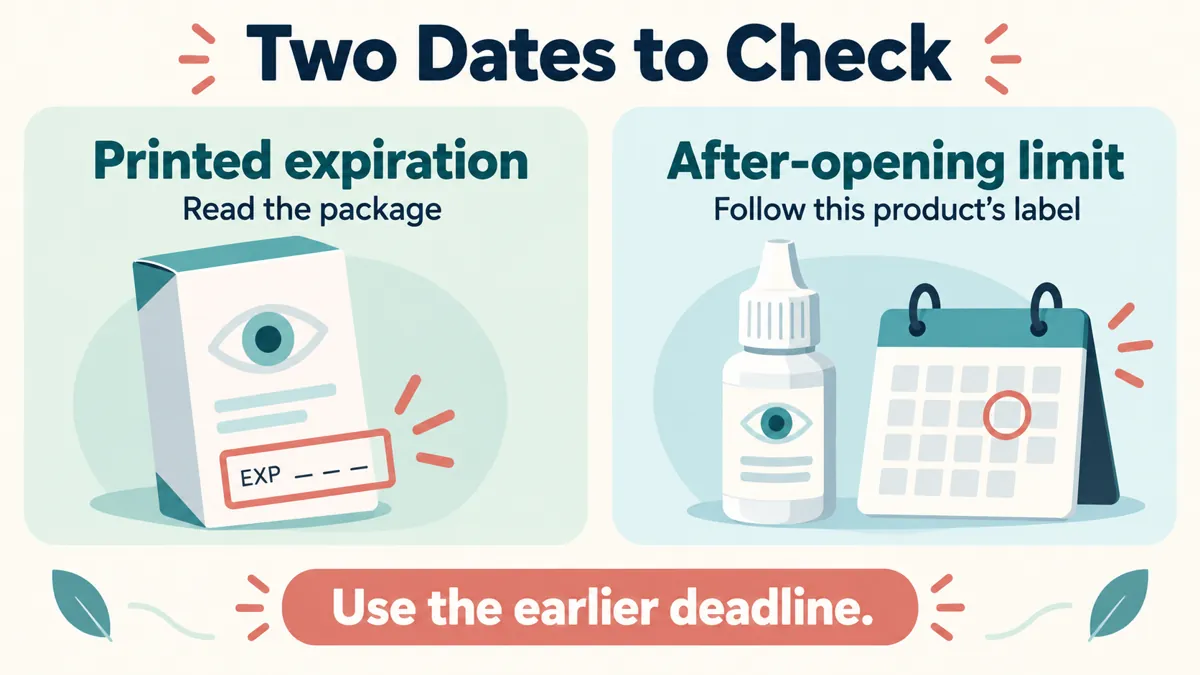
Eye drop expiration involves two checks: the printed expiration date and any product-specific deadline after opening. Use the earlier applicable deadline. Do not assume that every bottle lasts 28 days, 90 days, or until it looks empty. The instructions for your exact product and container matter.
A bottle found in a bedside drawer can raise an awkward question: “Is this still safe?” This guide helps older adults and caregivers read the dates, record the opening day, and decide when to ask a pharmacist for help. It covers date checking rather than choosing a treatment or changing a prescribed dose.
Sources checked October 9, 2026. This is general educational information based on official guidance and manufacturer instructions, not a hands-on product test or individualized medical advice.
Table of Contents
What eye drop expiration dates actually mean
The printed expiration date describes the period supported by the manufacturer’s stability data when a medicine is stored under its labeled conditions. FDA advises against using expired medicines. An intact seal does not turn an expired product into a current one. See the FDA explanation of medicine expiration dates.
Opening a container may introduce a separate limit. That limit depends on the formulation, packaging, and product instructions. “Preservative-free” does not tell you the entire story: a single-use vial and a specially designed multi-dose bottle can have different rules.
For example, the U.S. instructions for Systane PRO preservative-free multi-dose drops say to discard the bottle 90 days after opening. By contrast, Systane Original preservative-free single-use vials are not to be reused once opened. These are examples of different container instructions, not recommendations to buy either product. Check your own package, including the country-specific labeling.
7 eye drop expiration checks before the next dose
1. Identify the exact product and container
Start with the full name on the bottle and carton. Note whether it is a prescription medicine, an over-the-counter lubricant, a single-use vial, or a multi-dose bottle. Two products from the same brand can have different directions. A cap color or familiar-looking box is not enough to identify the instructions.
If you cannot read the label, take the actual bottle to the pharmacy or ask a trusted helper to read it with you. Keep the carton or leaflet while the bottle is in use so that you can return to the original instructions.
2. Read the printed expiration date
Look for the expiration marking on the bottle, vial, carton, or pouch. Keep the lot number separate from the date; it may be needed to check a recall. If the printing is smudged or the date format is unclear, ask the pharmacist rather than guessing.
An unopened spare belongs in your date check too. Arrange supplies so you can see which current package should be used first, and avoid opening several backup bottles simply to make them easier to reach.
3. Find the after-opening rule
Look for wording such as “discard after opening,” “use within,” or “single use.” Do not transfer a rule from another bottle. If the package provides no clear opening limit, ask the pharmacist or manufacturer whether one applies to that exact product.
A compounded preparation may carry a pharmacy-assigned beyond-use date and special storage directions. Bring those directions to the conversation. A generic internet chart should not replace the dispensing pharmacy’s instructions.
4. Record the opening day and discard deadline
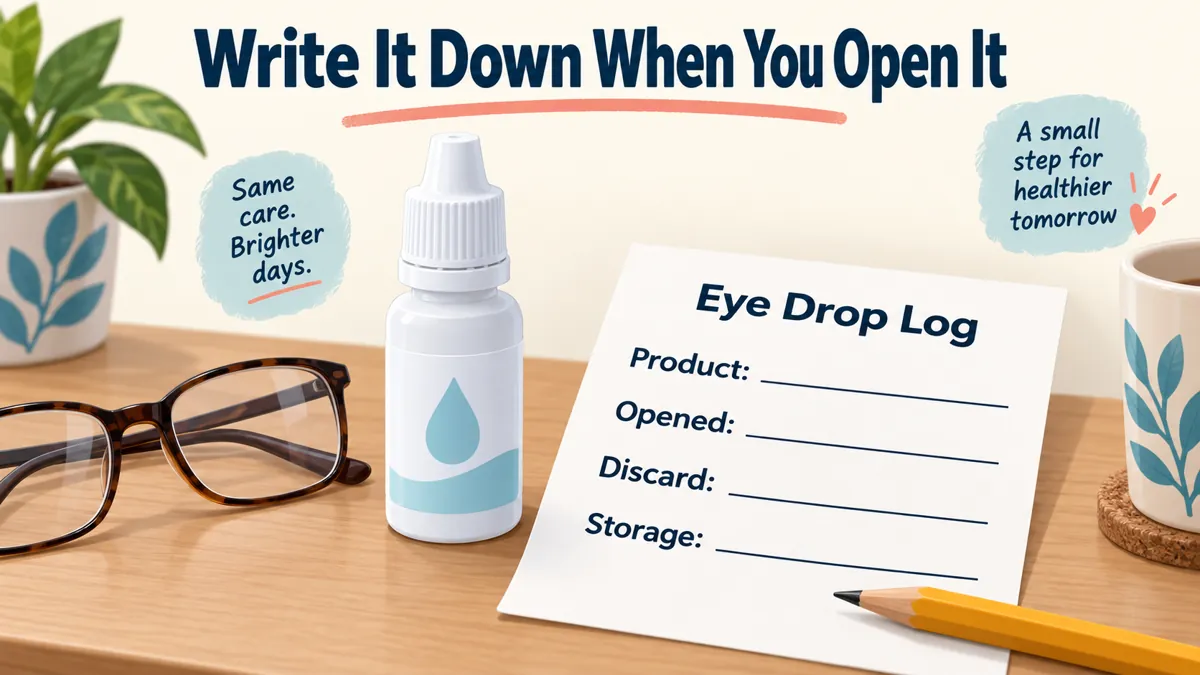
Write down the opening date immediately, then calculate the deadline using the verified instructions. A separate large-print card can be easier to read than a tiny sticker. Use clear month names, such as “October 9, 2026,” when numeric dates could be confused.
Suggested record: Product and strength / opened on / printed expiration / after-opening deadline / storage instructions / pharmacist contact. Add the final discard date after the pharmacist confirms any ambiguity. Do not cover the original name, directions, expiration marking, or lot number.
If the opening date is unknown, do not invent an approximate date to justify another week of use. Ask the pharmacist about replacement. For prescribed drops, arrange the next supply promptly so uncertainty about an old bottle does not turn into a missed-treatment problem.
5. Check storage against the label
Confirm whether your product requires room-temperature storage, refrigeration, protection from light, or a change in storage after opening. Refrigerating a bottle does not automatically extend its permitted life. If it sat in a hot car or froze, tell the pharmacist what happened before using it again.
Keep the record with the product during travel and caregiver handovers. For help arranging several current bottles, see our eye drop storage guide for seniors. The organizer should make the actual label easier to follow.
6. Inspect the container and handling history
FDA explains that eye medicines must be sterile. Wash your hands before use and keep the tip from touching your eye, fingers, or other surfaces. Do not share drops. A bottle within its date can still be unsuitable if its seal is damaged or it may be contaminated. Review the FDA eye drop safety guidance.
Follow the label’s warnings about changes in appearance. Clear-looking liquid is not proof that a bottle is sterile. If something has changed or the tip may have touched a surface, pause use of that bottle and contact the pharmacist for replacement advice; do not try to disinfect or refill it yourself.
7. Check recalls and your symptoms
Check FDA notices using the product name and lot information, and follow any recall instructions. A recall can apply before the expiration date. Do not assume a date check alone establishes safety.
Seek urgent eye care for significant eye pain, sudden vision changes, marked redness, or new light sensitivity. The American Academy of Ophthalmology identifies these as reasons for immediate assessment rather than assuming ordinary irritation. Bring the bottle and packaging if available.
A simple routine for seniors and caregivers
Choose one person to update the opening record, while keeping the patient involved. Read the product name aloud, confirm the opening date together, and put the next discard reminder on a calendar. Review the record whenever a refill, new prescription, or container change arrives.
Use a bold dark pen on a plain light card and place it where the person actually handles the drops. A reminder should say which bottle needs replacement, not just “throw drops away.” This makes the task understandable to a substitute caregiver and reduces reliance on memory.
Frequently asked questions
Do all eye drops expire 28 days after opening?
No. There is no single after-opening period that you can safely apply to every eye drop. Follow the exact product’s instructions and ask the pharmacist when the wording is unclear.
Can I save leftover drops from a single-use vial?
Follow the vial’s single-use instructions. The manufacturer example above says not to reuse an opened vial. Having liquid left over does not change that instruction. Do not apply a multi-dose bottle’s deadline to a single-use container.
What if my prescription bottle must be replaced before a refill is due?
Contact your pharmacist and prescribing eye clinic promptly. Explain the product, why the bottle may be unsuitable, and when the next dose is due. Ask about a replacement supply and next-dose instructions. Do not substitute a different medicine or double a dose on your own.
Sources and review date
Official sources reviewed October 9, 2026: FDA medicine expiration questions and answers; FDA eye drop safety guidance; Alcon’s U.S. Systane PRO and Original preservative-free product instructions; American Academy of Ophthalmology guidance on eye symptoms. Links appear beside the relevant statements above. Product labels and directions can change, so verify the instructions on your current package.
PUT THIS GUIDE TO WORK · INTERACTIVE WORKSHEET
Eye-drop label date planner
Use this worksheet alongside the article: Eye Drop Expiration: 7 Safety Checks After Opening. Use the fields provided to organize your notes and next actions, then save your worksheet.
Your entries stay in this page and are cleared when you reload. No account is needed. Saved files are downloaded only to your device.
FDA eye-drop safety information
How to use your result
Save the worksheet before leaving this page. Recheck any quote, date, or instruction with the relevant provider, pharmacist, manufacturer, or official organization. A completed checklist means you recorded the steps, not that an outcome is guaranteed.
Worksheet added October 20, 2026. Read the article above for context and its stated review scope.