
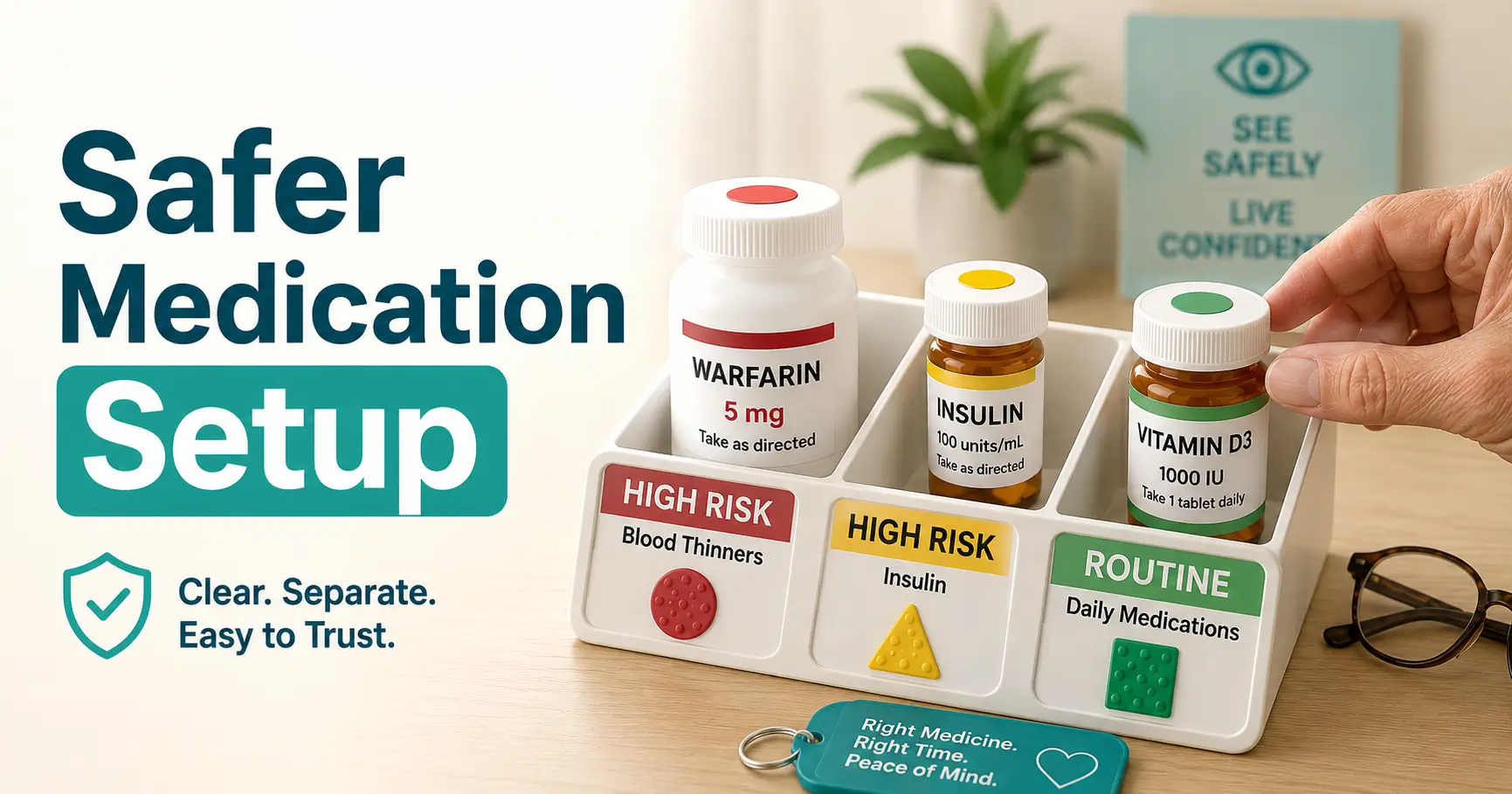

Low-Vision Medication Safety
How to Separate High-Risk Medications
Without Creating a More Confusing System
A crowded medicine shelf can look harmless until two nearly identical bottles are standing shoulder to shoulder. For an older adult with low vision, the problem is rarely carelessness. It is a design problem: small print, glare, similar packaging, changing instructions, and too many decisions compressed into one daily moment.
The safer answer is not to cover every bottle with bright stickers or pour every tablet into a weekly box. A useful system preserves the pharmacy label, separates meaningful risks, and gives the user more than one reliable way to identify each medicine.
This guide shows how to build that system with ordinary storage tools, accessible labeling, a one-minute verification routine, and pharmacist support. It also explains when a simple home setup is enough and when supervised packaging or medication-management services may be worth considering.
Reduce bottle mix-ups
Separate medicines by both potential harm and identification difficulty.
Keep labels usable
Add accessible cues without hiding drug names, strengths, or directions.
Know when to escalate
Recognize when pharmacy packaging, a dispenser, or caregiver control is safer.
The goal is not a prettier cabinet. It is one correct decision at a time. 🧭
Snapshot
This guide is for older adults with low vision, family caregivers, and home-health aides who need to reduce wrong-drug, wrong-strength, wrong-route, missed-dose, and duplicate-dose errors. By the end, you will have a practical storage map, an identification method, a verification routine, and a list of questions to take to the pharmacist.
Table of Contents
Before You Rearrange Anything
Safety and medication disclaimer
This article provides general organization and accessibility guidance. It cannot determine which medication is high risk for a particular person or whether a medicine can safely be repackaged, split, stopped, combined, refrigerated, or taken at a different time. Confirm those decisions with a pharmacist or prescribing clinician. Storage directions and the consequences of a missed or duplicate dose vary by medicine.
Preserve the current routine first
Do not begin by emptying every cabinet onto the kitchen table and inventing a new system in one afternoon. That can separate medicines from the information, routines, and locations the user currently recognizes.
Photograph the existing setup before moving anything. Record where each medicine is kept, who uses it, whether it is active, and how the person currently confirms that a dose was taken.
Do not turn an organization project into a medication change
Storage changes should not alter the prescribed dose, timing, route, or handling instructions. Do not move tablets into a different container, combine old and new refills, split tablets, or discard packaging unless a pharmacist confirms that the change is appropriate.
Older adults may become more sensitive to medication effects and interactions as health conditions, kidney function, diet, and other medicines change. The FDA advises taking medicine as directed and discussing side effects or questions with a health professional rather than changing treatment independently.
Key takeaway
Change the storage system, not the treatment plan. When packaging, timing, or instructions are uncertain, pause and ask the pharmacist.
Who Needs This System, and When DIY Is Not Enough
A practical fit for independent medication use
A home separation system may work well when an older adult understands the purpose and schedule of the medicines but has trouble reading small labels, distinguishing similar bottles, or finding the correct container in dim light.
- The person can reliably follow written, tactile, or spoken instructions.
- Errors are mainly caused by print size, glare, packaging similarity, or clutter.
- A caregiver can review the system after prescription changes.
- The user can explain how each category and marker works.
- There is one dependable record showing whether a dose was taken.
Warning signs that organization is not enough
A beautifully labeled cabinet cannot solve memory loss, rapidly changing cognition, severe hand limitations, or an inability to understand updated instructions. When the problem is no longer identification alone, adding more stickers can make the cabinet look busier while the real risk remains untouched.
- Repeated missed, doubled, or unexplained doses
- Uncertainty about whether medicine was taken minutes earlier
- New confusion after a hospital stay or prescription change
- Difficulty operating injection devices, inhalers, patches, or liquid-measuring tools
- Taking medicines from another household member’s supply
- Inability to recognize stopped or replaced prescriptions
- Falls, unusual sleepiness, dizziness, or behavior changes that may be medication-related
When caregiver control may be safer
Caregiver-controlled administration may be worth discussing when the user cannot consistently verify the person, medicine, strength, dose, and time. Options can include pharmacy-prepared adherence packaging, a locked automated dispenser, scheduled caregiver visits, home-health support, or a formal medication review.
The least restrictive safe option is usually the best starting point. Independence matters, but independence should not depend on guessing correctly.
| Observed problem | Possible next level of support |
|---|---|
| Labels are too small, but instructions are understood | Large-print, tactile, or audible labeling |
| Bottles are confused because they look alike | Physical separation plus multiple identification cues |
| Doses are forgotten after they are taken | Blister packaging, dose log, or timed dispenser |
| Instructions are no longer understood | Caregiver-controlled administration and clinical review |
| Errors continue after the system is improved | Pharmacist, prescriber, home-health, or occupational-therapy assessment |
Which Medicines Are Actually High Risk?
Let the pharmacist create the risk list
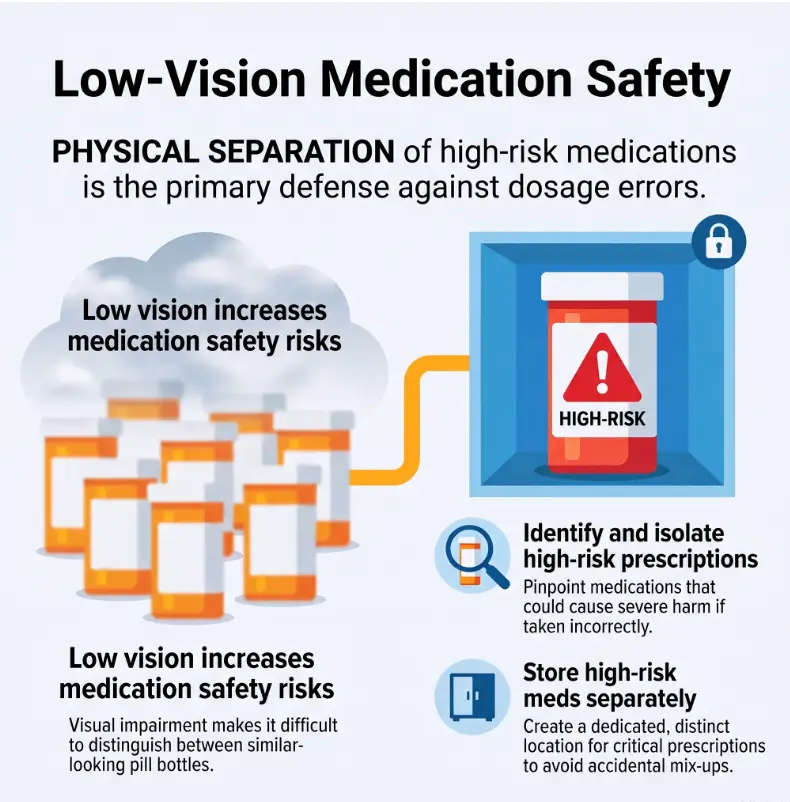
“High risk” should not become a homemade label applied to every prescription that sounds serious. If every bottle receives the same warning treatment, nothing stands out and the user must navigate an anxious wall of caution symbols.
Ask the pharmacist which medicines in this specific regimen could cause serious harm if they are taken twice, taken at the wrong time, confused with another product, administered by the wrong route, or stopped suddenly.
Use four risk questions
- What happens after a duplicate dose? Ask whether immediate action is required and whom to call.
- What happens after a missed dose? Do not assume the next dose should be doubled.
- Could this be confused with another medicine? Compare names, bottle shapes, strengths, devices, and packaging.
- Does storage protect the medicine? Ask about refrigeration, light, moisture, temperature, and original packaging.
Flag patient-specific confusion points
The most dangerous bottle may not be the medicine with the longest warning sheet. It may be the new strength placed beside the old strength, the bedtime tablet stored with morning medicine, or the eye drop that resembles an ear-drop bottle.
- Multiple strengths of the same medicine
- Similar drug names or manufacturer packaging
- Morning and bedtime versions
- Active and discontinued prescriptions
- Scheduled and “as needed” versions of similar medicines
- Different insulin pens or injectable products
- Medicines belonging to different household members
- Products added after hospital discharge
For more help spotting packaging and appearance traps, see the guide to managing similar-looking pills safely.
Key takeaway
The high-risk list should be short, specific, and pharmacist-verified. A smaller signal is easier to see and safer to follow.

Build a Two-Layer Medication Storage Map
Layer one: separate by access risk
The first layer controls which medicines appear together during an ordinary dosing decision. It reduces the number of containers the user must inspect at one time.
- High-risk daily medicines: pharmacist-identified medicines requiring extra verification
- Routine daily medicines: active scheduled medicines not placed in the high-risk group
- As-needed medicines: products with symptom and maximum-dose limits
- External-use products: drops, creams, patches, inhalers, and injectables
- Inactive medicines: stopped or expired products waiting for confirmed disposal
Use a separate tray, shallow drawer, shelf section, or lockable container for each meaningful category. Avoid deep baskets that allow bottles to hide behind one another.
Layer two: separate by identification risk
Within a category, create distance between items that could be mistaken for one another. Physical spacing is a quiet but powerful cue. It works before the label is read.
- Place different strengths of the same drug in separate compartments.
- Keep look-alike bottles at opposite ends of a tray.
- Store each household member’s medicine in a different location.
- Separate active insulin from unopened backup supplies.
- Keep newly changed prescriptions in a temporary review area until the routine is confirmed.
Design the zone for the human body using it
The safest shelf on paper may be unsafe in practice if it requires climbing, bending, balancing, or reaching behind toiletries. Choose a stable location at a comfortable height with strong, even lighting and little glare.
Arrange bottles in one visible row whenever space allows. Face labels forward, leave room for the hand to grasp one container, and return each item to the same position after use.
The four-step medication separation framework
1. Identify
Ask the pharmacist which medicines need extra protection.
2. Divide
Create physical zones for daily, PRN, external, cold, and inactive products.
3. Confirm
Use large text, touch, sound, and location rather than color alone.
4. Record
Document each dose and update the system after every medication change.
Make Every Container Identifiable in Three Ways
Cue one: large, high-contrast text
Ask the pharmacy whether it offers enlarged duplicate labels, accessible printouts, simplified directions, braille, audible labels, or compatible label-reading services. Availability and format vary, so ask what can be provided for the exact prescription container.
The U.S. Access Board’s advisory guidance discusses large print, braille, auditory technologies, and radio-frequency identification as ways to make prescription-label information more accessible to people who are blind, visually impaired, or elderly.
Large print should remain simple: strong contrast, non-glossy material, a clear sans-serif font, generous spacing, and the most important patient information easy to find. A wall of enlarged fine print is still a wall.
For a closer look at pharmacy options, read the guides to large-print prescription labels and what to do when medication labels are too small.
Cue two: tactile identification
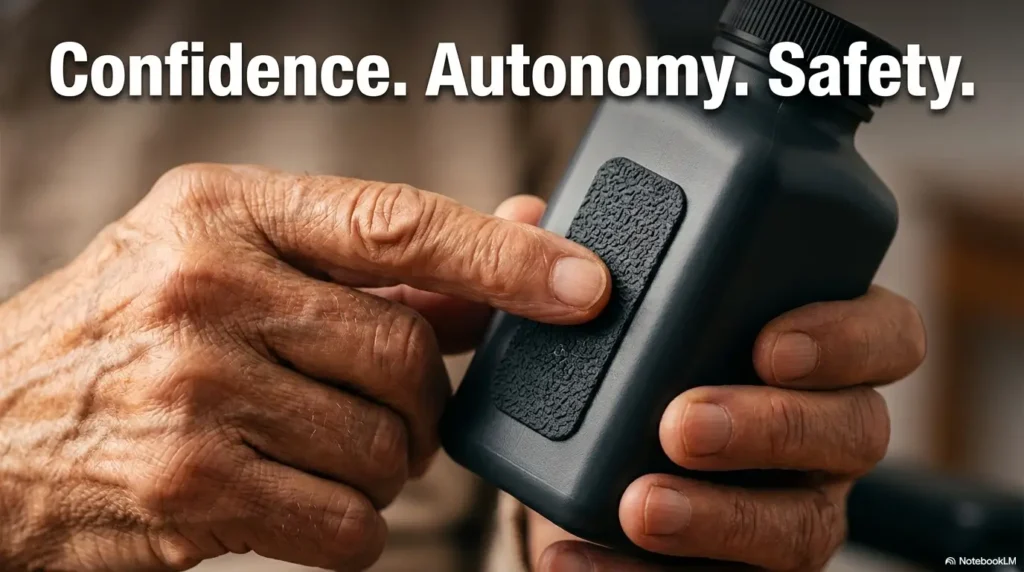
A raised dot, band, shape, or textured marker can help the user distinguish a small number of important containers. The marker should not cover the drug name, strength, directions, warnings, refill details, expiration information, or pharmacy contact information.
Keep the code tiny. One raised dot might mean “verify twice,” while a textured band might identify a particular insulin type. Ten shapes with ten meanings become a secret language nobody enjoys speaking at 7 a.m.
Document every tactile cue in large print and review it with the user. The guide to safe tactile-label placement on pill bottles can help prevent homemade markers from covering essential information.
Cue three: audible confirmation
Talking labels, pharmacy-provided readers, accessible pharmacy apps, smartphone text recognition, and recorded instructions can provide a second confirmation when print is difficult to read.
An audible tool should read or reproduce current pharmacy information, not an old family recording that remains in circulation after the prescription changes. Test the device in the actual dosing area, including volume, battery status, connectivity, and ease of use.
Why color alone is not enough
Color stickers can support recognition, but they should not carry the entire safety burden. Color perception, lighting, glare, fading, and memory can all interfere.
Pair color with at least two additional cues, such as shelf position, large text, tactile shape, bottle spacing, or audible verification. The medicine should remain identifiable even if one cue fails.
Key takeaway
Use three cues: what the container says, what it feels or sounds like, and where it belongs. No single sticker should be asked to do all the work.
Choose an Organizer, Pharmacy Package, or Dispenser
The bottle is part of the safety system
A pill organizer can reduce the number of containers handled each day, but it also removes the medicine from the label that identifies its name, strength, directions, warnings, expiration details, and pharmacy contact information.
Before transferring medicine, ask whether it can leave the original package and who should fill and verify the organizer. Some products require protection from moisture, light, air, or temperature changes. Others arrive in special packaging for a clinical reason.
Compare three levels of support
| Setup | What it may include | Best fit | Main caution | Relative cost |
|---|---|---|---|---|
| Good | Dedicated trays, large-print schedule, tactile markers, paper dose log | Independent user with stable prescriptions and reliable memory | Requires consistent setup and manual recording | Low |
| Better | Pharmacy-prepared blister packaging, accessible labels, caregiver review | User who struggles with bottles or weekly organizer filling | Changes and PRN medicines may require separate handling | Moderate or recurring |
| Best-supported | Locked timed dispenser, alerts, caregiver confirmation, pharmacist review | Repeated uncertainty, duplicate doses, or complex schedules | Device operation, refill process, power, alerts, and backup plan must be tested | Higher |
“Best-supported” does not automatically mean best for every person. A complicated dispenser that the user cannot load, hear, open, or reset can create a new bottleneck. Choose the least complicated option that reliably addresses the actual failure point.
What to ask before paying for a tool or service
- Can the user read, hear, and operate it without assistance?
- Does it accommodate the number and size of scheduled doses?
- How are prescription changes handled?
- Can PRN medicines remain separate?
- Does it create a reliable record of released or taken doses?
- What happens during a power, battery, internet, or cellular failure?
- Can a caregiver receive useful alerts without constant false alarms?
- Who fills the device, and how is that person’s work checked?
- Is there a trial, return window, setup fee, subscription, or cancellation rule?
Never mix leftovers with a new refill
A new refill may have a different manufacturer, appearance, strength, or instruction. Keep old and new supplies separate until the pharmacist confirms which prescription is active and what should happen to the remaining medicine.
Show me the nerdy details
Medication safety depends on reducing both the probability of an error and the severity of its consequences. Physical separation lowers the chance that the wrong product enters the decision. Large print, touch, sound, and location provide redundant identification channels. A dose log reduces uncertainty about whether an action already occurred.
The strongest system does not depend on perfect eyesight, perfect memory, or perfect technology. It places several modest safeguards in sequence, so one missed cue does not immediately become a medication error.
Create Special Lanes for Insulin, PRN, External, and Refrigerated Medicines
Insulin needs product-level separation
Different insulin products, concentrations, pens, and dosing schedules should not be treated as one category called “insulin.” Ask the pharmacist or diabetes-care clinician how each product should be stored, distinguished, and checked before injection.
- Store different insulin types in clearly divided locations.
- Keep active and unopened supplies distinguishable.
- Do not rely on pen color as the only identifier.
- Confirm the label and prescribed dose before every injection.
- Keep needles and related supplies organized without covering product labels.
- Document the dose immediately after administration.
PRN medicines need a limit checkpoint
“Take as needed” is not the same as “take whenever.” The storage area should make the timing and maximum-dose rules easy to confirm before the container is opened.
- What symptom the medicine is intended to treat
- The prescribed amount for one dose
- The minimum time between doses
- The maximum allowed within the stated period
- The time of the most recent dose
- When to call the pharmacist or clinician instead of taking more
Use one log, not several competing scraps of paper. A low-vision medication tracker can help create a visible record, provided it matches the pharmacist-confirmed directions.
External-use products need a physical barrier
Eye drops, ear drops, creams, patches, inhalers, and injectable medicines should be physically separated from oral tablets and liquids. A different shelf, drawer, tray, or closed compartment creates a pause before a wrong-route error.
Within the external-use area, separate products by route. Eye and ear drops deserve particular attention because the containers can feel and look similar. For more detail, see the guide to accessible eye-drop labeling for seniors.
Refrigerated medicines need their own labeled bin
Do not move a medicine to room temperature merely to keep it beside the rest of the daily supply. Follow the product-specific storage information supplied by the pharmacy or manufacturer.
Use a clean, dedicated refrigerator bin that protects the medicine from food spills and household confusion. Avoid locations where temperature may be less stable unless the medicine instructions specifically allow them.
| Medication lane | Primary separation | Extra verification |
|---|---|---|
| Insulin or injections | Divide by exact product and active versus unopened supply | Read or hear the product name and confirm dose before use |
| PRN medicine | Separate from scheduled daily doses | Check last dose, interval, and maximum limit |
| Eye, ear, skin, or inhaled product | Separate by route | Confirm body location and directions |
| Refrigerated medicine | Dedicated labeled refrigerator bin | Confirm storage and handling instructions |
Use a One-Minute Verification Routine
Step one: stop and identify
Before opening the container, say, read, feel, or hear five pieces of information:
- The person’s name
- The medicine name
- The strength
- The intended dose
- The intended time and route
This deliberate pause may feel slow at first. In practice, it is faster than sorting out an uncertain dose after the bottle has been put away.
Step two: match the medication list
Keep one current medication list that includes the complete drug name, strength, purpose, dose, timing, route, prescriber, and important handling instructions. Include prescription medicines, over-the-counter products, vitamins, supplements, eye drops, creams, inhalers, and injections.
The FDA recommends reviewing and updating the list when a prescription, dose, or medication status changes.
A printable one-page medication list template can make this easier to share with caregivers, emergency responders, pharmacists, and clinicians.
Step three: confirm it was not already taken
Choose one authoritative record. A checked paper schedule, pharmacy blister pack, timed dispenser record, or caregiver log may work. Two people keeping separate notes can create two confident but conflicting answers.
Mark the dose immediately. Do not plan to record it after breakfast, after the phone call, or when the kettle boils. Memory is generous with promises and stingy with receipts.
Step four: close, record, and return
- Close the container fully.
- Record the dose immediately.
- Return the medicine to its assigned position.
- Clear the dosing surface before reaching for another product.
- Report any uncertainty rather than trying to reconstruct events later.
Key takeaway
The safest routine ends with a record and a reset. An open bottle on the counter is an unfinished decision.
Avoid the Fixes That Quietly Increase Risk
Mistake: sorting by pill appearance
Tablet color and shape can change when a pharmacy uses a different manufacturer. Pill appearance may support a final sense-check, but it should not replace the pharmacy label or current medication record.
Mistake: using vague handwritten labels
Labels such as “blood pressure,” “sugar,” “night pill,” or “pain medicine” can refer to more than one product. Use the complete pharmacy-record name, strength, purpose, and instructions on any accessible duplicate label or schedule.
Mistake: keeping stopped medicines in the active zone
Move discontinued medicine out of the active dosing area as soon as its status is confirmed. Place it in a clearly marked quarantine container while you obtain disposal instructions.
For most unused or expired medicines, FDA guidance favors a drug take-back location or mail-back option when available. Do not flush a medicine unless current instructions specifically identify that method as appropriate.
Mistake: building a label maze
A dozen bins, six colors, eight tactile shapes, three alarms, and two competing schedules can turn a small cabinet into an escape room. Use the fewest categories and cues that still separate real risks.
| Common fix | Why it can fail | Safer alternative |
|---|---|---|
| Color sticker only | Color may be hard to see or remember | Pair color with location, text, touch, or sound |
| All pills in one organizer | Removes immediate access to labels and warnings | Confirm suitability and use verified packaging |
| Old and new refill mixed together | Strength or instructions may have changed | Keep separate until a pharmacist confirms status |
| Stopped medicine kept nearby | Can return to active use accidentally | Quarantine and arrange proper disposal |
| Caregiver changes layout silently | User follows the old location by habit | Demonstrate, document, and rehearse every change |
Real-world example: Two similar bottles
A caregiver notices that her father pauses every evening between two white prescription bottles. One contains a routine tablet. The other contains a different strength of a medicine whose dose was recently changed.
Her first idea is to add red and green stickers. Instead, she calls the pharmacist. The pharmacist confirms which strength is active, advises her not to combine the supplies, and explains how to dispose of the discontinued bottle.
They place the active medicine in a dedicated evening tray, add a large-print duplicate label, and use one raised marker that is also documented on the medication list. The stopped medicine leaves the dosing area completely.
The lesson is small but sturdy: clearer identification helped, yet removing the inactive bottle removed the risk more effectively.
What to Do After a Possible Medication Mix-Up
Do not wait for symptoms before seeking guidance
If a wrong medicine or duplicate dose may have been taken, do not guess that everything is fine because the person currently feels normal. The timing and seriousness of symptoms vary by medicine, amount, health condition, and other substances taken.
Keep the medicine container, medication list, estimated time, possible amount, and the person’s age and health information nearby. Do not induce vomiting or give food, drink, or another medicine unless a qualified professional instructs you to do so.
Call Poison Help in the United States
Call 1-800-222-1222 when a medication error or poisoning may have occurred. The national Poison Help line connects callers with a local poison center and provides free, confidential assistance 24 hours a day.
Call 911 for life-threatening symptoms
Call 911 immediately if the person collapses, cannot be awakened, is not breathing, has severe difficulty breathing, has a seizure, or develops another rapidly worsening emergency symptom.
Request a review after near-misses
A near-miss is useful information, not a private embarrassment to bury. Ask the pharmacist or clinician to review the system after repeated uncertainty, a fall, new confusion, unusual sleepiness, dizziness, hospital discharge, or a major prescription change.
Write down what happened while details are fresh: which containers were involved, where they were stored, what cue failed, and how the error was discovered. Fix the process rather than blaming the person.
Emergency takeaway
After a suspected mix-up, call for expert guidance rather than waiting, experimenting, or adjusting the next dose on your own.
FAQ: Separating High-Risk Medicines With Low Vision
Which medicines belong in the high-risk zone?
Only medicines identified by the pharmacist or prescribing clinician as needing additional safeguards should receive that designation. Ask specifically about harm from duplicate doses, missed doses, wrong timing, sudden stopping, product confusion, and storage errors.
Is a weekly pill organizer safer than original bottles?
It can be useful for some stable regimens, but it is not automatically safer. Repackaging removes immediate access to the original label and may be unsuitable for medicines affected by moisture, light, air, or special packaging requirements. Ask the pharmacist before transferring medicine.
Can tactile stickers be added to prescription containers?
A small, documented tactile marker may help when it does not hide required label information or interfere with opening and closing the container. Keep the code simple and confirm placement with the pharmacy when possible.
How should two nearly identical bottles be separated?
Place them in different physical locations, add distinct non-color cues, face labels forward, and verify each against the current medication list. If one bottle is discontinued or replaced, remove it from the active area after confirming its status.
Should different insulin pens be stored in different bins?
Physical separation may reduce product mix-ups, but the exact storage method should follow pharmacist or clinician instructions. Confirm the product name, concentration, dose, and whether the pen is active or unopened before each use.
Can a pharmacy provide large-print or talking labels?
Some pharmacies offer large print, braille, audible labels, accessible apps, RFID-supported readers, or other formats. Services vary by pharmacy and prescription, so ask what is available and how updates are handled after a medication change.
Where should stopped medicines be kept before disposal?
Keep them outside the active dosing area in a clearly marked quarantine container that is inaccessible to children, visitors, and anyone who might return them to use. Follow current take-back, mail-back, or product-specific disposal instructions.
When should a caregiver take control of medication administration?
Discuss greater supervision when the user repeatedly misses or repeats doses, cannot identify current medicines, cannot understand changed instructions, or cannot operate the storage and dosing system safely. A pharmacist, prescriber, nurse, or occupational therapist can help assess the least restrictive safe option.
Your 15-Minute Pharmacist-Led Reset
The most useful next step is not buying a larger organizer. It is creating a pharmacist-verified map of the medicines already in the home.
Gather everything in one place
Collect every prescription, over-the-counter medicine, vitamin, supplement, eye drop, cream, inhaler, patch, injection, and current medication list. Do not remove pills from their containers during this step.
Ask five pharmacist questions
- Which medicines require high-risk separation for this person?
- Which products must remain in their original packaging?
- Which medicines need refrigeration, light protection, or other special storage?
- Are there duplicate therapies, old strengths, or discontinued products that need review?
- Which large-print, tactile, braille, audible, blister-pack, or adherence options are available?
The low-vision pharmacy help script can make the conversation easier if the user or caregiver is unsure how to request accessible support.
Make one change today
Choose the clearest immediate risk: two similar bottles, an outdated strength, a PRN medicine without a dose log, or a refrigerated product mixed with food. Photograph the original arrangement, confirm the change, update the medication list, and teach the new location to everyone involved.
A safe medication system should feel almost boring. The right bottle is where expected, its identity can be confirmed more than one way, and the record calmly answers the question, “Was this already taken?” That quiet predictability is the real upgrade.
One action for the next 15 minutes
Place the current medication list beside every active container and circle the two products most likely to be confused. Bring those two containers to the pharmacist first.
Last reviewed: 2026-09