


Medication Safety for Aging Eyes
Medication Safety Checklist for Seniors With Presbyopia Make Every Dose a Zero-Guesswork Dose
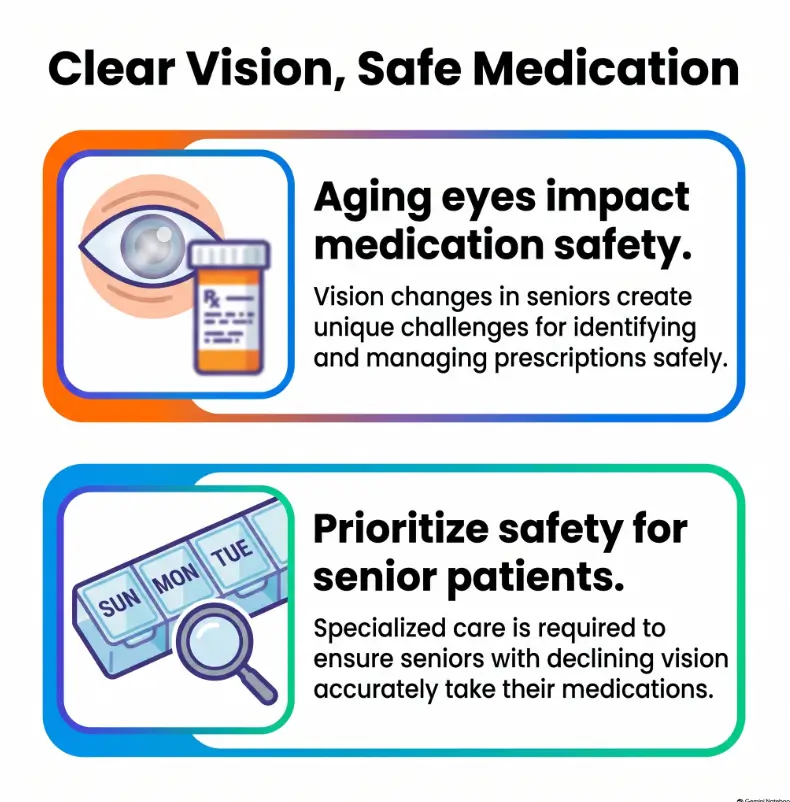
A prescription bottle can be perfectly familiar and still betray you with one tiny number. For older adults with presbyopia, the problem is rarely intelligence or effort. It is that medicine labels ask aging eyes to perform precision work using small type, crowded instructions, similar containers, and sometimes terrible lighting.
The safest response is not simply buying a stronger magnifier. It is building a routine in which the medicine name, strength, dose, timing, and patient can be checked without memory filling in the blanks. A bright table, the correct reading correction, a current medication list, and a deliberate pause can turn a fragile routine into something much easier to trust.
This guide shows seniors and family caregivers how to create that routine without unnecessarily taking away independence. You will also see where pill organizers help, where they can create new errors, what accessibility services are worth asking a pharmacy about, and when a vision or medication problem deserves professional attention.
See clearlySet up lighting, correction, contrast, and magnification for real label reading.
Check deliberatelyUse a five-point routine before the medicine leaves the bottle.
Know when to askSpot the point where a pharmacist, caregiver, or eye professional should step in.
The goal is simple: read first, recognize second, and never make the bottle guess for you. 👓
Snapshot
This guide is for older adults who can generally manage their own medicines but struggle with near print, as well as caregivers who want to make that routine safer. By the end, you will be able to build a readable medication station, run a repeatable label check, compare organization options, and recognize when self-management needs additional support.
Table of Contents
Safety / Disclaimer
This article provides general educational guidance, not individualized medical advice. Missed-dose instructions, tablet splitting or crushing, medication interactions, storage requirements, and organizer use differ by medicine and patient. Follow the prescription label and instructions from your prescribing clinician or pharmacist. Do not stop, double, split, crush, or otherwise change a prescribed medicine because of this article. If you are unsure what was taken or how much was taken, seek medication-specific professional guidance rather than trying to correct the next dose yourself.
Who This Medication Safety Checklist Is For, and When It Is Not Enough
Best fit: independent seniors who struggle with small print
Presbyopia makes close-up focusing harder with age. That can turn otherwise ordinary tasks, such as distinguishing “10 mg” from “20 mg” or finding a small timing instruction, into precision work.
This checklist is especially useful when you can still manage your medicines independently but find yourself holding bottles farther away, searching for brighter light, removing your glasses to read, or relying increasingly on where a bottle sits rather than what its label says.
If tiny pharmacy print is already the daily obstacle, our guide to medication labels that are too small for seniors offers additional readability fixes.
Caregiver fit: support the system, not just the person
Family caregivers can use the same framework without immediately taking over medication management. Often the most revealing first step is simply asking the older adult to show how they identify each medicine, when they take it, and what they do when something looks different.
That demonstration may reveal a fixable problem: reading glasses are in another room, the medication list is six months old, two bottles sit side by side because they “look different enough,” or evening doses are taken beside a dim bed lamp.
When self-management may need more support
Presbyopia may be only one part of the difficulty. Additional help is worth discussing when medication errors recur despite better lighting and clearer print, or when memory changes, significant low vision, confusion, tremor, poor dexterity, or a very complicated dosing schedule make accurate preparation unreliable.
- The patient cannot reliably explain what several medicines are for.
- Old and current prescriptions are mixed together.
- Doses are repeatedly missed or taken twice.
- A pill organizer is being filled from memory rather than labels.
- Corrected vision is still not adequate for reading medication information.
- Several people in the household use similar prescription containers.
Key takeaway: Independence and safety are not opposites. The strongest system lets an older adult do as much as possible while making uncertainty easy to notice and easy to escalate.
The Hidden Risk: A Label Can Look Readable and Still Be Misread
Presbyopia changes the task, not just the font size
The risky part of a medication label is often not a long sentence. It is one letter, one digit, one unit, or one changed instruction buried in otherwise familiar text.
A person may recognize the medicine name yet miss that the strength changed. They may read the dosage correctly yet miss “with food.” They may identify a familiar bottle but overlook that it belongs to a spouse.
That is why medication safety for seniors with presbyopia should focus on verification, not merely enlargement.
Contrast and lighting matter more than most medicine cabinets allow
Medicine cabinets are convenient storage spaces, but they are often poor reading spaces. Shadows, reflections from glossy labels, overhead lighting, and cramped shelves make a five-second glance less dependable.
Move the bottle to a stable, well-lit surface before reading it. Position the light so the label is bright without producing a white glare spot across the exact line you need to see.
The National Institute on Aging specifically advises older adults to turn on a light rather than taking medication in the dark.
Familiarity feels efficient, but it is not verification
A bottle handled every morning becomes part of the furniture of life. Your hand knows its shelf. Your eye knows the label color. Your brain knows what it expects to find.
That familiarity is useful until a refill, dosage change, new manufacturer, visiting relative, or moved bottle quietly changes the scene. The safer rule is simple: read first, recognize second.
Show me the nerdy details
Reading a medication label is a visual discrimination task. The brain does not inspect every character equally. Familiarity lets it predict missing information, which is usually efficient but can become troublesome when two medication names, strengths, or containers are similar. Presbyopia adds another layer by reducing comfortable near focus. Better illumination, sufficient magnification, strong contrast, and a deliberate second check reduce the amount of information the brain has to infer.

Build a Zero-Guesswork Medication Station Before the Next Dose
Give medication labels a proper reading surface
A medication station does not have to resemble a clinic. A clear section of a kitchen table, desk, or dresser can work if the surface is stable, well lit, dry, and suitable for the medication’s storage requirements.
The important part is that you can place the bottle down, use both hands if needed, put on the correct near-vision correction, and read without rushing.
Keep the reading tools where the medicines are checked
Reading glasses in the living room are not useful when a nighttime medicine is being checked in the bedroom. Keep the appropriate reading aid within easy reach of the medication station.
A handheld or stand magnifier may also help, depending on vision and hand stability. If you are deciding between aids, see our guide to reading glasses versus magnifiers.
A smartphone can provide temporary magnification as well. For compatible phones, features that enlarge text or use the camera as a magnifier can make small labels easier to inspect. Our guide to iPhone Magnifier settings for pill bottles explains one practical setup.
Free, low-cost, and higher-support options
You do not need to buy a basket of gadgets to improve medication safety. Start by removing visual friction, then add tools only where the routine still fails.
| Setup level | What it may include | Best fit | What to verify before spending |
|---|---|---|---|
| Good | Bright existing light, correct reading glasses, current medication list, dedicated surface | Clear vision once conditions improve | Can every label be read comfortably and accurately? |
| Better | Task lighting, large-print schedule, optical or phone magnification, separated containers | Persistent difficulty with small print or similar bottles | Is the magnification stable and easy to use every day? |
| Best support | Accessible pharmacy labels, pharmacist-prepared packaging when appropriate, caregiver checks, professional medication review | Complex schedules or repeated management errors | Who prepares the system, how changes are handled, and whether extra fees apply? |
If a printed schedule helps, use large, high-contrast type rather than squeezing every detail onto a tiny page. You can adapt the ideas in our large-print medication schedule guide.
1. Light
Bright, controlled illumination
2. See
Correct glasses or magnifier
3. Read
Name, strength, directions
4. Match
Check against the current list
5. Pause
Uncertain means verify first
Before You Swallow: Run This 5-Point Label Check
1. Read the medication name and strength
Do not begin with “this is my blood pressure pill.” Begin with the actual name on the label, then verify the strength and unit.
This matters especially when the same medicine is available in multiple strengths. One familiar drug name does not make two differently labeled bottles interchangeable.
2. Confirm dose, timing, and special instructions
Read how much to take, how often to take it, and any medication-specific directions. If the prescription has recently changed, slow down and read the current instructions twice.
Do not use a general rule for missed doses. Different medicines require different responses, so check the medication-specific instructions or ask a pharmacist rather than automatically doubling a later dose.
3. Check the person, then take one final pause
In a shared household, verify the patient’s name. Then ask one last question before taking the dose: Did I read this, or did I recognize it?
- Right medication name.
- Right strength.
- Right amount to take.
- Right timing and instructions.
- Right person.
Key takeaway: A medication routine should still work on a sleepy morning, after a refill, and when one bottle has been moved. If it only works when memory is perfect, the system needs another layer of verification.
Don’t Let Similar Pills, Bottles, or Memory Make the Decision
“The little white pill” is not an identification system
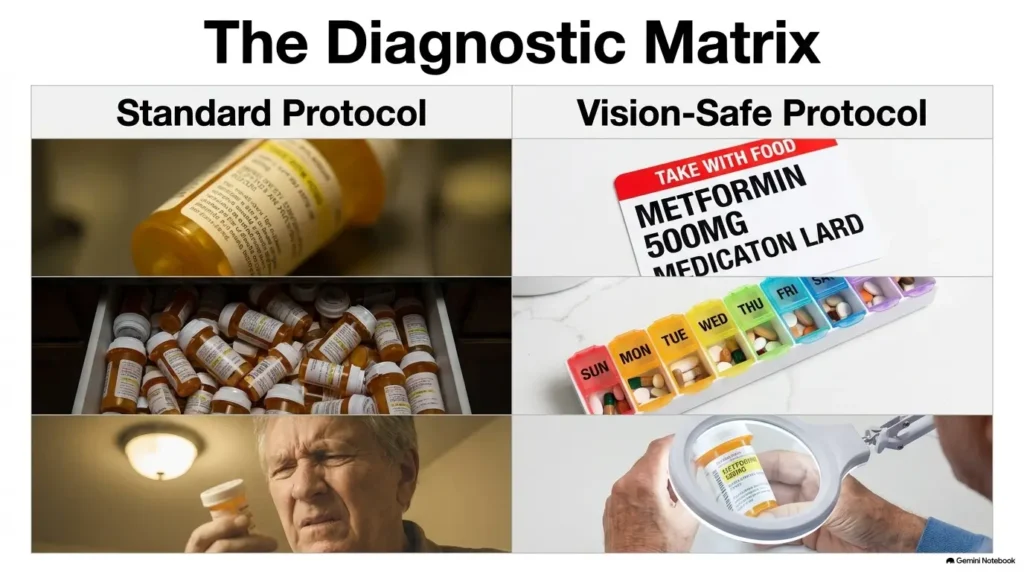
Color, shape, and size can be useful secondary clues, but they should not replace the prescription label. Many tablets share common appearances, and a familiar medicine may look different after a refill or manufacturer change.
If a new refill suddenly looks different, do not assume the pharmacy made an error, but do not assume everything is fine either. Stop and verify the medicine with the label and pharmacist before deciding what to take.
If look-alike tablets are a recurring problem, our guide to handling similar-looking pills safely goes deeper into separation and verification strategies.
The brown-bottle trap: identical containers, very different consequences
Prescription containers are designed to carry information safely, not to create visual variety. When three similar bottles sit in a row, location can quietly become the identification method.
Separate medicines in a way that preserves their original labeling. Large written cues can help, but avoid building a system that depends only on remembering what a colored sticker means.
Short Story: The Familiar Bottle That Suddenly Looked Wrong
Imagine a 72-year-old who has taken the same morning prescription for years. The bottle always lives on the left side of a small tray, and the tablet has always been pale and round.
After a refill, the tablet looks different. She is tempted to skip it because “the pharmacy must have given me the wrong thing.” Her daughter is tempted to compare the new tablet with an old one and decide by appearance.
Instead, they place the new bottle under the table lamp, read the medication name and strength, compare it with the current medication list, and contact the pharmacist about the appearance change.
The lesson is quiet but important: visual familiarity can tell you that something changed. It cannot tell you what the change means.
Pill Organizers Can Help, but Only After This Safety Check
An organizer should store verified doses, not uncertain pills
A weekly organizer can reduce daily bottle handling and make a routine easier to see. The risk moves upstream, however, to the moment the organizer is filled.
If the wrong tablet enters Monday morning’s compartment, an otherwise excellent organizer can repeat that error automatically. Fill compartments only from clearly identified medication sources and a current regimen.
Keep the original information available
Even when doses are transferred into an appropriate organizer, keep access to the original prescription labels and medication information. The organizer should not become the only record of what the medicine is.
A one-page master list makes cross-checking easier. You can build one using the structure in our one-page medication list template.
When pharmacy packaging or outside help may be worth considering
If filling a weekly organizer has become the least reliable part of the routine, ask the pharmacy what packaging or accessibility services it offers. Availability and fees differ, so compare how the service handles new prescriptions, dose changes, discontinued medicines, refills, and travel.
| Option | Main advantage | Main caution | Question to ask |
|---|---|---|---|
| Original bottles only | Full prescription information stays attached | Many daily bottles may be cumbersome | Can each label be read comfortably? |
| Self-filled organizer | Simplifies daily routine | Filling errors can repeat across several days | Can the organizer be filled accurately every time? |
| Pharmacy-prepared packaging | May reduce manual sorting | Availability, suitability, and fees vary | How are medication changes handled? |
| Caregiver-assisted setup | Adds a second check | Requires a reliable process for updates | Who confirms the master medication list? |
Never split, crush, open, or otherwise alter a tablet or capsule simply because it is difficult to identify or manage. Ask a pharmacist or prescribing clinician whether that specific medication can be altered safely.
Caregiver Cross-Checks That Add Safety Without Taking Over
Start with “show me your system”
A caregiver often learns more by watching one ordinary medication routine than by reorganizing an entire cabinet.
- Where are reading glasses kept?
- Where is the medication list?
- How is each bottle identified?
- What happens when a tablet looks unfamiliar?
- How are refill changes added to the routine?
- What happens after a missed or uncertain dose?
The aim is to find the weak link while preserving everything that already works.
Compare every bottle against one master medication list
The list should include prescription medicines, over-the-counter products, vitamins, dietary supplements, and herbal products. For each item, record enough information to support a useful professional review, such as the name, amount, timing, reason for use, and prescriber when applicable.
Update the list whenever something changes. A beautiful medication list that describes last winter’s regimen is a historical document, not a safety tool.
Turn refills into medication-review checkpoints
A refill is a natural moment to ask whether the appearance changed, confirm new instructions, mention side effects, review OTC products or supplements, and request accessible labeling if the print is difficult to use.
Caregivers who find pharmacy conversations awkward can adapt the questions in our low-vision pharmacy help script.
Pharmacy question checklist
Ask: Can the label be printed larger? Is accessible prescription information available? Did the tablet or manufacturer change? Are there special storage instructions? What should happen after a missed dose? Could any OTC medicine, vitamin, or supplement interact with this prescription? If packaging services are offered, how are mid-cycle medication changes handled?
Key takeaway: Repeated errors are evidence about the system. If mistakes continue after lighting, print, organization, and reminders improve, the next step is reassessment, not another promise to “be more careful.”
When to Seek Help: Medication Errors and Vision Changes That Need Attention
If the wrong medicine or amount may have been taken
Do not invent a correction for the next dose. Contact an appropriate pharmacist, clinician, poison-control service, or other qualified medical resource promptly for medication-specific guidance.
If the person develops severe symptoms such as difficulty breathing, collapse, loss of consciousness, or another potentially life-threatening reaction, seek emergency medical care.
Do not label every new vision problem “just presbyopia”
Needing help with near focus is common with age, but sudden or substantial vision changes deserve attention. Sudden loss or blurring of vision, many new floaters or flashes, eye pain, double vision, or significant eye redness or swelling should not be casually attributed to normal aging.
If ordinary reading has become much harder even with appropriate correction, consider discussing the change with an eye professional. Before an appointment, our eye doctor visit checklist for seniors can help organize symptoms and questions.
Watch dizziness, sleepiness, balance changes, and falls
Some medicines can affect alertness, coordination, or balance. A person who becomes unusually dizzy, sleepy, unsteady, or confused after medication changes should discuss those symptoms with an appropriate health professional rather than treating them as an unavoidable part of aging.
This matters even more when vision is also changing. A label-reading problem may begin at the medicine table, while the consequences can appear later on the stairs, in the bathroom, or behind the wheel.
Key takeaway: A new vision problem and a new medication problem can overlap. When the routine suddenly becomes harder, ask what changed instead of assuming aging is the whole explanation.
Medication Safety FAQ for Seniors With Presbyopia
Can presbyopia make medication errors more likely?
Presbyopia does not automatically cause medication errors, but reduced near-focus ability can make small labels, dosage strengths, and detailed instructions harder to read. Risk rises when visual difficulty is combined with dim light, similar containers, rushed routines, memory-based identification, or complex medication schedules.
Should seniors with presbyopia use a pill organizer?
A pill organizer may simplify a verified medication schedule. It is less useful if the person cannot reliably identify medicines while filling it. When organizer preparation itself is becoming uncertain, discuss packaging or assistance options with the pharmacist or healthcare team.
Can I ask a pharmacy for larger prescription labels?
Yes. Ask the individual pharmacy what large-print, accessible-label, audio, digital, or other prescription-information options it supports. Services vary, so ask how the format works for refills and medication changes and whether there is an additional cost.
Is a smartphone camera safe for magnifying medication labels?
Digital magnification can be a useful reading aid when it produces a clear, stable view. Make sure the complete relevant instruction is visible, not just one enlarged fragment. If the text remains unclear or an instruction is ambiguous, verify it with the pharmacist rather than interpreting a blurry image.
Should prescription information stay with the original bottle?
Keep access to the original prescription information even when an appropriate medication organizer is used. The organizer should simplify the schedule, not erase the source information needed to identify the medication and confirm instructions.
What if two pills look almost identical?
Do not decide which is which from appearance alone. Check the labeled medication source and current medication list, and ask the pharmacist when identification remains uncertain.
How often should a medication list be updated?
Update it whenever a prescription, dose, timing instruction, OTC medicine, vitamin, supplement, or herbal product changes. Review it before medical appointments and pharmacy conversations so the list reflects what is actually being taken now.
What should I do if I think I took the wrong medication?
Seek medication-specific professional guidance promptly. Do not automatically skip, double, or adjust the next dose in an attempt to compensate. For severe or potentially life-threatening symptoms, seek emergency medical care.
Do a 10-Minute Medication Safety Reset Today
Minutes 1 to 3: fix the viewing conditions
Choose one stable, brightly lit surface. Put on the correction normally used for near work. Move the reading glasses or magnifier to a place where they will actually be available at medication time.
Minutes 4 to 8: match the medicines to the current list
Check each medicine’s name, strength, purpose, amount, and timing against your current medication record. Include OTC medicines, vitamins, supplements, and herbal products.
Do not try to solve uncertain pills by memory. Set them aside in a safe manner that preserves their identifying information and add them to your pharmacist question list.
Minutes 9 to 10: remove one weak link
Choose the single problem most likely to cause tomorrow’s mistake. Maybe it is dim lighting. Maybe the reading glasses are never nearby. Maybe two nearly identical bottles share the same shelf. Maybe the medication list still contains a discontinued prescription.
- Move medicines to a clearer checking location if storage instructions allow.
- Place the proper reading aid beside the medication station.
- Print or rewrite the medication schedule in larger, higher-contrast text.
- Separate confusing containers while preserving their labels.
- Update the master medication list.
- Write down one question for the pharmacist rather than relying on memory later.
One concrete action before your next refill
Bring or send the pharmacy an updated list of every prescription medicine, OTC drug, vitamin, supplement, and herbal product being taken. Ask which part of the regimen could be made easier to read, distinguish, package, or review safely. One well-placed question can remove more risk than another drawer full of colored stickers.
The strongest medication safety system is not the one with the most gadgets. It is the one that makes the correct action obvious and uncertainty impossible to ignore. Give the label enough light, give your eyes the right help, read what is actually there, and make asking a pharmacist feel like part of the routine rather than a last resort.
Last reviewed: 2026-09