
Senior eye visit guide
Eye Doctor Visit Checklist for Seniors with Presbyopia:
What to Bring, Ask, and Confirm Before You Leave
Reading glasses can feel so ordinary that the appointment gets treated like a quick errand: bring the insurance card, read the tiny letters, leave with a prescription. But for older adults, near-vision blur is rarely just about making restaurant menus behave. It can sit beside cataracts, dry eye, glaucoma risk, medication effects, diabetes, blood pressure changes, falls, driving glare, and the quiet fatigue of daily small print.
This guide turns a routine eye doctor visit into a calmer, smarter checkpoint. It helps seniors, caregivers, and adult children arrive with the right glasses, symptom notes, medication details, Medicare questions, and follow-up prompts, so the exam does not vanish into a blur of machines, drops, and optical-shop decisions.
The goal is not to make anyone anxious. It is to protect the small freedoms that depend on vision: reading the pill bottle, driving at dusk, seeing the stove dial, signing the form, finding the door lock, and choosing glasses that actually fit the life being lived.
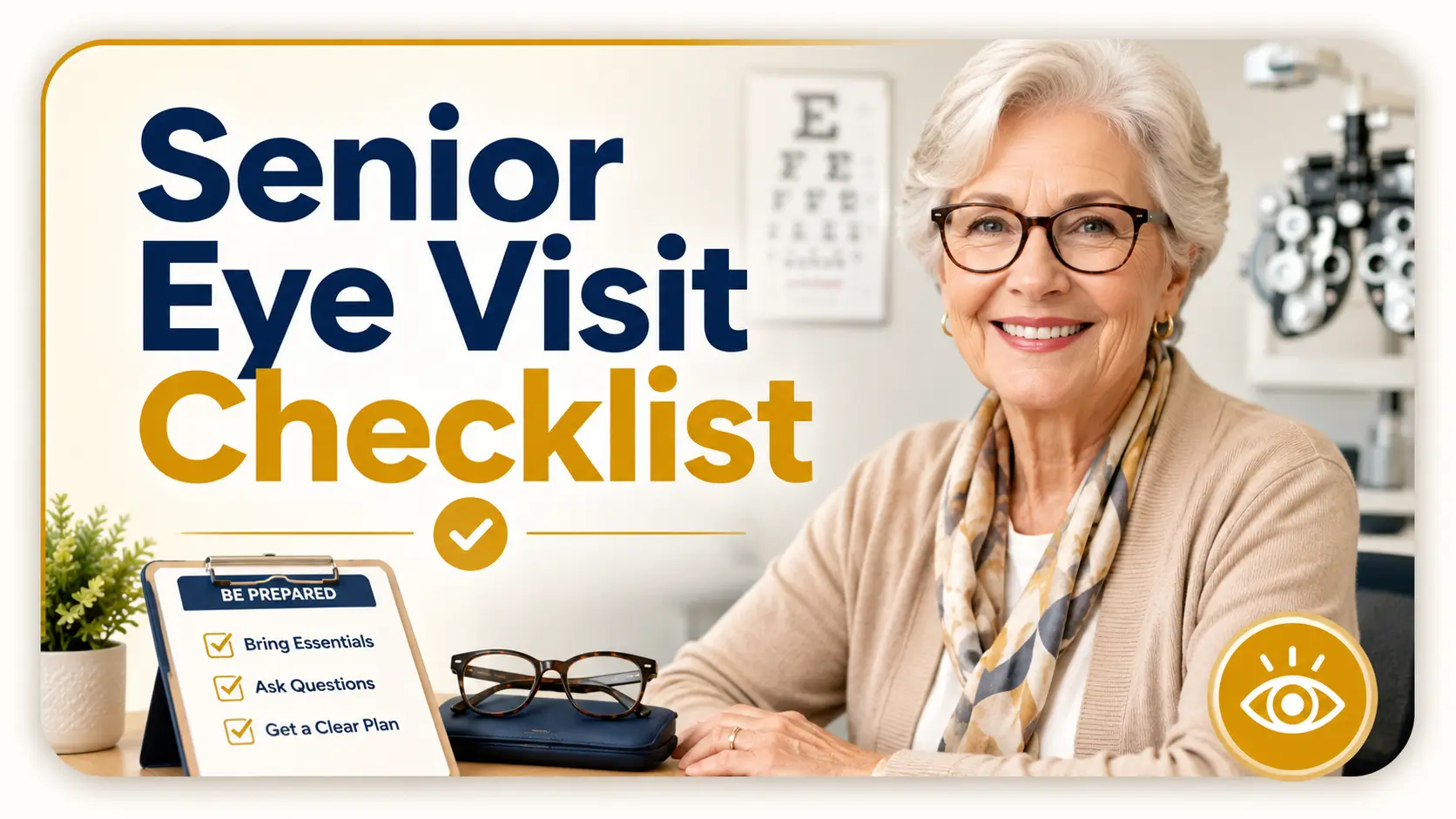
Bring the right items
Glasses, readers, drops, medications, insurance cards, and symptom notes.
Ask better questions
Confirm whether blur is presbyopia, cataract, dry eye, or something else.
Leave with a plan
Know the diagnosis, lens recommendation, follow-up date, and red flags.
Bring the drawer, not just the prescription. Those old readers, progressives, and “mystery glasses” may tell the doctor exactly what your eyes have been trying to explain. 👓
Snapshot
This article is for seniors, caregivers, and adult children preparing for an eye doctor visit where presbyopia, reading glasses, blurry near vision, Medicare questions, and age-related eye screening may all collide. By the end, you can pack the right items, ask the right questions, compare glasses options, avoid expensive do-overs, and make a one-page Eye Visit Card before the appointment.
Table of Contents

Before You Act: Reading Trouble Is Common, But Guesswork Is Not a Plan
Presbyopia is common with aging. It usually shows up as trouble focusing up close, holding books farther away, needing brighter light, or feeling tired after reading. That part may sound simple.
For seniors, though, “simple” is where the paperwork fox likes to hide. Blurry vision can also involve cataracts, glaucoma, macular degeneration, diabetic eye disease, dry eye, medication side effects, or neurological symptoms. A checklist is useful, but it is not a diagnosis.
Before you act
Use this guide to prepare for a visit, organize questions, compare lens options, and reduce preventable cost surprises. Do not use it to self-diagnose sudden, painful, one-sided, or rapidly changing vision symptoms. When symptoms feel urgent, contact an eye care professional, primary care clinician, urgent care, or emergency services.
Sudden vision loss, new flashes or floaters, a curtain-like shadow, severe eye pain, new double vision, weakness, slurred speech, or a severe headache with vision change should not wait for a routine glasses appointment. Those symptoms deserve prompt medical attention.
For official background on presbyopia and comprehensive eye exams, the National Eye Institute presbyopia guide is a helpful place to start.
What This Guide Can Do
This guide can help you prepare a visit folder, name symptoms clearly, ask about dilation, compare readers versus prescription lenses, understand routine versus medical billing questions, and leave with a follow-up plan.
It can also help caregivers avoid the familiar post-appointment detective game: “What did the doctor say?” “Did they change the drops?” “Are we buying glasses now?” “Why is this bill different?”
What This Guide Cannot Do
It cannot tell you whether a specific symptom is harmless. It cannot decide whether you need cataract surgery, glaucoma treatment, retinal care, a medication change, or a particular lens design. Those decisions belong in a clinical conversation with the right professional.
Think of this article as a well-labeled tote bag for the appointment. It keeps the important pieces from rolling under the seat.
Presbyopia Checklist First: What to Bring Before the Exam
The best eye doctor visit checklist for seniors with presbyopia starts before the appointment. Not in the waiting room. Not while looking for the parking ticket. The night before is the sweet spot.
Bring more than your current favorite glasses. Bring the old readers from the drawer, the progressives you “never really liked,” the bifocals from three years ago, the computer pair, the sunglasses, and any contact lens information if you use contacts. The eye doctor can learn a lot from what worked, what failed, and what was quietly abandoned.
Key takeaway
Bring every pair of glasses you actually use, not only the pair you think the doctor wants to see. “Mystery pairs” can reveal comfort problems, strength issues, frame-fit mistakes, and daily-life needs that a vision chart may not capture.
Current Glasses, Readers, Contacts, and “Mystery Pairs” From the Drawer
Over-the-counter readers can be useful, but they are blunt instruments. They usually use the same strength in both eyes and do not correct astigmatism or distance vision. Prescription lenses can be more precise, especially when the two eyes need different correction.
If reading glasses seem to stop working every few months, bring that complaint into the room. A related guide on why reading glasses stop working can help you organize what changed before the appointment.
Medication List, Eye Drops, Supplements, and Pharmacy Details
Bring a medication list that includes prescriptions, over-the-counter medications, allergy medicines, sleep aids, supplements, and all eye drops. Include glaucoma drops, dry-eye drops, redness relievers, allergy drops, and post-surgery drops if relevant.
Some medications can affect dryness, focusing comfort, pupil size, dizziness, or eye pressure risk. The doctor does not need a poetic history of every pill bottle, but they do need the names, strengths if available, and how often they are used.
If labels are getting hard to read at home, connect the appointment to practical safety. The guide on eye drop labels for seniors may help you prepare better questions about home routines.
Health Conditions That Belong in the Room
Eye visits are not sealed off from the rest of the body. Bring or write down diabetes history, recent A1C if you know it, blood pressure trends, autoimmune conditions, stroke history, prior eye surgery, cataract history, family history of glaucoma, falls, and driving concerns.
If you have diabetes or high blood pressure, the eye doctor may want to know who manages it and when you were last checked. This is not small talk. Blood vessels, nerves, lenses, and retinas are not fond of being treated as separate departments.
Let’s Be Honest: “I Forgot My Glasses” Can Waste the Visit
The night before, place the appointment bag beside the keys or by the door. Add glasses, readers, drops, medication list, insurance cards, sunglasses, and a folded sheet with three questions.
Five minutes before leaving is when glasses become woodland creatures. They vanish under newspapers, migrate to bedside tables, and hide in coat pockets from last winter.
| Bring This | Why It Helps | Caregiver Tip |
|---|---|---|
| All glasses and readers | Shows what strengths, lens types, and frame fits are actually being used | Put each pair in a small labeled bag if several look similar |
| Medication and eye drop list | Helps connect blur, dryness, dizziness, or eye pressure concerns | Take photos of bottle labels if writing is difficult |
| Health condition notes | Diabetes, blood pressure, stroke history, and family history may affect screening | Add doctor names and recent numbers when available |
| Insurance cards and payment method | Helps clarify routine vision, medical billing, copays, and refraction fees | Ask the office what may be billed separately |
| Sunglasses | Dilation can make sunlight uncomfortable for several hours | Bring a brimmed hat for extra comfort |

Who This Checklist Helps, and When to Call Faster
This checklist is best for older adults who are noticing reading blur, phone strain, menu trouble, label mistakes, computer discomfort, or confusion about readers, bifocals, and progressive lenses.
It is also useful for adult children who are helping a parent prepare for an appointment. The caregiver role is not to take over the visit. It is to keep the useful facts from evaporating in the fluorescent hum of the exam room.
Best Fit: Seniors With Reading Blur, Phone Strain, Menu Trouble, or Progressives Confusion
Presbyopia can make close work feel frustrating. Common clues include holding books farther away, increasing phone font size, using brighter lamps, removing distance glasses to read, or choosing restaurants based on whether the menu is readable.
For practical daily-life tips, your reader may also benefit from presbyopia menu reading tips and near vision problems in seniors. Those everyday clues are useful appointment material.
Not Enough: Sudden, Painful, or One-Sided Vision Changes
A presbyopia checklist is not the right tool for sudden loss of vision, a new dark curtain, new flashes and floaters, severe eye pain, severe redness, sudden double vision, or vision changes after an injury.
Those symptoms need a faster call. The rule is plain: if it changed quickly, do not file it under aging.
Caregiver Use Case: When an Adult Child Helps Prepare
A caregiver can help by checking transportation, gathering glasses, confirming medication names, asking whether dilation is likely, taking notes during the visit, and photographing the prescription or follow-up card afterward.
The best caregiver question is often quiet and practical: “What should we do differently at home before the next visit?” That question turns a prescription slip into a safety plan.
Short Story: The Pair in the Glove Box
Margaret arrived with one pair of readers and a sturdy belief that her eyes were “just old.” Her daughter had almost canceled the appointment because the visit felt routine. At the last minute, she emptied the glove box and found another pair of glasses wrapped in a gas station receipt.
Those were the driving glasses Margaret had stopped wearing because headlights looked smeared at night. She had not mentioned it because she was embarrassed.
The exam became more useful immediately. Instead of discussing only reading strength, the doctor asked about glare, night driving, cataracts, and whether new lenses should wait until the cataract discussion was clearer.
The lesson was small but powerful: bring the abandoned pair. Sometimes the glasses you do not wear are the loudest witness.
Symptoms Worth Naming Before They Get Minimized
Seniors often underreport vision symptoms because they sound ordinary. “I need more light.” “I do not drive much at night anymore.” “The print is just smaller now.” Some of that may be aging. Some of it may be a clue.
Do not arrive with a vague cloud called “blurry.” Break it into daily moments. The exam becomes sharper when the symptom has a setting, time of day, trigger, and consequence.
Reading Blur Is Only the Opening Scene
Near-vision symptoms can include holding books farther away, trouble reading medication labels, headaches with close work, eye fatigue after sewing or phone use, and needing brighter light for the same task.
Write down the three tasks that now feel annoying or risky. Examples: “reading pill bottles,” “checking freezer labels,” “using the banking app,” or “threading a needle.” This gives the doctor a life-sized target.
Distance Vision Changes That Don’t Belong to Presbyopia Alone
Presbyopia mainly affects near focus. If distance vision is changing, name it. Night driving glare, halos, dim vision, reduced contrast, trouble recognizing faces across a room, or needing more light to walk safely can point beyond ordinary reading blur.
For driving-related preparation, the guide on driving safety tips for seniors with presbyopia can help you turn vague discomfort into specific questions.
The “It’s Probably Aging” Trap
Age makes many eye changes more likely, but it does not make them all harmless. Cataracts, glaucoma, diabetic retinopathy, and age-related macular degeneration become more important to ask about as people get older.
The CDC overview of common eye disorders explains why age-related eye conditions deserve attention, especially when symptoms change.
| Symptom to Name | What to Tell the Doctor | Why It Matters |
|---|---|---|
| Reading blur | Which tasks are hardest and how long it has been happening | Helps separate presbyopia from other causes of near-vision trouble |
| Glare or halos | Whether it happens with headlights, lamps, or sunlight | Can affect cataract discussion, driving, and lens choices |
| Fluctuating blur | Time of day, screen use, dryness, blood sugar pattern if known | May point toward dry eye, diabetes-related changes, or medication effects |
| Wavy lines or central blur | Whether straight edges look bent or faces look distorted | Important for macular discussion |
| Falls or missteps | Where it happened, lighting, stairs, rugs, or progressive lenses | Connects vision correction to home safety |
Exam Room Questions to Ask Before the Doctor Moves On
Eye appointments can move quickly. Machines beep. Lenses flip. Drops appear. Suddenly you are at checkout holding a paper you cannot fully read because your pupils are the size of saucers.
Bring questions in writing. A good question does not need to sound medical. It needs to be answerable.
“Is This Presbyopia, Cataract, Dry Eye, or Something Else?”
Ask for a plain-language summary. “Is my reading problem mainly presbyopia?” is a useful opening. Follow with: “Did you see signs of cataract, dry eye, glaucoma risk, retinal concern, or anything that changes the plan?”
This is not challenging the doctor. It is asking for the map before you leave the building.
“Do I Need Dilation Today?”
Dilation can help the eye doctor examine parts of the eye that may not cause obvious early symptoms. Ask whether dilation is recommended today based on your age, symptoms, diabetes status, eye history, and previous exam findings.
If you drove yourself, ask before the drops go in. Some people feel comfortable driving after dilation, while others do not. There is no trophy for pretending sunlight is gentle.
“Has My Prescription Changed Enough to Buy New Glasses?”
Prescription changes can be small, meaningful, temporary, or complicated by cataracts. Ask whether the change is large enough to justify new lenses now.
If cataracts are being monitored or surgery may be discussed soon, ask whether expensive new progressives should wait. Sometimes patience is cheaper than polished plastic.
“What Should I Watch for Before My Next Visit?”
Before leaving, ask what symptoms should trigger a call sooner than the routine follow-up. Ask for the follow-up timing in months, not in vague air. “Come back if anything changes” is not as useful as “Return in six months, sooner for new flashes, sudden vision loss, pain, or distortion.”
Question card to bring
- Is my near blur mainly presbyopia, or did you see another cause?
- Do I need dilation today, and what will it help check?
- Did you see cataract, glaucoma risk, macular changes, diabetic eye concerns, or dry eye?
- Has my prescription changed enough to buy new glasses now?
- What lens type fits my daily tasks best?
- What symptoms should make me call before the next visit?
Glasses Options Decoded Without the Optical Shop Fog
Readers, bifocals, progressives, computer glasses, task lenses, prescription sunglasses: the menu can feel longer than a diner placemat. The best choice depends on your prescription, balance, habits, budget, and the daily tasks that matter most.
The most expensive lens is not automatically the best lens. The best lens is the one you can use safely and comfortably without turning stairs, stove controls, or pill bottles into tiny riddles.
Over-the-Counter Readers: Cheap, Useful, and Not Always Enough
Drugstore readers may work well when both eyes need similar help and distance vision is otherwise fine. They are low-cost, easy to replace, and useful for backup pairs in the kitchen, bedroom, purse, car, or reading chair.
They may be less helpful if you have astigmatism, unequal prescriptions between eyes, distance correction needs, prism needs, or symptoms that do not match a simple close-focus problem. For more detail, see reading glasses for astigmatism.
Progressives: Great Tool, Tiny Learning Curve
Progressive lenses combine distance, intermediate, and near correction without a visible line. Many seniors love them once fitted well. Others need adjustment time, frame tweaks, or a different design.
Ask about corridor width, frame fit, return or remake policies, and stair safety. If stairs feel strange with progressives, do not simply “push through” in silence. The guide on progressive lenses on stairs can help you ask better fitting and safety questions.
Task Glasses: The Underrated Pair for Cooking, Sewing, Screens, and Piano
One pair may not solve every problem. A person who reads, cooks, uses a tablet, plays piano, repairs fishing reels, paints miniatures, or works at a desktop computer may need task-specific glasses.
Ask: “What pair would be best for the thing I do for an hour every day?” That question often produces better guidance than asking for the “best glasses” in the abstract.
Here’s What No One Tells You: The Best Lens Is the One You’ll Actually Wear
A beautiful pair that sits in a drawer is not vision correction. It is expensive décor. Comfort, fit, weight, lens clarity, glare control, reading distance, and daily routine all matter.
| Option | Good For | Watch Out For | Budget Note |
|---|---|---|---|
| Over-the-counter readers | Simple near tasks when both eyes need similar strength | May not correct astigmatism, distance needs, or unequal eyes | Low-cost backup pairs can be useful |
| Single-vision prescription readers | Reading, crafts, labels, close tasks | Not for walking around or driving | Often less costly than progressives |
| Bifocals | Clear distance and near zones with a visible line | Line can feel distracting; intermediate distance may be limited | May cost less than premium progressives |
| Progressives | Distance, intermediate, and near in one pair | Adaptation, stair caution, fitting sensitivity | Compare remake policies before paying |
| Task or computer glasses | Cooking, screens, piano, hobbies, desktop work | Not general-purpose glasses | Worth considering if one task drives daily frustration |
Key takeaway
Before buying premium lenses, ask what problem the lens is solving. Reading labels, driving at dusk, using a laptop, walking down stairs, and sewing are different visual jobs.
Insurance, Refraction Fees, and Cost Questions Before Checkout
The billing side of senior eye care can feel like a hallway with doors labeled in very small print. Routine vision care, medical eye care, refraction, glasses, cataract-related coverage, Medicare, Medicare Advantage, and separate vision plans may all follow different rules.
Do not wait until checkout to ask. Cost clarity is not rude. It is how you avoid paying for the same confusion twice.
Medicare, Vision Plans, and the “Routine vs Medical” Billing Split
Routine eye exams for eyeglasses or contact lenses may be handled differently from medical eye exams related to conditions such as diabetes, glaucoma, cataracts, or retinal disease. Medicare rules can be narrow, and Medicare Advantage or vision plan benefits may add another layer.
Review the official Medicare routine eye exam coverage page before the appointment if Medicare questions are part of your visit.
Ask for the Refraction Fee Before the Test
Refraction is the part of the visit used to determine a glasses prescription. It may be billed separately from a medical eye exam, and some plans do not cover it.
Ask the office: “Will today include a refraction fee, and how much is it if insurance does not cover it?” For a deeper cost-focused explainer, see Medicare refraction fee.
Get the Prescription, Even If You Don’t Buy Glasses There
Ask for a copy of the glasses prescription and lens recommendation. You may still choose to buy glasses from the office. You may also compare prices elsewhere. Either way, having the prescription supports clearer decision-making.
If you are comparing optical shops, ask about lens type, coatings, remake policy, fitting adjustments, and whether the staff can help with progressive measurements. Cheap glasses that are poorly fitted may become expensive in daily frustration.
The Tiny Receipt Detail That Matters Later
Save itemized receipts, diagnosis codes if provided, lens details, and follow-up recommendations. If there is a later billing question, cataract discussion, glasses remake, or insurance appeal, vague memories are weak little lanterns.
| Cost Question | Ask This Before Paying | Why It Helps |
|---|---|---|
| Refraction fee | “Is the glasses prescription test covered, or is there a separate fee?” | Avoids surprise charges |
| Lens upgrade | “What problem does this upgrade solve for me?” | Keeps premium features tied to real needs |
| Progressive remake | “What happens if I cannot adapt or the fit feels wrong?” | Protects against an expensive do-over |
| Cataract timing | “Should I buy new glasses now if cataracts may change my prescription?” | Prevents buying lenses too close to a treatment decision |
| Itemized receipt | “Can I have lens details and diagnosis information for my records?” | Helps with future billing, comparison, or follow-up |
Senior Screening That a Presbyopia Visit Should Not Skip
A presbyopia visit should not become a tunnel where the only destination is stronger readers. Seniors should ask what else was checked and whether any age-related conditions need monitoring.
This is especially important when the appointment was scheduled for “just blurry reading.” The eyes may have other quiet news.
Cataract Check: Glare, Cloudiness, and Night Driving
Cataracts can make vision cloudy, dim, yellowed, or glare-prone. They can also make prescriptions less satisfying. If your glasses keep changing or night driving is becoming uncomfortable, ask how much cataract may be part of the story.
For a focused comparison, see presbyopia vs cataracts. That distinction can save money and reduce confusion before buying new lenses.
Glaucoma Risk: Pressure Is Not the Whole Story
Many people think glaucoma screening is only an eye pressure number. Pressure matters, but the optic nerve, visual field, family history, age, and other factors may also matter.
Ask: “Did my optic nerve look healthy?” and “Do I have any glaucoma risk factors that change my follow-up schedule?” The National Eye Institute glaucoma detection statement offers helpful background for readers who want the official view.
Macular Degeneration: Central Vision Deserves Its Own Question
Ask about the macula, especially if straight lines look wavy, faces seem distorted, reading has blank spots, or central vision feels different between eyes. Macular issues are not the same as needing stronger readers.
If the doctor recommends home monitoring, ask exactly what to watch for and when to call.
Diabetes and Blood Pressure: Bring the Numbers If You Have Them
Seniors with diabetes or high blood pressure should bring recent A1C and blood pressure information if available. Do not worry if you do not know the exact numbers. Bring the medication list and the name of the clinician managing the condition.
Fluctuating blur can sometimes be connected to blood sugar changes, dry eye, medication effects, or other issues. Naming the pattern helps the doctor sort the possibilities.
Visit flow infographic
The Senior Presbyopia Visit Map
1. Pack
Glasses, readers, drops, medications, insurance, sunglasses.
2. Name
Blur, glare, halos, distortion, falls, driving concerns.
3. Ask
Presbyopia only, or cataract, dry eye, glaucoma, retina?
4. Compare
Readers, bifocals, progressives, task glasses, budget.
5. Leave
Diagnosis, prescription, follow-up, red flags, receipt.
After Dilation and Take-Home Paperwork: The Exit Plan
The appointment does not end when the exam chair reclines back to normal. The exit is where many costly mistakes happen: buying frames while tired, forgetting the follow-up date, misplacing the prescription, or driving into bright sunlight without a plan.
Build the exit plan before the visit begins.
Bring Sunglasses and Avoid Scheduling Tiny-Print Errands
After dilation, sunlight may feel harsh and close reading may be harder for a while. Bring sunglasses and avoid scheduling errands that require careful reading, such as banking forms, medication labels, contracts, or phone setup.
Ask whether driving home is safe for you. The answer may depend on your eyes, the drops used, your comfort level, lighting, and the route home.
Don’t Pick Frames While Your Eyes Are Dilated and Your Patience Is Gone
Choosing frames right after dilation can be a heroic act of poor timing. Colors look odd, labels are blurry, and decision fatigue has arrived wearing tap shoes.
If the purchase is expensive or you are unsure about cataract timing, ask whether you can return another day to choose frames. A second visit may save more money than a rushed same-day decision.
Take-Home Paperwork: What Seniors Should Leave With
Ask for a plain-language diagnosis summary, glasses prescription, lens recommendation, follow-up date, medication instructions if any changed, and red-flag symptoms that should prompt a call.
A caregiver can photograph the prescription, follow-up card, and any written instructions. One clear photo can save three phone calls and a small family weather system.
Show Me the Nerdy Details
Why the same “blurry vision” complaint can produce different plans
A glasses prescription measures refractive correction. But vision quality also depends on the ocular surface, lens clarity, retinal health, optic nerve health, pupil behavior, lighting, contrast, and how the brain uses both eyes together.
That is why two seniors can both say “I cannot read well,” yet one needs stronger reading correction, one needs dry-eye treatment, one needs cataract monitoring, and one needs retinal evaluation.
The practical move is to ask for both: the prescription answer and the eye-health answer. “What is my glasses correction?” and “What did you find medically?” are different questions.
Key takeaway
Do not leave with only “new glasses.” Leave with a diagnosis summary, lens plan, follow-up timing, and clear red-flag symptoms.

FAQ for Seniors Preparing for a Presbyopia Eye Exam
How often should seniors get an eye exam if they have presbyopia?
It depends on age, symptoms, health conditions, eye history, medication use, family history, and prior findings. A senior who only needs routine prescription updates may follow a different schedule from someone with diabetes, glaucoma risk, cataracts, macular changes, or new symptoms. Ask the eye doctor for a specific follow-up interval before leaving.
Can an eye doctor tell if blurry reading vision is only presbyopia?
An eye doctor can check for presbyopia during an eye exam and may also evaluate other causes of blur. That is the reason the question should not be “What reader strength should I buy?” only. Ask whether cataract, dry eye, retinal disease, glaucoma risk, diabetes-related changes, or medication effects could be contributing.
Should I bring drugstore readers to my appointment?
Yes. Bring the readers you use, the readers you stopped using, and any pair that seems too weak or too strong. The strength, fit, and use pattern can help the doctor understand what has been working in real life.
Are progressives better than bifocals for seniors?
Not always. Progressives can be excellent for people who want distance, intermediate, and near correction in one lens. Bifocals may feel more direct for some readers and may cost less. Balance, stair comfort, adaptation, frame fit, reading habits, and budget should all be part of the decision.
Do seniors need dilation at every eye visit?
Not necessarily. Dilation decisions can depend on risk, symptoms, medical history, eye history, and what the doctor needs to examine. Ask whether dilation is recommended today and what it will help check.
Can cataracts make my reading glasses stop working?
Cataracts can affect clarity, glare, contrast, and prescription stability. If glasses no longer seem satisfying or prescriptions keep changing, ask whether cataract is part of the reason and whether it is wise to buy new lenses now.
What should caregivers ask during the visit?
Caregivers can ask for the diagnosis summary, medication or drop changes, follow-up date, driving concerns, home safety concerns, and symptoms that should trigger an earlier call. They can also photograph the prescription and instructions with permission.
Is presbyopia dangerous?
Presbyopia itself is a common age-related focusing change. The caution is that seniors should not assume every new or changing vision problem is presbyopia. Sudden, painful, one-sided, or rapidly changing symptoms need prompt attention.
Make a One-Page Eye Visit Card Tonight
The next step is small enough to do before the kettle boils. Make a one-page Eye Visit Card and put it in the appointment bag with glasses, drops, medications, insurance cards, and sunglasses.
Write three problems, three daily tasks, and three questions. That is enough to keep the visit grounded in real life instead of letting it float away into lens numbers and half-remembered instructions.
Write Down Three Problems, Three Daily Tasks, and Three Questions
- Three problems: “Menus are blurry,” “headlights bother me,” “I mix up eye drop bottles.”
- Three daily tasks: “reading medication labels,” “using my phone,” “driving to church at dusk.”
- Three questions: “Is this presbyopia only?” “Should I buy glasses now?” “What should make me call sooner?”
Pack the Small Bag: Glasses, Drops, Medications, Insurance, Sunglasses
Put the bag by the door. Add a pen. Add the caregiver’s phone number if someone else helps with appointments. If you use a note-taking system, the guide on doctor appointment note taking can help you keep the visit organized.
The Goal Is Not Just Sharper Reading
Sharper reading matters. So does confidence. So does fewer medication mistakes, safer stairs, calmer driving decisions, better lighting, smarter glasses spending, and a follow-up plan that does not depend on memory alone.
An eye doctor visit for presbyopia can be a simple prescription stop. Or it can be a useful senior vision checkpoint. Bring the drawer. Ask the plain questions. Leave with the paper trail. Your future self, squinting less at a pill bottle under the kitchen light, will be grateful.
Last reviewed: 2026-08