

Organize your questions and next steps, then save your worksheet.
Summary and next steps
Use the complication topics to ask what matters for your eye and how to respond during recovery. A reassuring example does not establish your own risk.
- Ask about the expected benefit and relevant eye conditions.
- Get written instructions for recovery and warning symptoms.
- Confirm who provides urgent advice and follow-up.
Editorial maintenance: October 24, 2026. Summary layout, related links and technical metadata updated. This is not a full clinical review.

This guide covers seven issues families can discuss before cataract surgery, along with recovery questions and cost planning. Family stories are illustrative, not verified patient histories or evidence about complication rates. Your surgical team should explain the risks and expected benefit for the individual eye.
Let’s make this less scary—and a lot more manageable.
What cataracts actually change in seniors
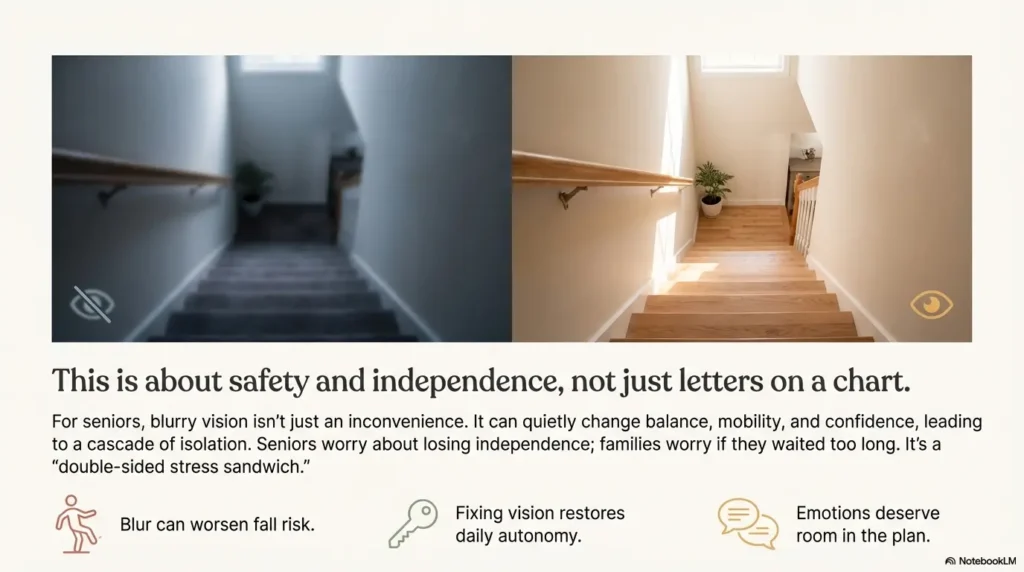
What surprised me was how a “routine” surgery can still feel emotionally loaded. Seniors often worry about losing independence if something goes wrong. Families worry about “What if we waited too long?” It’s a double-sided stress sandwich.
- Blur can worsen fall risk and confidence
- Fixing vision can restore daily autonomy
- Emotions deserve room in the plan
Apply in 60 seconds: Ask your loved one which daily task feels most risky right now.
Truth 1: The most common complications are often small and fixable
If you’re time-poor, here’s what matters: you’re not trying to memorize every rare term; you’re trying to recognize the few things that require fast care.
- Normal-ish early signs: mild scratchy feeling, light sensitivity, watery eye
- Call same day: new severe pain, sudden vision drop, intense redness
- Bring to the visit: your drop schedule and any medication list
Truth 2: Dry eye is the sneaky culprit that makes results feel “worse”
If one thing deserves a bigger warning label, it’s dry eye. Seniors already have higher dry-eye risk, and surgery can temporarily worsen surface irritation. The shock is psychological: people expect an instant HD upgrade. Dry eye can make vision fluctuate, especially later in the day.
Dry eye can cause irritation and fluctuating vision, but do not assume it explains a new visual problem after surgery. Ask the clinic about persistent or worsening symptoms. Sudden loss of vision, severe or worsening pain, new flashes or floaters, or a curtain or shadow require immediate eye care.
Show me the nerdy details
The tear film is the eye’s first refractive surface. Even with a perfect intraocular lens, unstable tear quality can blur contrast and cause fluctuating clarity. That’s why surgeons often treat the surface aggressively both before and after surgery.
Truth 3: Premium lens expectations can create regret if you don’t define success
This was the truth that hit my wallet and my heart at the same time. The decision between standard monofocal lenses and premium options can feel like buying a car with a mysterious “vision performance package.” Premium lenses can be amazing for the right person, but they are not a happiness vending machine.
In older adults who drive at night or are sensitive to halos, the conversation about trade-offs matters. This is not fear; it’s clarity.
- Define top 3 daily tasks first
- Ask about glare and night-vision trade-offs
- Get a written lens recommendation
Apply in 60 seconds: Write down three must-win activities: driving, reading, screens, hobbies.
Decision card: Standard vs premium IOL
- Choose standard monofocal if you want predictable clarity for one main distance and a simpler cost path. (See how it compares in monofocal vs. multifocal vs. toric IOL.)
- Consider premium if you value reduced glasses dependence and accept possible trade-offs like halos or contrast changes.
Save this card and confirm the lens options on your provider’s official patient materials.
Cost questions for standard and optional lens services (US)
Money conversations can feel awkward—like you’re throwing a calculator into a medical moment. But for time-poor families, cost clarity prevents last-minute stress. In the U.S., Medicare generally covers medically necessary cataract surgery with a standard IOL, while patients may still have deductibles or coinsurance depending on supplemental coverage. Premium lens upgrades often involve additional out-of-pocket costs.
Request a written quote separating patient charges for the surgeon, facility, anesthesia, any lens upgrade, medication, and separately billed follow-up. Confirm whether the remaining deductible and other cost sharing are already included, so they are not omitted or counted twice.
Fee/Rate table (typical structure, not a guarantee)
| Cost element | What it usually includes | Who often pays more |
|---|---|---|
| Standard cataract surgery package | Surgeon + facility workflow + standard IOL | Patients without supplemental coverage |
| Premium IOL upgrade | Multifocal/EDOF/toric upgrades and related measurements | Patients choosing advanced lens features |
| Post-op drops and visits | Medication plan + follow-up schedule | Those with complex eye conditions |
Save this table and confirm the current fee on the provider’s official page.
Calculator: subtotal of quoted patient charges
Enter the quoted patient charges below (use 0 only for a confirmed zero charge):
Save your estimate and confirm today’s numbers with the clinic’s written quote.
Truth 4: Preparation and medication review matter before surgery
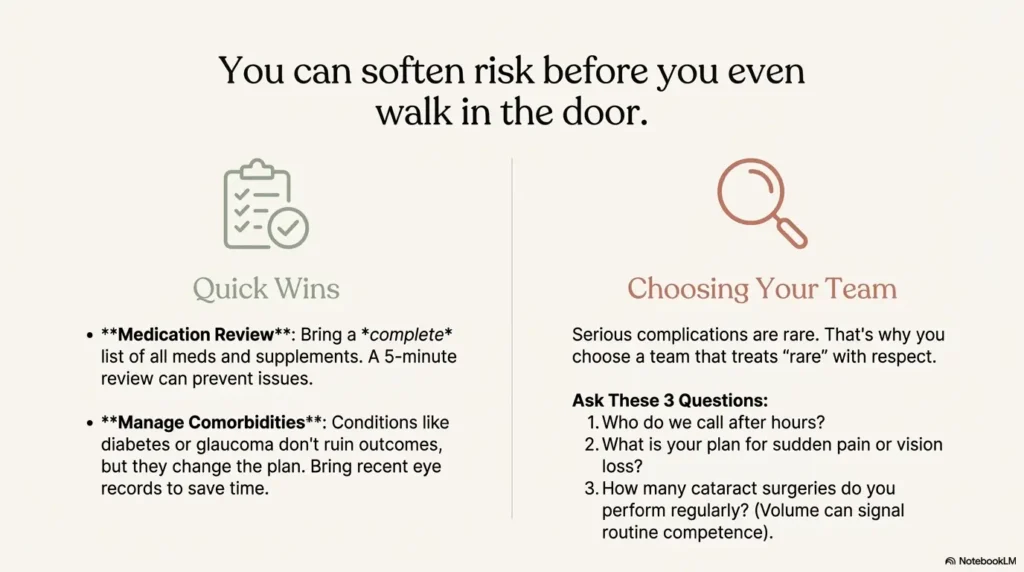
We brought an updated list of everything—blood thinners, diabetes meds, supplements, the whole “kitchen-sink pharmacy.” The doctor clarified what to continue and what to pause. That 5-minute review made me feel like we’d just found a hidden lever in a machine we didn’t fully understand.
Preparation questions for the surgical team
- Yes/No: We have a complete medication list for review.
- Yes/No: We understand the drop schedule for the first week.
- Yes/No: We arranged transportation for day 0 and day 1.
- Yes/No: We know which symptoms require same-day contact.
If any item is unclear, contact the surgical team before the procedure. This checklist cannot provide medical clearance. Obtain written fasting, medication, and drop instructions well in advance, and do not stop blood thinners, diabetes medicines, or other drugs on your own.
Truth 5: “Cloudy again” doesn’t always mean failure
Cloudiness months or years after surgery can result from posterior capsule opacification (PCO), in which the capsule behind the implanted lens becomes cloudy. The cataract itself has not grown back. An eye examination is needed because other causes of blur require different treatment; suitable PCO is often treated with a YAG laser procedure.
The emotional lesson here was huge: don’t confuse a common fix with a catastrophic outcome. Seniors can be quick to blame themselves for not following drops perfectly or not resting enough. The truth is this can happen even when everything was done right.
- Listen for “foggy again” complaints
- Schedule a quick check
- Reassure seniors they didn’t “ruin” anything
Next step: Report recurrent blur to your eye team rather than waiting for a calendar reminder. Sudden blur or other warning symptoms need immediate eye care.
Truth 6: Rare risks shape smart surgeon choice
We asked three blunt, polite questions:
- Who do we call after hours?
- What is your plan for sudden pain or vision loss?
- How many cataract surgeries do you perform regularly?
That last one felt awkward, like asking someone how many omelets they’ve made before breakfast. But volume can signal routine competence. The reassurance you’re buying isn’t just surgical skill; it’s a system that catches problems fast.
Truth 7: Comorbidities don’t automatically ruin outcomes—but they change the plan
Practical step: Bring recent eye records and a complete medication list so the team can plan around existing conditions and avoid unnecessary duplication.
Recovery instructions to request in writing
The post-op experience is where families either glide or spiral. Seniors often feel a weird mix of confidence and fragility: they want to prove they’re fine, but they’re also dealing with new routines and vision changes.
- Day 0–1: expect blur, light sensitivity, mild irritation.
- Week 1: vision often improves in steps, not a straight line.
- Later recovery: Healing can continue for several weeks; ask when the eye is ready for final refraction and usual activities.
Use a written drop chart with the medicine name, correct eye, dose, and times exactly as prescribed. Set reminders for those actual times; a generic morning/evening schedule may miss required doses.
- Make the drop schedule clear and easy to check
- Plan the first 48 hours tightly
- Normalize slow, stepwise improvement
Next step: Ask the clinic to check your drop chart, then set reminders for every prescribed dose and any planned taper.
Coverage and quote-prep for seniors: what to gather before you compare
Even when the medical side is clear, the payment side can feel like a maze with polite lighting. If your loved one is in the U.S., ask how Medicare, Medigap, or Medicare Advantage will apply to the facility and surgeon. If you’re in the U.K., ask whether you’re on an NHS pathway or considering private timing. The core idea is universal: get the fee structure in writing, early.
Quote-prep list
- Insurance cards and plan names
- Medication list
- Lens options summary
- Any prior eye diagnoses (glaucoma, diabetic changes, macular issues)
Save this list and confirm what your clinic wants before the final scheduling call.

How to pick a surgeon without falling into review roulette
Online reviews help, but they can’t replace a structured conversation. We looked for a practice that felt like a system, not a solo act: clear pre-op testing, transparent lens counseling, and a consistent follow-up plan.
- Ask how emergencies are handled after hours
- Ask who coordinates complex cases
- Ask whether they routinely manage seniors with your loved one’s conditions
A simple infographic: the 3 lanes of post-op urgency

- Mild scratchiness
- Light sensitivity
- Gradual improvement
- Persistent blur past expected window
- Persistent mild irritation or glare without sudden worsening
- New bothersome glare
- Severe or worsening pain, marked redness
- Sudden vision drop
- New flashes or a sudden increase in floaters; a curtain or shadow
Save this infographic and confirm your clinic’s emergency instructions for your exact case.
FAQ
How common are serious cataract surgery complications in seniors?
Most seniors experience smooth recoveries, and serious complications are uncommon. The key is not to obsess over rare outcomes but to prepare for fast response if warning symptoms appear. Apply in 60 seconds: Save your clinic’s after-hours number in your phone.
What symptoms should make us call the surgeon immediately?
Severe or worsening pain, sudden vision loss, marked redness, new flashes or floaters, or a curtain over vision need immediate contact with the surgical team and urgent eye assessment. If you cannot reach the team, use an emergency eye service. Save the after-hours number in advance.
Is it normal for vision to fluctuate after surgery?
Yes. Fluctuations can happen, especially with dry eye or while the eye is stabilizing. Consistent drops and surface care often help. Apply in 60 seconds: Add preservative-free artificial tears to your post-op supply list if your team approves them.
Will my parent still need glasses after cataract surgery?
Many seniors still need glasses for certain distances, particularly with standard monofocal lenses. The goal is better function, not necessarily zero glasses. Apply in 60 seconds: Ask, “Which daily task will this lens optimize?”
How should we think about costs and insurance?
Request a written breakdown that separates standard surgery costs from premium lens upgrades and post-op medications. This prevents surprises and helps you compare fairly. Apply in 60 seconds: Use the mini calculator with the clinic’s quote numbers.
What if my parent has diabetes or glaucoma?
These conditions can influence lens choice and recovery expectations, but they don’t automatically prevent good outcomes. A tailored plan matters. Apply in 60 seconds: Bring recent eye records to the pre-op visit.
Optional video: Open the video on YouTube (external site).
Your 15-minute pre-surgery plan
In the next 15 minutes, you can do three high-leverage things: (1) write down your loved one’s top three daily priorities, (2) confirm the warning signs that require same-day contact, and (3) request a written cost and lens breakdown. That’s not just preparation. That’s peace.
- Define success in daily-life terms
- Prevent avoidable anxiety with a system
- Get costs in writing before upgrade decisions
Apply in 60 seconds: Ask for a one-page written plan covering lens choice, drops, and emergency steps.
Updated October 15, 2026. Clarified urgent symptoms, recurrent cloudiness, medication planning, drop reminders, and cost-subtotal limitations. Sources: National Eye Institute, NHS cataract guidance, and Medicare coverage. Discuss personal risks and recovery with the surgical team.
PUT THIS GUIDE TO WORK · INTERACTIVE WORKSHEET
Prepare a cataract-risk and aftercare discussion
Use this worksheet alongside the article: Cataract Surgery Complications in Seniors: 7 Issues to Discuss. Use the fields provided to organize your notes and next actions, then save your worksheet.
Your entries stay in this page and are cleared when you reload. No account is needed. Saved files are downloaded only to your device.
This card organizes a discussion or task. It does not provide diagnosis, treatment, medication timing, driving clearance, or professional approval. Copy clinical instructions exactly and ask the professional about uncertainty.
How to use your result
Save the worksheet before leaving this page. Recheck any quote, date, or instruction with the relevant provider, pharmacist, manufacturer, or official organization. A completed checklist means you recorded the steps, not that an outcome is guaranteed.
Worksheet added October 20, 2026. Read the article above for context and its stated review scope.