

Organize your questions and next steps, then save your worksheet.
Summary and next steps
Does Medicare cover prescription glasses? Usually not, except after qualifying cataract surgery. See Part B and Medicare Advantage rules before you buy.
Editorial maintenance: October 24, 2026. Summary layout, related links and technical metadata updated. This is not a full clinical review.

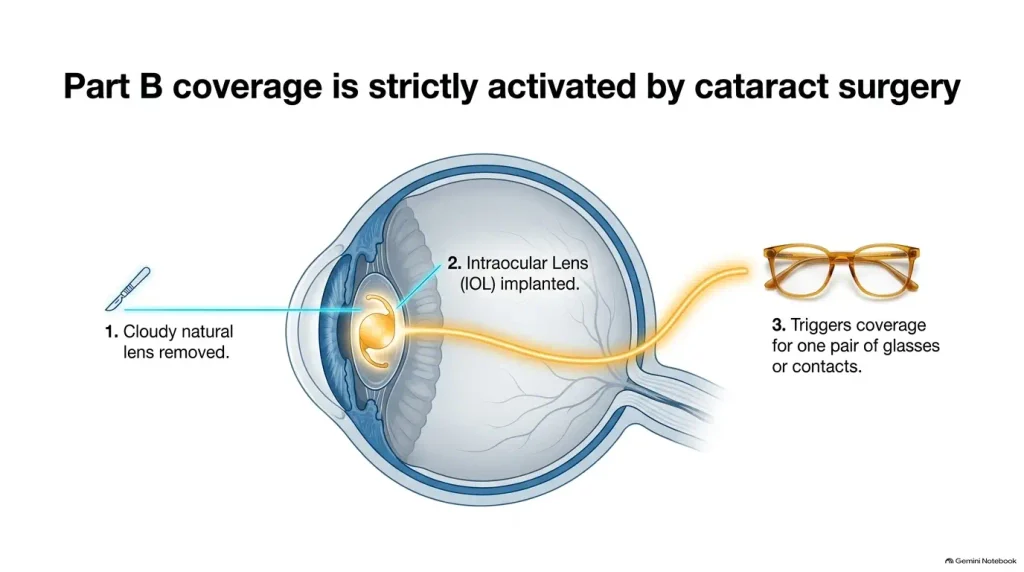
Usually, no. Original Medicare generally does not cover routine prescription glasses, contact lenses, or the routine eye refraction used to determine your glasses prescription. The main exception is important: Medicare Part B can help pay for one pair of eyeglasses with standard frames, or one set of contact lenses, after each cataract surgery that implants an intraocular lens.
The first thing to check is which Medicare coverage you actually have. If you have Original Medicare, the cataract-surgery exception is the key rule. If you have Medicare Advantage, your private plan may include an additional routine vision benefit. Before ordering glasses, verify the benefit, the optical provider, and any frame or lens allowance. Otherwise, an ordinary pair of prescription glasses can remain entirely your responsibility.
Table of Contents
What Original Medicare Actually Covers for Prescription Glasses
Original Medicare Part A and Part B do not provide a general eyewear allowance simply because you need prescription correction. Medicare’s official eyeglasses and contact lens coverage rules state that Part B does not usually cover eyeglasses or contact lenses.
| Situation | Original Medicare | What to Check |
|---|---|---|
| Routine prescription glasses | Generally not covered | Other insurance or Medicare Advantage benefits |
| Routine eye refraction for glasses | Generally not covered | Ask whether a separate refraction charge applies |
| Glasses after qualifying cataract surgery | Part B can cover one pair with standard frames | Supplier eligibility and Part B cost sharing |
| Premium frame or other upgrade | Additional charges may apply | Separate the covered amount from the upgrade price |
| Medicare Advantage member | Plan may offer extra vision benefits | Allowance, network, frequency and exclusions |
This distinction prevents a common and expensive assumption: Medicare may pay for certain medical eye services without paying for the glasses you need afterward.
The Cataract Surgery Exception: When Part B Helps Pay
After cataract surgery that implants an intraocular lens, Part B covers one pair of eyeglasses with standard frames or one set of contact lenses after each qualifying surgery. This is not a general annual vision benefit. It is a specific post-cataract benefit.
There is another detail worth checking before you walk into an optical shop: Medicare says it will pay for these covered corrective lenses only when they come from a supplier that participates in Medicare. A prescription from your surgeon does not, by itself, make every optical retailer eligible for Medicare payment.
If cataract surgery is the reason you need glasses, review the more focused Medicare cataract surgery glasses rule before choosing frames. That distinction matters because standard covered eyewear and optional upgrades can produce very different bills.
How Much Could Covered Cataract Glasses Cost in 2026?
For the post-cataract eyewear benefit, the Part B deductible and coinsurance rules apply. The 2026 Part B annual deductible is $283. After the applicable deductible has been met, you generally pay 20% of the Medicare-approved amount for covered corrective lenses.
Illustrative example: suppose the Medicare-approved amount for eligible post-cataract glasses is $200 and you have already satisfied your 2026 Part B deductible.
- Medicare-approved amount: $200
- Your 20% coinsurance: $40
- Remaining 80% of the approved amount: $160
Now suppose you choose an upgraded frame that adds $120 beyond what Medicare covers. Your simplified out-of-pocket amount could become $40 in coinsurance plus the $120 upgrade, or $160 total.
That example assumes the deductible was already met, the supplier accepts assignment for this covered claim, and the item and claim qualify. The store’s retail price is not necessarily the Medicare-approved amount. Ask the supplier whether it accepts assignment: this means accepting the approved amount as full payment for the covered item, with your applicable deductible and coinsurance still due. Uncovered upgrades remain separate.
Use Medicare’s eyewear coverage rules and the CMS 2026 deductible notice to check the rule behind the estimate; ask the supplier for a written itemized quote.
Medicare Advantage May Cover Routine Glasses, but the Benefit Is Plan-Specific
Medicare Advantage changes the decision because these plans may offer vision benefits beyond Original Medicare. Medicare confirms that Medicare Advantage plans can provide extra benefits, including vision services, but each plan determines the details within Medicare’s rules.
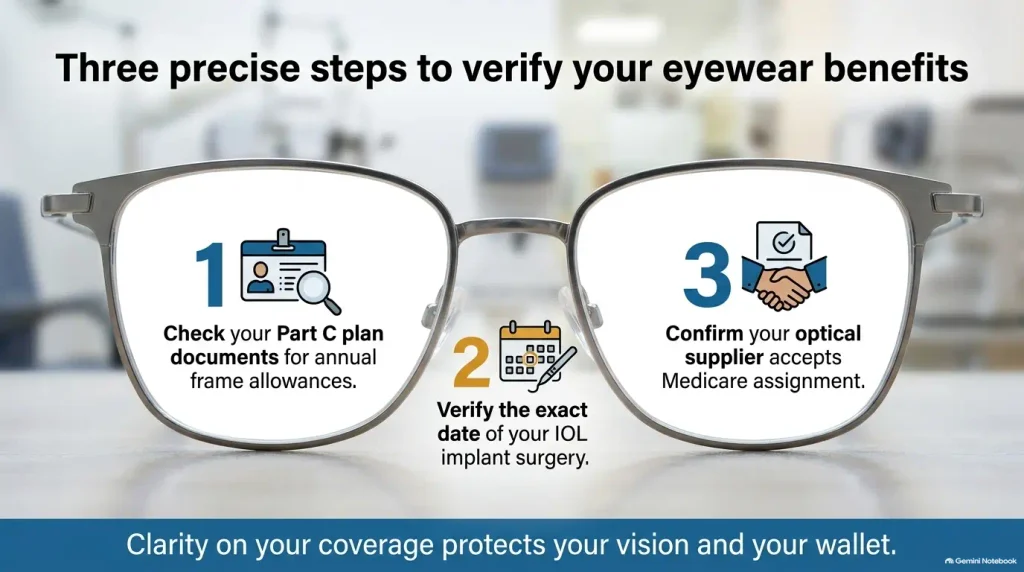
Do not stop at the phrase “vision included.” Before buying glasses, inspect the plan’s Summary of Benefits or Evidence of Coverage and verify these five points:
- How often can you use the eyewear benefit? Look for the plan’s benefit period or frequency limit.
- Is there an allowance, copayment, or another cost-sharing structure? Find the actual dollar rule rather than assuming glasses are free.
- Must you use an in-network optical provider? An attractive allowance is less useful if your preferred retailer is outside the plan’s network.
- What counts toward the benefit? Check frames, lenses, contacts and any excluded upgrades separately.
- Is the routine eye exam or refraction handled separately? The exam and the glasses may have different benefits.
You can compare the structural differences using Medicare’s Original Medicare and Medicare Advantage comparison, but your own plan documents control the supplemental vision benefit available to you.
A Five-Minute Coverage Check Before You Buy Glasses
The fastest way to avoid an unnecessary eyewear bill is to verify coverage before the lenses are made. Once custom glasses are ordered, reversing the purchase can be much harder than asking five questions first.
- Identify your coverage: Original Medicare or a Medicare Advantage plan.
- Ask why the glasses might be covered: routine prescription change, post-cataract benefit, or a Medicare Advantage supplemental benefit.
- Confirm the optical provider: ask whether the supplier can bill your specific Medicare coverage or Medicare Advantage plan.
- Ask for the covered price and upgrades separately: frames, progressive lenses, coatings, tinting and other options should not disappear into one unexplained total.
- Get your estimated out-of-pocket amount before ordering: ask what portion is expected to be covered and what portion is your responsibility.
If the salesperson says, “Medicare covers it,” ask the more useful question: Which Medicare benefit is paying for it, and what amount will I owe after the claim? That usually exposes the difference between genuine coverage and a hopeful assumption.
Why Medicare Can Cover an Eye Visit but Not Your New Glasses
Medicare separates medical eye care from routine refractive care. Part B can cover certain medically necessary eye services and specific screenings, including qualifying care related to conditions such as diabetes, glaucoma or macular degeneration. That does not automatically create coverage for routine prescription eyewear.
Likewise, Original Medicare does not generally cover the routine eye examination or refraction performed simply to prescribe eyeglasses or contact lenses. Medicare explains this distinction in its routine eye exam coverage guidance.
This is why one eye-care appointment can generate both a Medicare-covered medical service and a separate non-covered refraction charge. If that fee appears on your bill, the guide to the Medicare refraction fee explains what to check before assuming the office billed you incorrectly.
What Medigap Does and Does Not Change
A Medigap policy should not be confused with a routine vision plan. Medigap is mainly designed to help with certain out-of-pocket costs for services covered by Original Medicare. Medicare states that Medigap policies generally do not cover vision care or glasses.
That means Medigap does not normally transform an ordinary, non-covered pair of prescription glasses into a Medicare-covered purchase. Depending on your Medigap policy, however, it may help with applicable Medicare cost sharing when the underlying service or item is actually covered by Original Medicare.
Before assuming a supplement will pay, check Medicare’s official Medigap coverage explanation and then confirm the terms of your specific policy.
If Medicare Will Not Pay, Avoid Paying for Features You Do Not Need
If routine prescription glasses are not covered, the useful decision shifts from “Will Medicare pay?” to “Which parts of this quote actually solve my vision problem?” Ask the optical provider to separate the base frame, prescription lenses and optional features.
Some upgrades may be worthwhile for an individual prescription or daily activity, while others may add cost without solving the problem that brought you to the optical shop. Your eye-care professional determines what prescription and lens design are clinically appropriate; the insurer or Medicare plan determines what it will cover; you decide whether uncovered upgrades are worth purchasing.
Also check other coverage you already have before buying a separate vision product. Retiree coverage, employer-sponsored benefits, Medicaid for eligible beneficiaries, or another existing benefit may affect what you actually need to pay. Coverage varies, so confirm the specific program rather than assuming that having two insurance cards means one will cover eyewear.
Frequently Asked Questions About Medicare and Prescription Glasses
Does Medicare give you money for new glasses every year?
Original Medicare does not provide a general annual allowance for routine glasses. A Medicare Advantage plan may offer a recurring eyewear benefit, but the frequency and dollar amount depend on that individual plan.
Do progressive lenses become covered just because they are prescription lenses?
No. Needing progressive, bifocal or another prescription lens design does not by itself create routine eyewear coverage under Original Medicare. If you qualify for the post-cataract corrective-lens benefit, ask which lens and frame features fall within the covered benefit and which are considered additional upgrades.
Can an eye disease make Medicare cover my regular glasses?
Not automatically. Medicare may cover qualifying medical examinations, diagnostic testing or treatment for an eye condition while routine corrective eyewear remains non-covered. Medical coverage for the disease and coverage for the glasses should be checked as two separate questions.
Can I use a Medicare Advantage eyewear benefit at any glasses store?
Not necessarily. Some plans may limit supplemental vision benefits to particular providers or apply different rules outside their network. Before ordering, give the optical provider your exact plan information and confirm network status directly with the plan when there is any uncertainty.
Could Medicaid help if Original Medicare does not cover my glasses?
Possibly. Medicaid vision benefits and eligibility rules vary by state and beneficiary category. If you have both Medicare and Medicaid, check your state Medicaid benefits before paying cash for routine eyewear.
Optional video: Open the video on YouTube (external site).
Your Next 10 Minutes: Verify the Benefit Before the Order Is Placed
Take out your Medicare card or Medicare Advantage card and call the number that administers your coverage. Ask one sentence: “For prescription glasses, what vision benefit do I have, how often can I use it, and must I use a particular optical provider?”
If your glasses follow cataract surgery, add: “Does this supplier qualify for Medicare’s post-cataract corrective-lens benefit, and which frame or lens upgrades would I pay for myself?” Write down the representative’s answer, the date, and any reference number before authorizing the order.
That short check separates three very different situations: eyewear Medicare does not cover, post-cataract eyewear Part B can cover, and supplemental vision benefits supplied by a Medicare Advantage plan. Knowing which bucket you are in is the part that can save the bill from becoming an unpleasant little optical surprise.
Targeted update: 17 October 2026. Verified Medicare eyewear coverage, assignment guidance, and the 2026 Part B deductible; added an illustrative remaining-deductible calculation.
PUT THIS GUIDE TO WORK · INTERACTIVE WORKSHEET
Post-cataract eyewear cost planner
Use this worksheet alongside the article: Does Medicare Cover Prescription Glasses?. Use the fields provided to organize your notes and next actions, then save your worksheet.
Your entries stay in this page and are cleared when you reload. No account is needed. Saved files are downloaded only to your device.
This worksheet does not establish coverage or eligibility. Use the Part B model only after the provider confirms a covered service and accepts assignment. It uses deductible applied + 20% of the remaining approved amount + extra charges. Medigap, Medicaid, other insurance, facility charges, excess charges, and plan-specific rules are not modeled. A plan quote is entered directly rather than applying the Part B formula.
Verify Medicare’s current costs and assignment rules · Worksheet rules checked October 20, 2026.
How to use your result
Save the worksheet before leaving this page. Recheck any quote, date, or instruction with the relevant provider, pharmacist, manufacturer, or official organization. A completed checklist means you recorded the steps, not that an outcome is guaranteed.
Worksheet added October 20, 2026. Read the article above for context and its stated review scope.