

Organize your questions and next steps, then save your worksheet.
Summary and next steps
Medicare glasses after cataract surgery may be covered by Part B. See what Medicare pays, what costs extra, and what to check before you order.
Editorial maintenance: October 24, 2026. Summary layout, related links and technical metadata updated. This is not a full clinical review.

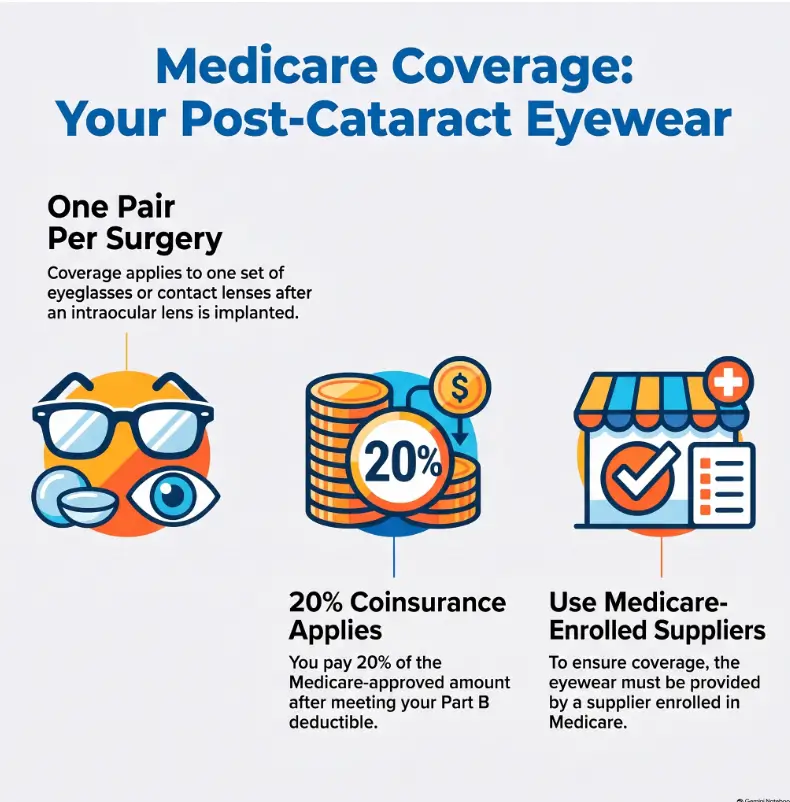
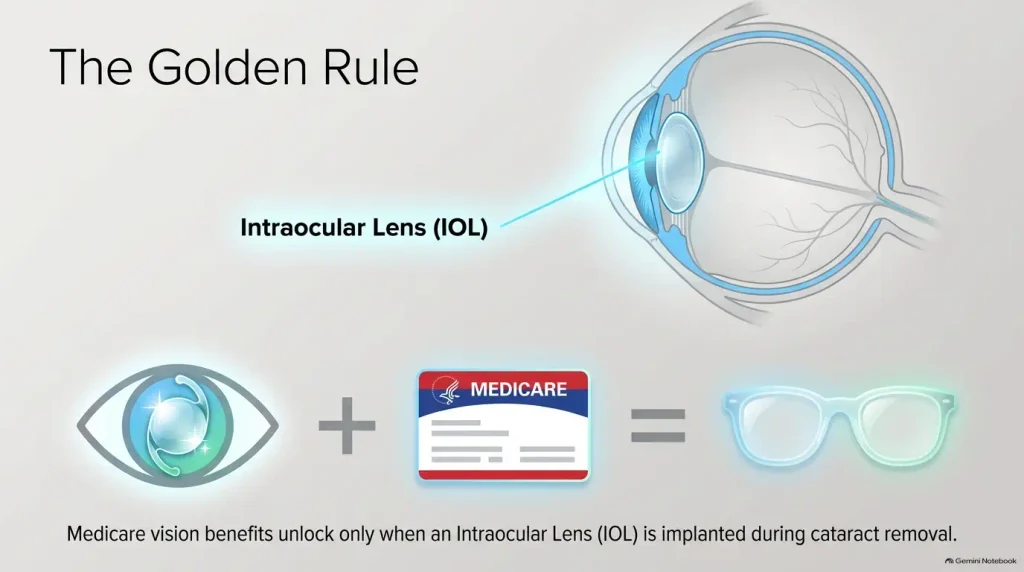
Yes. Medicare Part B can cover one pair of eyeglasses with standard frames, or one set of contact lenses, after each cataract surgery that implants an intraocular lens (IOL). This is a specific exception to Medicare’s usual rule that routine eyeglasses are not covered.
The variable that matters most is not simply whether you had cataract surgery. The eyewear must follow qualifying surgery with an implanted IOL, and you must get it from a supplier that participates in Medicare. Under Original Medicare, the Part B deductible applies, then you generally pay 20% of the Medicare-approved amount for the covered corrective lenses. Upgraded frames and many optional lens features can create additional out-of-pocket costs.
Before ordering anything, ask the optical supplier one question: “Will you bill Medicare for my post-cataract eyewear benefit, and which parts of this quote are not covered?” That short conversation can prevent a surprisingly expensive pair of glasses from quietly becoming a fully self-pay purchase.
Table of Contents
What Medicare Actually Covers After Cataract Surgery
Original Medicare normally does not pay for prescription glasses or contact lenses. Cataract surgery creates a narrow exception. According to Medicare’s current eyeglasses and contact lens coverage rules, Part B covers one pair of eyeglasses with standard frames or one set of contact lenses after each cataract surgery that implants an IOL.
| Situation | Original Medicare treatment | What to verify |
|---|---|---|
| Eyeglasses after qualifying cataract surgery with an IOL | Covered benefit | Supplier participation and Medicare-approved amount |
| Contact lenses instead of glasses | May be chosen instead of the covered pair of glasses | Do not assume Medicare pays for both |
| Standard frames | Included within the covered benefit | Which frames the supplier treats as standard |
| Upgraded or deluxe frames | Extra cost is generally your responsibility | Ask for the upgrade amount separately |
| Routine prescription glasses unrelated to qualifying cataract surgery | Generally not covered by Original Medicare | Check other insurance or Medicare Advantage vision benefits |
The phrase “one pair” matters. This is not an ongoing eyewear allowance. It does not turn Medicare into routine vision insurance, and it does not automatically cover a future replacement whenever your prescription changes.
How Much You May Pay for the Covered Glasses
For Original Medicare, your cost is based on the Medicare-approved amount, not necessarily the optical shop’s retail sticker price. After the Part B deductible is satisfied, you generally pay 20% of the Medicare-approved amount for the covered corrective lenses.
The annual Part B deductible is $283 in 2026. Medicare publishes current figures in its Medicare cost information. Whether you have already met that deductible can materially change what you owe at the optical counter.
Illustrative example
Suppose the Medicare-approved amount for your covered post-cataract glasses is $200, and assume you have already met your 2026 Part B deductible.
- Medicare-approved amount: $200
- Your 20% coinsurance: $40
- Medicare’s share: $160
Now suppose you choose a frame upgrade that adds $150 and that upgrade is not covered. Your simplified out-of-pocket amount could become $40 in Medicare coinsurance plus the $150 upgrade, or $190.
If you still had $100 of your Part B deductible remaining in this example, that remaining deductible would have to be satisfied before normal Part B coinsurance applies to the balance. Your real claim can differ because Medicare-approved amounts, secondary coverage, and the items selected all matter.
If you are still sorting out the surgery bill itself, rather than the glasses, see the site’s guide to Medicare cataract surgery costs in 2026.
Standard Glasses and Optional Upgrades Are Not the Same Bill
The easiest way to overspend is to hear “Medicare covers glasses” and assume the entire pair on the display rack is covered. Medicare’s benefit is built around covered corrective lenses and standard frames. Optional upgrades can sit outside that benefit.
CMS coverage policy identifies several features that may be non-covered for a post-cataract beneficiary, including progressive lenses, certain deluxe lens features, scratch-resistant coatings, polarization, some high-index or lightweight materials, and deluxe frames. Medical necessity can alter treatment of particular materials in limited circumstances, so the supplier should determine how the exact item will be billed.
The practical move is to request two numbers before choosing the glasses:
- the amount associated with the Medicare-covered standard option, and
- the additional amount you would personally pay for upgrades.
If the supplier cannot clearly separate those numbers, do not assume the attractive frame package on the counter represents the covered benefit.
Why the Optical Supplier Matters as Much as the Prescription
Having eligible surgery does not guarantee that Medicare will pay whichever optical store you happen to visit. Medicare states that it will only pay for post-cataract eyeglasses or contact lenses from a supplier that participates in Medicare.
That makes supplier verification one of the highest-value checks you can perform. Before placing an order or paying a deposit, ask whether the location participates in Medicare and whether it will submit the post-cataract eyewear claim correctly. You can also use Medicare’s supplier search tool when checking participating suppliers.
“Do you participate in Medicare for post-cataract eyeglasses, and will you bill Medicare for this specific order?”
That question is more useful than simply asking, “Do you take Medicare?” A store may handle some Medicare-related business without your particular eyewear transaction being processed the way you expect.
The Eye Refraction May Still Be a Separate Charge
A covered pair of post-cataract glasses does not mean every service used to produce the prescription is automatically covered. Original Medicare generally does not cover routine eye exams performed to determine a prescription for eyeglasses or contact lenses, often called refractions.
Medicare explains this separately in its routine eye exam coverage rules. That distinction is why a patient can legitimately receive Medicare-covered post-cataract eyewear yet still encounter a separate refraction charge.
If an unfamiliar refraction fee appears on your eye doctor’s bill, the site’s guide to the Medicare refraction fee explains that billing issue in more detail.
Before paying, ask the practice to identify which charge was for medical postoperative care and which charge was for prescription refraction. They are not necessarily treated the same way by Medicare.
If Both Eyes Have Cataract Surgery, Timing Can Affect the Benefit
Separate cataract surgeries can create a post-surgery eyewear benefit after each qualifying procedure, but Medicare does not simply accumulate unused pairs for later.
CMS policy provides an especially useful example: if you have cataract surgery with an IOL in the first eye, later have the second eye treated, and do not obtain glasses between the surgeries, Medicare generally covers only one pair after the second surgery rather than two pairs saved up from both procedures. The detailed rule appears in CMS’s refractive lens coverage policy.
This makes timing a real decision rather than a paperwork detail. If your surgeries are close together, ask your surgeon when your refraction is expected to stabilize and ask the supplier how the Medicare benefit would be handled before buying interim glasses. Your surgeon decides when your eyes are clinically ready for a prescription; Medicare and the supplier determine coverage and claim processing.
Original Medicare and Medicare Advantage Can Produce Different Eyewear Bills
If you have Medicare Advantage rather than Original Medicare, do not assume the optical shop should apply the Original Medicare process directly. Medicare Advantage plans must provide Medicare-covered benefits, but many also offer additional routine vision benefits with their own networks, allowances, copayments, frequency limits, and authorization rules.
An advertised vision allowance may therefore be separate from the specific post-cataract benefit. Medicare explains the broader structural differences in its Original Medicare and Medicare Advantage comparison.
Before ordering eyewear under a Medicare Advantage plan, call the number on the plan card and ask:
- Is post-cataract eyewear processed as a Medicare-covered medical benefit or through my supplemental vision benefit?
- Must I use an in-network optical provider?
- Do I have a dollar allowance, copayment, or coinsurance?
- Are standard frames treated differently from frame or lens upgrades?
- Does the plan require a claim, referral, authorization, or specific documentation from my surgeon?
The plan, not the optical store’s general sales policy, controls how your Medicare Advantage benefit is administered.
Your Five-Minute Coverage Check Before You Order
You do not need to become a Medicare billing expert. You need five pieces of information that fit on one sheet of paper.
- Confirm the surgery: Write down the cataract surgery date and whether an IOL was implanted.
- Identify your Medicare setup: Original Medicare or Medicare Advantage.
- Check the supplier: Confirm that the optical supplier can bill the applicable Medicare benefit before ordering.
- Separate standard from upgraded: Ask for the Medicare-covered portion and optional upgrade charges to be shown separately.
- Check your deductible: If you have Original Medicare, determine whether your 2026 Part B deductible has already been met.
Keep the prescription, surgeon information, optical order, receipt, and any Medicare paperwork together until the claim is settled. If small print and paperwork are becoming a barrier, this site’s Medicare paperwork tips can help simplify the review process.
What to Do If the Claim or Quote Still Looks Wrong
If coverage appears eligible but the price still looks wrong, work through the problem in order rather than arguing about the final total first.
- If Medicare was never billed: ask whether the supplier participates in Medicare and whether the order was submitted as post-cataract eyewear.
- If Medicare was billed but paid less than expected: compare the Medicare-approved covered items with any non-covered upgrades.
- If a separate eye-exam fee appears: determine whether it was a non-covered refraction rather than postoperative medical care.
- If you have Medicare Advantage: verify network and vision-benefit rules directly with the plan.
- If the explanation still does not match the paperwork: request an itemized bill and compare it with the processed Medicare claim or plan explanation before paying a disputed balance.
Coverage questions are easiest to solve when “glasses: $450” is broken into its actual components. A standard frame, covered lenses, progressive upgrade, coating, refraction, and retail add-on are very different billing questions even when they all arrive on the same afternoon.

Frequently Asked Questions
Does Medicare replace the post-cataract glasses if I lose or break them?
For a beneficiary with an implanted IOL, Medicare’s post-cataract benefit is generally limited to the covered pair associated with the qualifying surgery. CMS policy does not treat ordinary replacement frames, lenses, or contact lenses as another covered pair simply because the original was lost, damaged, or the prescription later changed. Other insurance or a Medicare Advantage vision benefit may have different rules.
What if my cataract surgery happened before I became eligible for Medicare?
CMS policy states that refractive lenses can still qualify even when surgical removal of the natural lens occurred before Medicare entitlement. Because previous eyewear, the type of surgery, and current eligibility can affect claim handling, ask a Medicare-participating supplier to verify the specific case before ordering.
What if no intraocular lens was implanted?
The common Medicare rule discussed in this article applies to cataract surgery with an implanted IOL. People without a natural lens and without an IOL, known as aphakia, can fall under different prosthetic-lens coverage rules. The supplier should verify the applicable Medicare policy rather than treating the case as ordinary routine eyewear.
Is a Medicare Advantage eyewear allowance the same thing as the cataract benefit?
Not necessarily. A Medicare Advantage plan may provide supplemental routine vision benefits in addition to Medicare-covered services. Those extra benefits can use different networks, dollar allowances, copayments, or frequency limits, so ask the plan how it wants post-cataract eyewear processed.
Optional video: Open the video on YouTube (external site).
The One Check Worth Doing Before You Pay
Take the optical quote and draw a line between Medicare-covered standard eyewear and everything optional or separately billed. Then confirm that the supplier is eligible to bill Medicare and that your deductible status has been considered.
If those pieces are clear, the bill usually becomes much easier to understand. If they are not clear, ask for an itemized estimate before the glasses are made. Once an upgrade has been ordered, the conversation is no longer about what Medicare covers. It is also about what you chose to buy.
Editorial update: October 22, 2026. Clarified this page’s coverage-and-upgrades focus, removed a stray opening phrase and added separate ordering and supplier guides. This update is not a clinical review.
PUT THIS GUIDE TO WORK · INTERACTIVE WORKSHEET
Post-cataract eyewear cost planner
Use this worksheet alongside the article: Medicare Glasses Coverage After Cataract Surgery. Use the fields provided to organize your notes and next actions, then save your worksheet.
Your entries stay in this page and are cleared when you reload. No account is needed. Saved files are downloaded only to your device.
This worksheet does not establish coverage or eligibility. Use the Part B model only after the provider confirms a covered service and accepts assignment. It uses deductible applied + 20% of the remaining approved amount + extra charges. Medigap, Medicaid, other insurance, facility charges, excess charges, and plan-specific rules are not modeled. A plan quote is entered directly rather than applying the Part B formula.
Verify Medicare’s current costs and assignment rules · Worksheet rules checked October 20, 2026.
How to use your result
Save the worksheet before leaving this page. Recheck any quote, date, or instruction with the relevant provider, pharmacist, manufacturer, or official organization. A completed checklist means you recorded the steps, not that an outcome is guaranteed.
Worksheet added October 20, 2026. Read the article above for context and its stated review scope.