

Organize your questions and next steps, then save your worksheet.
Summary and next steps
Medicare vision coverage differs for routine exams, glasses, and medical eye care. See what Part B covers, key exceptions, and what to check before paying.
Editorial maintenance: October 24, 2026. Summary layout, related links and technical metadata updated. This is not a full clinical review.

Medicare Vision Coverage:
What Is and Isn’t Covered
You can sit through an eye exam, hand over your Medicare card, and still discover that one part of the visit is covered while another part is entirely your responsibility. That is not necessarily a billing mistake. Medicare treats routine vision correction differently from medical eye care.
Original Medicare generally does not cover routine eye refractions or ordinary eyeglasses. Yet Part B can cover specific eye services connected to diabetes, glaucoma risk, age-related macular degeneration, cataract surgery, and other medically necessary care when Medicare’s requirements are met.
This guide shows you how to tell those categories apart, what to ask before an appointment, where Medicare Advantage may change the answer, and how to avoid paying for something simply because nobody clarified the service before the bill arrived.
The fastest money-saving move is to name the exact service before asking whether it is covered. 👓
Snapshot
Who this is for: Medicare beneficiaries, caregivers, and families trying to understand an eye-care bill or plan an upcoming exam. What it solves: the confusion between routine vision benefits and Medicare-covered medical eye care. After reading: you should be able to identify which coverage question to ask before paying.
Table of Contents
Before You Act
This article can help you organize coverage questions, but it cannot determine whether a particular test is medically necessary or whether your individual claim will be approved. An eye professional determines what examination or treatment is clinically appropriate; Medicare or your Medicare Advantage plan determines coverage under its rules. Sudden new floaters, flashes of light, or a dark curtain or shadow in your vision can be symptoms of retinal detachment and should be evaluated promptly rather than delayed while you investigate benefits. The National Eye Institute describes retinal detachment as a medical emergency.
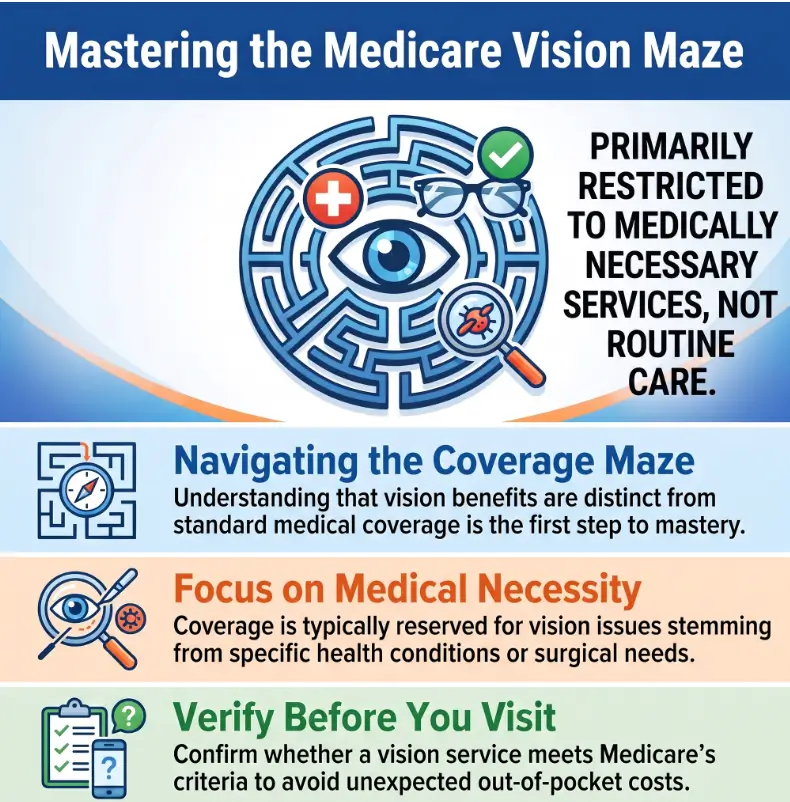
The 30-Second Answer: Routine Vision vs. Medical Eye Care
Original Medicare does not provide a general routine vision benefit. A routine eye exam performed mainly to determine an eyeglass or contact-lens prescription, often called a refraction, is not covered by Original Medicare. You generally pay the full cost.
That does not mean Medicare ignores your eyes. Part B covers certain eye-related services when specific medical or risk-based requirements apply. Examples include annual diabetic retinopathy exams for people with diabetes, glaucoma screenings for eligible high-risk beneficiaries, certain testing and treatment for age-related macular degeneration, and covered cataract surgery.
| Eye-care situation | Original Medicare | What to verify |
|---|---|---|
| Routine refraction for a glasses prescription | Generally not covered | Ask whether the refraction fee is separate |
| Ordinary eyeglasses or contact lenses | Generally not covered | Check other coverage or Medicare Advantage benefits |
| Diabetic retinopathy eye exam | Part B covers eligible exams once a year | Provider eligibility and your cost-sharing |
| Glaucoma screening | Part B covers eligible high-risk beneficiaries once every 12 months | Confirm that you meet a high-risk category |
| AMD diagnostic testing or treatment | Part B may cover qualifying care | Confirm the specific test, drug, and setting |
| Eyewear after covered cataract surgery with an intraocular lens | One pair of standard-frame glasses or one set of contacts may be covered | Use a participating supplier and ask about upgrades |
Key Takeaway: Do not ask only, “Does Medicare cover eye exams?” Ask, “Does Medicare cover this specific eye service for this medical reason?” That small change usually produces a much better answer.
The Three Doors of Medicare Eye Coverage
Refraction, ordinary glasses, ordinary contacts. Original Medicare usually says no.
Diabetes or qualifying glaucoma risk can trigger specific Part B benefits.
Covered diagnosis, treatment, and cataract care may fall under Part B rules.
Medicare’s official routine-eye-exam page is worth bookmarking if an office tells you that a standard prescription exam will be covered simply because you have Part B.
Check routine eye exam coverage on Medicare.gov
What Original Medicare Usually Does Not Cover
Routine refraction is the most common surprise
You may schedule what everyone casually calls an “eye exam,” but the appointment can contain several separate services. The doctor may evaluate an eye condition and also perform a refraction to determine your updated prescription.
Original Medicare specifically excludes routine eye exams for eyeglasses or contact lenses, including refraction. This is why a person can have Medicare-covered medical eye care and still receive a separate bill for the prescription portion of the visit.
If that is the issue you are trying to price, the site’s guide to the Medicare refraction fee is the more useful next question.
Most ordinary glasses and contact lenses are also outside Original Medicare
Original Medicare generally does not cover the glasses or contacts you routinely buy to correct nearsightedness, farsightedness, astigmatism, or presbyopia. The major exception is qualifying corrective eyewear after covered cataract surgery with an intraocular lens.
That distinction matters because an eyeglass store saying it “accepts Medicare” does not mean Medicare will pay for an ordinary pair of prescription glasses. Coverage depends on the item and the circumstances, not merely the store’s billing capability.
Key Takeaway: A Medicare card is not a routine vision plan. Think of Original Medicare primarily as medical insurance that includes certain covered eye services, not as an annual glasses-and-refraction benefit.

What Medicare Part B May Cover for Your Eyes
The useful part of the Medicare vision story begins when the question moves from “What is my glasses prescription?” to “Is there a covered screening, disease, diagnostic test, treatment, or surgery involved?”
If you have diabetes
Medicare Part B covers an eye exam for diabetic retinopathy once a year for beneficiaries who have diabetes. The exam must be performed by an eye doctor legally allowed to perform it in the state. After the Part B deductible, the beneficiary generally pays 20% of the Medicare-approved amount for the doctor’s services, with additional cost-sharing possible in a hospital outpatient setting.
For the cost side of that benefit, see how Medicare diabetic eye exam costs can be structured.
Verify Medicare’s diabetic eye exam benefit
If you are at high risk for glaucoma
Part B covers glaucoma screening once every 12 months for beneficiaries who meet Medicare’s high-risk criteria. Medicare currently lists diabetes, a family history of glaucoma, being African American and age 50 or older, or being Hispanic and age 65 or older among the qualifying categories. After the Part B deductible, Medicare states that the beneficiary generally pays 20% of the Medicare-approved amount, with an additional copayment possible in a hospital outpatient setting.
If diabetes is the reason you may qualify, the more focused guide on Medicare glaucoma screening for people with diabetes can help you prepare the right questions.
If you have age-related macular degeneration
Part B may cover certain diagnostic tests and treatments for age-related macular degeneration, including treatment with certain injectable drugs. Medicare states that cost-sharing commonly includes 20% of the Medicare-approved amount after the Part B deductible, although the care setting and other coverage can affect what you actually owe.
If an eye condition requires medically necessary care
The fact that routine refraction is excluded does not mean every examination of the eye is excluded. Medicare Part B covers defined medical and preventive services when its coverage conditions are met. The practical issue is identifying what the doctor is evaluating and which individual services are being billed.
Show me the nerdy details
Medicare coverage works at the service level, not simply at the appointment level. One office visit can contain a covered medical evaluation, a covered diagnostic test, and a non-covered refraction. This is why asking “Is today’s appointment covered?” can produce an answer that is technically true but financially incomplete.
A better pre-visit question is: “Which services do you expect to perform, and is the refraction billed separately?” If you have Medicare Advantage, add: “Are all of those services in network and subject to any plan-specific authorization or benefit rules?”
Cataract Surgery, Glasses, and the Important Medicare Exception
Eyewear after cataract surgery is the exception many Medicare beneficiaries hear about, but the details matter.
Medicare Part B covers one pair of eyeglasses with standard frames, or one set of contact lenses, after each covered cataract surgery that implants an intraocular lens. After the Part B deductible, Medicare currently states that you generally pay 20% of the Medicare-approved amount for the corrective lenses. You are responsible for additional costs associated with upgraded frames. Medicare also requires the glasses or contacts to come from a supplier that participates in Medicare.
Before ordering post-cataract glasses, ask four questions:
- Was my cataract surgery a Medicare-covered procedure with an intraocular lens?
- Does this eyewear supplier participate in Medicare?
- Which frames are considered standard under the covered benefit?
- What portion of my chosen frame or lens options would be an upgrade I pay for myself?
If you are still deciding about surgery, review the separate guide to Medicare cataract surgery costs. If the operation is already behind you, go directly to how Medicare glasses coverage works after cataract surgery.
Check Medicare’s eyeglasses and contact lens rules
Example scenario: The surgery is covered, but the upgrade is not
Illustrative example: A beneficiary has Medicare-covered cataract surgery and later visits an optical supplier for the post-surgery pair of glasses. The supplier offers a basic frame and several higher-priced designs. Medicare’s post-cataract benefit may apply to qualifying standard eyewear, but choosing an upgraded frame can create additional out-of-pocket cost.
The useful question is not simply, “Are my glasses covered?” It is, “Which part of this order falls within Medicare’s post-cataract benefit, and what am I adding beyond that benefit?”
The same habit works throughout Medicare: separate the covered service from the optional upgrade before comparing prices.
How Medicare Advantage Vision Benefits Can Change the Answer
Medicare Advantage plans must provide the Medicare-covered services required of Part A and Part B, but many plans also offer extra benefits that Original Medicare does not provide. Medicare specifically notes that some Medicare Advantage plans offer additional vision benefits.
That may include routine eye care or eyewear benefits, depending on the individual plan. The words “vision included,” however, tell you very little about the usable value of the benefit.
| Question | Original Medicare | Medicare Advantage |
|---|---|---|
| Routine refraction | Generally not covered | May be included as an extra benefit |
| Routine glasses | Generally not covered | May have an allowance or other plan benefit |
| Covered medical eye care | Part B rules apply | Covered Medicare benefits remain required, but plan rules may apply |
| Provider choice | Check Medicare participation | Network status can be especially important |
| Prior authorization | Generally less common under Original Medicare | May apply to certain covered services |
| What determines your cost | Medicare-approved amount, deductible, coinsurance, setting, supplemental coverage | Plan copays, network, benefit limits, allowances, and other plan terms |
Seven questions to ask about a Medicare Advantage vision benefit
- Is a routine eye exam included?
- Is refraction included, or billed separately?
- How often can I use the routine exam benefit?
- Is there an eyeglass or contact-lens allowance?
- Which optical providers are in network?
- Are frames, lenses, lens options, and contacts treated differently?
- When does an unused allowance expire or reset?
Key Takeaway: Do not compare Medicare Advantage plans by the headline value of a vision allowance alone. A generous-looking benefit can be much less useful if your preferred eye doctor is outside the network or the allowance excludes what you actually buy.
More importantly, changing your Medicare coverage is a much larger decision than buying a pair of glasses. Medical networks, prescription drug coverage, prior authorization rules, total out-of-pocket exposure, and access to specialists can matter far more than a routine vision extra. Treat vision as one line in the comparison sheet, not the whole sheet.
The 10-Minute Medicare Vision Coverage Check
You do not need to become a Medicare billing expert before an eye appointment. You need a small amount of precise information.
Minute 1–2: Name the reason for the visit
- Routine prescription update?
- Diabetic retinopathy exam?
- Glaucoma screening?
- New symptom?
- Follow-up for a diagnosed eye disease?
- Cataract evaluation or post-surgery eyewear?
The word “eye exam” is too broad for a useful coverage answer.
Minute 3–5: Ask the eye office what will be billed
You can use this wording:
“I have Medicare. Is this visit being scheduled as routine vision care or medical eye care? Will you perform a refraction, and if so, is that billed separately? Are there any services you expect Medicare not to cover?”
Minute 6–8: Verify the payer side
With Original Medicare, check the relevant Medicare coverage page and confirm that the provider or supplier meets Medicare requirements. With Medicare Advantage, call the member-services number on the plan card and describe the exact service.
Do not stop at “yes, vision is covered.” Ask for frequency limits, network requirements, copay or coinsurance, allowances, and any other plan conditions that affect your situation.
Minute 9–10: Ask what you will owe if Medicare says no
The most useful final question is wonderfully plain: “If this part is not covered, what is the expected self-pay price?”
Now you can make a decision instead of discovering the decision after the service has already happened.
A Simple Coverage Decision Flow
Expect Original Medicare exclusions. Ask for the self-pay price or check other vision coverage.
Check the specific Part B eligibility rule before the appointment.
Confirm the ordered service, provider, setting, and Medicare or plan rules.
Add network, frequency, allowance, and authorization questions.
What You Can Check, What the Eye Doctor Decides, and What Medicare Determines
Insurance questions become much easier when three jobs are kept separate.
| What you can do now | What an eye professional decides | What Medicare or your plan determines |
|---|---|---|
| Describe why you are making the appointment | Which examination is clinically appropriate | Whether the billed service meets coverage rules |
| Ask whether refraction is separate | Which diagnostic tests are medically appropriate | Your deductible, copay, coinsurance, or non-covered amount |
| Verify provider or supplier participation and network status | Diagnosis and treatment recommendations | Whether plan authorization or other conditions apply |
| Request an estimate for non-covered care | Whether symptoms require urgent evaluation | Final claim processing and benefit application |
This separation is especially important when an insurer denies something. A denial does not automatically mean the test was medically unnecessary, and a doctor’s recommendation does not automatically mean Medicare must cover the service. Those are different questions.
Key Takeaway: Your doctor answers “What care do I need?” Medicare answers “Does this benefit pay under these rules?” Your job is to make sure those two conversations meet before the bill does.
When Free Verification Is Enough and When Extra Vision Coverage Matters
If your main problem is uncertainty, do not buy anything yet. A phone call to the eye office and your insurer may solve the problem for free.
Spending money becomes relevant when the remaining issue is not confusion but an actual coverage gap: routine refraction, ordinary glasses, contact lenses, frame upgrades, or other services outside your existing benefits.
| Approach | May fit when | Check before paying | Potential poor value |
|---|---|---|---|
| Pay routine vision costs yourself | Your routine needs are modest or infrequent | Cash exam price, refraction fee, eyewear total | Buying more coverage than your likely use justifies |
| Use existing employer, retiree, Medicaid, or other eligible coverage | You already have another source of benefits | Coordination rules and provider network | Assuming two types of coverage automatically stack |
| Use a Medicare Advantage vision extra | Your existing plan includes a useful routine vision benefit | Network, frequency, allowance, copays, lens restrictions | Choosing a broader Medicare plan mainly for a modest eyewear perk |
| Pay for an eyewear upgrade | The covered or basic option does not meet your preferences | Exact incremental upgrade cost | Paying for features you do not need or cannot comfortably use |
What problem would justify spending more?
A paid option makes more sense when it solves a clearly identified gap. Perhaps you need routine refractions every year, replace glasses frequently, use expensive lens options, or prefer providers unavailable through a limited network.
What should you test first?
Calculate what your existing coverage already provides and what you would otherwise pay yourself. Benefits should be compared against your actual eye-care habits, not against the largest number printed in a brochure.
Which features matter?
- Provider network
- Routine exam frequency
- Whether refraction is included
- Eyewear allowance or benefit limits
- Frame versus lens rules
- Contact-lens treatment
- Copays and coinsurance
- Benefit expiration or reset dates
A premium benefit is poor value when the provider network does not work for you, the allowance cannot be used on what you actually need, or the broader health-plan tradeoffs outweigh the vision perk.
Common Medicare Vision Billing Traps to Avoid
Mistake 1: Assuming “annual eye exam” means covered preventive care
Medicare’s yearly wellness visit and its “Welcome to Medicare” preventive visit are not substitutes for a routine comprehensive eye exam. The “Welcome to Medicare” visit can include a simple vision test, but Medicare still excludes routine eye exams for prescription eyeglasses.
Mistake 2: Forgetting that a refraction can be billed separately
A medical eye appointment can still include a non-covered routine prescription service. Ask before the refraction is performed if the fee matters to your budget.
Mistake 3: Buying post-cataract eyewear from the wrong supplier
Medicare says it will only pay for qualifying post-cataract eyeglasses or contact lenses from a supplier that participates in Medicare. Confirm participation before ordering, not after the glasses are made.
Mistake 4: Treating an eyewear allowance as cash
A Medicare Advantage vision allowance may be tied to specific providers, products, frequencies, or plan years. Ask how the benefit actually works before choosing a frame based on the headline amount.
Mistake 5: Waiting for insurance answers when symptoms may be urgent
Coverage verification is useful for planned care. It should not delay evaluation of sudden major visual changes, especially flashes, a sudden shower of floaters, or a curtain-like shadow associated with retinal detachment warning signs.
Before You Leave an Eye Appointment
- Ask which services were billed as medical care.
- Ask whether a separate refraction was performed.
- Keep your receipt and itemized statement.
- If something is denied, identify the exact denied service before assuming the entire visit was denied.
- Compare the explanation from the provider with the Medicare Summary Notice or your plan’s explanation of benefits.

Medicare Vision Coverage FAQ
Does Medicare cover an annual eye exam for seniors?
Original Medicare does not generally cover a routine eye exam performed to determine a prescription for eyeglasses or contact lenses. It does cover certain eye exams and screenings when specific medical or eligibility requirements are met, such as qualifying diabetic retinopathy exams and glaucoma screenings.
Does Medicare cover an eye exam if I have diabetes?
Part B covers an eye exam for diabetic retinopathy once a year for beneficiaries with diabetes, subject to Medicare’s provider and coverage requirements. Cost-sharing generally applies after the Part B deductible.
Does Medicare pay for glaucoma testing?
Part B covers glaucoma screening once every 12 months for people Medicare considers at high risk. The qualifying categories currently include diabetes, family history of glaucoma, certain age and ethnicity criteria, and required provider qualifications.
Does Medicare pay for eyeglasses?
Original Medicare generally does not cover ordinary eyeglasses. A major exception is one pair of standard-frame glasses or one set of contacts after each covered cataract surgery that implants an intraocular lens, subject to Medicare’s rules.
Can Medicare Advantage cover routine eye exams and glasses?
Yes, some Medicare Advantage plans offer extra vision benefits that Original Medicare does not cover. The actual benefit can vary by plan, so verify the routine exam benefit, refraction coverage, eyewear allowance, network, frequency, and cost-sharing directly with your plan.
My eye doctor says Medicare will not cover something. What should I ask?
Ask for the exact service being discussed, why the provider recommends it, whether another part of the visit is covered, and the expected self-pay amount. If you have Medicare Advantage, also verify network and plan requirements with member services. Do not delay medically urgent evaluation simply to settle a coverage question first.
Optional video: Open the video on YouTube (external site).
Your Next 15 Minutes
Take out your Medicare or Medicare Advantage card and write down the reason for your next eye visit in one sentence. Avoid the phrase “eye exam” by itself. Write something specific: “routine glasses prescription,” “annual diabetic retinal exam,” “glaucoma screening,” “cataract follow-up,” or “new blurred vision.”
Then call the eye office and ask two questions: What services are you expecting to perform, and is refraction billed separately? If you have Medicare Advantage, make one second call to member services and confirm the provider, benefit, network, frequency, and expected cost-sharing.
Where to go next
If the uncovered charge is the prescription portion of the exam: review the Medicare refraction fee guide.
If diabetes is driving the visit: check the Medicare diabetic eye exam cost guide.
If glaucoma screening is the issue: review Medicare glaucoma screening eligibility for people with diabetes.
If cataract surgery has changed the coverage question: continue with the Medicare post-cataract glasses guide.
The central rule is simple enough to keep on a sticky note: identify the service first, then verify the coverage. That prevents a surprisingly large share of Medicare vision confusion before it turns into a bill.
Last reviewed: 2026-09
PUT THIS GUIDE TO WORK · INTERACTIVE WORKSHEET
Eye-care out-of-pocket cost planner
Use this worksheet alongside the article: Medicare Vision Coverage: What Is and Isn’t Covered. Use the fields provided to organize your notes and next actions, then save your worksheet.
Your entries stay in this page and are cleared when you reload. No account is needed. Saved files are downloaded only to your device.
This worksheet does not establish coverage or eligibility. Use the Part B model only after the provider confirms a covered service and accepts assignment. It uses deductible applied + 20% of the remaining approved amount + extra charges. Medigap, Medicaid, other insurance, facility charges, excess charges, and plan-specific rules are not modeled. A plan quote is entered directly rather than applying the Part B formula.
Verify Medicare’s current costs and assignment rules · Worksheet rules checked October 20, 2026.
How to use your result
Save the worksheet before leaving this page. Recheck any quote, date, or instruction with the relevant provider, pharmacist, manufacturer, or official organization. A completed checklist means you recorded the steps, not that an outcome is guaranteed.
Worksheet added October 20, 2026. Read the article above for context and its stated review scope.