

Organize your questions and next steps, then save your worksheet.
Summary and next steps
Medicare eye care costs without vision insurance depend on the service. See what Part B may cover, what stays cash-pay, and what to price before booking.
Editorial maintenance: October 24, 2026. Summary layout, related links and technical metadata updated. This is not a full clinical review.

Medicare Eye Care Costs Without Vision Insurance:
What You May Pay and What Medicare Still Covers
You can have Medicare and still walk out of an eye appointment with a bill for the exam, the refraction, the glasses, or all three. The confusing part is that Medicare does cover some eye care. It simply draws a sharp line between routine vision services and medical eye care.
That line matters when you do not have separate vision insurance. A routine prescription check may be entirely your responsibility, while an examination for diabetic retinopathy, certain glaucoma screening, cataract care, or treatment of an eye disease may qualify for Medicare Part B coverage.
This guide shows you how to identify which wallet a service belongs in, ask for the right prices before the appointment, and decide whether paying cash or adding vision coverage makes more sense for your actual eye-care habits.
👁️ The money-saving question is not simply “Does Medicare cover eye care?” It is “What kind of eye care am I receiving?”
Snapshot
For people with Medicare who do not have a separate routine vision benefit. You will learn which eye-care costs are commonly paid in cash, which services may qualify for Part B, and how to get a usable price before agreeing to an exam, test, or pair of glasses.
Table of Contents
Before You Act
This guide helps you understand cost and coverage questions. It cannot determine why your vision changed or whether a particular examination is medically necessary. Sudden new floaters, flashes, a dark curtain or shadow in your vision, severe eye pain, or sudden major vision change should not be treated as a routine glasses-shopping problem. Seek prompt medical evaluation.
The Fast Answer: What You Pay Without Vision Insurance
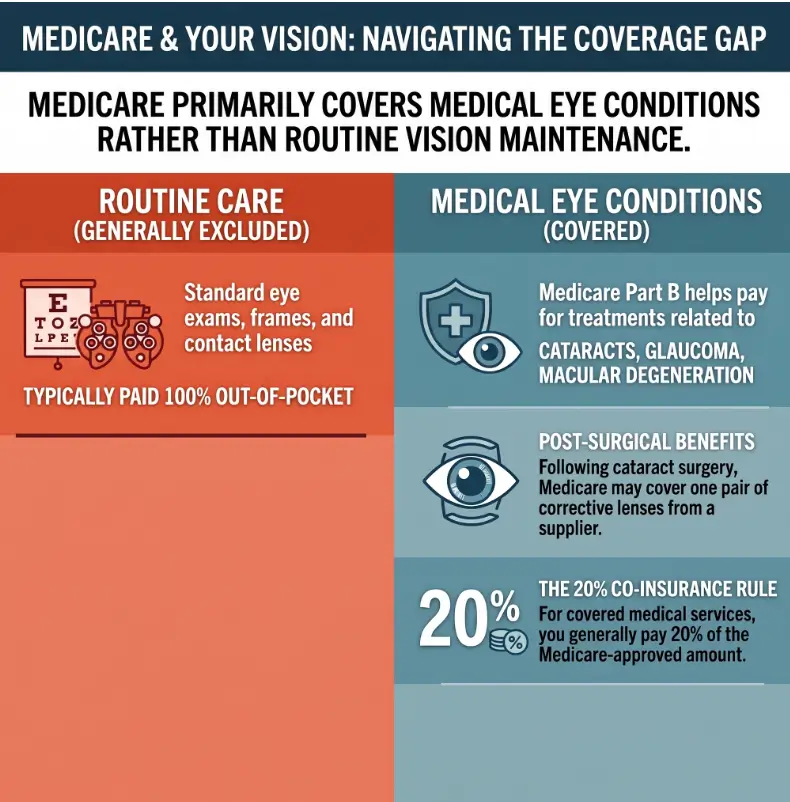
If you have Original Medicare but no separate vision coverage, expect to pay the full price for most routine eye exams performed to obtain a glasses or contact-lens prescription. Medicare specifically states that routine eye exams, sometimes described as eye refractions, are not covered for eyeglasses or contact lenses.
Most ordinary eyeglasses and contact lenses are also not covered. The major exception is corrective lenses after qualifying cataract surgery in which an intraocular lens is implanted.
Medical eye care is different. Medicare Part B can cover eligible examinations, tests, and treatment related to conditions such as diabetic retinopathy, glaucoma risk, cataracts, macular degeneration, or other medically necessary eye problems.
For 2026, the annual Part B deductible is $283. For many Part B-covered services, you generally pay 20% of the Medicare-approved amount after meeting the deductible when the provider accepts Medicare assignment. Hospital outpatient services can involve additional facility cost-sharing.
Key Takeaway
No vision insurance does not mean every eye-related visit is uncovered. Routine prescription services and medical eye care travel through different payment paths.
If an office quotes a separate charge for determining your glasses prescription, our guide to the Medicare refraction fee explains why that particular part of the visit can remain your responsibility even when another portion of the appointment is covered.
Routine Vision and Medical Eye Care Use Different Medicare Rules
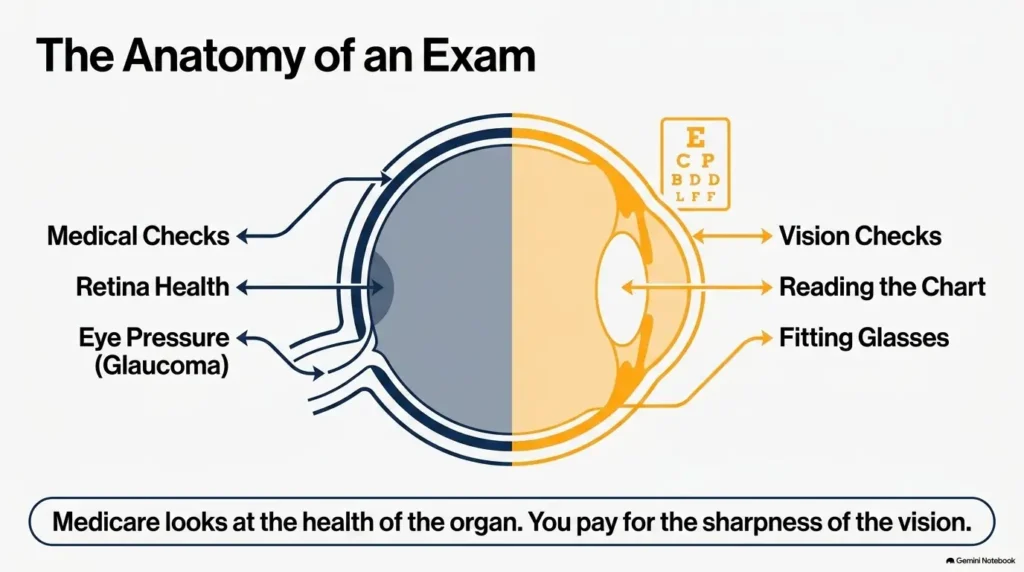
The easiest way to understand Medicare eye costs is to stop thinking of an eye appointment as one indivisible service. A single visit can contain several pieces, and those pieces may not share the same coverage status.
Routine vision care asks, “What prescription helps me see clearly?”
A routine vision visit commonly centers on visual acuity, refractive error, and the prescription needed for glasses or contact lenses. Original Medicare does not generally cover the routine refraction performed for this purpose.
You can confirm the rule directly on the Medicare routine eye exam coverage page.
Medical eye care asks, “Is there a disease, injury, or medical problem to evaluate or treat?”
Blurred vision can sometimes be a prescription issue, but it can also accompany cataracts, retinal disease, glaucoma, diabetes-related eye disease, inflammation, or other medical conditions. When a clinician evaluates or treats a medical eye problem and Medicare’s requirements are met, Part B rules may apply.
The clinician determines what is medically appropriate. The provider and Medicare determine how the service is coded and whether it meets coverage requirements. The patient can ask questions and verify costs, but should not try to persuade an office to label a routine service as medical simply to obtain coverage.
Real-world example
Consider an illustrative patient who schedules an appointment because reading has become blurry. The examination finds a change in glasses prescription, but no medical eye disease requiring treatment.
The patient may be responsible for the routine refraction and new glasses because those services fall on the routine vision side.
Now change one fact: the patient has diabetes and is due for an eligible diabetic retinopathy examination. That covered medical examination can follow Part B rules, while a separate refraction performed to produce a new glasses prescription may still remain an out-of-pocket charge.
One appointment, two payment categories. That is the piece many surprise bills are built around.
Build Your Eye-Care Cost Map Before the Appointment
There is no reliable national cash price for “an eye exam” because that phrase can describe several different bundles. Location, provider type, facility, tests performed, contact-lens fitting, and eyewear choices can all change the bill.
A better approach is to price the pieces before you compare providers.
| Possible charge | What to ask | Why it matters |
|---|---|---|
| Comprehensive eye examination | “What is the self-pay price?” | Establishes the base appointment cost. |
| Refraction | “Is refraction included or charged separately?” | This is a common Medicare coverage gap. |
| Dilation | “Is dilation included in the exam price?” | Prevents assuming every clinical step is bundled. |
| Retinal imaging or other testing | “Is it medically necessary, optional, and covered?” | Optional imaging can change the total quickly. |
| Contact-lens fitting | “Is fitting separate from the eye exam?” | A contact prescription can involve additional work. |
| Frames | “What is the frame price before discounts?” | Keeps the frame allowance from hiding the true cost. |
| Prescription lenses | “What is included in the base lens?” | Progressives and other options can alter the quote. |
| Lens upgrades | “Which upgrades are optional?” | Helps separate useful features from automatic upsells. |
Key Takeaway
Do not compare “exam prices.” Compare the same bundle of services. A lower advertised price is not cheaper if refraction, fitting, or required tests are added later.
Show me the nerdy details
The cleanest comparison is an all-in annual eye-care cost. Add the routine exam, separate refraction, expected eyewear, contact-lens fitting if applicable, replacement frequency, and likely non-covered extras. Then compare that total with the complete annual cost of any vision plan, including premiums, copays, network limitations, material allowances, waiting rules if applicable, and the portion of upgraded lenses you would still pay yourself. The advertised allowance is not the same thing as your financial savings.
Eye Services Medicare May Still Cover
Not having routine vision insurance does not erase Medicare’s medical eye benefits. Several common situations deserve a coverage check before you agree to pay the entire bill yourself.
Diabetic retinopathy eye examinations
Medicare Part B covers an eligible eye examination for diabetic retinopathy once a year for people with diabetes. After the Part B deductible, Medicare says the beneficiary generally pays 20% of the Medicare-approved amount for the doctor’s services, with possible additional cost in a hospital outpatient setting.
See Medicare’s official diabetic eye exam coverage guidance, or use our Medicare diabetic eye exam cost guide when the immediate question is what you may owe.
Glaucoma screening for people at high risk
Part B covers glaucoma screening once every 12 months for people who meet Medicare’s high-risk criteria. Medicare currently lists diabetes, a family history of glaucoma, African American beneficiaries age 50 or older, and Hispanic beneficiaries age 65 or older among the qualifying categories.
If glaucoma risk is your concern, the high-risk glaucoma and Medicare guide can help you prepare the next coverage questions before scheduling.
Corrective lenses after cataract surgery
Original Medicare does not normally pay for glasses or contacts, but Part B covers one pair of eyeglasses with standard frames or one set of contact lenses after each qualifying cataract surgery that implants an intraocular lens. Medicare also requires the eyewear supplier to participate in Medicare for this benefit.
Before purchasing postoperative glasses elsewhere, review the Medicare cataract surgery glasses rule. This is one situation where buying first and asking about Medicare later can be an expensive order of operations.
Key Takeaway
Before paying cash for an eye service, ask whether the purpose is routine prescription care, preventive screening under a specific Medicare benefit, or diagnosis and treatment of a medical eye condition.
The 10-Minute Call That Can Prevent a Surprise Eye Bill
The most useful cost-saving tool here is not a coupon. It is a short phone call before the appointment.
Ask the eye office these questions
- Do you accept Original Medicare, and do you accept Medicare assignment?
- What is the cash price for a routine comprehensive eye exam?
- Is refraction included in that price or billed separately?
- If my visit is for a medical eye condition, which services do you expect to bill to Medicare?
- Are any tests you plan to perform optional rather than medically necessary?
- If retinal imaging is offered, is it included, covered, or self-pay?
- Is there a separate contact-lens fitting charge?
- Can you give me an estimated patient responsibility before the service?
Then call Medicare or your plan when the answer is unclear
Have the name of the service, provider, and reason for the visit in front of you. If the office gives you a procedure code, keep it with your notes. Coverage still depends on the actual service and Medicare rules, but precise information produces a much better conversation than asking whether “eye stuff” is covered.
If you find Medicare paperwork difficult to sort after the visit, the site’s guide to Medicare notices for seniors can help you organize what the notice is telling you before you make the next call.
A useful phone script
“I have Medicare but no separate routine vision coverage. Before I schedule, could you tell me the self-pay price for the exam, whether refraction is separate, and which services you expect to submit to Medicare if the visit involves a medical eye problem?”
How to Control Glasses and Contact Lens Costs Without Vision Insurance
Once the prescription is written, Medicare’s routine vision gap becomes more visible. Most ordinary frames, prescription lenses, and contacts are out-of-pocket expenses under Original Medicare.
That does not automatically mean buying the cheapest product on the shelf. It means deciding which parts of the purchase affect function and which are optional upgrades.
| Approach | Best fit | Check before paying | Watch out for |
|---|---|---|---|
| Existing frames + new lenses | Frames still fit and are in usable condition | Whether the optical shop will reglaze your frame and what happens if it breaks | Old or fragile frames that cannot tolerate lens replacement |
| Basic new pair | Simple prescription and budget priority | Total price including lenses, not frame-only advertising | Add-ons quietly doubling the quote |
| Progressive or specialized lenses | Prescription or daily tasks genuinely require them | Measurements, adaptation policy, remake policy | Paying for premium options that do not solve your actual task |
| Contact lenses | People who prefer or require contacts | Fitting fee, evaluation fee, supply price, replacement schedule | Comparing lens boxes while ignoring fitting costs |
Try the free part first: define the task
Before choosing premium lenses, identify what is actually difficult. Reading a paperback at 16 inches? Seeing a dashboard? Working at a desktop monitor? Moving between near and distance vision all day?
The correct product is the one that performs the real task comfortably and safely. A feature list is not a substitute for that test.
If the question is simply whether over-the-counter readers may be enough, the site’s reading glasses for seniors guide provides a useful next step. If you are preparing for an appointment instead, use the eye doctor visit checklist.
Know the cataract exception before buying
If you recently had qualifying cataract surgery with an implanted intraocular lens, do not assume your postoperative glasses are automatically a normal cash purchase. Medicare’s eyeglasses and contact lenses coverage page explains the limited postoperative benefit and supplier requirements.
When the Cheapest Option Stops Being the Right Option
A cash-pay routine exam, inexpensive readers, or a basic pair of prescription glasses can be perfectly sensible when the problem is straightforward. The free-before-paid principle still needs a stopping rule.
Sudden showers of new floaters, flashes of light, or a dark curtain or shadow can be symptoms of retinal detachment, which the National Eye Institute identifies as a medical emergency. Severe eye pain with sudden blurry vision, red eye, or nausea can also require emergency assessment.
Key Takeaway
A glasses budget is useful only after you are reasonably sure the problem belongs in the glasses aisle. Persistent or sudden vision changes deserve clinical evaluation.
Is Separate Vision Coverage Worth Paying For?
Not necessarily. The absence of a routine Medicare vision benefit does not automatically make a separate vision plan good value.
Vision coverage tends to be easier to evaluate than major medical insurance because much of the spending is predictable. That makes a simple annual comparison possible.
Compare the entire year, not the frame allowance
- Add the annual vision-plan premiums.
- Add the exam copay or coinsurance.
- Add material copays.
- Estimate what you would pay above the frame or contact allowance.
- Add non-covered lens upgrades you actually use.
- Check whether your preferred eye doctor and optical shop are in network.
- Compare the result with the cash prices you already collected.
A plan may make more sense when spending is predictable
A person who gets an exam every year and regularly replaces prescription glasses or contacts has a different cost pattern from someone who uses inexpensive readers and replaces them infrequently.
The question is not whether the plan “includes glasses.” The question is whether the benefits you expect to use exceed the premium, copays, uncovered upgrades, and network friction.
Do not expect Medigap to become routine vision insurance
Medigap can help with some of your share of costs for services Original Medicare covers, depending on the policy. Medicare states, however, that Medigap policies generally do not cover routine vision care or glasses.
If your concern is the coinsurance or deductible for Medicare-covered eye treatment rather than routine glasses, that is a separate problem. The site’s Medicare Part B copay assistance guide is the more relevant next question.
Money Moment
Price one realistic year of cash eye care before buying a vision plan. If the plan only rearranges the same dollars through premiums and copays, the insurance card may be doing more work than the benefit.
For reference, Medicare lists the 2026 Part B deductible as $283 and says beneficiaries generally pay 20% of the Medicare-approved amount for many covered Part B services after the deductible. Review the current figures on Medicare’s official Medicare costs page before making a coverage decision.

FAQ
Does Medicare pay for a yearly routine eye exam?
Original Medicare generally does not cover a routine eye examination or refraction performed to prescribe glasses or contacts. Separate Medicare benefits may cover specific medical or preventive eye services when eligibility requirements are met.
Can an eye doctor bill Medicare and still charge me for refraction?
Yes. A visit can contain a Medicare-covered medical examination and a separately non-covered refraction. Ask the office to explain which portion is being submitted to Medicare and which portion is your responsibility.
Does Medicare cover glasses after cataract surgery?
Part B covers one pair of eyeglasses with standard frames or one set of contact lenses after each qualifying cataract surgery in which an intraocular lens is implanted. Supplier participation and cost-sharing rules apply, and upgraded frames can create additional costs.
Does Medicare cover eye exams if I have diabetes?
Part B covers an eligible diabetic retinopathy eye examination once a year for people with diabetes. The Part B deductible and usual coinsurance rules apply.
Should I buy vision insurance just because Medicare does not cover routine glasses?
Not automatically. First total what you would realistically spend in cash on an exam, refraction, glasses or contacts, and any needed upgrades. Compare that with the annual premium, copays, allowances, network restrictions, and remaining out-of-pocket costs of the vision plan.
What if I cannot afford the coinsurance for Medicare-covered eye treatment?
Do not assume routine vision assistance and help with Medicare-covered medical services are the same program. Ask Medicare, your state Medicaid agency if applicable, or an independent benefits counselor about programs for which you may qualify. Eligibility and assistance vary.
Optional video: Open the video on YouTube (external site).
Your 15-Minute Eye-Care Cost Check
Before booking the next eye appointment, take one sheet of paper and divide it into two columns: routine vision and medical eye care.
- Write the actual reason for your appointment.
- Ask the office whether refraction is separate from the exam.
- Get the cash price for anything Medicare is not expected to cover.
- Ask which services the office expects to submit to Medicare.
- If you have diabetes, glaucoma risk, recent cataract surgery, or another diagnosed eye condition, check the corresponding Medicare benefit before paying cash.
- For glasses, request the total price with the lens options you actually need.
- Only then compare a separate vision plan against your likely annual cash spending.
This sequence keeps a routine vision expense from masquerading as a mysterious Medicare denial, and it keeps a potentially covered medical service from being dismissed too quickly as “just an eye exam.”
The principle is pleasantly unglamorous: identify the service, separate the charges, verify the coverage, then spend. Medicare eye care becomes much easier to budget once every item is sitting in the right column.
Last check before you book
If the visit is routine, get the complete cash price. If it is medical, verify Medicare coverage and expected cost-sharing. If it contains both, ask the office to separate the two. That single habit can make an eye-care bill far less foggy.
Last reviewed: 2026-09
PUT THIS GUIDE TO WORK · INTERACTIVE WORKSHEET
Eye-care out-of-pocket cost planner
Use this worksheet alongside the article: Medicare Eye Care Costs Without Vision Insurance: What You May Pay and What Medicare Still Covers. Use the fields provided to organize your notes and next actions, then save your worksheet.
Your entries stay in this page and are cleared when you reload. No account is needed. Saved files are downloaded only to your device.
This worksheet does not establish coverage or eligibility. Use the Part B model only after the provider confirms a covered service and accepts assignment. It uses deductible applied + 20% of the remaining approved amount + extra charges. Medigap, Medicaid, other insurance, facility charges, excess charges, and plan-specific rules are not modeled. A plan quote is entered directly rather than applying the Part B formula.
Verify Medicare’s current costs and assignment rules · Worksheet rules checked October 20, 2026.
How to use your result
Save the worksheet before leaving this page. Recheck any quote, date, or instruction with the relevant provider, pharmacist, manufacturer, or official organization. A completed checklist means you recorded the steps, not that an outcome is guaranteed.
Worksheet added October 20, 2026. Read the article above for context and its stated review scope.