

Organize your questions and next steps, then save your worksheet.
Summary and next steps
Review the path from bed to toilet with help; do not demonstrate safety by walking an uncertain route in darkness.
- Identify clutter and reach problems from a safe position.
- Arrange useful low-glare route lighting.
- Ask for assessment of falls, dizziness or supports that need installation.
Editorial maintenance: October 24, 2026. Summary layout, related links and technical metadata updated. This is not a full clinical review.

Senior home safety guide
Night Bathroom Safety Tips for Seniors with Presbyopia:
A Safer Path From Bed to Toilet
Nighttime bathroom trips look ordinary from the outside. A lamp clicks, slippers shuffle, a hallway waits in half-darkness. But for an older adult with presbyopia, that small walk can become a tricky sequence of blur, glare, urgency, memory, balance, and furniture that was harmless at noon.
Presbyopia mainly affects near focus, yet the problem at night is rarely “just reading glasses.” The safer question is broader: can the person move from bed to toilet without searching, squinting, bending, rushing, or grabbing the wrong thing? That route is not a hallway. It is a tiny obstacle course wearing pajamas.
This guide gives caregivers, spouses, adult children, and safety-minded seniors a practical way to reduce fall risk without turning the home into a hospital corridor. The goal is calm: fewer surprises underfoot, less glare in tired eyes, better support where hands naturally reach, and a plan that can begin tonight.
See the route
Map the real danger zone from bedside to bathroom, not just the bathroom itself.
Reduce glare
Choose low, warm, even lighting that helps vision without startling sleepy eyes.
Support the turn
Place grab bars, contrast, and supplies where the body actually moves.
Tiny promise: fix the first three feet tonight, then let the rest of the route become safer one careful change at a time. 🌙
Snapshot
This article is for seniors, spouses, and adult children trying to make nighttime bathroom trips safer when near vision, darkness, glare, or urgency make the route feel uncertain. You will learn what to remove first, where lighting helps most, how to think about glasses, when grab bars matter, what to ask a professional, and how to complete a 15-minute safety audit tonight.
Table of Contents
Before You Act: Safety, Vision, and Medical Common Sense
Night bathroom safety is a home-safety topic, but it touches health, vision, medication, mobility, and elder care. That means the best advice is practical and careful, not grand and glossy.
This guide can help you spot hazards, compare safety options, and make the bedroom-to-bathroom route easier to use at night. It cannot diagnose why someone is falling, dizzy, confused, weak, or suddenly seeing poorly.
If an older adult has repeated falls, new balance problems, fainting, sudden blurry vision, double vision, halos, chest pain, stroke symptoms, severe confusion, or pain after a fall, treat that as a medical concern. Rearranging furniture is not a substitute for getting the right evaluation.
Key takeaway
Start with the home route, but do not stop there. Nighttime falls often happen when several small risks stack together: dim light, urgency, weak contrast, medication side effects, dizziness, clutter, and the sleepy confidence of a familiar room.
Who this guide fits best
This guide fits older adults who can usually move around the home but have trouble with nighttime blur, glare, poor contrast, or finding things quickly. It also fits caregivers who want a safer setup before a fall happens.
It is especially useful when the senior says things like, “I see fine during the day,” “the bathroom light is too bright,” “I just feel a little unsure at night,” or “I do not want grab bars because they look medical.” Those sentences are not complaints. They are breadcrumbs.
When home fixes are not enough
Home changes can reduce avoidable hazards, but they do not explain sudden symptoms. A fall after standing, a blackout, a new shuffle, one-sided weakness, sudden vision change, or worsening confusion deserves prompt professional guidance.
For official fall-prevention guidance, the National Institute on Aging has a useful room-by-room home safety resource that caregivers can use alongside this article.
The Night Bathroom Route Is the Real Hazard
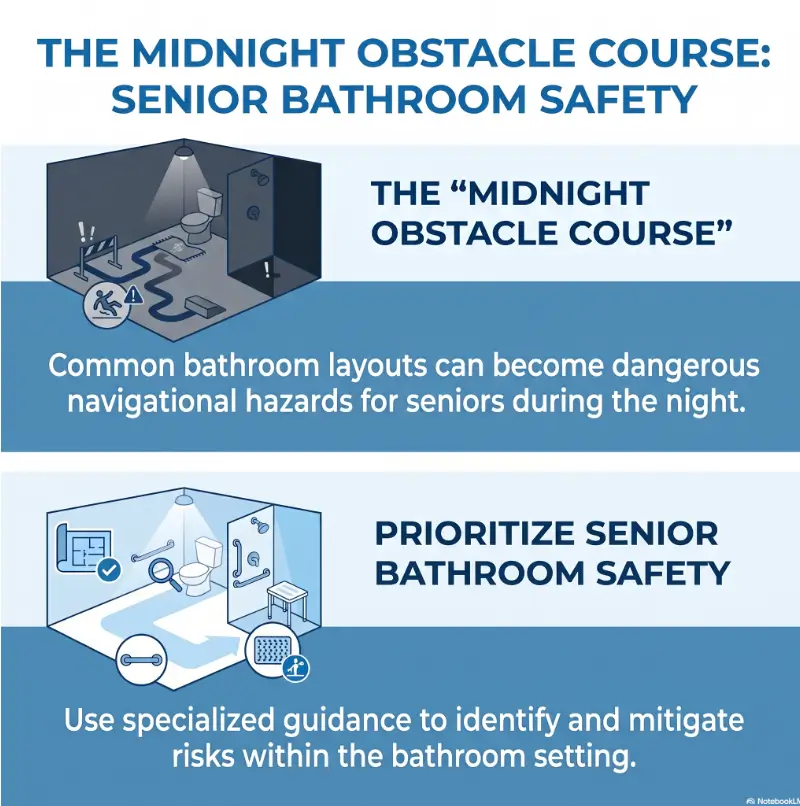
Most people hear “bathroom safety” and picture wet tile, grab bars, and bath mats. Those matter. But many nighttime falls begin before the bathroom door, in the quiet stretch between mattress and toilet.
For someone with presbyopia, the danger is not only poor near focus. It is the whole midnight situation: eyes adjusting slowly, feet finding slippers, hands reaching for furniture, bladder urgency whispering “hurry,” and a half-lit room turning familiar objects into vague shapes.
Map the 12-foot danger zone before buying gadgets
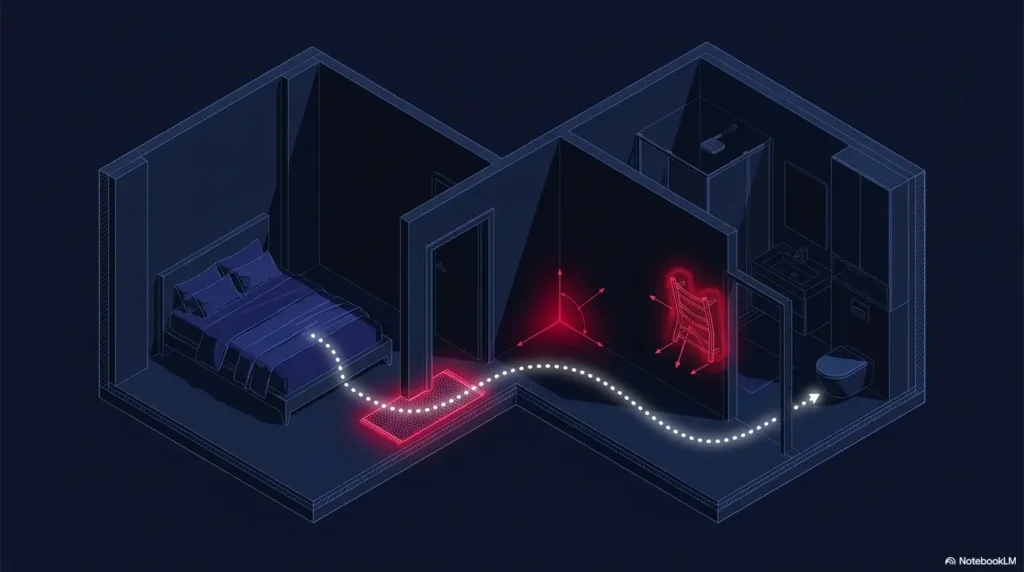
Before you buy motion lights, rails, nightstands, toilet aids, or anti-slip tape, walk the route. Start with the exact spot where the senior’s feet touch the floor. End where they can sit safely on the toilet.
Notice the first turn. Notice the narrowest passage. Notice the spot where the person reaches for balance. A good bathroom safety checklist is not a shopping list first. It is a map.
The 12-foot route check
- Stand where the senior sits on the bed before getting up.
- Turn off the bright overhead lights.
- Use the same lamp, night light, or darkness they normally use.
- Walk slowly toward the bathroom and name every object your foot could touch.
- Repeat while carrying nothing, then while wearing the usual slippers.
Remove the toe traps: rugs, cords, baskets, and pet beds
The most dangerous item is often not dramatic. It is a laundry basket that migrated two inches into the path. It is a curled rug corner. It is a phone charger cord with all the innocence of a sleeping snake.
Remove anything soft, low, mobile, dark-colored, or easy to nudge into the route. Pet beds, decorative baskets, footstools, throw rugs, floor fans, charging cables, and slipper piles all deserve suspicion.
If the bedroom has poor visual contrast, read more about building a safer room in this related guide to bedroom safety for seniors with poor vision.
Here’s what no one tells you: the bathroom starts at the bed
A senior who stands too quickly, cannot find glasses, steps into loose slippers, or reaches for an unstable nightstand is already in the bathroom-safety system. The toilet is simply the destination.
Think of the route as one continuous chain: bed edge, floor space, slippers, lamp control, glasses, walking path, doorway, toilet, grab point, sink, and return path. A weak link anywhere can turn the whole chain wobbly.
Lighting That Helps Presbyopia Without Blinding Tired Eyes
“Add more light” sounds sensible, but nighttime vision is fussy. Too little light hides hazards. Too much light causes glare, squinting, and disorientation. The sweet spot is low, warm, even, and predictable.
Presbyopia makes close tasks harder, but older eyes may also need more light overall and may be more bothered by glare. That is why the best night bathroom lighting setup is not one bright ceiling light. It is a quiet trail.
Use motion lights low to the floor, not harsh overhead beams
Motion sensor lights can be helpful when they turn on early enough, point away from the eyes, and illuminate the floor path rather than the mirror. Low placement can define the walking route without making the room feel like a stage.
Place lights so they reveal thresholds, corners, and the toilet area. Avoid aiming a plug-in light directly across shiny tile, glossy paint, or a mirror. The goal is to show the floor, not interrogate the face.
If your current sensor light feels harsh, this guide on what to do when a motion sensor light is too bright may help you adjust placement and brightness.
Choose warm, even lighting for the route and bathroom entrance
Warm light often feels less jarring at night than cool, bluish light. The exact preference can vary, especially for people with glare sensitivity, cataracts, low vision, or sleep concerns.
Instead of obsessing over one perfect bulb, test the real experience. Can the senior see the bed edge, floor, slippers, doorway, toilet outline, and grab point without squinting? If not, the lighting needs adjustment.
For a deeper comparison, see this practical guide to red vs amber night lights for low-light comfort.
Avoid mirror glare, shiny tile glare, and bright phone flashlights
Phone flashlights can feel convenient, but they often create sharp shadows and bright reflections. For a sleepy older adult, that can make depth and obstacles harder to judge.
Bathroom mirrors, glossy counters, white tile, and polished faucets can bounce light into tired eyes. If the senior says, “The light hurts,” do not treat that as fussiness. It may be the clue that helps you choose safer lighting.
Key takeaway
A safer night light setup should reveal the path without creating glare. Test it from the senior’s eye level, not from a healthy adult child’s confident daytime viewpoint.
Small but mighty: light switches seniors can find by touch
Light switches are often placed for builders, not for half-awake people with aging eyes. If a switch is hard to find, place a tactile marker near it or use an easier lamp control by the bed.
For practical placement ideas, see this related guide to light switches for seniors. A small tactile cue can be more useful than a fancy device nobody remembers how to use.
Glasses, Focus, and the Midnight Blur Problem
Presbyopia means near tasks become harder: reading labels, seeing small controls, checking medication print, or finding a tiny switch. But walking to the bathroom is not a reading task.
That is why reading glasses can be both useful and misleading. They may help with close-up details, but they may not be the safest choice for walking, judging distance, or navigating a dim route.
Keep reading glasses reachable, but do not rely on them for walking
Reading glasses belong in a fixed place, not under tissues, behind a water bottle, or somewhere in the duvet wilderness. A bedside tray, shallow dish, or high-contrast glasses stand can prevent 2 a.m. searching.
But if the senior needs distance correction, bifocals, progressives, or another prescription for safe movement, confirm the right nighttime plan with an eye-care professional. The safest glasses for reading a pill bottle may not be the safest glasses for walking across a dark room.
For placement ideas, this article on the best places to keep reading glasses can help create a routine that sticks.
Use distance-safe vision correction when prescribed
Some seniors use readers only. Others use prescription glasses, bifocals, progressive lenses, or separate glasses for specific tasks. The right answer depends on the person’s eyes, prescription, balance, and walking environment.
Progressive lenses can be especially tricky on stairs, thresholds, and floor-level hazards because lens zones change how the lower field looks. If the senior feels uncertain stepping down or turning at night, ask the eye-care provider whether the current glasses setup is appropriate for nighttime movement.
You may also find this related guide helpful: progressive lenses on stairs.
Label essentials with large, high-contrast cues
At night, the goal is not beautiful labeling. The goal is instant recognition. Use large, high-contrast labels or tactile markers for items the senior must identify quickly: lamp control, glasses case, phone charger, medication reminder, bathroom switch, and hot/cold faucet direction.
Labels should be few and obvious. A bathroom filled with tiny labels becomes visual confetti. Choose the handful of items that actually affect safety.
Let’s be honest: searching for glasses at 2 a.m. is a fall setup
Searching creates bending, twisting, reaching, and frustration. Add urgency, darkness, and a sleepy brain, and the risk rises. The fix is wonderfully unglamorous: one dedicated landing zone.
Place glasses in the same spot every night. Keep that spot within easy reach from a seated position on the bed. Make it visually obvious and hard to knock over.
Bathroom Layout Fixes That Prevent Reaching, Twisting, and Guessing
A senior-friendly bathroom is not just a bathroom with more products. It is a room where the next safe action is obvious: where to step, where to hold, where to sit, where to reach, and how to leave.
Small layout changes can reduce the movements that often cause trouble at night: leaning, twisting, searching, stepping around clutter, bending for supplies, or grabbing unstable fixtures.
Put toilet paper, wipes, and lights within easy reach
Anything used during a nighttime bathroom trip should be reachable without standing, leaning far forward, or twisting sharply. Toilet paper, wipes, a covered trash bin, and the light control should have predictable homes.
Avoid low storage baskets near the toilet. They seem tidy during the day and become shin-height surprises at night.
Add contrast around the toilet, sink edge, and grab points
White toilet, white wall, white tile, white bath mat: it may look clean, but it can erase boundaries for aging eyes. Contrast helps the brain find edges faster.
Consider contrast around the toilet seat, the front edge of the sink, the threshold, and approved grab points. This does not have to look medical. A darker toilet seat, matte tape on an edge, or a high-contrast towel placed away from the floor can help the room make visual sense.
For a focused guide, see toilet seat contrast color and how it can help older adults locate the seat more easily.
Move storage off the floor before it becomes an obstacle course
Floor storage is one of the quiet villains of bathroom safety. Extra toilet paper, cleaning sprays, hair tools, towels, scale, stool, hamper, and backup toiletries often collect along the edges.
At night, edges are exactly where feet search for stability. Move storage into wall shelves, drawers, closed cabinets, or a stable standing unit that does not narrow the walking path.
Good / Better / Best bathroom setup comparison
| Setup level | Best for | What it includes | What to verify before spending |
|---|---|---|---|
| Good | Budget-conscious caregivers | Clear floor, reachable supplies, low-glare night light, fixed glasses spot | No loose rugs, no harsh glare, no cords in the route |
| Better | Seniors with mild unsteadiness | Layered motion lighting, contrast markers, non-slip flooring, safer slippers | Lights turn on early enough and do not create shadows |
| Best | Repeated near-falls or difficult transfers | Professionally installed grab bars, toilet rails or raised seat if appropriate, OT input | Correct placement, weight rating, wall structure, and medical fit |
Grab Bars Are Not Decor, They Are Steering Wheels
Grab bars are not a sign that someone has become fragile. They are a steering system for the moments when the body must sit, stand, turn, and recover balance.
The mistake is thinking any nearby object can do the same job. A towel rack, sink edge, shower door, or toilet paper holder may be exactly where the hand goes, but that does not mean it can safely hold body weight.
Install bars where hands naturally go during sit, stand, and turn
Good placement depends on the person and the bathroom. Watch the movement first. Where does the hand reach while sitting down? Where does it reach when standing? Where does balance get uncertain during the turn?
That observation helps decide whether grab bars near the toilet, inside the shower, outside the shower, or along a wall would be useful. For installation, weight rating, wall anchoring, and placement, consider a qualified installer or occupational therapist.
Do not trust towel racks as balance support
Towel racks are for towels. They may look sturdy until the exact wrong moment. A senior who grabs a towel rack during a slip may pull it from the wall and lose balance faster.
Replace “do not grab that” with “grab this instead.” The hand needs a safe alternative in the right place. Safety improves when the easier choice is also the stronger choice.
Consider toilet safety rails or a raised toilet seat when standing is hard
If standing from the toilet takes effort, toilet safety rails or a raised toilet seat may reduce strain. These are not one-size-fits-all choices. Height, stability, bathroom space, weight rating, cleaning needs, and user comfort all matter.
Before buying, ask: will the person use it correctly every time? Does it fit the toilet shape? Does it wobble? Can it be cleaned easily? Does it create a new obstacle? Cheap but unstable is not a bargain. It is a suspense novel with plumbing.
Questions to ask before paying for bathroom safety help
- Will the installer anchor grab bars into suitable structure, not just surface material?
- Can they explain the placement for sitting, standing, and turning?
- Will the chosen product support the user’s weight and movement needs?
- Can an occupational therapist review the bathroom if falls or near-falls keep happening?
- Does the setup still leave enough space for a walker, cane, caregiver, or door swing?
Show me the nerdy details
A nighttime bathroom trip combines multiple movement tasks: rising from bed, initial balance after standing, gait initiation, turning, threshold crossing, visual scanning, toilet transfer, hygiene movements, standing again, and returning to bed. Each task may be safe alone but harder when combined with darkness, urgency, dehydration concerns, medication effects, poor contrast, or bifocal/progressive lens distortion.
That is why a single safety product rarely solves the whole problem. The more reliable approach is layered: reduce trip hazards, improve visual cues, provide stable hand support, make supplies reachable, slow the first stand, and review medical contributors when symptoms change.
Common Mistakes That Make Night Bathroom Trips More Dangerous
Some safety fixes look helpful because they feel familiar. A soft mat, a brighter bulb, a taped rug, a phone flashlight. Unfortunately, the nighttime route has no patience for good intentions.
The safest home improvements are the ones that reduce confusion and effort. If a fix adds glare, clutter, wobble, or extra decisions, it may be working against you.
Mistake 1: using loose bath mats because they feel “soft”
Soft does not always mean safe. A loose bath mat can slide, curl, bunch, or hide a wet floor edge. If a mat is necessary, choose one designed to stay flat and check it often.
In many bathrooms, non-slip strips or a more secure flooring solution may be safer than a decorative mat. The best option depends on the surface, moisture level, cleaning routine, and the person’s walking pattern.
Mistake 2: adding one bright light instead of layered route lighting
A single bright light may help the caregiver feel better during setup, but it may feel harsh to the senior at night. Layered route lighting is usually more comfortable: bedside cue, path cue, bathroom entrance cue, and toilet cue.
Test the setup when the home is actually dark. Daytime optimism has excellent manners and terrible night vision.
Mistake 3: keeping medication, water, or tissues across the room
If a senior must cross the room for water, tissues, glasses, or a phone, the number of nighttime trips and reaches may increase. Keep essential items near the bed in a stable setup.
If medications are involved, check with a pharmacist or clinician before changing timing, storage, or fluid intake habits. Some dizziness and nighttime urgency patterns may be tied to medications or medical conditions.
Mistake 4: assuming presbyopia is the only reason for poor night vision
Presbyopia is common, but poor night vision may also involve cataracts, glaucoma, macular disease, dry eye, medication effects, neurological issues, or other conditions. Sudden changes should not be brushed off as normal aging.
For a related comparison, see presbyopia vs cataracts. If symptoms are new, worsening, or one-sided, schedule an eye exam rather than guessing.
Common mistake vs safer alternative
| Taping down a curled rug | Remove the rug or replace it with a safer flooring solution. |
| Using a phone flashlight | Use low-glare motion lighting that turns on before the first step. |
| Grabbing the towel rack | Install a properly anchored grab bar where the hand naturally reaches. |
| Moving furniture without testing | Walk the route in real nighttime conditions before calling it fixed. |
The Bedside Setup That Reduces Rushing
Night bathroom safety begins before the first step. A stable bedside setup gives the senior a calm launch point: sit, orient, find the light, find glasses if needed, stand, pause, then walk.
This matters because rushing is a risk multiplier. When someone is urgent, sleepy, and annoyed by blur, the body takes shortcuts. The bedside setup should slow the first moment without making the person feel managed.
Place glasses, lamp control, phone, and water in a fixed landing zone
A good landing zone is reachable from a seated position, not from a half-standing lean. It should hold only the essentials: glasses, lamp control, phone, water if appropriate, tissues, and perhaps a medication reminder if approved by the care plan.
Use contrast. A dark tray on a light nightstand, or a light tray on a dark nightstand, can help the items stand out. For more ideas, see this related guide to a bedside tray setup for seniors.
Use slippers with backs, grip, and easy entry
Slippers should not slide, flop, fold, or require a balancing act to put on. Open-back slippers may feel easy, but they can slip off during turning or catch under the heel.
Look for stable soles, good grip, a secure back, and a shape that can be put on without bending too far. If the senior uses a cane or walker, make sure the footwear works with that routine.
A tiny ritual: sit, breathe, stand, pause, walk
The first seconds after standing can be wobbly, especially if someone is dehydrated, takes certain medications, or has blood pressure changes. A simple ritual can reduce rushing.
Sit at the bed edge. Breathe once. Put both feet flat. Stand. Pause. Then walk. It sounds almost too small to matter, which is exactly why it can work. Small routines survive sleepy brains.
Key takeaway
The bedside zone should prevent searching. Searching leads to reaching, bending, twisting, and rushing. A fixed home for glasses, light, phone, and slippers is one of the cheapest safety upgrades available.
Short Story: The bathroom trip that changed the house
Marian told her daughter she did not need help. She had lived in the same house for 32 years. She could walk from bed to bathroom with her eyes half-closed, and sometimes she nearly did.
Then one winter night, she caught her slipper on the edge of a soft rug. She did not fall, but her hand slapped the wall hard enough to wake the dog. In the morning, everyone acted casual. The rug did not.
Her daughter came back that evening and walked the route in the dark. The hallway looked different. The bathroom light glared in the mirror. The toilet paper holder sat just far enough away to require a twist.
They changed only five things: removed the rug, added a low motion light, moved the toilet paper, marked the lamp switch, and gave the glasses a tray. Marian still lived in her house. The house simply stopped setting tiny traps.
When to Seek Help Instead of Rearranging the House Again
If you have already cleared the path, improved lighting, adjusted the bathroom, and the senior still feels unsafe, it may be time to widen the lens. Falls are often multifactorial, which is a tidy word for “several little gremlins teamed up.”
Professional input can save money and stress by helping you avoid random purchases. A clinician, pharmacist, eye-care professional, physical therapist, or occupational therapist may see patterns a family misses.
Call a clinician after falls with pain, head impact, or new weakness
Any fall with head impact, significant pain, inability to bear weight, new weakness, chest pain, fainting, severe confusion, or possible stroke symptoms needs prompt medical attention. Do not let embarrassment delay care.
Even a “minor” fall can reveal a bigger issue: medication effects, infection, dehydration, vision change, low blood pressure, foot problems, or balance decline.
Ask about medication timing if dizziness happens at night
Some medications may contribute to dizziness, sleepiness, urgency, or balance changes. Do not stop or change medications on your own. Instead, ask the prescriber or pharmacist to review timing, interactions, and nighttime symptoms.
Bring a written list. Include prescription drugs, over-the-counter medicines, supplements, sleep aids, eye drops, and any recent changes.
Schedule an eye exam for sudden blur, halos, double vision, or poor night vision
Presbyopia changes gradually. Sudden blur, halos, double vision, flashes, new floaters, eye pain, one-sided vision loss, or rapidly worsening night vision should be checked by an eye-care professional.
The American Optometric Association offers a helpful overview of adult vision changes and presbyopia for readers who want a plain-English starting point.
Consider occupational therapy for repeated bathroom-route falls
An occupational therapist can assess how the person actually moves through the home. That can be more useful than guessing from product descriptions online.
Ask whether the therapist can evaluate transfers, lighting, contrast, flooring, reach zones, bathroom support, assistive devices, and caregiver workflow. The right advice can prevent a drawer full of safety gadgets that never get used.
DIY vs professional help: what is worth paying for?
| Need | DIY may be enough when… | Professional help may be worth it when… |
|---|---|---|
| Lighting | You need simple plug-in or battery motion lights and can test glare safely. | Wiring, switch relocation, stair lighting, or glare-sensitive vision issues are involved. |
| Grab bars | Temporary support is not needed and you are only planning placement. | Bars must support body weight and require correct anchoring. |
| Vision concerns | The issue is stable, mild, and already evaluated. | Vision changes are sudden, worsening, painful, or affecting mobility. |
| Repeated falls | There have been no falls and you are doing prevention. | Falls, near-falls, dizziness, weakness, or fear of walking continue. |
Caregiver Walkthrough: The 15-Minute Night Safety Audit
The best audit is simple enough to do tonight. You do not need a clipboard worthy of a submarine inspection. You need darkness, patience, and a willingness to notice what the senior actually does.
Invite the older adult into the process when possible. Safety changes work better when they preserve dignity and routine.
Walk the route at night exactly as the senior uses it
Do not test the route at noon with the curtains open. Nighttime safety must be tested in nighttime conditions. Use the real lights, real slippers, real door position, and real bathroom setup.
If safe, have the senior narrate what they notice: “I can’t see the rug edge,” “I reach for the sink here,” “the light hits the mirror,” or “I cannot tell whether the toilet lid is up.” These comments are gold.
Check what the feet hit, what the hands grab, and what the eyes miss
Use three categories: feet, hands, eyes. Feet reveal trip hazards. Hands reveal missing support. Eyes reveal lighting and contrast problems.
If the feet shuffle around a rug, remove it. If the hands reach for a towel rack, consider proper support. If the eyes miss the toilet, switch, threshold, or doorway, add contrast or lighting.
Take photos of hazards before changing anything
Photos help families agree on what changed. They also help if you later speak with an occupational therapist, installer, or clinician.
Take photos from the senior’s eye level and from the bed edge. The bathroom may look safe from the doorway and completely different from a seated position in dim light.
Make one change, test it, then add the next
Do not rearrange the whole room in one heroic afternoon. Sudden layout changes can create new memory problems. Make one change, test it, and give the senior time to adapt.
Start with the highest-risk, lowest-cost fixes: clear the floor, stabilize the bedside zone, add gentle route lighting, improve contrast at the toilet, and remove anything the feet can catch.
Night Route Safety Flow
Use this simple sequence before buying more gear. The order matters: first remove the hazard, then add the help.
1. Bed
Create a fixed landing zone for glasses, phone, lamp, and slippers.
2. Floor
Remove rugs, cords, baskets, pet beds, and floor clutter.
3. Light
Add low-glare route lighting that turns on before the first step.
4. Support
Use real grab support where hands reach during sit, stand, and turn.
5. Review
Seek help for falls, dizziness, sudden vision changes, or repeated near-misses.
Key takeaway
The best safety audit follows the body: feet, hands, eyes. What the feet hit, what the hands grab, and what the eyes miss will tell you what to fix first.
For a broader official fall-prevention resource, the CDC’s STEADI program offers tools and education for older adult fall risk conversations.

FAQ
What is the safest night light setup for seniors with presbyopia?
A safer setup usually uses low-glare lighting along the route from bed to bathroom, plus a gentle light near the bathroom entrance or toilet area. The light should reveal the floor and edges without shining into the eyes or reflecting harshly from mirrors and tile.
Are motion sensor lights better than leaving the bathroom light on?
Motion lights can be better when they turn on early, stay on long enough, and avoid glare. Leaving the bathroom light on may help some people, but it can also create harsh brightness or mirror reflections. Test both in real nighttime conditions.
Should seniors wear reading glasses when walking to the bathroom at night?
Reading glasses help with close-up tasks, not necessarily walking. Some seniors may need distance-safe correction or a different glasses plan for movement. Ask an eye-care professional what is safest for the person’s prescription and route.
What color light is best for nighttime bathroom safety?
Many people prefer warm, gentle light at night because it feels less harsh. The best choice is the one that lets the senior see the path, toilet, floor edges, and grab points without glare or confusion.
Are grab bars necessary if the senior has not fallen yet?
Not always, but they may be wise if standing, turning, shower entry, or toilet transfers feel uncertain. The better question is: where does the person reach for balance now? If the answer is a towel rack or sink edge, proper support may be worth considering.
How can I make a bathroom safer without making it look medical?
Use subtle contrast, warm lighting, matte finishes, tidy storage, modern grab bars, and a clean floor plan. Safety does not have to look clinical. It just has to be visible, stable, and easy to use at night.
What should I remove first from the bedroom-to-bathroom path?
Remove loose rugs, cords, baskets, pet beds, floor fans, low stools, and anything that can shift into the path. Start beside the bed, not at the bathroom door.
When is nighttime bathroom trouble a medical concern?
Seek medical guidance after falls, fainting, new weakness, dizziness, sudden vision changes, severe confusion, head impact, chest pain, or stroke-like symptoms. Repeated near-falls also deserve a professional review.
Optional video: Open the video on YouTube (external site).
Fix the First Three Feet Tonight
The first three feet beside the bed are the launchpad. If they are cluttered, dark, slippery, or confusing, the whole bathroom trip begins with risk. If they are clear, predictable, and gently lit, the rest of the route becomes easier to improve.
Start there tonight. Clear the floor beside the bed. Put slippers in one stable position. Place glasses, phone, and lamp control in the same reachable spot. Add one low-glare motion light aimed at the walking path. Then walk the route in the same conditions the senior uses at night.
That 15-minute change will not solve every fall risk. It will, however, turn the first step from guesswork into a routine. And sometimes the safest home begins not with a renovation, but with removing the one small thing a tired foot should never have had to negotiate.
Your 15-minute next step
- Stand at the bedside in nighttime lighting.
- Remove every object within the first three feet of the walking path.
- Create one fixed landing zone for glasses, lamp control, phone, and water if appropriate.
- Add or adjust one low-glare light aimed at the path.
- Test the route again before calling it finished.
For a wider home review, you can also use this related home safety checklist for seniors and the earlier guide to low vision nighttime bathroom safety.
Last reviewed: 2026-07
PUT THIS GUIDE TO WORK · INTERACTIVE WORKSHEET
Night bathroom route checklist
Use this worksheet alongside the article: Night Bathroom Safety Tips for Seniors with Presbyopia: A Safer Path From Bed to Toilet. Use the fields provided to organize your notes and next actions, then save your worksheet.
Your entries stay in this page and are cleared when you reload. No account is needed. Saved files are downloaded only to your device.
How to use your result
Save the worksheet before leaving this page. Recheck any quote, date, or instruction with the relevant provider, pharmacist, manufacturer, or official organization. A completed checklist means you recorded the steps, not that an outcome is guaranteed.
Worksheet added October 20, 2026. Read the article above for context and its stated review scope.