
Senior eye appointment guide
How Seniors Can Use an Eye Symptom Card at Appointments
So the Important Details Don’t Disappear
Eye appointments can move quickly. One moment you are describing “a little blur,” and the next you are sitting behind a machine, chin on the rest, trying to remember whether the shadow started Tuesday morning or sometime last week. For many older adults, the hardest part is not noticing a vision change. It is explaining it clearly while the room hums with testing, paperwork, and quiet pressure.
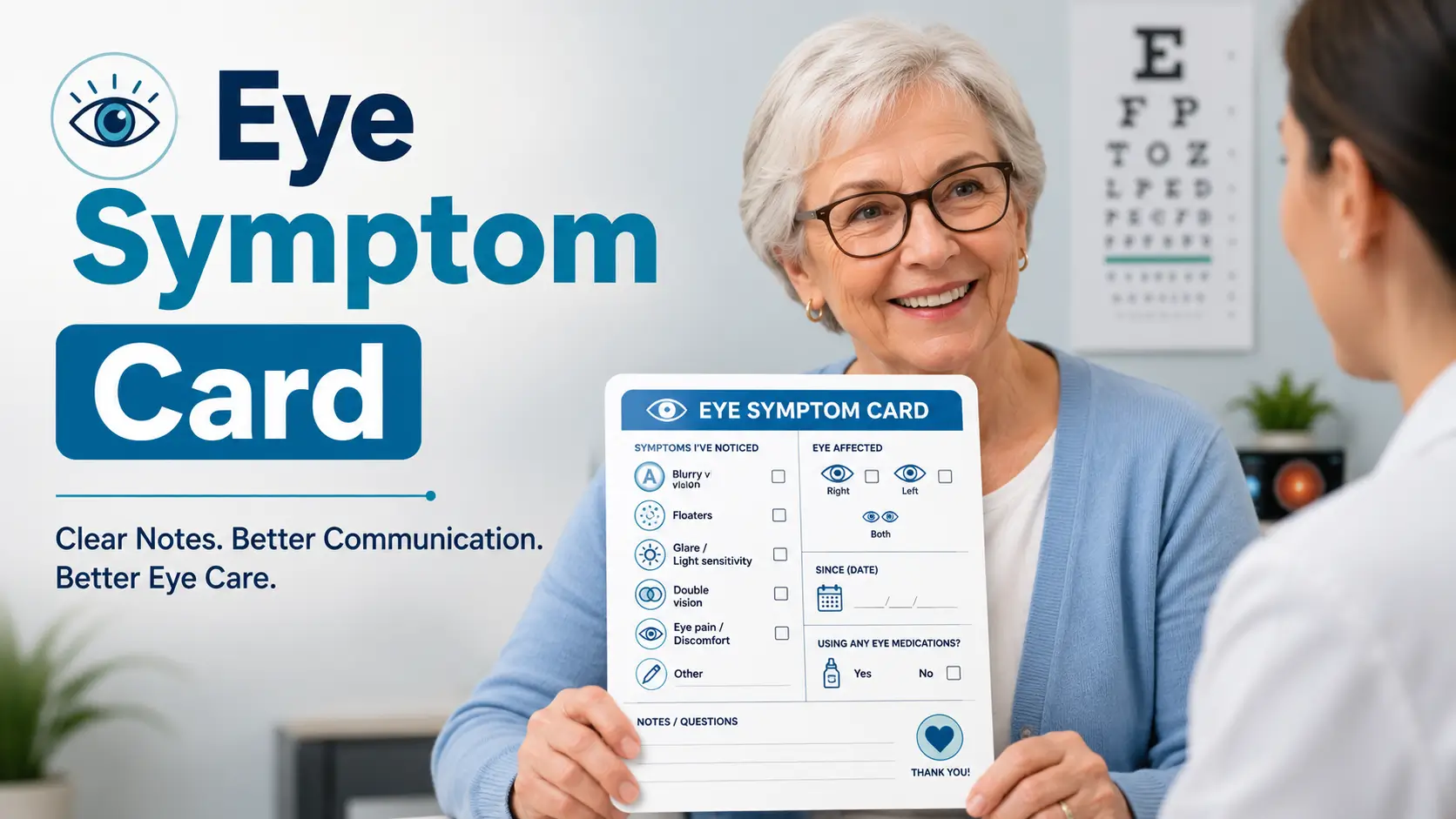
An eye symptom card is a small, large-print note that travels with your glasses, insurance card, or eye drops. It does not diagnose anything. It simply turns memory into a usable record: what changed, when it started, which eye is affected, how severe it feels, and what questions need an answer before you leave.
For seniors, caregivers, and adult children, this tiny paper can prevent a surprisingly large amount of confusion. It helps the patient keep their own voice in the room, gives the technician a cleaner starting point, and helps the doctor focus on the symptom pattern rather than playing detective through a foggy hallway of half-remembered details.
Clearer visits
Bring the right details before the exam-room clock starts sprinting.
Safer decisions
Separate routine appointment notes from symptoms that should be handled sooner.
Caregiver-friendly
Help without accidentally taking over the patient’s own words.
Keep it simple: one card, large print, six fields, and a habit of updating it before the appointment. 🕯️
Snapshot
This guide is for seniors, caregivers, and adult children preparing for eye appointments. You will learn what to put on an eye symptom card, how to use it during check-in and testing, which warning signs should not wait, and how to make a one-page version in about 15 minutes.
Table of Contents

Before You Use an Eye Symptom Card, Know What It Cannot Do
An eye symptom card is an appointment communication tool. It helps organize details, reduce forgetfulness, and make the first few minutes of the visit more useful.
It is not a home diagnosis tool. It cannot tell whether a symptom is cataracts, dry eye, retinal detachment, stroke, glaucoma, medication side effect, migraine, infection, or something else. That distinction matters, because some eye symptoms need same-day or emergency care.
Before You Act
Use this article to prepare for appointments and communicate symptoms more clearly. Do not use it to decide whether a sudden vision change is safe to ignore. If symptoms are sudden, severe, painful, or linked with weakness, confusion, facial droop, injury, or a curtain-like shadow in vision, contact an eye care professional, urgent care, emergency services, or your local medical advice line promptly.
Routine notes vs warning signs
The card is excellent for tracking symptoms that are ongoing, recurring, or easy to forget: glare while driving, trouble reading menus, burning eyes in the afternoon, wavy lines, new trouble with eye drops, or blurry vision that seems linked with screen use.
It is less appropriate as a “wait until next month” tool when the symptom is sudden. New floaters, flashes of light, a dark curtain, sudden vision loss, severe eye pain, or new double vision should be treated as a reason to call sooner.
Who should use this card
This tool is especially helpful for older adults who forget details in the exam room, caregivers managing multiple appointments, and adult children who want a calm way to help without sounding like a clipboard with shoes.
It can also help people with diabetes, glaucoma, age-related macular degeneration, cataracts, dry eye, double vision, low vision, or recent eye surgery. In those situations, small changes may matter, and the timeline can be just as important as the symptom itself.
The one sentence that keeps it safe
Write this near the bottom of the card: “If this symptom is sudden, painful, or getting worse, I will call the eye clinic instead of waiting.”
That sentence is a tiny guardrail. It reminds everyone that appointment preparation is useful, but urgent symptoms deserve urgent attention.
What to Put on an Eye Symptom Card
The best eye symptom card is not a long worksheet. Long forms get abandoned in kitchen drawers, usually under a receipt, a battery, and a pen that no longer works.
A good card has enough information to be useful, but not so much that it becomes homework. Think of it as a boarding pass for the appointment: compact, readable, and ready to hand over.
The six fields every card needs
Start with six fields. These are the details that often change the quality of the conversation:
- Symptom: What changed?
- Start date and time: When did you first notice it?
- Affected eye: Right eye, left eye, both eyes, or not sure?
- Severity: Mild, moderate, severe, or a 0 to 10 rating.
- Triggers: Reading, bright light, night driving, screens, bending over, standing up, eye drops, or rest.
- Medication or surgery changes: New eye drops, missed drops, new pills, recent injections, cataract surgery, or other procedures.
Put “one eye or both?” near the top
Many patients say “my vision is blurry,” but the clinic may need to know whether the change is in one eye or both. That detail can point the conversation in a different direction.
If the senior is not sure, write “not sure.” That is better than guessing. The doctor can test each eye separately.
Include medicines, drops, and recent procedures
The back of the card should include current eye drops, how often they are used, allergies, recent medication changes, and recent eye procedures. This is especially useful for glaucoma drops, dry eye treatments, steroid drops, post-surgery drops, and injections for retinal disease.
For a deeper medication setup, you can pair this card with a simple medication list. A related guide, one-page medication list template, can help keep the eye card from getting overcrowded.
Key Takeaway
If the card has room for only one thing, prioritize the symptom timeline. “Started suddenly yesterday at 4 p.m.” is more useful than “has been weird for a while.”
A simple card template you can copy
| Card field | What to write | Example |
|---|---|---|
| Symptom | Use plain words | New cobweb shapes |
| First noticed | Date and time, if possible | Monday morning, July 6 |
| Eye affected | Right, left, both, or not sure | Left eye |
| Severity | 0 to 10 or mild/moderate/severe | 6 out of 10 |
| Triggers | What makes it better or worse | Worse in bright sunlight |
| Recent changes | Medicines, drops, injury, surgery | Started new blood pressure pill |

Fill It Out While the Symptom Is Fresh
The best time to fill out an eye symptom card is not in the parking lot outside the clinic. By then, memory has already started polishing the details into something smoother and less useful.
Write the first note as soon as the symptom appears, or as soon as the senior mentions it. The note can be messy at first. You can rewrite it in larger print later.
Use the “first noticed” timestamp
“First noticed” is often more realistic than “started.” Many eye symptoms do not arrive with a drumroll. A person may notice wavy lines while reading, glare while driving, or a shadow while looking at a white wall.
Try this format: “First noticed: Tuesday after breakfast while reading the newspaper.” That one line gives time, activity, and context.
Describe vision like a scene, not a diagnosis
Patients often try to diagnose themselves: “I think it is cataracts,” or “Maybe it is just dry eye.” That may be understandable, but a symptom card works better when it describes what the patient actually sees.
- “Straight lines look wavy when I look at the door frame.”
- “There is a gray curtain on the left side.”
- “New black dots move when my eye moves.”
- “Lights have starbursts at night.”
- “Reading is clear for 10 minutes, then the words smear.”
This kind of language gives the clinician something concrete. It is not fancy. It is accurate, and accuracy is the elegant part.
Track “better,” “worse,” and “new”
Many eye issues change throughout the day. Dry eye may worsen in the afternoon. Glare may show up under store lighting. Reading problems may appear only with small print. Dizziness or blur may happen after a new medication.
On the card, use three simple prompts: “better when,” “worse when,” and “new since last visit.” Those lines help prevent the classic appointment problem: everything gets reduced to “blurry.”
Quick Fill-In Prompt
“I first noticed ______ while ______. It affects my ______ eye. It feels worse when ______ and better when ______. Since my last visit, ______ changed.”
Short Story: Mrs. Allen and the Gray Smudge
Mrs. Allen kept telling her daughter, “It is just a smudge.” She had cleaned her glasses twice, changed lamps, and blamed the newspaper ink. By the time her appointment arrived, she was ready to say only, “My vision is blurry.”
Her daughter asked one quiet question at breakfast: “Where is the smudge?” Mrs. Allen pointed to the same spot in her right-side vision. Then she added, almost casually, “It started after lunch on Sunday.”
They wrote it down on a card: right-side gray smudge, first noticed Sunday after lunch, worse against white walls, no pain.
At the clinic, the card did not solve the problem. But it changed the visit. Instead of beginning with a vague blur, the appointment began with a map. The lesson was plain: a symptom does not need perfect language. It needs a place to land.
How to Use the Card at the Appointment
The card should appear early, not at the end when the doctor has one hand on the door and the patient suddenly remembers three important details. Timing is part of the tool.
Bring the card to check-in, keep it visible, and hand it to the technician before testing begins. Many eye visits start with intake questions and vision testing before the doctor enters the room.
Give it to the technician first
The technician often asks about medications, symptoms, eye drops, allergies, and vision changes. This is the perfect moment for the card.
Use a simple line: “I wrote this down because I may forget details once the exam starts.” That sentence is polite, direct, and disarming. It tells the clinic that the card is there to help, not to take over the visit.
Keep the card on top of the paperwork
Do not bury the symptom card inside a folder with insurance papers, referral forms, and old appointment summaries. Put it on top, or clip it to the front.
If the senior uses reading glasses, tuck the card into the glasses case. If they use eye drops, keep the card in the same pouch. The best system is the one that meets the hand before the mind has to search.
Use the card after the visit too
After the visit, use the back of the card to write down the next step. This might be a follow-up date, a new drop schedule, a test to schedule, or a warning sign that should trigger a call.
This is where many families lose the thread. Everyone nods in the exam room, then the instructions become mist by the time the elevator doors open.
Appointment-Day Checklist
- Bring the symptom card, glasses, eye drops, insurance card, and medication list.
- Hand the card to the technician before testing starts.
- Ask whether any symptom on the card needs earlier follow-up.
- Write the next step on the back before leaving the clinic.
- Store the card with glasses, drops, or appointment papers at home.
Words That Help Eye Doctors Understand Symptoms
“Blurry vision” is real, but it is often too broad. It can mean haze, distortion, dryness, double vision, glare, missing areas, poor contrast, or trouble focusing up close.
The goal is not to sound medical. The goal is to sound specific.
Replace “blurry” with a clearer description
| Instead of only saying | Try adding | Why it helps |
|---|---|---|
| Blurry vision | “Letters smear after 10 minutes of reading.” | Shows timing and activity |
| Bad night vision | “Headlights have halos and starbursts.” | Describes the visual effect |
| Something floating | “New cobweb shapes move with my eye.” | Clarifies floaters and movement |
| Lines look strange | “Door frames look wavy.” | Gives a concrete distortion example |
| I cannot see part of things | “The left side seems missing.” | Points to a field-of-vision concern |
| My eyes hurt | “Severe pain with redness and nausea.” | Flags symptoms that may need faster care |
Note the activity that reveals the problem
Some symptoms appear only during certain tasks. That detail helps the clinic understand the practical impact.
- Reading medicine labels
- Driving at night
- Walking down stairs
- Using a phone
- Reading restaurant menus
- Recognizing faces across a room
- Using eye drop bottles correctly
If near tasks are the main issue, you may also find the guide on near vision problems in seniors helpful for organizing everyday examples before the visit.
Keep the senior’s own words
A caregiver may be tempted to translate everything into polished medical language. Resist that urge. The patient’s own words often contain the clue.
“The wall looks like it has smoke on it” may be more useful than “visual disturbance.” “The steps disappear” may be more useful than “mobility issue.” Plain language is not less intelligent. It is often more precise.
The Eye Symptom Card Flow
1. Notice
Something changes: blur, glare, floaters, pain, distortion, or missing vision.
2. Write
Record when, which eye, severity, triggers, and recent changes.
3. Check urgency
Sudden loss, flashes, floaters, curtain, severe pain, or neurologic symptoms need a call.
4. Bring
Hand the card over early, ideally before testing begins.
5. Confirm
Write the next step before leaving, while instructions are still fresh.
Caregiver Help Without Taking Over
Caregivers often walk a narrow bridge. They want to help, but they do not want to erase the older adult’s voice. The eye symptom card makes that easier.
The caregiver can write, organize, carry, and prompt. The patient can still describe, choose, correct, and ask.
Ask, then write
Start with open questions: “What do you see?” “When did you first notice it?” “Which eye seems different?” “What makes it worse?”
Then write the patient’s answer as close to their words as possible. If they say, “It looks like a spiderweb,” write “spiderweb,” not “opacity.”
Use the card to avoid family crossfire
Without a card, the appointment can turn into three people trying to remember the same event differently. One says Tuesday. One says Friday. One says it was after the pharmacy visit. The room becomes a tiny courtroom with fluorescent lighting.
A written note lowers the emotional temperature. It gives everyone something shared to look at.
Confirm the plan before leaving
At the end of the visit, the caregiver can ask: “Can we write the next step on the card so we follow it correctly?”
This is especially useful if there are new eye drops, changes to drop timing, referral instructions, warning signs, or follow-up testing. For drop-related organization, the guide on eye drop labels for seniors can help make the home routine easier to follow.
Key Takeaway
The caregiver’s best role is not “family spokesperson.” It is memory assistant, safety spotter, and calm scribe.
Tools, Costs, and Printing Options
An eye symptom card can be free. It can also be part of a more polished appointment system, especially for families managing several conditions, multiple specialists, or memory challenges.
The best option is not the fanciest one. It is the one the senior can actually read, update, carry, and use without fuss.
Good / Better / Best setup
| Setup | Typical cost | Best for | What to watch |
|---|---|---|---|
| Good: handwritten large-print index card | Usually free or very low cost | Simple symptoms and occasional appointments | Handwriting must be large and high contrast |
| Better: printed one-page template | Low cost for paper and ink | Caregivers, recurring eye visits, medication changes | Do not make it too crowded |
| Best: appointment folder with card, medication list, and visit notes | Low to moderate, depending on supplies | Multiple doctors, chronic eye disease, memory support | Keep the top card short so urgent details are not buried |
| Digital note plus printed card | Free to moderate, depending on device | Adult children helping from a distance | Bring a printed version because phones can be hard to read in clinic lighting |
Readability matters more than design
Use black text on white or pale paper. Avoid pale gray text, decorative fonts, glossy paper, and tiny lines. Older eyes often need more contrast, more spacing, and less visual clutter.
As a practical rule, use at least 16- to 18-point type when possible, with generous spacing. If the senior uses a magnifier or reading glasses, test the card at the kitchen table before the appointment.
Helpful official readability resource
For older-adult materials, clear contrast and larger type can make health information easier to use. This is worth checking before printing cards, medication lists, or caregiver notes.
Free vs paid help: when each makes sense
Most families do not need a paid product. A printed sheet, a bold marker, and a folder can work beautifully.
Paid help may be worth considering if the senior has low vision, tremor, memory challenges, many medications, multiple caregivers, or a complex schedule of appointments. In those cases, large-print organizers, talking labels, magnifiers, appointment folders, or professional low-vision support may reduce daily friction.
Before buying anything, compare size, contrast, portability, refill cost, ease of updating, and whether the senior will actually use it. A premium organizer that stays on the shelf is just furniture with pockets.
Questions to ask before paying for tools
- Can the senior read it without strain?
- Does it fit in a purse, glasses case, walker pouch, or appointment folder?
- Can a caregiver update it quickly?
- Does it help with eye drops, medicines, appointments, or all three?
- Is the design high contrast, matte, and uncluttered?
- Will it still be useful if the clinic asks for the information verbally?
If the main problem is reading small print in daily life, the article on the best font size for seniors offers a practical companion to this card system.
Show me the nerdy details
Why the card works
The eye symptom card reduces cognitive load. Instead of forcing the patient to remember symptom timing, severity, affected eye, medications, and questions during a fast appointment, the card stores those details externally.
It also improves signal quality. “Blurry” is a low-resolution word. “New cobweb floaters in the left eye since yesterday afternoon” gives the clinic a much sharper starting point.
Finally, it supports shared attention. Patient, caregiver, technician, and doctor can look at the same short document instead of reconstructing the story from memory.
When to Call Before the Appointment
The eye symptom card should never become a permission slip for waiting through serious changes. Some symptoms belong on the card and in a phone call to the clinic.
If the patient has sudden or severe symptoms, call the eye doctor, primary care clinician, urgent care, emergency services, or local medical advice line. If the person may be having stroke-like symptoms, treat it as an emergency.
Eye symptoms that should not wait
- Sudden increase in floaters
- Flashes of light, especially with new floaters
- A curtain, veil, shadow, or missing side vision
- Sudden vision loss in one or both eyes
- Severe eye pain, redness, nausea, or headache
- New double vision
- Eye injury, fall, or head injury with vision changes
- Vision changes with facial droop, weakness, confusion, trouble speaking, or trouble walking
Do not drive yourself with new vision loss
If vision changes suddenly, do not drive yourself to the clinic or emergency room. Ask someone else to drive, use a ride service, or call emergency services if the situation may be urgent.
This is not about pride. It is about not adding a traffic problem to a medical problem.
What to say when you call
Use the symptom card as your call script. Keep it short and specific:
Call Script
“I am calling about a sudden vision change. It started ______. It affects the ______ eye. The symptom is ______. I also have ______. Should I be seen today, go to urgent care, or go to the emergency room?”
For official information about retinal detachment symptoms, see the National Eye Institute’s patient resource below.
Important eye safety resource
Sudden floaters, flashes, or a curtain-like shadow can be warning signs. This official resource explains retinal detachment symptoms and why prompt evaluation matters.
If you want a broader home safety companion, the guide to senior vision changes warning signs can help families separate routine changes from symptoms that deserve faster attention.

FAQ
What is an eye symptom card?
An eye symptom card is a small, large-print note that records vision changes before an appointment. It usually includes the symptom, when it started, which eye is affected, severity, triggers, medication changes, and questions for the clinician.
Should seniors bring an eye symptom card to every eye exam?
Yes, it is a good habit, especially for seniors with ongoing eye conditions, eye drops, diabetes, glaucoma, macular degeneration, cataracts, low vision, or recent surgery. Even when nothing major has changed, the card can list questions and medication updates.
What symptoms should go on the card?
Include blurry vision, glare, halos, floaters, flashes, wavy lines, missing vision, double vision, eye pain, redness, dryness, burning, trouble reading, trouble driving at night, or any change that affects daily life.
Can a caregiver fill it out?
Yes. A caregiver can write the card, but should preserve the senior’s own words whenever possible. The best approach is to ask open questions, write what the patient says, and let the patient correct the note.
Is blurry vision enough detail?
Usually, no. Add what kind of blur it is, when it happens, which eye is affected, and what activity reveals it. “Letters smear after 10 minutes of reading” is more helpful than “blurry.”
Should the card include medications?
Yes, especially eye drops, new prescriptions, over-the-counter medicines, missed doses, allergies, and recent medication changes. Keep the medication section short, or attach a separate one-page medication list if needed.
What font size is best for seniors?
Use large, high-contrast print. A practical starting point is 16- to 18-point type or larger, with black text on white or pale paper and plenty of spacing. Test it with the senior’s usual reading glasses or magnifier.
When should seniors call the eye doctor instead of waiting?
Call sooner for sudden vision loss, new flashes, a sudden shower of floaters, a curtain or shadow, severe eye pain, eye injury, new double vision, or vision changes with weakness, confusion, facial droop, or trouble speaking.
Make Your Card in 15 Minutes
The eye symptom card works because it is small enough to use. You do not need a perfect template, a color printer, or a home office that looks like a tax professional lives there.
You need one readable page, six useful lines, and a place to keep it.
The 15-minute card build
- Take one sheet of white paper or one large index card.
- Write “Eye Symptom Card” at the top in large, dark letters.
- Add six lines: symptom, first noticed, affected eye, severity, triggers, recent changes.
- Add a small back section for eye drops, allergies, questions, pharmacy, and emergency contact.
- Place it with glasses, eye drops, insurance cards, or the appointment folder.
- Update it whenever a new symptom appears.
Copy this large-print layout
Eye Symptom Card
Symptom: ______________________________
First noticed: ___________________________
Eye affected: Right / Left / Both / Not sure
Severity: Mild / Moderate / Severe / 0–10: ____
Worse or better when: ____________________
Recent medicines, drops, surgery, fall, or injury: ____________________
Call sooner if sudden: vision loss, flashes, new floaters, curtain/shadow, severe pain, injury, double vision, weakness, confusion, or facial droop.
The calm next step
Today, make one card and put it where the next appointment will naturally find it: inside the glasses case, beside the eye drops, or clipped to the insurance card. That is the whole beginning.
A symptom card will not make aging eyes simple. But it can make the next conversation clearer, safer, and less dependent on memory under pressure. In a rushed medical room, that little rectangle of paper can behave like a lantern: modest, steady, and suddenly very useful.
Last reviewed: 2026-08