

Organize your questions and next steps, then save your worksheet.
Summary and next steps
Discuss changing vision, medicines and driving difficulties with qualified professionals. Plan alternatives for trips that cannot be made reliably.
- Write down a recent driving difficulty and when it occurred.
- Review vision and medicine concerns with the appropriate professional.
- Choose a backup ride for evenings and appointments.
Editorial maintenance: October 24, 2026. Summary layout, related links and technical metadata updated. This is not a full clinical review.
Navigating the Twilight: A Guide to Senior Driving Safety
For many older adults, the hardest part isn’t reading an eye chart—it’s handling headlight glare, low-contrast signs, and night driving decisions under pressure. Families feel it too: one new scrape, one tense ride, and every conversation about independence gets heavier.
Keep guessing, and the risk isn’t just a crash. It’s a slow shrink of confidence, mobility, and daily freedom.
This guide helps you make smart, low-drama changes that improve senior driving safety and everyday life: better exam conversations, quick car-visibility fixes, practical route boundaries, and home-lighting upgrades that reduce fall risk. You’ll also get a clear plan for those difficult family talks—without turning it into a keys battle.
These strategies come from a function-first approach: fix what’s measurable, reduce what’s risky, and preserve what matters most.
Aging eyes can change glare recovery, contrast, night vision, and depth perception—and that affects driving and everyday safety. Start with the highest-impact moves: schedule an eye exam, update lenses, reduce night driving if glare is an issue, improve car “fit” (seat/mirrors/lighting), and reduce home fall risks with brighter, well-placed lighting. Families should watch for red flags like frequent close calls, new scrapes, or getting lost on familiar routes.
Table of Contents
Safety / Disclaimer
This guide is educational, not medical or legal advice. Vision changes can be caused by treatable conditions and medications, and driving rules vary by state. If safety is in question, prioritize a professional eye exam and a calm family plan over “pushing through.” If you’re reading this because something feels off, trust that instinct—then aim your energy toward the safest next step.
- If driving feels suddenly unsafe, choose immediate safety: don’t drive until you’re evaluated.
- If symptoms are gradual but worsening, book an eye exam and put boundaries in place now (daytime routes, shorter trips).
- If family conflict is the issue, treat it as a planning problem, not a character flaw.
Who this is for / not for
For: “still driving, but it feels harder lately”
- Seniors noticing glare, halos, night-driving discomfort, or slower sign reading
- Adult children who want a respectful plan (not a confrontation)
- Care partners coordinating appointments, transportation, and home safety
Not for: “urgent symptoms or unsafe driving right now”
- Sudden vision loss, new double vision, severe eye pain, or fast-worsening symptoms (seek urgent care)
- Repeated near-misses, getting lost on familiar routes, or family members refusing to ride with the driver (move to immediate safety steps)
A quick personal note: I’ve had conversations like this with someone I love, and I learned the hard way that fear makes people stubborn. When we switched from “You shouldn’t” to “Let’s make it easier,” everything softened. The goal isn’t to win an argument. The goal is to keep a life intact.
The “aging eyes” changes that matter on the road (and the ones that don’t)
Why “20/20” can still be unsafe
“Can you read the letters on the chart?” is a useful question. It’s just not the only question. Driving is a moving puzzle: low contrast lane lines, glare from oncoming headlights, quick depth judgments on left turns, and the brain’s ability to recover after bright light hits the eye. You can have “decent acuity” and still struggle with real-world driving tasks—especially at dusk and night.
In an illustrative discussion, a person may report difficulty noticing a sign despite being able to read small print. This does not establish the cause or identify a fix. Ask for appropriate vision and driving assessment rather than treating the example as a diagnosis or a reported ride with a relative.
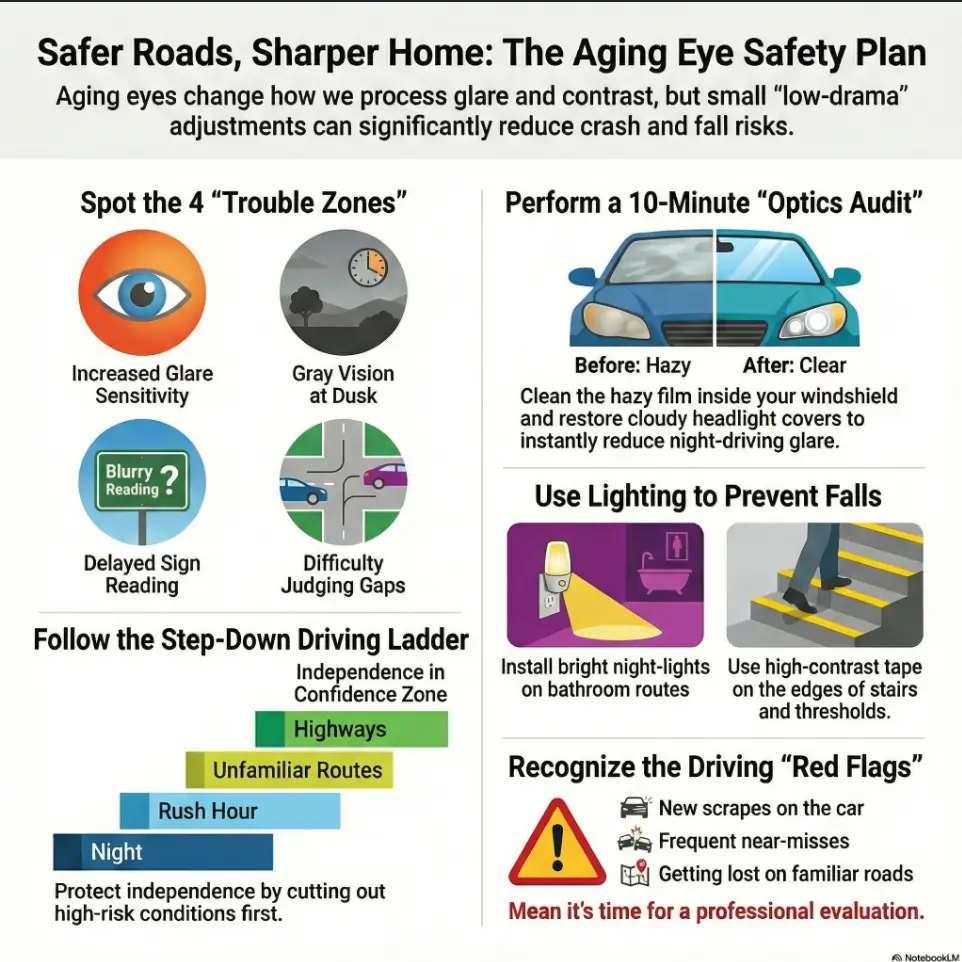
The 4 trouble zones families describe (without using medical jargon)
- Glare: headlights feel like camera flashes
- Low light: dusk/dawn feels like “driving through gray soup”
- Details: signs and lane lines arrive “too late”
- Depth: gaps, merges, and left turns feel harder
Show me the nerdy details
Driving performance is shaped by more than sharpness. Glare sensitivity and recovery, contrast sensitivity, and the way pupils respond in low light can change with age and with common conditions like cataracts or dry eye. The practical takeaway: you can often improve safety faster by addressing lighting, windshield clarity, and route timing than by “trying harder.” Also, medications (including some for sleep, allergies, or anxiety) can affect alertness and visual comfort—so the most helpful exam is one where you mention real driving symptoms, not just “check my prescription.”
- Driving stresses contrast and glare recovery, especially at dusk and night.
- Route timing and windshield/headlight clarity can create immediate improvement.
- Describe real symptoms at your eye exam (glare, halos, late sign reading).
Apply in 60 seconds: Write down your top 2 “hard moments” (e.g., left turns, headlight glare) to bring to your next appointment.
The headlight glare problem is real—so what can you control?
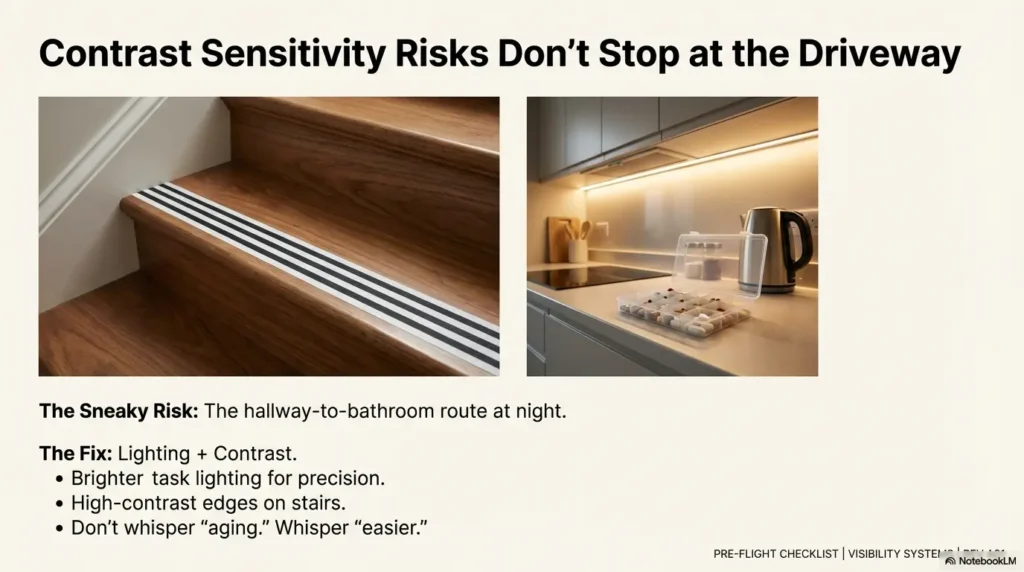
The “inside the car” glare audit (5 minutes)
Before you buy anything—before you blame LED headlights—do the cheap wins. Glare isn’t just “outside light.” It’s also how light scatters through your glass and reflects off your interior surfaces.
- Windshield haze: That thin film on the inside of glass can turn headlights into starbursts.
- Micro-scratches: Wipers, dust, and time can scratch the windshield in ways that scatter light.
- Dash reflections: Glossy dashboards can bounce light upward at night.
- Dirty glasses: Yes, really. Smudges can multiply halos.
In a hypothetical vehicle check, an unclear windshield is one concern to address according to the vehicle’s care instructions. Cleaning does not establish fitness to drive or resolve the cause of glare. This is not a report of the author’s week-long symptoms or a ten-minute improvement.
The “outside the car” fixes people forget
- Clean headlight covers (cloudy lenses scatter light and reduce your own visibility).
- Replace worn wipers (smearing at night is its own horror movie).
- Check headlight aim (mis-aimed headlights can reduce what you see and increase glare for others).
- Confirm the right exterior bulbs for your vehicle (avoid unapproved modifications).
Here’s what no one tells you…
Sometimes the biggest improvement isn’t new glasses—it’s clean glass + correct headlight aim + better mirror settings. In other words: fix the “optics” you can control, then reassess symptoms.
- Clean the inside windshield properly (film is common).
- Clear or restore cloudy headlight covers.
- Adjust mirrors to reduce direct headlight blast.
Apply in 60 seconds: Wipe your glasses and the inside driver-side window—then notice if halos drop even slightly.
For readers comparing symptom patterns, this can overlap with waking up with blurry vision and daytime fluctuation patterns such as 3 p.m. burning eyes.
Everyday life with aging eyes: the non-driving risks that sneak up first
Lighting upgrades that reduce falls and kitchen accidents
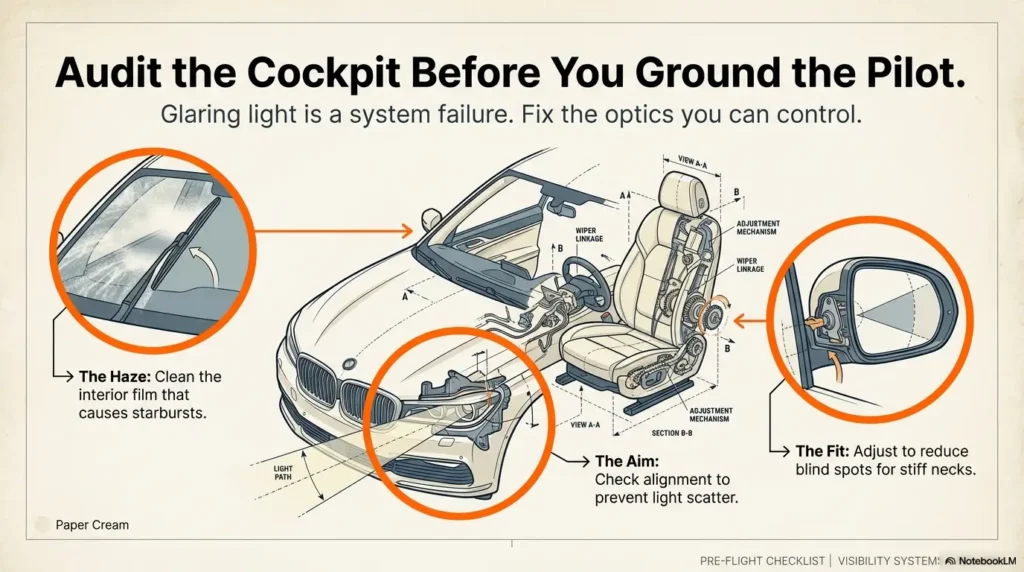
Driving gets the spotlight (pun intended), but daily life is where risk quietly stacks up: stairs, bathrooms, kitchens, and that one hallway you’ve walked a thousand times—until the light is low and your foot finds the edge the hard way. The goal here is simple: make your environment kinder to your eyes.
- Bright, even lighting where you read labels, sort pills, and cook.
- Night-lights for hallway-to-bathroom routes (especially if you wake up groggy).
- Task lighting at the stove and sink (shadows are sneaky).
- Reduce glare at home with lamp shades and indirect lighting (less “light bounce”).
Discuss changes to home lighting as practical accessibility choices rather than labels about age. Ask what makes the route easier to use, and keep the person’s preferences central to the conversation. A lighting change does not establish that a route is free of fall hazards.
Contrast hacks that reduce “misreads”
- High-contrast tape on step edges.
- Dark cutting board for light foods, light board for dark foods.
- Bold labels on pantry items and medication organizers.
- Matte (non-glossy) surfaces where possible to reduce reflections.
- Fix the hallway/bathroom route first (night is when falls happen).
- Use task lighting where precision matters (kitchen, pill sorting).
- Increase contrast on steps and thresholds.
Apply in 60 seconds: Walk your home route at night and identify the darkest 2 spots—those are your first upgrades.
If you want practical room-by-room implementation, pair this section with nighttime bathroom safety for low vision, glare-free under-cabinet lighting, and a full home safety checklist for vision changes.
Common mistakes that quietly increase crash risk
Mistake #1: “I’ll just avoid highways” (but keep driving at dusk)
This one is brutally common. Highways feel scary, so you choose surface streets. That can be smart. But then you keep your usual routine and end up driving during the hardest visual conditions—dusk—when contrast drops, glare rises, and everyone else is also half-blind and in a hurry. If dusk is your trigger, your “avoid highways” strategy needs a timing upgrade.
Mistake #2: Updating the prescription but ignoring glare and dry eye
A new prescription can improve clarity and still leave you miserable at night. That’s not failure; it’s information. Dry eye, lens coatings, and conditions like cataracts can influence glare and comfort. The key is to describe symptoms (halos, starbursts, slower recovery) so the clinician knows you’re not just shopping for sharper letters—you’re chasing safer function. If your symptoms are screen-heavy, you may also need a separate plan for dry eyes from reading and evening routines like this 15-minute night routine for dry eyes.
Mistake #3: Fighting the conversation (“I’m fine”) instead of building a plan
Denial feels like independence. But it usually leads to a harsher outcome later—when a small scrape becomes a DMV report, or a close call becomes a family ultimatum. A plan protects independence. It keeps the steering wheel in your hands longer, in the ways that matter.
- Yes if you notice halos/starbursts, headlight glare, or slower sign reading.
- Yes if you avoid night driving or feel tense behind the wheel in low light.
- Yes if family members have started offering to drive “more often than usual.”
- Yes if you’ve had new scrapes, near-misses, or “where am I?” moments.
- No (but still consider) only if driving feels stable and you’re already on a regular exam schedule.
Next step: Call and say, “I’m having trouble with glare and night driving—I’d like an exam that addresses that.”
The 60-second “self-check” seniors can do before driving
The quick checklist (before you start the engine)
- Can you read your dashboard clearly without leaning forward?
- Can you turn your head/neck comfortably to check blind spots?
- Are lights and signs “blooming” or haloing today?
- Do you feel unusually tired, foggy, or medication-sedated?
- Is the weather adding difficulty (rain + night + glare is a triple stack)?
Let’s be honest…
If today is a “bad vision day,” the smartest move is not willpower—it’s changing the trip. Swap the time, shorten the route, ask for a ride, or use delivery. It’s not giving up. It’s choosing a safer version of independence.
Agree on transport alternatives before they are needed, including the return trip. If someone has concerns about driving, make it easy to ask for a ride and discuss the concern with the appropriate professional rather than relying on reassurance alone.
Driving concerns and transport options
Route design: make the road easier, not your life smaller
Think like a pilot. Pilots don’t fly “by vibes.” They reduce complexity when conditions are tough. You can do the same.
- Plan errands in daylight when possible.
- Choose familiar routes with fewer merges and fewer surprise left turns.
- Prefer intersections with protected left turns (green arrow).
- Pick “easy parking” locations even if it adds 2 minutes of walking.
- Avoid the high-stress combo: rush hour + rain + low light.
Night-driving boundaries that actually work
If glare or other changes affect driving, raise those concerns with an eye-care professional and ask about an appropriate driving assessment. Do not use a “good day,” a sunset rule or familiar streets as a substitute for assessment advice or applicable licensing requirements. Arrange another way to travel when the driver cannot safely complete the journey.
Vehicle fit & tech: small adjustments, big payoff
Sometimes the car is the problem—not the driver. A car that doesn’t fit your body invites fatigue and blind spots, especially if your neck mobility is reduced. In five minutes, you can make the cockpit friendlier.
- Seat height: sit high enough to see the road clearly without straining.
- Distance: keep a safe distance from the steering wheel while maintaining full pedal control.
- Mirrors: set side mirrors to reduce blind spots (many drivers keep them too “inward”).
- Lighting: ensure dashboard lights are readable but not glaring.
- Tech: consider backup cameras, blind-spot alerts, and lane support as assistive tools—not replacements for attention.
Show me the nerdy details
“Vehicle fit” affects reaction time and comfort. If the steering wheel is too far, you lean forward and lose stable posture; if too close, you risk airbag injury and tense shoulders. Mirror positioning matters because older drivers may rotate the torso less comfortably, and blind spots become more dangerous when neck motion is limited. Driver-assist features can reduce workload, but they vary widely by model and can create overconfidence if treated like autopilot. The best use is “extra awareness,” not “I don’t have to check.”
- Headlights cause halos or “blooming.”
- Dusk feels tense or confusing.
- You’ve started avoiding certain routes at night.
- Family notices you look stressed driving after dark.
Trade-off: less flexibility, more safety and calm.
- Night vision feels stable and comfortable.
- You recover quickly from bright lights.
- No close calls, scrapes, or “lost” moments.
- You’re up to date on exams and your car visibility is optimized.
Trade-off: more freedom, higher exposure to risk if symptoms evolve.
Neutral action: Trial a 2-week daylight plan, then reassess how you feel.
- Use daylight and familiar routes as your safety foundation.
- Optimize vehicle fit and visibility before judging your ability.
- Treat night driving as a conditional privilege, not a fight.
Apply in 60 seconds: Pick one “easy route” for essentials (pharmacy, grocery) and save it as your default.
When to seek help (vision + driving safety red flags)
Book an eye exam soon if you notice
- Headlight glare/halos or starbursts
- Faded colors or “dim” vision in low light
- Double vision in one eye
- Rapid changes in what feels clear
- Dry, scratchy eyes that worsen at night (comfort affects safety)
Seek urgent care / prompt medical evaluation if you have
- Sudden vision loss
- Severe eye pain
- Sudden new double vision
- Flashes, a “curtain” effect, or sudden dramatic new floaters
Consider a driving evaluation if
If there are multiple close calls, unexplained scrapes, family fear, or getting lost on familiar roads, a professional driving evaluation can turn vague anxiety into specific, solvable issues. Organizations like AAA and some rehab hospitals offer assessments in many areas, and some states have mature programs through licensing agencies or occupational therapy networks. It’s not a punishment. It’s a measurement—like a blood pressure reading for mobility.
A qualified assessment may lead to advice about adaptations, driving restrictions or stopping driving. Record the actual recommendations and follow applicable licensing requirements. Do not assume that an evaluation will necessarily allow continued driving.
Family playbook: how to talk about driving without a fight
Start with values, not verdicts
The fastest way to trigger defensiveness is to lead with a verdict: “You can’t drive.” The better opening is value-based: “I want you safe and independent.” Those words still carry urgency—but they don’t strip dignity. If you’re the adult child reading this, remember: you’re not negotiating a car. You’re negotiating identity.
Use neutral triggers (not accusations)
- “Night glare seems worse lately—want to try daytime errands this week?”
- “Let’s get your eyes checked and mention the glare specifically.”
- “Can we do a quick windshield/headlight clean together?”
- “I’d feel better if we had a backup plan for bad-vision days.”
Build a “mobility menu” before you need it
When families panic, they reach for the nuclear option: “Give me the keys.” But if you build alternatives early, you rarely need a dramatic moment. A “mobility menu” can include ride shares, community transport, a family driving schedule, delivery options, and simple routines like “doctor appointments are always rides.” AARP often publishes practical older-adult mobility resources, and many local communities have dial-a-ride or senior shuttle programs.
- Lead with values and safety, not blame.
- Use concrete observations (glare, stress, scrapes) rather than labels.
- Normalize alternatives before driving becomes a crisis.
Apply in 60 seconds: Write one sentence you can repeat calmly: “I want you safe and independent. Let’s make a plan.”
The transition plan that prevents the “keys battle”
Build a transport plan from assessment advice
Do not use a preset sequence of increasingly restricted driving as a test of fitness. Discuss observed changes with the appropriate professional and follow the actual assessment advice and licensing requirements. A plan may involve adaptations, restrictions or stopping driving; it does not have to progress through each condition first.
- Record the concerns and the assessment advice.
- Confirm any applicable licence restrictions.
- Arrange transport for the whole journey.
- Record who will review the plan if circumstances change.
Make alternatives feel normal (not punitive)
- Pre-load ride apps and do a practice ride together (one time, low stakes).
- Set up grocery delivery and save favorite items for easy re-order.
- Try community shuttles once, then decide if they’re a fit.
- Create “always-a-ride” categories (night events, long distances, bad weather).
Illustrative planning example: A family records the driver’s concerns, requests an appropriate assessment and arranges rides for appointments and social events while questions are unresolved. They check the return journey as well as the outward trip. This is an example of organizing transport, not a reported personal experience or a finding that someone is safe to drive.
- What assessment advice or licence restrictions apply to the driver?
- Which transport alternative can be arranged for the whole trip, including the return?
- Could weather, glare, traffic, fatigue, or a delay change the plan?
- Who can help change the arrangement if conditions do not meet the agreed plan?
Sunset minus travel time and a buffer cannot establish a safe departure time or clear someone to drive. Daylight alone does not establish fitness to drive. Use appropriate assessment and the applicable licensing requirements rather than a home calculator.
NHTSA’s older-driver guidance discusses assessing changes and transport choices; it does not endorse this page as a driving assessment.
Next step: one concrete action you can do today
Schedule one appointment + do one 10-minute audit
If you do nothing else, do these two things in the next 15 minutes:
- Book an eye exam and mention “glare/night driving” specifically. Ask whether your symptoms suggest treatable causes or adjustments (lenses, coatings, dry eye care, or evaluation for common age-related conditions). If cost is a barrier, review expected out-of-pocket details in this guide to Medicare refraction fees.
- Do a 10-minute car visibility audit: clean windshield inside/out, check wipers for smearing, clear headlight covers, and verify you can read your dashboard without leaning.
Ask what the examination or driving evaluation will assess, who will explain its findings and what transport to arrange while questions remain unresolved. A family schedule or a daylight-only plan does not itself determine fitness to drive.
- Your top 3 driving pain points (glare, dusk, left turns, reading signs).
- Medication list (some can affect alertness or visual comfort).
- Car details: year/make/model + whether you have backup camera/blind-spot alerts.
- A short list of “must-do” trips (pharmacy, groceries, appointments).
- Local supports to check: AAA driving resources, AARP mobility info, state DMV senior driver programs, and clinic-based driving evaluations.
Neutral action: Put these notes in your phone so you don’t rely on memory under stress.
Record concerns, seek assessment, arrange transport
- Describe what changed and when it happened.
- Ask the appropriate professional how to assess the concern.
- Record the actual advice and applicable licence restrictions.
- Arrange the outward journey, return journey and a backup.
This organizer is not a driving test. It does not prescribe a sequence of road trials or a two-week waiting period before assessment. NHTSA’s older-driver guidance discusses assessing changes and planning transportation.
FAQ
1) What are the first signs that aging eyes affect driving?
Common early signs include increasing discomfort with headlight glare, needing more light to read road signs, feeling tense at dusk, and noticing that lane lines are harder to track in rain or low light. A subtle clue is “I’m fine— I just don’t like driving at night anymore,” especially if that’s a new change.
2) Is night driving always unsafe for older adults?
Driving decisions should not be based on age alone. Changes in vision, attention, movement or reaction can affect driving and should be assessed. Daylight and familiar routes do not by themselves establish fitness to drive. Discuss observed problems with the appropriate professional and arrange suitable transport while questions remain unresolved.
3) Do anti-glare glasses help with headlight glare?
Sometimes, but it depends on the cause. Lens coatings can reduce reflections, and having the correct prescription matters. But glare can also come from windshield haze, dirty glasses, dry eye, or cataract-related changes. The best approach is a systems check: clean glass, optimize mirrors and headlights, and talk to your eye care professional about the specific symptom (glare/halos at night).
4) How often should seniors get eye exams if they still drive?
Many clinicians recommend regular eye exams for older adults, but the right schedule varies by health history, symptoms, and conditions like diabetes. The practical rule: if driving feels harder—or if glare and night discomfort are increasing—book sooner rather than “waiting until the yearly.” Mention driving symptoms explicitly so the exam addresses function, not only sharpness. For a practical prep sheet, use this annual eye exam checklist for seniors.
5) What vision conditions most commonly interfere with driving?
Several conditions can affect driving comfort and safety, including cataracts, glaucoma, macular degeneration, and uncorrected refractive changes. Dry eye can also worsen visual clarity and glare comfort, especially in heated or air-conditioned cars. The important point: many issues are treatable or manageable, and early evaluation gives you more options.
6) What should families do if a parent refuses to stop driving?
Start with values and collaboration: “I want you safe and independent.” Offer a trial boundary (like daylight-only) and help with practical supports (rides, delivery, scheduling). If there are red flags like getting lost or repeated near-misses, consider a professional driving evaluation to move the conversation from emotion to specifics. Keep it calm and consistent—panic and shame backfire.
7) Are there car features that help older drivers see better?
Backup cameras, blind-spot alerts, good headlight performance, and clear displays can reduce workload. The best feature is still the basics: a clean windshield, clear headlights, proper mirror settings, and a seat position that supports posture and full field of view. Treat technology as an assist, not a replacement for scanning and judgment.
8) How can I tell the difference between normal aging and a serious eye issue?
Gradual, mild changes can happen with age, but sudden or rapidly worsening symptoms are not “normal.” Seek prompt evaluation for sudden vision loss, severe eye pain, new double vision, or flashes/curtain-like effects. If you’re unsure, err on the side of getting checked—especially if driving is involved.
Optional video: Open the video on YouTube (external site).
Conclusion
Let’s close the yes, the headlight glare problem is real—and it’s not just “in your head.” But it’s also not a verdict. It’s a signal. Sometimes the fix is as unglamorous as cleaning glass and adjusting mirrors. Sometimes it’s a prescription update, dry eye care, or evaluation for common age-related conditions. Sometimes it’s a boundary—daylight driving for now—paired with a mobility menu that keeps your life wide.
Choose one useful next action: record the driving concern, contact the appropriate professional about assessment, and arrange transport for the planned journey. Include the return trip and a backup if plans change. If cataract care becomes part of that discussion, the guide to driving after cataract surgery can help organize questions; it does not clear an individual to drive.
Last reviewed: 2026-01-31
Targeted editorial correction: October 24, 2026. Removed the “latest safe departure” calculator, the preset driving-restriction ladder and its two-week road trial, and unverified personal driving experiences. Clarified that daylight or a “good day” does not establish fitness to drive. This is not a complete clinical or licensing review.
PUT THIS GUIDE TO WORK · INTERACTIVE WORKSHEET
Plan a driving-and-daily-task discussion
Use this worksheet alongside the article: Driving and Daily Life with Aging Eyes: Safety Tips for Seniors and Their Families. Use the fields provided to organize your notes and next actions, then save your worksheet.
Your entries stay in this page and are cleared when you reload. No account is needed. Saved files are downloaded only to your device.
This card organizes a discussion or task. It does not provide diagnosis, treatment, medication timing, driving clearance, or professional approval. Copy clinical instructions exactly and ask the professional about uncertainty.
How to use your result
Save the worksheet before leaving this page. Recheck any quote, date, or instruction with the relevant provider, pharmacist, manufacturer, or official organization. A completed checklist means you recorded the steps, not that an outcome is guaranteed.
Worksheet added October 20, 2026. Read the article above for context and its stated review scope.