

Organize your questions and next steps, then save your worksheet.
Summary and next steps
Plan the journey home before dilation and ask the clinic for your individual preparation instructions.
- Confirm the appointment type and transport plan.
- Pack usual glasses, sunglasses and a current medicine list.
- Ask how to obtain readable findings and follow-up instructions.
Editorial maintenance: October 24, 2026. Summary layout, related links and technical metadata updated. This is not a full clinical review.

A calmer appointment starts before the first eye drop
How to Prepare for a Dilated Eye Exam
with Aging Eyes
A dilated eye exam is usually straightforward, but the hours around it can feel surprisingly awkward. Sunlight becomes theatrical, phone text turns slippery, and a familiar dashboard may suddenly look less cooperative than it did that morning.
The safest preparation is not complicated. Arrange a ride, bring the information your eye doctor needs, move precision tasks to another day, and prepare a comfortable place to recover. For older adults, a few accessibility requests can also prevent important instructions from disappearing into tiny print and bright glare.
This guide walks through the practical decisions before, during, and after dilation. It also separates expected blur and light sensitivity from symptoms that deserve a prompt call, so you can leave the appointment informed rather than guessing through wide pupils.
Travel safely
Plan transportation before appointment day, not from the parking lot afterward.
Bring better evidence
Turn vague vision complaints into useful examples your clinician can evaluate.
Recover without guesswork
Know what is common, what can wait, and what needs urgent attention.
The goal is simple: let the exam reveal more while making the rest of your day demand less. 👁️
Snapshot
This guide is for adults with age-related focusing, glare, contrast, or mobility concerns, as well as caregivers helping with an eye appointment. You will learn how to plan transportation, pack the right information, request accessible instructions, reduce post-exam discomfort, and recognize symptoms that should not be treated as routine dilation.
Table of Contents
Before You Act
This article provides general preparation and safety information. It cannot determine whether dilation is appropriate for you, explain an individual test result, or replace instructions from your ophthalmologist or optometrist. Contact the clinic in advance if you have narrow angles, glaucoma, recent eye surgery, an eye injury, medication allergies, a previous reaction to eye drops, or significant new vision symptoms.
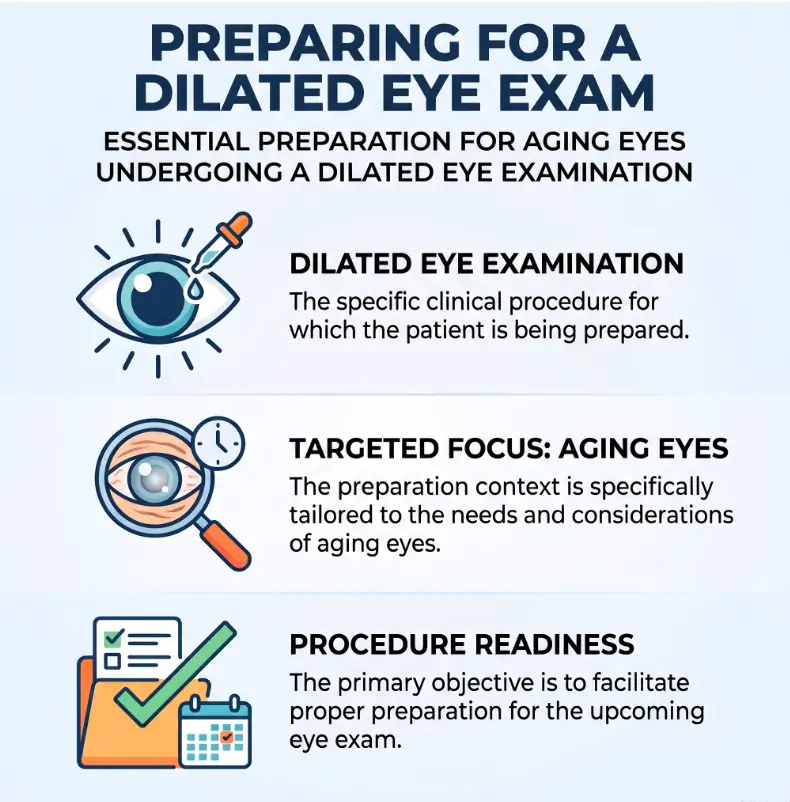
Answer the Ride-Home Question Before You Book
The most important preparation decision is also the easiest to postpone: how will you get home if your vision is blurred or bright light feels harsh?
Dilating drops temporarily widen the pupils and often reduce near focusing ability. You may still be able to walk, talk, and recognize familiar objects, yet struggle with dashboard numbers, mirrors, traffic glare, or signs in shadow. That is not an ideal moment to improvise a transportation plan.
Assume You May Not Be Driving-Ready
Plan the appointment as though you will not drive afterward. A friend, family member, caregiver, taxi, rideshare, senior transport service, or paratransit option can remove pressure from the decision.
Planning a ride does not mean every patient will be unable to drive for the same length of time. It means you will not have to test your safety under parking-lot glare while feeling rushed.
Familiar Roads Are Not a Safety Test
A short route can still contain reflective pavement, unexpected construction, shaded intersections, cyclists, and small dashboard warnings. Familiarity does not restore contrast sensitivity or near focus.
For additional planning around age-related focusing changes, review these driving safety tips for seniors with presbyopia before appointment day.
Transportation Options Compared
| Option | Best for | What to confirm | Possible drawback |
|---|---|---|---|
| Family member or friend | Patients who also want help taking notes | Pickup time, appointment length, parking | The visit may run longer than expected |
| Caregiver | Mobility, hearing, memory, or transfer support | Whether the caregiver may join the discussion | May involve a paid service |
| Taxi or rideshare | Independent travelers who need door-to-door transport | Pickup point and safe building exit | The driver may not provide mobility assistance |
| Senior transportation service | Older adults needing scheduled local travel | Reservation rules and return-trip procedure | Advance booking may be required |
| Paratransit | Eligible riders with disability-related transport needs | Eligibility, pickup window, companion rules | Longer travel windows are possible |
Key takeaway
Make the transportation decision while your pupils are normal, your phone is readable, and no one is waiting behind you with car keys.
The 24-Hour Preparation Plan That Prevents Friction
Most routine dilated exams do not require elaborate preparation. The useful work is administrative: confirm the appointment, protect the rest of your day, and make sure the clinic knows about any special concerns.
Confirm What the Visit Includes
Ask whether the appointment includes pupil dilation, refraction for a glasses prescription, eye-pressure testing, retinal photography, optical coherence tomography, a visual field test, or another procedure.
This matters for timing. A basic appointment can expand when additional images, repeat measurements, or a discussion with the doctor becomes necessary. Tell your driver that the scheduled start time is not a reliable pickup time.
- Confirm the clinic address, floor, parking entrance, and check-in time.
- Ask how long patients are usually in the office.
- Ask whether your contacts should be removed before arrival.
- Confirm whether the visit includes a separate refraction charge.
- Ask whether a caregiver may accompany you into the examination room.
Keep Meals and Medicines Routine Unless Instructed Otherwise
A routine dilated eye examination generally does not require fasting. Eat normally and take prescribed medicines unless the clinic or prescribing professional has given different instructions.
Do not skip glaucoma drops, blood pressure medicine, diabetes medicine, or another regular treatment merely because an eye appointment is scheduled. When in doubt, call the clinic rather than editing your medication routine yourself.
Protect the Hours Afterward
Move tasks that demand fine focus or confident depth perception. That may include night driving, sewing, woodworking, financial paperwork, medication sorting, document signing, or detailed computer work.
Appointments late in the afternoon may also leave you dealing with dilation as outdoor light fades and headlights begin to bloom. Some patients prefer a morning appointment because it allows more recovery time before evening.
Request Accessibility Before Arrival
Tell the office before appointment day when you need large-print forms, a wheelchair-accessible room, an interpreter, hearing support, extra time, assistance in dim hallways, or permission for a caregiver to take notes.
Accessibility works best when it is scheduled, not whispered at the front desk while a waiting room fills.

Bring the Evidence Your Eyes Cannot Explain Alone
The clinician can examine your eyes, but only you can describe what happens at the grocery shelf, on the highway, beside the medicine cabinet, or under dim restaurant lighting.
A good appointment kit joins those two forms of evidence: what the doctor can observe and what you have noticed in daily life.
Bring Every Pair You Actually Use
- Distance glasses
- Reading glasses
- Bifocals or progressive lenses
- Prescription sunglasses
- Computer glasses
- Contact-lens packaging or prescription information
- A contact-lens case, solution, and backup glasses
- Magnifiers or low-vision devices used at home
Do not leave an older pair at home because the prescription is outdated. The doctor may learn something useful from how and when you still use it.
Make a One-Page Medication List
Include prescription medicines, nonprescription products, vitamins, supplements, and all eye drops. Record the dose, frequency, and reason for use when known.
Eye-drop names are especially easy to lose in a fog of colored caps. Bring the bottles when you are uncertain. You can also prepare a printable one-page medication list and use these eye-drop labeling ideas for seniors to reduce mix-ups at home.
Replace Adjectives With Examples
“My vision is getting worse” is sincere, but it leaves several clinical questions unanswered. A concrete example gives the doctor a pattern to investigate.
| Instead of saying | Try describing |
|---|---|
| My night vision is bad. | Road signs become difficult to read after sunset, especially in rain. |
| Reading is harder. | I lose my place after two paragraphs unless the print is enlarged. |
| Things look distorted. | Bathroom tile lines look bent when I cover my right eye. |
| My vision comes and goes. | The left eye becomes cloudy for about ten minutes, twice this week. |
| Lights bother me. | Store lighting creates glare, but warm lamps at home do not. |
| I see spots. | I noticed several new moving specks and two flashes yesterday. |
Symptom Notes to Record
- When the problem began
- Whether it affects one eye or both
- Whether it is constant or intermittent
- What makes it better or worse
- Whether straight lines appear bent or missing
- Any flashes, new floaters, halos, double vision, pain, redness, or shadows
- Previous eye surgery, laser treatment, injections, injury, or infection
- Family history of glaucoma, macular degeneration, or retinal disease
- Recent changes in diabetes, blood pressure, or medication use
The Four-Part Preparation Framework
1. Ride
Choose transportation before the appointment.
2. Records
Bring glasses, medicines, drops, and eye history.
3. Questions
Write specific symptoms and desired answers.
4. Recovery
Prepare sunglasses, soft light, and easy tasks.
Key takeaway
The most useful symptom note contains an eye, a time, a trigger, and a real-life consequence.
What Happens After the Dilating Drops Go In
Knowing the sequence of the exam can make it feel less mysterious. The drops are not the examination itself. They create a wider opening through which the clinician can inspect more of the retina, macula, blood vessels, and optic nerve.
The Waiting Period Is Part of the Exam
A commonly used dilating medicine may take about 15 to 20 minutes or longer to work. The exact timing depends on the drops, pupil response, eye color, age, and the purpose of the examination.
You may wait in a dimmer area while the pupils enlarge. This is a useful time to ask the most important questions, especially if reading your notes will become difficult once near focus changes.
What Dilation Helps the Doctor See
The wider pupil allows a more complete view inside the eye. A dilated examination may help identify signs of glaucoma, diabetic retinopathy, age-related macular degeneration, retinal tears, optic nerve changes, and other conditions that may have few early symptoms.
The doctor may use a bright light and magnifying lens, a slit lamp, retinal photography, or optical coherence tomography. Not every patient needs every test.
Expect Brightness, Not Necessarily Pain
The drops may sting briefly. Examination lights can feel intense and may leave a temporary after-image, especially for glare-sensitive eyes. The examination should not ordinarily produce severe eye pain.
Tell the clinician immediately if you experience significant pain, breathing difficulty, severe dizziness, marked nausea, or another unusual reaction. Quiet endurance is not a required examination skill.
The Near-Vision Surprise
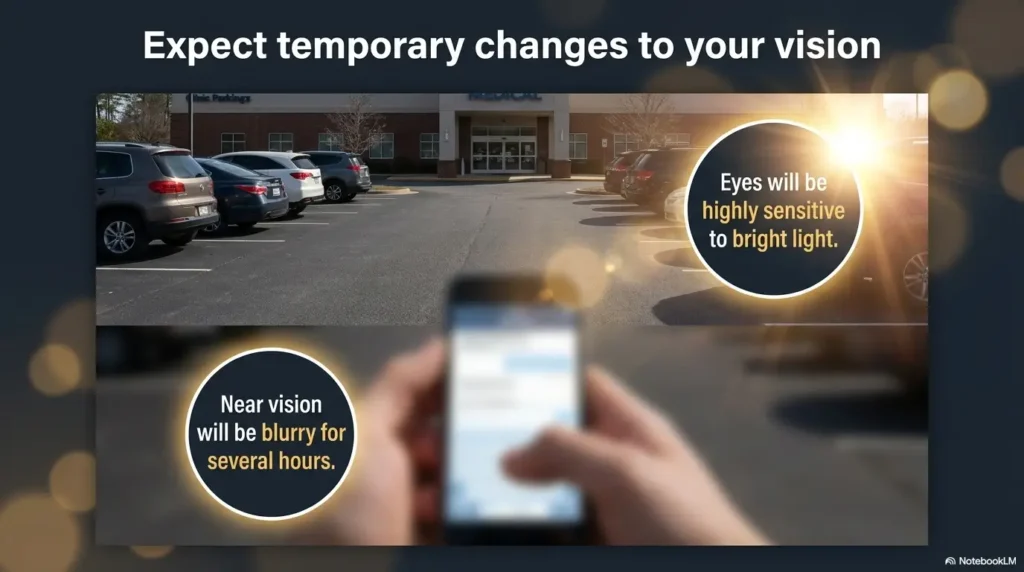
Many people expect distance blur but are more inconvenienced by near tasks. A phone screen, medicine label, form, restaurant menu, parking ticket, or payment terminal may become difficult to focus on.
Complete essential reading, navigation setup, and medication organization before the drops. Enlarge your phone text in advance rather than trying to find accessibility settings through a luminous blur.
Show me the nerdy details
Dilating medicines temporarily affect muscles involved in pupil size and, depending on the drug, near focusing. Tropicamide is one medicine commonly used for diagnostic dilation. It may take 15 to 20 minutes or longer to reach its full effect.
Its effects often last about four to eight hours, but some people experience effects for longer. Another dilating medicine may be used alone or in combination, so your clinic’s estimate matters more than a universal clock.
This is why safe function is a better recovery measure than elapsed time. Clear signs, comfortable light tolerance, dependable depth perception, and readable dashboard information matter more than whether four hours have passed.
Aging-Eye Accommodations Worth Requesting
An eye clinic examines vision, yet its forms, lighting, signs, and instructions may still be difficult for someone with reduced contrast sensitivity, glare discomfort, hearing loss, arthritis, or memory concerns.
Asking for assistance is not asking for special treatment. It is asking for important information to arrive in a usable form.
Tiny Print Is Not a Test of Character
Ask for large-print forms, dark high-contrast text, verbal instructions, or digital documents that can be enlarged. Pale print under bright fluorescent light can defeat even a determined pair of reading glasses.
When test results or instructions arrive as a digital file, this guide to reading PDF test results on a phone can make follow-up information easier to review.
Ask Important Questions Before Dilation
- What did you find?
- Is the finding new or stable?
- Which eye is affected?
- Does it explain my symptoms?
- Is treatment, monitoring, or another test recommended?
- What symptoms should trigger an urgent call?
- When should I return?
- Who should I contact if I have a problem tonight?
Write your top three questions in large text. A longer list may be useful, but the top three protect the issues you most need answered.
Use a Second Set of Ears
With your permission, a caregiver can take notes, confirm medication changes, remember follow-up dates, and help you move safely through unfamiliar hallways.
Agree on roles before the appointment. The patient should remain at the center of the conversation, while the caregiver fills gaps rather than answering every question first.
Capture Instructions Before Leaving
Ask for written instructions and photograph them while still in the clinic. Check that the image is sharp, complete, and not washed out by glare.
A structured doctor appointment note-taking system can also help families keep findings, medication changes, and next steps in one place.
Short Story: Margaret’s Three Questions
Margaret arrived with seven pages of notes folded into her handbag. Once her pupils were dilated, the pages became a pale accordion of unreadable print.
Her daughter tried to help, but neither could remember which questions mattered most. They discussed new glasses, left the clinic, and only in the car remembered the episodes when straight lines looked bent.
Before the follow-up visit, Margaret rewrote three questions in thick black marker: “Why do lines bend?” “Which eye is changing?” and “When should I call urgently?” Her daughter took notes beneath each answer.
The second appointment was not longer. It was simply better aimed. The lesson was not to bring fewer concerns, but to place the most important ones where blur, glare, and nervousness could not bury them.
Key takeaway
Accessibility is part of medical accuracy. Instructions that cannot be read, heard, remembered, or enlarged are not fully usable instructions.
Common Mistakes That Turn a Simple Exam Into a Long Day
Most exam-day problems are not dramatic medical events. They are small planning gaps that stack together: no ride, no glasses, no medication list, a low phone battery, and an evening full of fine-print tasks.
Mistake 1: Arriving Without Transportation
Do not assume a previous experience predicts today’s response. The drops, dosage, weather, appointment timing, and your eyes may differ.
Mistake 2: Forgetting Eye Drops
A medication list that omits eye drops is incomplete. Bring the bottles when names are uncertain, particularly if several caps look similar.
Mistake 3: Wearing Contacts Without a Backup
Contacts may need to be removed before drops or testing. Bring glasses, a clean case, and solution unless the clinic has told you otherwise.
Mistake 4: Scheduling Precision Work Afterward
Postpone medication sorting, sewing, power-tool use, dense paperwork, tax forms, banking changes, and documents that require careful reading. The problem is not merely inconvenience. A blurred decimal point or misread label can have consequences.
Mistake 5: Assuming Every Symptom Is Normal
Temporary blur and light sensitivity are common. Severe pain, marked redness, vomiting, pronounced halos, major vision loss, new flashes, a sudden increase in floaters, or a curtain-like shadow should not be folded into the phrase “probably just the drops.”
| Common mistake | Safer alternative |
|---|---|
| I will decide about driving afterward. | Arrange transportation before the visit. |
| I can remember all my medicines. | Bring a written list or the containers. |
| The office will provide everything. | Pack sunglasses, glasses, a contact case, and a charged phone. |
| I will finish paperwork after dilation. | Complete essential reading before the drops. |
| Any discomfort must be normal. | Ask the clinic what to expect and which symptoms require a call. |
| I can schedule my normal evening. | Keep the recovery period flexible and low-demand. |
Recover After the Exam Without Guesswork
Recovery is less about doing something to reverse dilation and more about making the temporary effects easier to live with. Time, shade, comfortable lighting, and reduced visual demand usually do most of the work.
Reduce Glare Before Leaving the Building
Put on sunglasses before stepping into direct sunlight. Wraparound styles may provide more side coverage, but the best pair is one that is comfortable, reasonably dark, and already familiar.
If the lobby, stairway, curb, or reflective pavement feels difficult, ask for guidance. Temporary uncertainty with depth or contrast is a poor reason to hurry.
Let Clarity, Not the Clock, Decide
Dilation often wears off within several hours, but duration varies. Some people notice lingering effects into the evening or longer.
Resume driving only when vision is clear and comfortable enough to read signs, mirrors, dashboard information, lane markings, and hazards in changing light. A preset waiting period cannot certify that you are safe to drive.
Prepare an Eye-Friendly Recovery Space
- Soft indoor lighting
- Blinds or curtains that reduce direct glare
- Audio entertainment
- Large-print reading material
- A charged phone with enlarged text and voice controls
- Meals that do not require fine preparation
- Medicines organized before the appointment
- A clear walking route without loose cords or clutter
If glare and dim-light navigation are persistent concerns, not just post-exam inconveniences, a night bathroom safety setup for seniors may make the home easier to move through after dark.
Good, Better, and Best Recovery Setups
| Setup | Cost profile | What it includes | Best for |
|---|---|---|---|
| Good | No-cost preparation | Existing sunglasses, closed blinds, audio content, pre-sorted medicines | Independent patients with mild temporary blur |
| Better | Low-cost comfort upgrade | Wraparound sunglasses, large-print notes, glare-reduced lighting, phone accessibility settings | People with stronger glare or near-focus difficulty |
| Best | Paid or family-supported assistance | Door-to-door transportation, caregiver notes, mobility help, prepared meals, follow-up support | Patients with mobility, memory, hearing, or significant vision concerns |
A premium setup is not automatically necessary. The best choice is the least complicated arrangement that safely covers your transportation, communication, mobility, and recovery needs.
Key takeaway
Do not buy a basket of special products for one appointment. Start with transportation, sunglasses, readable instructions, and a low-demand recovery plan.
When to Seek Help Instead of Waiting
Most people experience temporary blur, difficulty focusing up close, and light sensitivity. The clinic should tell you what it expects from the drops used in your examination.
The important distinction is not between “comfortable” and “annoying.” It is between expected temporary effects and symptoms that may signal a separate eye problem or unusual reaction.
Call the Eye Clinic Promptly
- Blur or light sensitivity is much more severe than the clinic predicted.
- Symptoms continue longer than the expected range you were given.
- You develop significant headache, nausea, or unusual dizziness.
- An eye becomes increasingly red or painful.
- You are unsure whether a new symptom is related to the drops or the condition being examined.
Seek Urgent Eye Evaluation
Severe eye pain, substantial redness, rapidly worsening vision, colored halos with headache or vomiting, sudden flashes, a shower of new floaters, or a curtain-like shadow should be evaluated urgently.
A rare acute angle-closure glaucoma attack can cause sudden eye pain, blurry vision, redness, halos, headache, nausea, or vomiting. People who have been told they have narrow angles should discuss dilation precautions with their eye doctor before the appointment.
Call Emergency Services for a Broader Emergency
Call 911 for difficulty breathing, loss of consciousness, severe confusion, stroke-like symptoms, or another life-threatening reaction. Do not attempt to drive yourself.
Key takeaway
Routine dilation can explain temporary blur and glare. It should not be used to explain away severe pain, major vision loss, vomiting, new flashes, or a curtain-like shadow.
Dilated Eye Exam FAQ
Can I eat before a dilated eye exam?
A routine dilated eye exam usually does not require fasting. Follow any separate instructions when the appointment includes surgery, sedation, laboratory work, or another procedure.
Should I wear contact lenses to the appointment?
You may be able to wear them unless the clinic says otherwise, but bring backup glasses, a contact-lens case, and solution. Certain drops or tests may require the lenses to be removed.
How long will my eyes stay dilated?
Effects commonly last several hours. A medicine such as tropicamide may have effects for roughly four to eight hours and occasionally longer. The exact duration depends on the medicine used and your individual response.
Can I drive myself home?
Plan not to drive and arrange transportation in advance. Do not drive while blur, glare, near-focus difficulty, or reduced visual confidence interferes with safe operation.
Will a dilated eye exam hurt?
The drops may sting briefly, and bright examination lights can be uncomfortable. The examination is generally not painful. Report severe or increasing pain immediately.
Should I bring my current glasses?
Yes. Bring every pair you regularly use, including reading, distance, progressive, computer, and prescription sunglasses, even when a prescription seems outdated.
Can I use my phone after dilation?
You can, but near text may be difficult to focus on. Increase font size, reduce glare, use voice controls, or postpone detailed screen work until your vision is comfortable.
What should I tell the eye doctor before the drops?
Mention all medicines and eye drops, allergies, glaucoma or narrow angles, previous reactions, eye surgery, medical conditions, family eye history, and current vision symptoms.
Can a caregiver come with me?
Many clinics allow a caregiver or support person, but room size and privacy policies vary. Ask when scheduling and tell the staff what type of help you need.
Optional video: Open the video on YouTube (external site).
Create Your Five-Minute Eye Exam Card
The best final preparation is not another hour of research. It is one page that keeps the appointment from becoming a scavenger hunt through pockets, portals, pill bottles, and blurry phone screens.
Put These Items in One Place
- Write the name and time of the appointment.
- Record your transportation plan and driver’s phone number.
- Add your medication and eye-drop list.
- List three specific vision changes.
- Record previous eye procedures and important family history.
- Write your three most important questions.
- Place sunglasses, glasses, identification, insurance information, and contact-lens supplies together.
- Charge your phone and enlarge the text before bed.
Your 15-Minute Next Step
Open a phone note or place a sheet of paper beside your keys. Write four headings: Ride, Medicines, Vision Changes, Questions. Fill in each heading, then place your sunglasses and glasses beside the note.
That small card cannot control how long dilation lasts or what the doctor finds. It can do something quieter and immediately useful: protect the information, safety, and next steps that are easiest to lose when the world becomes bright and close-up print turns soft.
The calm exit checklist
Before leaving the clinic, confirm what was found, what happens next, which symptoms require urgent attention, and when you should return.
Then put on your sunglasses, accept the ride, and let the afternoon be wonderfully unambitious.
Last reviewed: 2026-08
PUT THIS GUIDE TO WORK · INTERACTIVE WORKSHEET
Build your dilated-exam day card
Use this worksheet alongside the article: How to Prepare for a Dilated Eye Exam with Aging Eyes. Use the fields provided to organize your notes and next actions, then save your worksheet.
Your entries stay in this page and are cleared when you reload. No account is needed. Saved files are downloaded only to your device.
This card organizes a discussion or task. It does not provide diagnosis, treatment, medication timing, driving clearance, or professional approval. Copy clinical instructions exactly and ask the professional about uncertainty.
How to use your result
Save the worksheet before leaving this page. Recheck any quote, date, or instruction with the relevant provider, pharmacist, manufacturer, or official organization. A completed checklist means you recorded the steps, not that an outcome is guaranteed.
Worksheet added October 20, 2026. Read the article above for context and its stated review scope.