
What Eye Exams Does Medicare Actually Cover?
The Routine vs. Medical Exam Rule That Changes the Bill
You can have Medicare, sit in the same examination chair, see the same eye doctor, and still have one visit covered while another is entirely your responsibility. The difference often comes down to why the exam is being performed.
Original Medicare generally does not pay for a routine eye exam or refraction simply to update an eyeglass or contact-lens prescription. It does cover certain eye examinations, screenings, diagnostic services, and treatments when specific medical or eligibility requirements are met.
This guide separates those situations so you can ask the right question before the appointment, understand what Part B may pay for, and spot the parts of a visit that may still be billed to you.
Diabetes, glaucoma, medical eye problems, AMD, and cataract-related care.
A medical exam and a glasses refraction can appear in the same appointment.
Use a five-question call script before the visit begins.
Bottom line: With Original Medicare, “I need my glasses checked” and “my doctor is evaluating an eye disease” are financially different appointments. 👁️
Snapshot
For: Medicare beneficiaries and family members trying to determine whether an upcoming eye visit is covered. Problem solved: distinguishing routine vision care from Medicare-covered screening or medically necessary eye care. After reading: you will know what to verify with the eye doctor’s office and your Medicare coverage before the appointment.
Before you act
This article explains Medicare coverage rules, not whether a particular eye test is medically necessary for you. Your eye-care professional decides what evaluation is clinically appropriate. Medicare, a Medicare Advantage plan, or another insurer determines whether the billed service meets its coverage rules. If vision changes suddenly, do not delay medical care while trying to solve the insurance question first.
Table of Contents
The Quick Answer: Which Eye Exams Medicare Covers
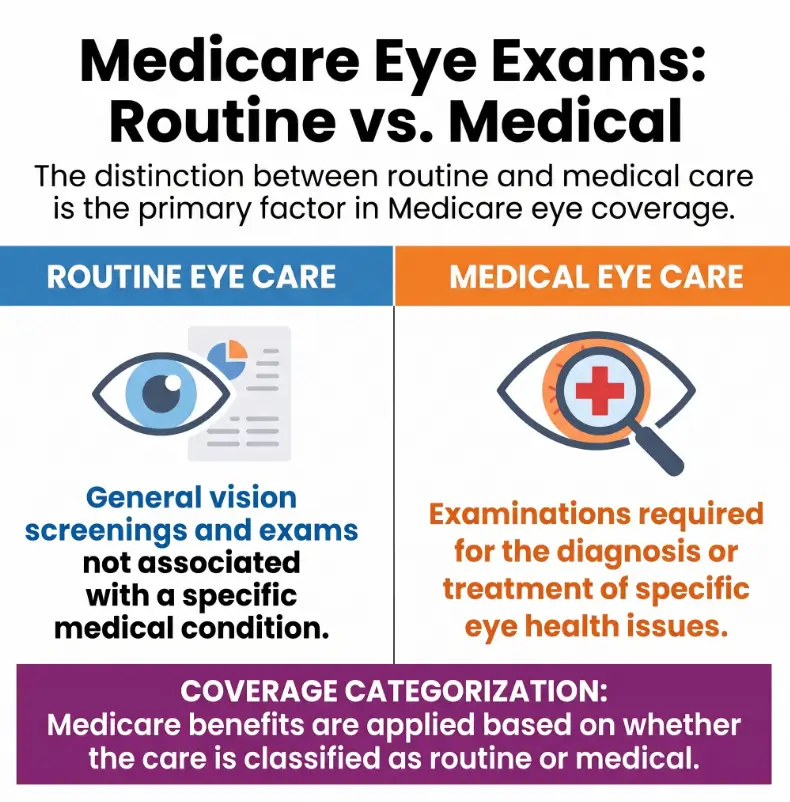
If you have Original Medicare, start with a simple rule: routine vision correction is generally not the same thing as covered medical eye care.
Original Medicare does not generally cover a routine eye exam or refraction performed to prescribe eyeglasses or contact lenses. Some Medicare Advantage plans add routine vision benefits, but those benefits are plan-specific.
Part B can, however, cover certain eye-related services when you meet the relevant rules.
| Reason for the eye visit | Original Medicare | What to verify |
|---|---|---|
| Routine exam to update glasses | Generally not covered | Ask for the cash price of the exam and refraction |
| Diabetic retinopathy eye exam | Part B covers an eligible exam once a year | Diabetes diagnosis, provider eligibility, cost sharing |
| High-risk glaucoma screening | Part B covers eligible screening every 12 months | Whether you meet Medicare’s high-risk criteria |
| Evaluation of eye symptoms, disease, or injury | May be covered when medically necessary | Reason for visit, documentation, specific tests ordered |
| Tests or treatment for age-related macular degeneration | Certain services may be covered | Diagnosis, test or treatment, provider and setting |
| Eyeglasses after covered cataract surgery with an implanted intraocular lens | Limited Part B benefit applies | Standard frames versus upgrades, approved supplier |
Key takeaway: Do not ask only, “Does Medicare cover eye exams?” Ask, “What is the medical reason for this particular exam, and which part of today’s visit is being billed to Medicare?”
Routine vs. Medical Eye Exams: The Distinction That Matters
A routine refraction is usually the uncovered part
A refraction is the familiar “Which is clearer, one or two?” portion of an eye examination used to determine a corrective-lens prescription. Original Medicare says routine eye exams for eyeglasses or contact lenses are not covered.
That means turning 65, enrolling in Part B, or simply being due for an annual glasses check does not automatically create an Original Medicare routine vision benefit.
A medical eye visit starts with a medical reason
The picture changes when an eye doctor is evaluating or managing an abnormal symptom, known disease, injury, or medically relevant condition. Part B covers medically necessary doctor services, and Medicare contractors can cover particular ophthalmic diagnostic tests when their medical-necessity criteria are satisfied.
Examples may include evaluating unexplained visual loss, monitoring glaucoma, investigating retinal disease, or performing a diagnostic test that is needed to manage an established eye condition. The exact service still needs to meet Medicare’s rules.
One appointment can contain both
This is where bills become confusing. You might see an ophthalmologist because of a medical eye condition and also ask for a new glasses prescription while you are there.
The medically necessary portion may qualify for Part B coverage while the routine refraction remains a separate non-covered charge. The fact that both happened in the same room does not make them the same Medicare service.
Why are you making the appointment?
Think routine vision care. Original Medicare generally does not cover the refraction.
Check the specific Part B preventive eye benefit and frequency rule.
Ask whether the visit is being billed as medically necessary eye care.
Ask whether the refraction will be a separate self-pay charge.

Eye Exams and Eye Care Medicare Can Cover
1. Annual diabetic retinopathy eye exams
If you have diabetes, Medicare Part B covers an eye exam for diabetic retinopathy once a year when you get the exam from an eye doctor legally permitted to perform it in your state. After the Part B deductible, Medicare says you generally pay 20% of the Medicare-approved amount for the doctor’s service, with possible additional outpatient hospital costs depending on the setting.
This is different from saying that Medicare gives every beneficiary one free annual routine eye exam. It does not. The diabetes benefit exists because of the qualifying medical condition.
You can confirm the current rule on Medicare’s official diabetic eye exam coverage page.
2. Glaucoma screening for people Medicare considers high risk
Part B covers a glaucoma screening once every 12 months when you fall into one of Medicare’s high-risk groups. Medicare currently lists people with diabetes, people with a family history of glaucoma, African Americans age 50 or older, and Hispanic Americans age 65 or older. The screening must be done or supervised by an eye doctor legally authorized to perform glaucoma testing in your state.
This screening also normally involves Part B deductible and coinsurance rather than the zero-dollar cost sharing associated with some other Medicare preventive services.
Before booking solely for this benefit, compare your situation with Medicare’s glaucoma screening eligibility rules.
3. Medically necessary evaluation of an eye problem
A visit prompted by an actual medical problem can be very different from a routine glasses exam. Part B covers medically necessary doctor services, including services from an optometrist in situations where Medicare recognizes that provider type.
The important words are medically necessary. Medicare coverage can depend on the diagnosis or symptoms documented, what test is ordered, the frequency of testing, the provider, and sometimes the local Medicare Administrative Contractor’s coverage policy.
So an OCT scan, visual-field test, retinal image, or other diagnostic service should not be treated as automatically covered merely because Medicare sometimes pays for that type of technology. The clinical reason and billing rules matter.
4. Certain testing and treatment for age-related macular degeneration
Medicare Part B may cover certain diagnostic tests and treatments, including certain injectable drugs, for people with age-related macular degeneration. Medicare’s coverage page also notes the usual Part B deductible and coinsurance rules and possible outpatient facility charges.
That does not translate into a general Medicare-paid “macular degeneration screening” for everyone without symptoms or a diagnosis. Ask whether the service is being performed to diagnose, monitor, or treat a medical condition and whether the particular service meets Medicare requirements.
5. Cataract-related medical care and limited post-surgery eyewear
Medicare covers medically necessary cataract surgery when coverage requirements are met. After cataract surgery in which an intraocular lens is implanted, Part B also covers one pair of eyeglasses with standard frames or one set of contact lenses after each such surgery.
Upgraded frames and other non-covered extras can increase what you pay. If cataracts are part of your current concern, it can also help to separate ordinary near-vision changes from cataract symptoms before assuming that stronger readers are the whole answer. See the site’s guide to presbyopia versus cataracts.
Key takeaway: Medicare eye coverage is usually triggered by a defined preventive benefit, a medical condition, symptoms, injury, treatment, or surgery. Age alone does not turn a routine glasses exam into a covered Part B service.
Show me the nerdy details
Medicare billing does not simply classify an entire eye-office appointment as “covered” or “not covered.” Services can be billed separately. A medical examination, refraction, diagnostic image, visual-field test, treatment, drug, and facility charge may each have different coverage and cost-sharing rules.
Medicare Administrative Contractors also publish Local Coverage Determinations for certain diagnostic procedures. These policies can spell out indications, documentation requirements, utilization limits, and circumstances considered screening rather than medically necessary testing.
That is why asking whether “the appointment” takes Medicare is less useful than asking which services are expected, which are being submitted to Medicare, and which may be treated as non-covered.
What You May Pay Even When Medicare Covers the Visit
“Covered” is not another word for “free.” With Original Medicare, many covered Part B eye services are subject to the Part B deductible and then the usual beneficiary coinsurance. Hospital outpatient services can also create separate facility cost sharing.
| Potential charge | Why it appears | Question to ask |
|---|---|---|
| Part B deductible | A covered Part B service may be subject to the annual deductible | Have I already met my Part B deductible this year? |
| Coinsurance | Many Part B services leave the beneficiary a percentage of the Medicare-approved amount | What is my estimated share if Medicare approves the service? |
| Refraction fee | Routine determination of a glasses or contact-lens prescription is generally not covered by Original Medicare | Will a refraction be performed, and what is the self-pay charge? |
| Facility copayment | Hospital outpatient care can involve additional facility cost sharing | Is this visit taking place in a hospital outpatient department? |
| Non-covered upgrades | Examples can include upgraded eyewear beyond a covered benefit | Which options are standard and which are upgrades? |
The “we accept Medicare” trap
A practice saying “we accept Medicare” does not mean every service it provides is a Medicare benefit. It means you still need to establish whether your specific service is covered and how the provider participates in Medicare.
For Original Medicare, asking whether the clinician accepts Medicare assignment can also matter because assignment affects how the Medicare-approved amount is handled.
The cheapest useful question
Before arriving, ask the billing desk:
“Which part of this visit do you expect to bill to Medicare, and is there a separate charge for the refraction or any other non-covered service?”
That one sentence can uncover the most common source of surprise before the drops are in your eyes and the bill is already growing roots.
How Medicare Advantage Changes the Routine Vision Question
Medicare Advantage plans must provide the Medicare-covered services required under Parts A and B, but many plans also offer extra benefits that Original Medicare does not, including vision benefits. The details can differ substantially by plan.
A plan may, for example, include some routine eye care or an eyewear benefit, but you should not assume that “vision included” means unlimited exams or unrestricted eyeglasses.
| Coverage path | Routine glasses exam | Medical eye care | What needs checking |
|---|---|---|---|
| Original Medicare | Generally not covered | Covered when Medicare requirements are met | Medical necessity, provider, deductible, coinsurance |
| Medicare Advantage | May include an extra vision benefit | Must include Medicare-covered medical services, subject to plan rules | Network, copay, frequency, allowance, authorization |
| Original Medicare plus Medigap | Medigap generally does not create a routine vision benefit | May help with eligible Original Medicare cost sharing depending on the policy | Whether Medicare covers the underlying service first |
Five Medicare Advantage vision details worth comparing
- Exam frequency: How often is a routine eye exam covered?
- Provider network: Must you use a contracted optometrist, ophthalmologist, or optical retailer?
- Eyewear allowance: Is there an allowance, copay structure, or defined selection?
- Lens upgrades: Which lens types or coatings cost extra?
- Medical versus supplemental billing: Does the visit fall under the medical Part B benefit or the plan’s supplemental vision benefit?
Use Medicare’s official Original Medicare versus Medicare Advantage comparison as the starting point, then read your own plan’s evidence of coverage for the actual benefit limits.
Money moment: Do not change Medicare coverage solely because an advertisement mentions “vision.” Compare the actual routine exam benefit, eyewear limit, provider network, medical-care rules, total premiums, and broader health coverage before deciding that one vision perk is valuable.
Your 10-Minute Medicare Eye Exam Coverage Check
This is the useful part to do before the appointment, especially if you are helping a parent and want to avoid a three-way conversation between the front desk, Medicare, and a bill that arrived six weeks later.
Step 1: Write down the real reason for the visit
- Routine glasses or contact-lens prescription?
- Diabetes-related retinal exam?
- High-risk glaucoma screening?
- Known eye disease that needs monitoring?
- New or changing vision symptom?
- Follow-up after surgery or treatment?
If you are struggling to describe a new visual change clearly, use the site’s guide to explaining vision changes to an eye doctor before making the call.
Step 2: Call the eye doctor’s billing office
- Do you bill Medicare for the medical reason I am coming in?
- Does the clinician accept Medicare assignment?
- Are you planning to perform a refraction, and is that a separate self-pay charge?
- Are there diagnostic tests that may be ordered separately?
- If I have Medicare Advantage, are you in my plan’s network for both medical eye care and supplemental vision services?
Step 3: Verify the benefit with Medicare or the plan
For Original Medicare, use Medicare’s official coverage pages or call Medicare if the situation is unclear. For Medicare Advantage, check the member portal, evidence of coverage, or member-services number on the insurance card.
Do not rely solely on a receptionist’s memory of another patient’s coverage. The office can tell you how it expects to bill the service; your insurer determines how your coverage applies.
Step 4: Bring a one-page visit sheet
Write down your medications, eye symptoms, surgeries, diabetes status if relevant, current glasses, and the questions you want answered. The site’s eye doctor visit checklist for seniors can make the medical side of the appointment easier to manage.
The five-question card
- What diagnosis, symptom, or Medicare screening benefit is this visit for?
- Which services do you expect Medicare or my Medicare Advantage plan to cover?
- Is a refraction included, and will I pay separately for it?
- Are any tests billed separately from the office visit?
- Can you give me an estimate for anything you expect insurance not to cover?
Real-world example
Illustrative scenario: A Medicare beneficiary books an appointment because reading has become harder. During scheduling, the visit is described simply as an “annual eye exam.” At the office, the patient expects Medicare to pay because the practice accepts Medicare.
The examination shows no previously documented disease requiring medical management, and the main service requested is an updated eyeglass prescription. The refraction is therefore not automatically transformed into a Medicare-covered service just because a physician performed it.
Now change one fact. Suppose the patient has diabetes and is scheduling the annual eye examination for diabetic retinopathy. That creates a specific Part B coverage pathway, subject to Medicare’s rules and cost sharing.
The lesson is wonderfully unglamorous: the reason written next to the appointment can matter more than the word “eye exam.”
What to Do If the Eye Exam Bill Is Not What You Expected
First, separate the charges
Do not start with “Medicare denied my eye exam.” Start with the individual line items.
- Was the office visit paid but the refraction denied?
- Was a diagnostic test denied?
- Was the entire claim rejected?
- Was the provider out of network under Medicare Advantage?
- Was the service applied to your deductible?
- Is the amount simply your coinsurance rather than a denial?
Then compare three documents
- The provider’s itemized bill.
- Your Medicare Summary Notice, or your Medicare Advantage Explanation of Benefits.
- Any estimate or coverage information you received before the visit.
If Medicare paperwork is hard to decode, the site’s guide to reading Medicare notices for seniors can help you identify what was paid, denied, or assigned to you.
If the service was non-covered, ask whether you agreed to it
Ask the provider what service was performed, why it was not covered, how it was coded, and what notice or financial agreement applied. If the dispute concerns whether Medicare should have covered a service, follow the appeal instructions on the Medicare Summary Notice or your plan’s Explanation of Benefits rather than arguing only from the office invoice.
If this is still hard: If the problem is an unexplained refraction charge, start with the provider. If the problem is a denied Medicare-covered medical service, review the claim decision and appeal rights. If the problem is a Medicare Advantage network or supplemental vision benefit, contact the plan because its rules can differ from Original Medicare.
When the Insurance Question Should Wait
Most Medicare coverage questions can survive a telephone queue. Some vision symptoms should not.
A sudden shower of new floaters, flashes of light, or a dark curtain or shadow across the vision can be symptoms of retinal detachment. The National Eye Institute advises people with retinal-detachment symptoms to seek eye care or emergency evaluation right away because prompt treatment can help protect vision.
If there is sudden significant vision loss, a serious eye injury, or another rapidly developing eye problem, seek appropriate medical evaluation rather than postponing care until you have solved every billing detail.
For a broader checklist of changes that deserve attention, see senior vision changes and warning signs. You can also review the National Eye Institute’s retinal detachment guidance.
Safety boundary: Insurance verification is useful for scheduled care. It should not become a reason to delay evaluation of a potentially urgent vision problem.

Frequently Asked Questions
Does Medicare cover one routine eye exam every year after age 65?
Not under Original Medicare simply because you are 65 or older. Routine eye exams or refractions for eyeglasses and contact lenses are generally not covered. Specific Part B eye benefits exist for qualifying situations such as diabetic retinopathy exams and high-risk glaucoma screening.
Does Medicare cover an eye exam if my vision is blurry?
Potentially, if the eye doctor is evaluating a medically necessary symptom or condition and Medicare’s requirements are met. A routine refraction performed only to update a glasses prescription remains a separate issue. Describe the symptom when scheduling instead of simply requesting a “routine eye exam.”
Does Medicare pay for dilated eye exams?
Medicare does not cover a test merely because dilation is used. Coverage depends on the reason for the examination. A dilated exam may form part of a covered diabetic retinopathy exam or medically necessary evaluation, for example, while a routine vision visit does not automatically become covered because the pupils were dilated.
Does Medicare cover glaucoma tests every year?
Part B covers glaucoma screening once every 12 months for people who meet Medicare’s specified high-risk criteria. People already being evaluated or treated for glaucoma may receive medically necessary testing under different coverage rules rather than the preventive screening benefit alone.
Will Medicare cover glasses after cataract surgery?
Part B covers one pair of eyeglasses with standard frames or one set of contact lenses after each cataract surgery that implants an intraocular lens. You may owe deductible and coinsurance amounts, and upgraded frames or other extras can cost more.
Can Medicare Advantage cover routine eye exams that Original Medicare does not?
Yes. Medicare Advantage plans may offer supplemental vision benefits that Original Medicare does not provide. The frequency, network, copay, eyewear allowance, and other terms depend on the individual plan, so verify the current evidence of coverage rather than assuming all Medicare Advantage vision benefits are alike.
Can I be charged for a refraction during an otherwise covered medical eye visit?
Yes. A refraction for an eyeglass or contact-lens prescription can be a separately billed non-covered service even when another part of the visit qualifies for Medicare coverage. Ask about the refraction fee before the examination begins.
Your Next 15 Minutes
If you have an eye appointment coming up, do one small piece of administrative housekeeping today. Find your Medicare card or Medicare Advantage card, write down the actual reason for the appointment, and call the eye doctor’s billing desk.
Ask these two questions first: “What part of my visit do you expect to bill as medical eye care?” and “Will I have a separate charge for refraction or another non-covered service?”
If you have diabetes, high glaucoma risk, known macular degeneration, an eye disease, or a new symptom, say that clearly. If all you want is an updated pair of reading glasses, say that clearly too. Accurate words make better appointments and, quite often, cleaner bills.
Your simple decision rule
Routine prescription only → check the self-pay or Medicare Advantage vision benefit.
Qualifying preventive screening → verify eligibility, frequency, provider, and cost sharing.
Eye disease, injury, or symptom → ask whether the service is medically necessary and being submitted to Medicare.
Sudden serious vision change → get appropriate medical care first and sort out the bill second.
Last reviewed: 2026-09