
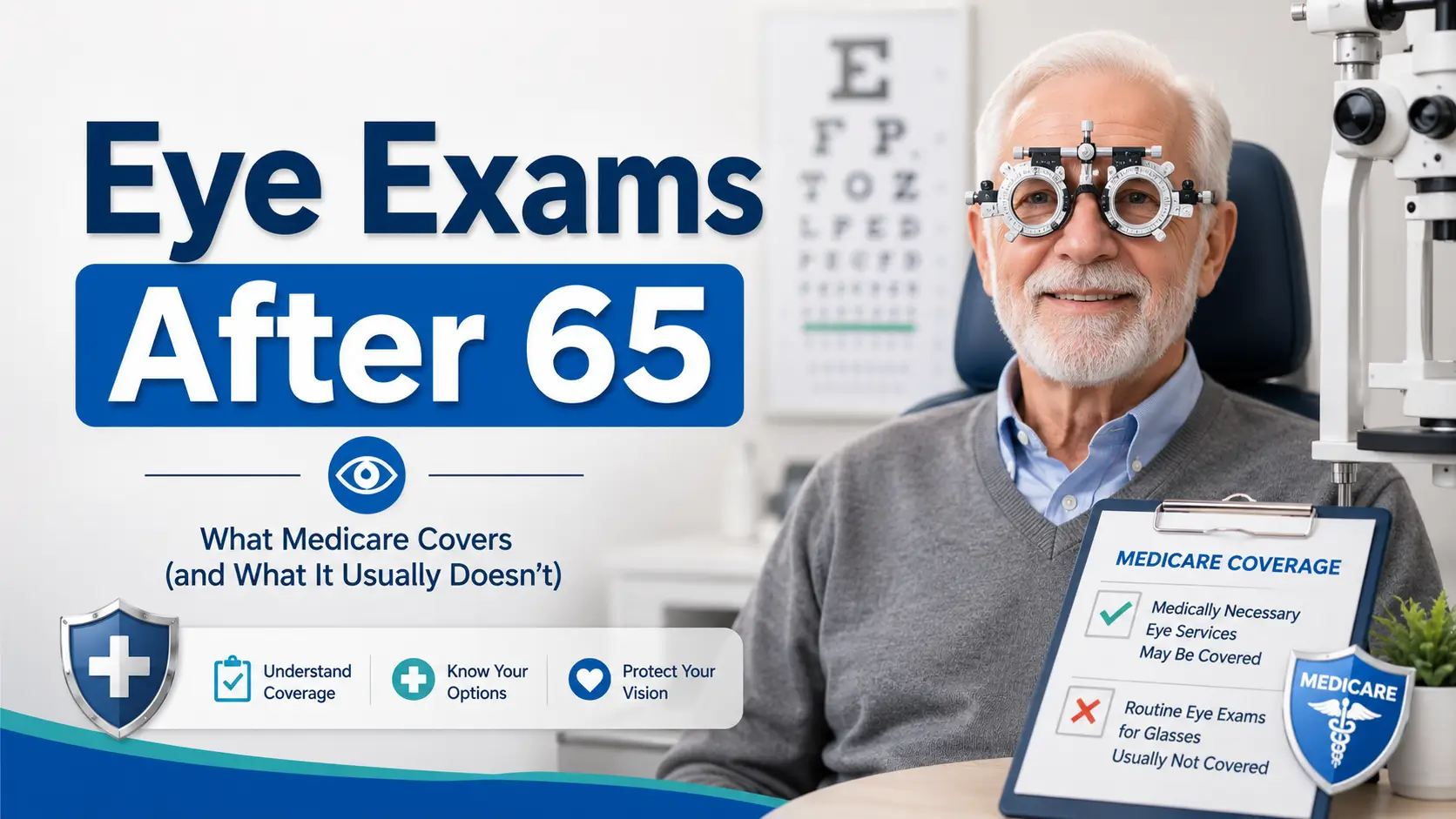

Does Medicare Cover Eye Exams After 65?
What Original Medicare Actually Pays For
The short answer surprises plenty of people: turning 65 does not automatically give you Medicare coverage for routine eye exams used to update an eyeglass or contact-lens prescription. With Original Medicare, that type of routine vision care is generally something you pay for yourself.
But that is only half the story. Medicare Part B does cover certain eye services when the reason is medical, preventive, or connected to a covered condition. Diabetes-related retinal exams, glaucoma screening for eligible high-risk patients, some macular degeneration care, and corrective lenses after qualifying cataract surgery all sit on the covered side of the line.
So the useful question is not simply, “Does Medicare cover my eye exam?” It is, “Why is this eye exam being done, which part of the visit is Medicare-covered, and which part might be billed to me?” That distinction can prevent a routine appointment from turning into a confusing bill.
🔎 The money-saving habit: ask the eye office what is being billed before assuming “Medicare accepted” means the entire visit is covered.
Snapshot
This guide is for people age 65 and older, caregivers, and anyone entering Medicare who wants to know whether an eye appointment will be covered. You will learn which exams Original Medicare does and does not cover, how Medicare Advantage changes the answer, what to ask before the appointment, and how to separate medical eye care from routine prescription costs.
Table of Contents

The Short Answer: Medicare Does Not Cover Every Eye Exam After 65
Original Medicare does not cover routine eye exams for the purpose of prescribing eyeglasses or contact lenses. Medicare.gov specifically identifies routine eye exams, sometimes described as eye refractions, as a non-covered service. If that is the only reason for the appointment, you generally pay the cost yourself.
Age 65 itself does not change that rule. Medicare eligibility and routine vision coverage are two different things.
Medicare Part B can, however, cover certain eye exams, diagnostic services, and treatments when you meet specific eligibility or medical requirements. That is why two people of the same age can walk into similar-looking eye appointments and receive very different Medicare bills.
Key Takeaway
Do not ask only, “Do you take Medicare?” Ask, “Is this visit being billed as routine vision care or as a Medicare-covered medical eye service, and is there a separate non-covered refraction charge?”
Before You Act
This article explains Medicare coverage categories, not whether a particular symptom, test, diagnosis, or claim qualifies in your individual case. Your eye-care professional determines what care is medically appropriate. Medicare, your Medicare Advantage plan, and the provider’s billing rules determine coverage and your final cost.
If you have a sudden major change in vision, a sudden shower of new floaters, flashes of light, or a curtain-like shadow in your vision, seek prompt eye care rather than delaying the visit while investigating insurance. The National Eye Institute identifies these as possible retinal-detachment symptoms requiring immediate attention.

Which Eye Exams Can Medicare Part B Cover?
The easiest way to understand Medicare vision coverage is to forget the broad phrase “eye exam” for a moment. Medicare treats several specific situations differently.
Diabetic retinopathy eye exams
If you have diabetes, Medicare Part B covers an eye exam for diabetic retinopathy once a year when the exam is provided by an eye doctor legally permitted to perform it in your state. After the Part B deductible, Medicare.gov says the patient generally pays 20% of the Medicare-approved amount for the doctor’s services, with an additional copayment possible in a hospital outpatient setting.
This is not merely a benefit for someone who has already noticed blurry vision. Diabetic retinopathy may initially have no symptoms, which is one reason regular dilated eye examinations are medically useful for people with diabetes.
Glaucoma screening for people at high risk
Part B covers glaucoma screening once every 12 months for people Medicare considers at high risk. Medicare.gov currently lists people with diabetes, people with a family history of glaucoma, African Americans age 50 or older, and Hispanics age 65 or older among the eligible groups. After the Part B deductible, the patient generally pays 20% of the Medicare-approved amount, with an additional outpatient facility copayment possible.
Review Medicare’s official glaucoma screening rules before assuming that a standard annual vision appointment automatically qualifies.
Age-related macular degeneration tests and treatment
Medicare Part B may cover certain diagnostic tests and treatments for age-related macular degeneration, including certain injectable medications. For covered care, the Part B deductible and coinsurance rules generally apply, and outpatient facility charges may also matter.
A simple vision test during the Welcome to Medicare visit
Your one-time “Welcome to Medicare” preventive visit can include a simple vision test. That screening is not the same as a comprehensive eye examination or an eyeglass prescription exam, so it should not be treated as a substitute for eye care recommended by your clinician.
Medicare Eye-Care Coverage Map
Routine Eye Exam vs. Medical Eye Exam: The Distinction That Matters
An eye-care appointment can contain several services under one roof. That is where Medicare billing can become foggier than the eyesight that sent you there.
| Reason for visit | Original Medicare | What to ask |
|---|---|---|
| “I need my glasses prescription updated.” | Routine prescription eye exam is generally not covered. | What is the self-pay exam or refraction fee? |
| Annual diabetic retinopathy examination | Part B covers qualifying exams once a year. | Is the provider billing the covered diabetic eye exam? |
| Glaucoma screening in an eligible high-risk patient | Part B covers qualifying screening once every 12 months. | Do I meet Medicare’s screening criteria? |
| Evaluation or treatment related to AMD | Certain tests and treatments may be covered. | Which services are medically necessary and Medicare-covered? |
| Eyeglasses after qualifying cataract surgery | One qualifying pair or set of contacts may be covered. | Does the supplier participate in Medicare, and are frame upgrades extra? |
The first row is the expensive misunderstanding to avoid. A practice may participate in Medicare and still charge you for a service Medicare excludes. Medicare.gov states that routine eye exams for eyeglasses or contact lenses are not covered, so “we accept Medicare” is not the same sentence as “Medicare pays for everything we are doing today.”
If you are preparing for an appointment, the site’s eye doctor visit checklist for seniors can help you organize medications, symptoms, questions, and practical vision problems before you arrive.
Show me the nerdy details
Medicare coverage works better when you think in terms of services rather than appointments. A single visit can include an evaluation, diagnostic testing, a prescription refraction, treatment, or supplies. Medicare rules may apply differently to each component.
For example, Medicare explicitly excludes routine exams for prescribing glasses or contacts, while separately establishing benefits for diabetic retinopathy exams, high-risk glaucoma screening, certain macular degeneration services, and post-cataract corrective lenses.
This is why asking for an estimated patient responsibility by service can be more useful than asking whether “the appointment” is covered.
Original Medicare vs. Medicare Advantage vs. Medigap
Your answer changes significantly depending on which Medicare arrangement you have.
| Coverage type | Routine vision | Medical eye care | Main thing to verify |
|---|---|---|---|
| Original Medicare | Routine prescription eye exams generally not covered. | Specific Part B eye benefits and medically covered services may apply. | Why the service is being performed and how it is billed. |
| Medicare Advantage | Some plans include extra routine vision benefits. | Plans must cover Medicare-covered medically necessary services, subject to plan rules. | Network, frequency, authorization, copay, exam benefit, and eyewear benefit. |
| Medigap with Original Medicare | Generally does not create a routine vision benefit. | May help with eligible Original Medicare cost-sharing depending on the policy. | Whether the underlying service is covered by Original Medicare first. |
Original Medicare
Original Medicare does not cover routine eye exams for prescription eyeglasses or corrected contact lenses. Medicare’s 2026 handbook continues to list these among services Original Medicare does not cover.
You can confirm the rule directly on Medicare’s routine eye exam coverage page.
Medicare Advantage
Some Medicare Advantage plans offer extra vision benefits that Original Medicare does not. The exact benefit is plan-specific, so coverage can differ in provider networks, frequency limits, copayments, eyewear allowances, and other conditions. Medicare advises members to contact their plan for details.
That means a neighbor’s “Medicare paid for my annual eye exam” may be completely accurate while still having little relevance to your own coverage. The neighbor may have a different Medicare Advantage plan.
Medigap
Medigap is designed primarily to help with certain out-of-pocket costs for services Original Medicare covers. Medicare.gov says Medigap policies generally do not cover routine vision care or glasses.
In other words, a Medigap card should not be assumed to turn a non-covered routine refraction into a covered benefit.
Key Takeaway
When someone says “Medicare covers vision,” identify the coverage type first. Original Medicare, Medicare Advantage, and Medigap answer the routine-eye-care question differently.
Your 10-Minute Coverage Check Before the Appointment
This is the practical centerpiece. You do not need to understand Medicare billing codes to avoid most surprises. You need five clear answers.
Step 1: Identify your coverage
- Confirm whether you have Original Medicare or a Medicare Advantage plan.
- If you have Medicare Advantage, have the exact plan name and member card available.
- If you also have Medigap or another secondary policy, note that separately.
Step 2: Write down the real reason for the visit
- New glasses prescription?
- Diabetic retinal exam?
- Glaucoma screening?
- Follow-up for diagnosed glaucoma or macular degeneration?
- Cataract evaluation?
- Sudden or changing vision symptoms?
If you have trouble turning symptoms into useful words, use the guide to explaining vision changes to an eye doctor before your appointment.
Step 3: Call the eye office
Use this plain-English script:
“I have [Original Medicare / plan name]. My appointment is for [reason]. Which parts of the visit do you expect Medicare or my plan to cover? Will you perform a refraction or any other service that is not covered, and what would I owe for that?”
Step 4: Ask your insurer when necessary
For Medicare Advantage, confirm the provider’s network status and ask about the routine exam benefit separately from the eyeglasses or contact-lens benefit. A plan can have rules that make those two benefits operate differently.
Step 5: Write down who told you what
Record the date, the office or plan representative’s name if available, and the answer. This will not guarantee claim payment, but it gives you a much cleaner trail if the bill differs from what you expected.
If insurance paperwork itself is becoming the obstacle, this guide to reading and organizing Medicare notices may be a useful next step.
What Might You Still Have to Pay?
There is no single honest price for “an eye exam with Medicare.” Your cost depends on whether the service is covered, whether the Part B deductible applies, the Medicare-approved amount, the setting where care is delivered, other insurance you have, and whether the provider accepts assignment. Medicare repeats these variables across its eye-care coverage guidance.
If the service is not covered
For a non-covered routine eye exam or prescription refraction, you may be responsible for the full charge.
If Part B covers the service
For several covered eye benefits discussed in this article, Medicare.gov states that after the Part B deductible you generally pay 20% of the Medicare-approved amount. Hospital outpatient care can create additional copayment obligations.
If you have Medicare Advantage
Your plan’s cost-sharing and supplemental vision benefit rules matter. Check the current Evidence of Coverage or Summary of Benefits rather than relying on last year’s benefit or another person’s plan.
Before paying, ask for these four numbers
1. The charge for the routine exam, if non-covered.
2. The separate charge for refraction, if there is one.
3. Your estimated responsibility for Medicare-covered medical services.
4. The price difference for optional eyewear or frame upgrades.
What Medicare May Cover After Cataract Surgery
Cataract surgery creates one of the most useful exceptions to Medicare’s usual rule on glasses.
Medicare Part B covers one pair of eyeglasses with standard frames or one set of contact lenses after each cataract surgery that implants an intraocular lens. After the Part B deductible, the patient generally pays 20% of the Medicare-approved amount for the qualifying corrective lenses. Additional costs for upgraded frames are the patient’s responsibility. Medicare also requires the glasses or contact lenses to come from a supplier that participates in Medicare.
Check Medicare’s official eyeglasses and contact-lens coverage rules before ordering eyewear after cataract surgery.
If you are not sure whether the blur you are noticing behaves more like ordinary near-vision change or cataract-related vision loss, the site’s presbyopia vs. cataracts guide can help you organize the differences to discuss with an eye professional. It should not be used to diagnose the cause yourself.
Key Takeaway
After cataract surgery, do not buy glasses first and investigate Medicare later. Confirm that the surgery and lenses qualify, and that the eyewear supplier participates in Medicare.
When Coverage Is Not the First Question to Ask
A routine prescription change and a sudden vision change belong in different mental drawers.
If your complaint is simply that small print has gradually become harder to read, it may be reasonable to schedule ordinary eye care and investigate coverage before the appointment.
But a sudden increase in floaters, flashes of light, or a dark curtain or shadow across the visual field can be associated with retinal detachment. The National Eye Institute advises people with those symptoms to go to an eye doctor or emergency room right away.
Before You Pay for Extra Vision Coverage
If routine eye exams and glasses are important recurring expenses, it can be reasonable to compare Medicare Advantage vision benefits or other vision arrangements. But a benefit is only valuable if you can actually use it.
Start with the free step: total what you realistically expect to use during the year. Then compare coverage rather than simply reacting to the phrase “vision included.”
| What to compare | Why it matters | Possible poor-value sign |
|---|---|---|
| Routine exam frequency | Determines how often the plan benefit can actually be used. | You pay for coverage you rarely use. |
| Provider network | Your preferred eye doctor may not participate. | A generous benefit requires changing providers when you do not want to. |
| Refraction coverage | The prescription portion may be handled differently from medical eye care. | You assumed every part of the exam was included. |
| Eyewear benefit | Exam coverage and glasses coverage are separate questions. | The frame or lens options you need are largely outside the benefit. |
| Premiums and copays | Extra benefits should be assessed in the context of the entire health plan. | You select a health plan mainly for glasses while overlooking broader medical costs or provider access. |
Medicare confirms that some Medicare Advantage plans offer extra vision benefits that Original Medicare does not, but the exact terms belong to the individual plan.
For an official side-by-side explanation, review Medicare’s comparison of Original Medicare and Medicare Advantage.
Money Moment
Do not choose an entire Medicare health plan only because the vision benefit looks generous. Compare the eye benefit, but also verify the medical network, prescription coverage, plan rules, and total costs that matter to your broader health care.

Frequently Asked Questions
Does Medicare pay for an annual eye exam once you turn 65?
Not automatically. Original Medicare does not cover a routine eye exam performed for eyeglasses or contact lenses simply because you are 65 or older. Specific Part B benefits can apply when eligibility or medical criteria are met.
Does Medicare cover eye exams if I have diabetes?
Yes, Medicare Part B covers an eye exam for diabetic retinopathy once a year for people with diabetes when the provider requirements are met. The Part B deductible and coinsurance rules generally apply.
Does Medicare cover glaucoma tests after 65?
Part B covers glaucoma screening once every 12 months for people who meet Medicare’s high-risk criteria. Being 65 alone is not the only criterion, although Medicare specifically includes Hispanics age 65 or older among its listed high-risk groups.
Does Medicare pay for glasses?
Original Medicare usually does not cover eyeglasses or contact lenses. One major exception is one qualifying pair of glasses with standard frames or one set of contact lenses after each cataract surgery that implants an intraocular lens.
Can Medicare Advantage cover routine eye exams?
Yes. Some Medicare Advantage plans provide additional vision benefits that Original Medicare does not. Coverage terms differ by plan, so confirm the current network, exam frequency, cost-sharing, and eyewear rules directly with your plan.
If my eye doctor accepts Medicare, does that mean my whole visit is covered?
No. A Medicare-participating practice can provide both covered and non-covered services. Routine prescription eye exams remain excluded under Original Medicare, so ask which components of the appointment are expected to be covered before the visit.
Your 15-Minute Medicare Eye-Care Check
Before your next eye appointment, spend 15 minutes doing one small piece of administrative housekeeping. It can answer more than an hour of vague searching.
- Minutes 1 to 3: Find your Medicare and insurance cards and identify whether you have Original Medicare or Medicare Advantage.
- Minutes 4 to 6: Write one sentence describing why you are seeing the eye doctor.
- Minutes 7 to 10: Call the practice and ask which parts of the appointment are expected to be Medicare-covered and whether a separate refraction fee applies.
- Minutes 11 to 13: If you have Medicare Advantage, verify the practice’s network status and your current routine vision benefit with the plan.
- Minutes 14 to 15: Write down the estimated amount you may owe and any questions you still need answered.
The principle is simple: coverage follows the reason and service, not your birthday alone. Original Medicare may say no to a routine glasses exam while saying yes to qualifying disease-related screening, treatment, or post-cataract corrective lenses.
Once you know which side of that line your appointment falls on, the rest becomes much easier: confirm the provider, verify the benefit, ask about non-covered services, and then decide what is worth paying for.
Last reviewed: 2026-09