


Medicare Eye Exam Cost for Seniors:
What You Pay in 2026
If you are scheduling an eye exam and assuming Medicare will pick up the bill, one small word can change the answer: routine. Original Medicare generally does not cover a routine eye exam or refraction performed simply to update an eyeglass or contact-lens prescription. In that situation, you normally pay the full cost.
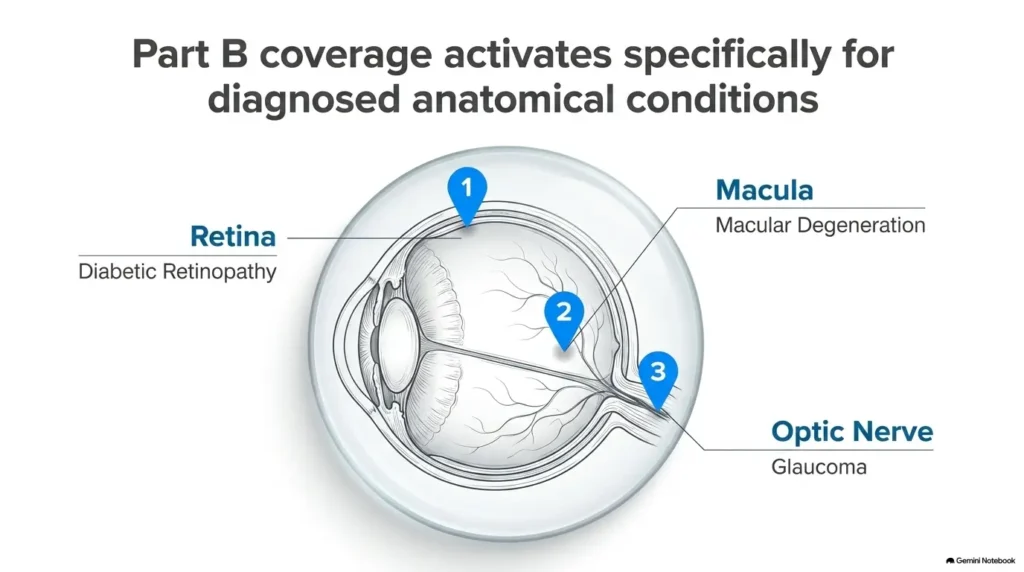
The picture changes when the visit involves a Medicare-covered medical reason. Part B can cover certain diabetic-retinopathy exams, glaucoma screenings for people who meet the risk criteria, diagnostic or treatment services for age-related macular degeneration, and corrective lenses after qualifying cataract surgery. Many covered Part B services leave the patient responsible for 20% of the Medicare-approved amount after the Part B deductible.
This guide helps you separate those situations before the appointment, estimate which part of the bill may be yours, and ask the office the questions that uncover hidden extras such as a separate refraction charge, imaging fee, upgraded frames, or an out-of-network Medicare Advantage visit.
👁️ The useful question is not simply “Does Medicare cover eye exams?” It is “What kind of eye service am I actually receiving?”
Snapshot
This article is for Medicare beneficiaries and family caregivers trying to price an eye-doctor visit. You will learn when Original Medicare generally leaves you with the full bill, when Part B may contribute, what changes under Medicare Advantage, and how to get a usable cost estimate before the appointment.
Before you treat this as a routine cost question
A gradually outdated glasses prescription is different from a sudden vision problem. A sudden shower of new floaters, flashes of light, or a dark curtain or shadow across the field of vision can be associated with retinal detachment and warrants prompt eye care or emergency evaluation rather than shopping for the cheapest routine exam. This article explains coverage and cost, not diagnosis.
Table of Contents
How much does a Medicare eye exam cost in 2026?
There is no single Medicare eye exam price. Your out-of-pocket cost depends first on whether the service is covered at all.
Under Original Medicare, a routine eye exam or refraction for eyeglasses or contact lenses is generally not covered, so you pay the provider’s charge yourself. Medicare therefore does not supply a universal beneficiary price for that routine service.
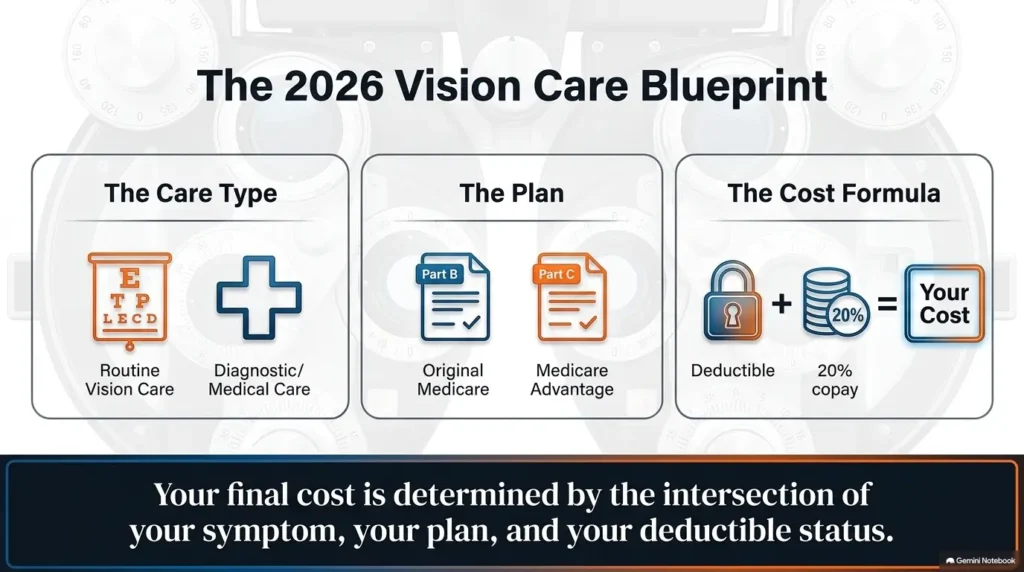
For many eye services that Part B does cover, you generally pay 20% of the Medicare-approved amount after satisfying the Part B deductible. The annual Part B deductible is $283 in 2026. A hospital outpatient service can involve additional facility cost-sharing depending on the service.
| Eye-care situation | Original Medicare treatment | What you may pay | First question to ask |
|---|---|---|---|
| Routine exam to update glasses | Generally not covered | Full provider charge | “What is your total self-pay price including refraction?” |
| Annual diabetic-retinopathy eye exam | Part B covers eligible exams | Generally 20% after Part B deductible | “Is this being billed as the covered diabetes eye exam?” |
| Glaucoma screening for a qualifying high-risk patient | Part B covers once every 12 months | Generally 20% after deductible; outpatient facility copay can apply | “Do I meet Medicare’s glaucoma-screening eligibility?” |
| AMD diagnostic testing or treatment | Part B may cover qualifying services | Generally 20% after deductible | “Which services are medically necessary and Medicare-covered?” |
| Standard corrective lenses after qualifying cataract surgery | Part B covers one pair of standard-frame glasses or one set of contacts after each qualifying surgery | Generally 20% after deductible; upgrades can cost extra | “Does this supplier participate in Medicare?” |
| Medicare Advantage vision visit | Depends on the individual plan | Plan copay, network rules, allowances, or other terms may apply | “What are my 2026 routine vision benefits?” |
Key takeaway
Do not estimate your cost from the words “eye exam” alone. Identify the reason for the visit, the services being performed, and whether each service is covered.
Routine vs. medical eye exams: the distinction that changes the bill
Two appointments can occur in the same exam chair, use some of the same equipment, and produce very different Medicare bills.
A routine refraction is usually a self-pay service
If the purpose is simply to determine whether your glasses or contact-lens prescription has changed, Original Medicare generally does not cover the routine examination or refraction. Medicare explicitly lists routine eye exams for prescription eyewear among non-covered services.
This is why a person can have Medicare, visit a Medicare-participating eye doctor, and still receive a completely legitimate self-pay bill for part of the appointment.
A medical eye visit can be different
If an eye doctor is evaluating or managing a medical condition, Medicare coverage may apply to medically necessary services under Part B. Coverage still depends on the actual service, eligibility requirements, Medicare rules, and how the provider bills the visit.
That distinction matters particularly for seniors with diabetes, glaucoma risk, cataracts, macular degeneration, or new symptoms. A changing prescription may be mundane. A change in vision caused by disease is a medical question for the clinician.
The eye-exam cost fork
Which eye exams and services can Medicare cover?
Original Medicare’s routine-vision exclusion does not mean that Medicare ignores eye disease. Several specific categories deserve a closer look.
Diabetic-retinopathy eye exams
If you have diabetes, Medicare Part B covers an eye exam for diabetic retinopathy once a year when the eligibility and provider requirements are met. After the Part B deductible, Medicare states that the patient generally pays 20% of the Medicare-approved amount, with other costs potentially applying.
You can confirm the current requirements on the official Medicare diabetic eye exam coverage page.
Glaucoma screening for people at high risk
Medicare Part B covers glaucoma screening once every 12 months for people who meet Medicare’s high-risk criteria. Medicare currently lists diabetes, a family history of glaucoma, being African American and age 50 or older, or being Hispanic and age 65 or older among the qualifying risk categories. After the deductible, the usual patient share is 20% of the Medicare-approved amount, and a hospital outpatient copayment can also apply.
See the Medicare glaucoma screening rules before assuming that an ordinary comprehensive eye exam qualifies as the covered screening.
Age-related macular degeneration
Part B may cover certain diagnostic tests and treatments for age-related macular degeneration, including certain injectable drugs. For covered services, Medicare says the patient generally pays 20% of the Medicare-approved amount after the Part B deductible, with additional facility cost-sharing possible in a hospital outpatient setting.
Corrective lenses after cataract surgery
Original Medicare does not usually cover eyeglasses or contacts. One important exception comes after cataract surgery that implants an intraocular lens: Part B covers one pair of eyeglasses with standard frames or one set of contact lenses after each qualifying surgery. You generally pay 20% of the Medicare-approved amount after the Part B deductible. Upgraded frames can create additional out-of-pocket cost.
The three-layer rule
You can identify your coverage and ask for an estimate. The eye-care professional determines what examination or treatment is medically appropriate. Medicare or your health plan determines whether the billed service qualifies for coverage and what cost-sharing applies.
The 10-minute Medicare eye exam cost check
You can remove most of the billing fog before anyone dilates a pupil. Have your Medicare card, insurance card, and appointment reason in front of you, then run this checklist.
- Identify your coverage. Are you using Original Medicare, or are your Part A and Part B benefits being delivered through Medicare Advantage?
- Write the reason for the appointment in one sentence. Examples: “I only need a new glasses prescription,” “I have diabetes and need my annual retinal exam,” or “My vision has changed unexpectedly.”
- Ask the office whether the planned visit is Medicare-covered. Do not stop at “Do you take Medicare?” A provider may accept Medicare while a particular service remains non-covered.
- Ask whether refraction is billed separately. This is one of the most useful questions when you are expecting an eyeglass prescription.
- Ask whether dilation, retinal imaging, photography, OCT, visual-field testing, or other procedures are expected. Then ask which are medically necessary and which are optional for your visit.
- If you have Original Medicare, ask whether the provider accepts Medicare assignment. Providers who accept assignment agree to accept the Medicare-approved amount as full payment for covered Part A and Part B services.
- If you have Medicare Advantage, verify the provider’s network status with the plan itself. Also ask for the specialist or routine-vision copay and whether a separate vision network is used.
- Request an estimate of your patient responsibility. If the practice cannot provide an exact number, ask which charges may be added separately.
If preparing for an appointment is the harder part, use this eye doctor visit checklist for seniors to organize medications, questions, symptoms, and practical details before you go.
One sentence that can save a second phone call
“Before I schedule, can you tell me the estimated amount I would pay for the exam, whether refraction is separate, and whether any imaging or testing is likely to be billed separately?”
How Medicare Advantage vision benefits change the calculation
Medicare Advantage creates the biggest reason not to generalize from another senior’s eye-exam bill.
Medicare Advantage plans must cover the medically necessary services Original Medicare covers and may offer extra benefits that Original Medicare does not, including some routine vision services. The exact benefit, network, copayment, eyewear allowance, frequency limit, and authorization rules depend on the individual plan.
| Check | Original Medicare | Medicare Advantage |
|---|---|---|
| Routine refraction for glasses | Generally not covered | May be included as an extra plan benefit |
| Medically necessary Part B eye care | Covered when Medicare requirements are met | Must cover Medicare-covered medically necessary services, subject to plan rules |
| Provider choice | Any Medicare provider who can furnish the covered service, subject to participation rules | Network rules may materially affect cost |
| Patient cost | Medicare deductibles and coinsurance apply to covered services | Plan-specific copays and cost-sharing apply |
| Routine eyewear benefit | Usually not covered except qualifying post-cataract lenses | Some plans offer eyewear benefits or allowances |
The fastest route is not to ask the eye clinic to explain every detail of your insurance contract. Call the member-services number on your plan card or check your current Evidence of Coverage, then confirm that information with the office before booking.
Key takeaway
A friend’s “free Medicare eye exam” may actually be a Medicare Advantage vision benefit. Do not assume the same benefit exists under Original Medicare or under a different Advantage plan.
What to check before paying for an eye exam
The cheapest appointment is not automatically the best value, but neither is the exam with the longest menu of add-ons. The useful target is the care you actually need at a cost you understand.
Ask what the quoted price includes
- Comprehensive eye examination
- Refraction for a glasses prescription
- Dilation
- Retinal photography or scanning
- Visual-field testing
- Contact-lens fitting or evaluation
- Medical evaluation of a known condition
- Follow-up visit, if one is expected
You do not need to decide which clinical tests are necessary. That belongs to the clinician. Your job is to understand which services are planned, whether they are covered, and what portion you may owe.
Confirm assignment, network status, and separate fees
With Original Medicare, asking whether a provider accepts assignment can help you understand how covered Part B charges will be handled. Medicare explains that a provider accepting assignment agrees to accept the Medicare-approved amount as payment in full for the covered service.
With Medicare Advantage, network status may be just as important as the exam itself. Verify the exact office location and clinician whenever possible. Large practices sometimes participate differently across locations or provider contracts.
Do not buy eyewear before you understand the prescription
If the exam results in a straightforward near-vision prescription, you may next want to compare prescription eyewear with simpler options. The guide to reading glasses for seniors explains the practical differences to consider before buying.
If the larger concern is whether a vision change sounds more like ordinary presbyopia or cataract-related difficulty, review presbyopia vs. cataracts as a question-preparation guide rather than a substitute for an eye examination.
Show me the nerdy details
Medicare billing separates coverage status from the provider’s retail price. For a covered Part B service, Medicare determines a Medicare-approved amount. Deductibles and coinsurance are then applied under Medicare rules. For a service that Medicare excludes, such as a routine refraction for eyeglasses under Original Medicare, the normal Part B coinsurance formula does not magically convert it into a covered service.
This is why “20% after the deductible” is an incomplete answer to the question “How much is an eye exam with Medicare?” The 20% rule matters only after you establish that the particular service is actually covered. A visit can also contain both covered and non-covered components.
The 2026 annual Part B deductible is $283. Whether you still owe some or all of that deductible on the date of the eye visit depends on what eligible Part B expenses you have already incurred during the year.
What happens when the exam leads to new glasses?
An eye-exam bill and an eyeglasses bill are two different spending decisions. Treating them separately makes comparison much easier.
If you simply need ordinary glasses
Original Medicare usually does not cover ordinary eyeglasses or contact lenses. If you are paying yourself, compare the complete price rather than the frame sticker: lenses, prescription complexity, coatings, progressives, warranties, adjustment services, and return or remake policies can all change the final value.
| Option | Best fit | Check before paying | Potential poor-value signal |
|---|---|---|---|
| Keep current glasses temporarily | Prescription change is minor and current glasses still handle daily tasks safely | Ask the eye doctor whether continued use is reasonable | Struggling with medication labels, steps, driving signs, or other safety-sensitive tasks |
| Basic replacement glasses | Simple prescription and predictable daily use | Total lens and frame price, remake policy, fit | Paying for extras you will not use |
| Progressive or specialized prescription lenses | Multiple viewing distances or a more complex prescription | Measurements, adaptation policy, lens design, follow-up adjustments | Buying an expensive lens without understanding the tradeoffs |
| Post-cataract Medicare-covered eyewear | Qualifying cataract surgery with an intraocular lens | Medicare-participating supplier and standard-frame coverage | Assuming premium frame upgrades are included |
If you recently had cataract surgery
This is the moment to slow down before buying frames somewhere convenient. Medicare’s post-cataract corrective-lens benefit has supplier and coverage requirements. The official Medicare guidance states that Part B covers one pair of standard-frame glasses or one set of contact lenses after each cataract surgery that implants an intraocular lens, and that extra costs can apply for frame upgrades.
You can verify the current rule on Medicare’s eyeglasses and contact lenses coverage page before placing an order.
Before you buy
Ask whether the vision problem is actually corrected by a new prescription, whether your existing glasses remain usable, whether Medicare or your Advantage plan contributes to the eyewear, and what portion of the quoted price comes from optional upgrades.
If the eye exam still looks expensive
A surprisingly high quote usually falls into one of a few buckets. Identifying the bucket is more useful than simply searching for another office.
| If this is the problem | Try this next |
|---|---|
| The exam is routine and Original Medicare will not cover it | Ask several practices for the complete self-pay price, including refraction, before comparing appointments. |
| The office says Medicare is accepted but you still owe a refraction fee | Ask which part of the appointment is non-covered and whether the fee is separate from any covered medical service. |
| You have Medicare Advantage and the copay seems unexpectedly high | Verify that both the clinician and location are in network and that you are using the plan’s designated routine-vision benefit correctly. |
| Extra imaging or tests increase the estimate | Ask what each test is for, whether it is medically necessary, and what Medicare or your plan is expected to cover. |
| The eyewear costs more than the exam | Separate the prescription decision from the frame and lens-upgrade decision. Compare total prices and remake policies. |
| Your vision has changed enough to interfere with ordinary tasks | Prioritize appropriate clinical evaluation rather than delaying solely to search for the lowest routine-exam price. |
If you are unsure how to describe a change without forgetting important details during the appointment, the guide on how to explain vision changes to an eye doctor provides a useful structure.
For changes that feel more substantial than an ordinary prescription issue, also review these senior vision change warning signs so you can distinguish a routine scheduling question from symptoms that deserve quicker professional attention.
Key takeaway
If the cost still feels wrong, identify whether the friction comes from coverage, the deductible, a network rule, a non-covered refraction, extra testing, or eyewear. Each problem has a different fix.
Medicare eye exam cost FAQ
Does Medicare pay for a yearly routine eye exam for everyone over 65?
No. Age 65 by itself does not turn a routine refraction for eyeglasses or contacts into an Original Medicare-covered service. Original Medicare generally does not cover routine eye exams for prescription eyewear. Some Medicare Advantage plans offer additional routine vision benefits.
Is an eye exam automatically free after I meet the Part B deductible?
No. First, the service must qualify for Medicare coverage. For many covered Part B eye services, the beneficiary then generally owes 20% of the Medicare-approved amount after the deductible. A non-covered routine refraction remains non-covered simply because the deductible has been met.
What is the Medicare Part B deductible in 2026?
The annual Medicare Part B deductible is $283 in 2026. CMS also set the 2026 standard monthly Part B premium at $202.90, although a person’s actual premium can differ in certain circumstances.
Does Medicare cover a diabetic eye exam?
Part B covers an eye exam for diabetic retinopathy once a year for beneficiaries with diabetes when Medicare’s requirements are met. After the Part B deductible, the patient generally pays 20% of the Medicare-approved amount, with other costs potentially applying.
Does Medicare cover glaucoma eye exams?
Medicare Part B covers glaucoma screening once every 12 months for people who meet Medicare’s high-risk criteria. The usual Part B deductible and 20% coinsurance rules apply, and a hospital outpatient copayment may also apply.
Why did my eye doctor charge separately for refraction?
A refraction determines the lens prescription needed to correct vision. Original Medicare generally does not cover a routine refraction for eyeglasses or contact lenses, even when another portion of an eye appointment may qualify as medical care. Asking about the refraction fee before the visit can prevent a small but irritating billing surprise.
Can Medicare Advantage pay for routine eye exams and glasses?
Some Medicare Advantage plans provide extra routine vision benefits that Original Medicare does not. What is included depends on the plan, so verify the 2026 benefit, network requirements, copay, exam frequency, and eyewear allowance directly with your plan.
Should I postpone an eye exam if Medicare will not cover it?
Coverage and medical need are separate questions. If the appointment is purely routine, comparing self-pay prices may be reasonable. If you have new or worsening symptoms, diabetes, known eye disease, or another medical concern, ask an eye-care professional how quickly you should be evaluated rather than delaying solely because of cost. Sudden flashes, many new floaters, or a curtain-like shadow warrant prompt evaluation.
Your next 15 minutes
Take out your Medicare or Medicare Advantage card and write one sentence describing why you need the eye appointment. That sentence is the hinge on which the rest of the cost conversation turns.
- Confirm whether you have Original Medicare or Medicare Advantage.
- Write down whether the visit is for routine glasses, a known condition, screening, or a new symptom.
- Call the eye office and ask for the estimated patient cost, including any separate refraction charge.
- If you have Medicare Advantage, confirm network status and routine vision benefits with your plan.
- If cataract surgery is involved, verify the post-surgery eyewear benefit before ordering glasses.
The central rule is wonderfully unglamorous: find out what service you are buying before trying to calculate what Medicare will pay. That one distinction separates a predictable eye-care bill from the kind that arrives wearing a tiny financial trench coat.
For the official baseline, Medicare’s routine eye exam coverage guidance is the best place to confirm the current Original Medicare rule before scheduling.
Last reviewed: 2026-09