

Eye exam prep guide
What to Ask the Eye Doctor
Before Buying New Reading Glasses
Buying new reading glasses should feel simple. Then you stand in a drugstore aisle, try on five strengths, read the back of a vitamin bottle under fluorescent lights, and somehow leave more confused than when you walked in. Near vision is small-print work, but the decision behind it is not small.
This guide turns your next eye appointment into a calm buying conversation. Instead of asking only, “What strength do I need?” you will know how to ask about OTC readers, prescription readers, computer glasses, bifocals, progressives, astigmatism, pupillary distance, coatings, fit, and the eye-health signs that should be checked before you spend money.
The goal is not to make you buy the most expensive pair. It is to help you leave the exam with one clear instruction: the right lens type, the right strength, the right working distance, and the right follow-up plan for your actual life.
Avoid wasted pairs
Know when cheap readers are enough and when custom lenses may save frustration.
Ask sharper questions
Bring symptoms, distances, screen habits, and old glasses into the conversation.
Protect eye health
Learn when blur may need more than a stronger pair from the rack.
Best promise: walk into the exam with five minutes of prep, walk out with fewer maybes and a much better buying plan. 👓
Snapshot
This article is for adults noticing near-vision changes, replacing readers, comparing over-the-counter reading glasses with prescription options, or preparing for an eye exam. You will learn what to ask, what to bring, what buying mistakes to avoid, and how to leave with a clear next step instead of a drawer full of almost-right glasses.
Table of Contents

Before You Act: Reading Glasses Help, But They Are Not an Eye Exam
Reading glasses can be wonderfully practical. A simple pair can make menus, medicine labels, recipe cards, and phone screens feel less like tiny legal contracts printed for ants.
But new blur is not always just presbyopia, the normal age-related loss of near focusing ability. Stronger readers may make small print look clearer for a moment while hiding a bigger issue, especially if vision changes suddenly, affects one eye, comes with pain, or appears alongside flashes, floaters, double vision, or a curtain-like shadow.
This article is educational, not medical advice. Use it to prepare better questions for an optometrist or ophthalmologist. For symptoms that feel sudden, severe, unusual, or one-sided, contact an eye care professional promptly instead of experimenting with stronger readers.
Key takeaway
Readers are a focusing tool, not a diagnosis. Before you buy, ask whether your near blur fits normal presbyopia or whether your eye doctor wants to check eye health, medication effects, dry eye, cataracts, diabetes-related changes, or another cause.
For general patient education, the American Academy of Ophthalmology explains common causes of blurry vision and when symptoms may need urgent attention. The American Optometric Association also offers public guidance on comprehensive eye exams and adult vision care.
Start With This One Question Before You Spend Money
The most useful first question is not “What number should I buy?” It is this:
“Are drugstore readers enough for my eyes, or do I need prescription reading glasses?”
That one sentence opens the right doors. It invites your eye doctor to consider eye health, lens strength, differences between your eyes, astigmatism, your daily distances, and whether one pair can realistically handle your life.
“Are drugstore readers enough for my eyes?”
Over-the-counter readers are mass-produced magnifying lenses. They usually have the same strength in both lenses and do not correct astigmatism or eye-to-eye differences. For some people, that is perfectly fine. For others, it is like wearing shoes that are technically the right size, but only if both feet agreed to be identical.
Ask your eye doctor to say clearly whether OTC readers are reasonable for you. If the answer is yes, ask for a suggested starting strength and the best distance for testing them. If the answer is no, ask what part of your prescription makes custom lenses more appropriate.
Ask whether both eyes need the same strength
Many people assume both eyes need matching lenses because most reader racks are arranged that way. Real eyes are more opinionated. One eye may need more plus power, one may have more astigmatism, and one may be doing more of the close-up work.
Ask: “Do my two eyes need the same near correction?” If the answer is no, cheap readers may still help in a pinch, but they may also cause eye strain, headaches, or a feeling that the print is clear yet somehow not comfortable.
Confirm whether blur is presbyopia or something else
Presbyopia usually sneaks in gradually. You hold the menu farther away. You brighten the lamp. You increase the phone font size and pretend it is a design preference. This is common with age.
Still, ask your eye doctor: “Does this pattern look like normal presbyopia, or do you see another reason my near vision is changing?” This question matters if your blur changed quickly, varies during the day, worsens with screens, or comes with dryness, glare, halos, or headaches.
Appointment question card
- Are OTC readers safe enough for me?
- Do both eyes need the same strength?
- Do I have astigmatism that affects reading comfort?
- Is this normal presbyopia or something else?
- What exact strength and lens type should I buy first?
Who This Is For, And Who Should Pause First
This guide is for the everyday reading-glasses buyer: the person who can still drive, cook, work, text, read recipes, pay bills, and function, but close print has become annoyingly slippery.
It is also for caregivers and adult children helping a parent choose readers safely. A good pair can restore a little daily dignity: reading a church bulletin, checking a medication label, finding the right setting on a thermostat, or signing a form without squinting into the paper.
Good fit: mild near blur, menus, labels, books, phones
You are in the usual reading-glasses zone if your main complaint is close-up blur that improves when you move print farther away or add light. Common examples include trouble reading restaurant menus, sewing labels, pill bottles, paperback books, phone screens, receipts, and small instructions on home devices.
For this group, the buying decision is often about strength, distance, comfort, and task. The right question is not only “Can I read this?” but “Can I read this comfortably for the amount of time I actually need?”
Not ideal: sudden blur, pain, double vision, flashes, or one-eye changes
Pause before buying readers if the change is sudden, severe, or mostly in one eye. Also pause if you have eye pain, new double vision, flashes of light, a sudden shower of floaters, a dark curtain or shadow, a major headache, or vision loss that does not clear.
Those symptoms deserve professional attention. Stronger readers are not the right first experiment when your eyes are waving a flare.
Here’s what no one tells you: “reading glasses” may not mean one pair
One pair may be enough if your reading life is simple: book on lap, lamp nearby, no long computer sessions. But many adults now read across several distances. A phone is close. A laptop is farther. A desktop monitor may be farther still. Sheet music, craft tables, recipes, and medicine cabinets each have their own tiny geography.
Ask your eye doctor whether you need one pair for close reading and another for computer work. That may sound inconvenient until you compare it with craning your neck at a laptop for two hours because your book readers are too strong for the screen.
Quick self-check
Before the appointment, list where blur bothers you most:
- Phone held close
- Book or e-reader in lap
- Laptop on table
- Desktop monitor
- Medication labels
- Needlework, crafts, tools, or recipes
Prescription Details That Quietly Change Everything
A reading-glasses prescription is more than a simple plus number. The fine print in your prescription can explain why one pair feels crisp, another feels swimmy, and a third gives you a headache by lunchtime.
You do not need to become an optics professor. You do need to ask for the details that affect buying.
Ask for your near-vision prescription, not just distance numbers
Many people leave an exam with a prescription and no idea whether it is for distance, reading, computer work, or progressives. Ask directly: “Can you show me the near-vision part of my prescription and explain what it means for buying readers?”
If the prescription includes an “ADD” value, that usually refers to the added magnifying power for near tasks. Your doctor or optician can explain how that translates into single-vision reading glasses, bifocals, or progressive lenses.
Ask about pupillary distance for reading glasses
Pupillary distance, often called PD, helps place the optical center of the lenses where your eyes actually look. For reading glasses, near PD can differ from distance PD because your eyes turn inward when focusing up close.
Ask: “Do I need a separate near PD for ordering reading glasses?” This is especially useful if you plan to order prescription readers online or if previous glasses felt slightly off even when the prescription seemed correct.
Confirm whether astigmatism correction matters for your readers
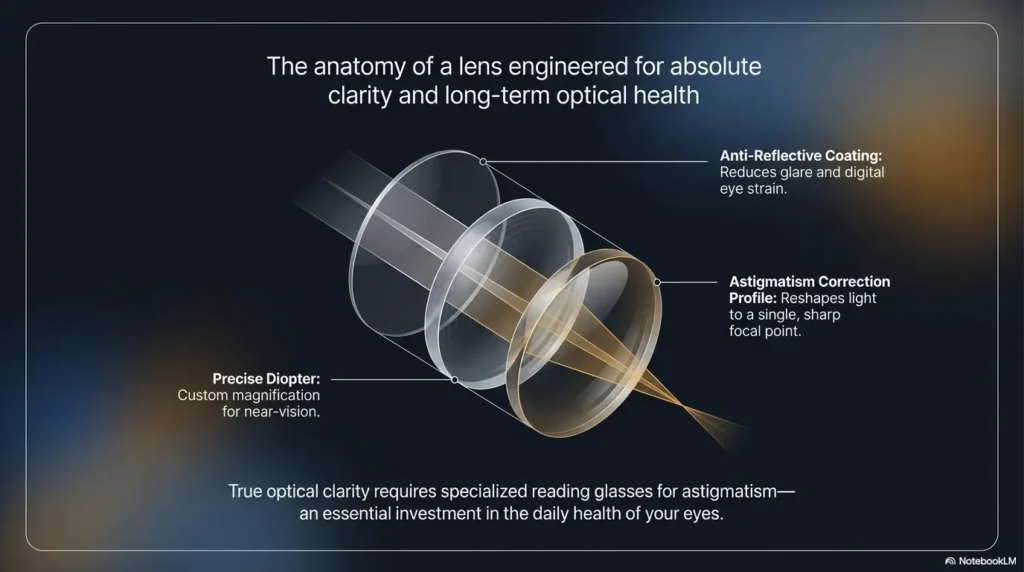
Astigmatism can make letters look shadowed, stretched, smeared, or uneven. OTC readers do not correct it. If you have enough astigmatism, the right plus strength alone may not feel comfortable.
Ask: “Is my astigmatism mild enough to ignore for readers, or should my reading glasses correct it?” If you already have an astigmatism prescription, this question may save you from buying three pairs of readers that all feel almost right, the most expensive kind of wrong.
| Prescription detail | Why it matters | Question to ask |
|---|---|---|
| Near add power | Helps determine reading strength. | What strength should I use for close reading? |
| Near PD | Helps align lenses for close work. | Do I need a separate reading PD? |
| Astigmatism | May affect clarity and comfort. | Should my readers correct astigmatism? |
| Eye-to-eye difference | May make equal-strength OTC readers uncomfortable. | Are both eyes close enough for OTC readers? |
Related Reading
OTC Readers vs Prescription Readers: Where the Line Is
OTC readers are not automatically bad. Prescription readers are not automatically better for every person. The smarter question is which tool matches your eyes, your tasks, and your budget.
Think of it like buying a chair. A basic chair can be perfectly fine for short use. But if you sit for hours, have back trouble, or need a precise height, the “good enough” version may become a daily annoyance.
Ask when over-the-counter readers are safe enough
OTC readers may be reasonable if your eyes need similar correction, you do not need meaningful astigmatism correction, your eye health exam is reassuring, and you mostly use them for short close-up tasks.
Ask your eye doctor to define your lane: “Am I a good candidate for OTC readers, or would prescription readers be more comfortable?” If you are budget-conscious, say so. A good buying plan should respect both your eyes and your wallet.
Ask what strength to buy if you choose OTC readers
Reader strength is commonly labeled in diopters, such as +1.00, +1.50, +2.00, and so on. Stronger is not automatically better. It may look sharper at one close distance but feel awful at a laptop or across a kitchen counter.
Ask: “If I buy OTC readers, what strength should I start with, and at what distance should I test them?” Then test them with real material, not just the tiny card attached to the display.
Ask how often to recheck your eyes after starting readers
Near vision changes over time. Your ideal strength may shift, and eye-health screening matters more as you age or if you have diabetes, high blood pressure, a family history of glaucoma, cataracts, macular degeneration, or medication-related eye symptoms.
Ask your doctor how often you should return for exams based on your age, health history, symptoms, and risk factors. Do not rely on a reader rack as your only vision plan.
| Option | Good for | Watch out for | Ask before buying |
|---|---|---|---|
| Low-cost OTC readers | Short tasks, similar eyes, simple near blur. | Same power in both eyes; no astigmatism correction. | Is OTC enough for my prescription? |
| Prescription readers | Longer reading, eye differences, astigmatism, comfort issues. | Higher cost; needs accurate prescription and fit. | What prescription details make these worthwhile? |
| Computer glasses | Laptop, desktop, work-from-home, long screen sessions. | May be too weak for books and too strong for distance. | What distance should these be set for? |
| Bifocals or progressives | People who need distance and near correction in one pair. | Adaptation time; fit and lens height matter. | Will these fit my driving, stairs, and reading needs? |
Show me the nerdy details
Reading-glasses strength is measured in diopters. A higher plus number focuses closer. That is why a stronger pair can make a label held very close look clearer, yet make a laptop feel uncomfortable. The “best” strength depends on your working distance, your distance prescription, your near add, eye alignment, astigmatism, and whether both eyes need the same correction.
This is also why testing readers in a store can mislead you. Bright lighting, short test cards, and a five-second trial do not reveal whether the glasses will feel good for twenty minutes of reading, paying bills, or working at a computer.
The Screen Question Most People Forget
Many people buy book readers, then use them for everything. That is where trouble begins. Reading a paperback, checking a phone, and working on a desktop are not the same visual task.
Your eyes may need different focusing help at different distances. The more screen time you have, the more important this question becomes.
Ask whether you need computer glasses instead of book readers
Book readers are usually set for close work. Computer glasses are often set for an intermediate distance. If you wear strong book readers at a laptop, you may lean forward, lift your chin, or chase the clear spot like a cat following a sunbeam.
Ask: “Should I have a separate computer prescription, or can one reader strength cover both books and screens?” If you work from home, bring that up. If you use two monitors, mention it. If your job involves spreadsheets, medical charts, editing, coding, sewing patterns, or music stands, say that too.
Explain your real working distance: laptop, desktop, phone, tablet
Do not guess your reading distance. Measure it. Use a tape measure from your eyes to your phone, book, laptop, and desktop monitor. Bring those numbers to your appointment.
Try saying: “My phone is usually about 14 inches away, my laptop is 22 inches away, and my monitor is about 28 inches away. Which lens setup matches that?” This gives your doctor better information than “I read a lot,” which could mean anything from poetry in bed to six hours of email triage.
Let’s be honest: your “reading distance” is probably not one distance
Modern life is a stack of screens, labels, and tasks. A retiree may read devotional books, pill bottles, and TV subtitles. A busy parent may read school forms, phone messages, and grocery labels. A professional may live between a laptop and a legal pad.
One pair can work if your tasks cluster at one distance. Multiple pairs may be better if your day stretches across close, intermediate, and occasional distance needs.
The Clear-Pair Framework
1
Name the blur
When, where, and in which eye?
2
Check health
Rule out warning signs first.
3
Measure distance
Phone, book, laptop, monitor.
4
Choose lens type
OTC, prescription, computer, bifocal, progressive.
5
Plan follow-up
Know when to recheck or adjust.
Lens Type Decisions That Save Future Regret
The lens type matters as much as the number. A perfect strength in the wrong lens design can still disappoint you.
Before you buy, ask which design best matches your day. Your answer may be different if you read novels, run errands, work at a computer, drive often, cook from recipes, or help a spouse manage medication labels.
Ask about single-vision readers, bifocals, and progressives
Single-vision readers correct one close range. Bifocals typically combine distance and near areas in one lens. Progressives blend multiple powers without a visible line, but they require proper fit and adaptation.
Ask: “Which lens type fits my routine best, and what trade-off should I expect?” The trade-off is the part people forget. A single-vision reader may be wonderfully clear for books but useless across the room. Progressives may reduce pair-swapping but can feel strange at first, especially on stairs or when looking through the wrong part of the lens.
Ask whether anti-reflective coating is worth it for your use
Anti-reflective coating may be helpful if glare bothers you, you drive at night with prescription lenses, spend long hours on screens, or notice reflections on your lenses. It is not magic, but it can improve comfort for some people.
Ask: “Based on my use, is anti-reflective coating worth the extra cost?” Also ask how to clean coated lenses properly. Some premium features are useful; others are merely tiny tuxedos for your lenses.
Ask about blue-light claims without buying the marketing fog
Blue-light glasses are heavily marketed, especially for screen fatigue. But digital eye strain is often linked to focusing demand, dryness, glare, blinking less, screen distance, lighting, and breaks. The lens color alone may not solve the real problem.
Ask your doctor: “Would blue-light filtering help my symptoms, or should I focus on prescription accuracy, glare control, dry-eye care, and screen habits?” This keeps the conversation practical instead of floating into the marketing mist.
Good / Better / Best buying setup
| Tier | Best fit | Smart question |
|---|---|---|
| Good | One OTC pair for short, simple close tasks. | What strength should I start with? |
| Better | Prescription readers for longer reading or eye differences. | Should these correct astigmatism and near PD? |
| Best | Task-specific setup: reading, computer, and daily-distance needs. | Which pair should I use for each task? |
Do Not Buy Before Asking About Eye Health
It is tempting to treat every near-vision complaint as a shopping problem. Sometimes it is. Sometimes it is a health clue wearing tiny shoes.
Your eye doctor can check whether your vision change fits normal aging or deserves another look.
Ask if cataracts, dry eye, diabetes, or medication side effects could affect near vision
Near blur can be influenced by several factors. Cataracts may create glare or cloudy vision. Dry eye may cause fluctuating blur, especially during screen use. Diabetes can affect vision and requires regular eye care. Certain medications may contribute to dryness, focusing changes, or visual symptoms.
Ask: “Do you see any eye-health reason my reading vision has changed?” Also share your medical history, medication list, supplements, diabetes status, recent surgeries, and any new symptoms. Your eyes do not live in a separate apartment from the rest of your body.
Ask whether your prescription changed normally or suspiciously fast
Gradual changes can be expected as presbyopia progresses. A fast change may call for more questions. The meaning depends on your age, eye history, health conditions, medications, and exam findings.
Ask: “Does this change look typical for my age and eye health, or should we investigate why it changed?” This is a calm question, not a panic button.
Do not do this: treating every blur problem with stronger readers
Stronger readers can be seductive. They make print pop at very close range, which feels like a quick victory. But too much power can shorten your comfortable working distance and create strain.
Ask for the weakest strength that gives clear, comfortable vision at your real working distance. “Clear for five seconds” is not the same as “comfortable for twenty minutes.”
Common Mistakes That Make New Readers Feel Wrong
Most bad reader purchases are not foolish. They are rushed. A person tests glasses in poor conditions, chooses the sharpest instant result, and discovers later that the pair only works when held at exactly the distance of a museum artifact.
Here are the traps to dodge.
Buying the strongest pair because it looks sharp for five seconds
A stronger pair can make tiny print look dramatic up close. But if the strength is too high, you may need to hold reading material closer than feels natural. That can cause neck posture problems, eye strain, or quick fatigue.
Ask your doctor what strength gives comfort at your preferred distance. Then test for at least a few minutes with real print.
Testing readers while standing in a bright store aisle
Store lighting can make readers seem better than they are. Bright light improves contrast and may make small print easier. At home, under a warm lamp after dinner, the same pair may feel less impressive.
When possible, test readers with the kind of material you actually read: phone text, a receipt, a paperback page, a medication label, or instructions printed on packaging.
Forgetting that headaches can come from fit, distance, or lens mismatch
Headaches with readers do not always mean the strength is wrong, though it might. The frame may sit crooked. The lenses may be poorly aligned. The working distance may be wrong. Your eyes may need different correction. Dry eye or screen habits may also be part of the story.
If new readers cause headaches, do not simply buy the next strength up. Ask your eye doctor or optician to check fit, prescription, lens alignment, and whether the glasses match the task.
Short Story: Margaret’s Three Pairs
Margaret bought three pairs of readers in one week. The first pair made a paperback look beautiful, but her laptop blurred. The second pair helped the laptop, but she could not read a soup can. The third pair lived in her purse, where it performed the noble duty of being lost.
At her eye exam, she brought all three pairs and one grocery receipt. Her doctor measured her reading distance, asked about her tablet, and noticed that her two eyes did not need identical correction.
Margaret did not leave with the fanciest glasses in the office. She left with one prescription reader for books and labels, plus a separate computer recommendation. The lesson was small but useful: the problem was never “weak eyes.” It was three different tasks pretending to be one.
Mistake checklist
- Choosing the strongest pair instead of the most comfortable pair
- Testing only tiny display-card print
- Ignoring computer distance
- Forgetting astigmatism or eye-to-eye differences
- Assuming headaches mean you need stronger lenses
- Not bringing old glasses to the appointment
Bring These Clues to the Appointment
The best eye exam questions come from real life. Your doctor cannot see your kitchen counter, your favorite chair, your phone brightness, your laptop height, or the way you read medicine labels at midnight.
Bring clues. They turn a generic exam into a useful buying conversation.
Bring your old readers, prescription glasses, and contact lens details
Bring every pair that matters: old readers, current prescription glasses, computer glasses, sunglasses with prescription lenses, and any contact lens information. If a pair works well for one task but not another, label it with a sticky note.
Ask: “Can you tell me why this pair works for labels but not my laptop?” Old glasses are evidence. They can reveal whether the issue is strength, design, fit, scratch damage, outdated prescription, or task mismatch.
Write down when blur happens: morning, night, screens, small print
Blur that appears after hours of screen work may point to a different conversation than blur that is present all day. Blur that changes with blinking may suggest dryness. Blur that is worse at night may involve lighting, glare, cataracts, fatigue, or lens strength.
Write a simple note: “Small print is hardest at night,” “phone is fine but laptop is bad,” or “labels blur after ten minutes.” Specifics are more valuable than heroic squinting.
Measure your usual reading and computer distance at home
Use a tape measure before your appointment. Measure from your eyes to your book, phone, laptop, desktop monitor, craft table, music stand, or kitchen recipe spot.
Bring the numbers. They help your eye doctor recommend a lens strength or computer prescription that fits your posture rather than forcing your posture to obey the glasses.
5-minute prep template
My top three problems: ______________________________
My phone distance: ______ inches
My book distance: ______ inches
My computer distance: ______ inches
One pair that works or fails: ______________________________
Fit Questions That Matter More Than They Sound
Even the right prescription can feel wrong in a poor frame. Lens position, frame width, nose fit, temple length, and lens height all affect comfort and clarity.
This matters even more for bifocals and progressives, where your eyes must look through the correct part of the lens.
Ask how frame width affects comfort and clarity
A frame that is too wide may slide. A frame that is too narrow may pinch. If the frame sits crooked, the optical centers may not line up well with your eyes.
Ask the optician: “Does this frame position the lenses well for my eyes and prescription?” This is especially important if you are buying prescription readers online. You may still do it, but you need accurate measurements and a frame that suits your prescription.
Ask whether lens height matters for progressives or bifocals
Progressives and bifocals need enough lens height and correct placement. If the frame is too shallow or sits too low, the useful reading area may be awkward. If it sits too high, distance viewing may feel strange.
Ask: “Is this frame deep enough for the lens type I’m choosing?” A stylish frame that ruins your reading posture is not stylish; it is furniture for your face with poor management skills.
Ask what to do if the glasses slide, pinch, or distort
Before you leave, ask about adjustment policies. If the glasses slide down your nose, pinch behind your ears, sit crooked, or create distortion, you may need a frame adjustment or lens review.
Ask: “If these feel wrong after a few days, what should I come back and check first?” That answer can save you from blaming your eyes when the frame is the tiny villain.
| Problem after buying | Possible cause | What to ask |
|---|---|---|
| Headache after reading | Strength, fit, PD, astigmatism, dry eye, or working distance. | Can you check the fit, alignment, and prescription? |
| Laptop blurry | Readers may be set for closer book distance. | Do I need computer glasses? |
| Distance blurry with readers | Normal for single-vision readers; they are for close work. | Would bifocals or progressives fit my routine? |
| Print clear but uncomfortable | Eye difference, astigmatism, lens quality, or posture mismatch. | Are equal-strength lenses enough for me? |
FAQ: Smart Questions Before Buying Reading Glasses
Do I need an eye exam before buying reading glasses?
An eye exam is wise if you have not had one recently, your vision has changed, you have health conditions such as diabetes, you have a family history of eye disease, or you are unsure whether OTC readers are enough. Readers can help with focusing, but an exam checks more than lens strength.
Are cheap drugstore reading glasses bad for your eyes?
Cheap readers are not automatically bad for everyone. They may work well for simple, short near tasks if both eyes need similar strength and you do not need custom correction. They may feel uncomfortable if you have astigmatism, unequal eyes, poor fit, or the wrong working distance.
What strength reading glasses should I start with?
Ask your eye doctor for a recommended starting strength based on your prescription and reading distance. Do not choose only by the strongest pair that makes tiny print pop. The right strength should feel clear and comfortable at the distance where you actually read.
Why do reading glasses make my distance vision blurry?
Single-vision reading glasses are designed for close work. Looking across the room through them often makes distance vision blurry. That does not necessarily mean the readers are defective. It means they are doing a close-up job.
Can I use reading glasses for computer work?
Sometimes, but book readers may be too strong for a laptop or desktop monitor. If you spend long hours on screens, ask whether computer glasses set for your actual screen distance would be more comfortable.
Why do I get headaches with new readers?
Headaches can come from the wrong strength, unequal eyes, uncorrected astigmatism, poor frame fit, incorrect lens alignment, dry eye, glare, or using the readers at the wrong distance. If headaches persist, have the glasses and your prescription checked.
Do I need different reading glasses for each eye?
You might. Many OTC readers use the same strength in both lenses, but some people need different powers or astigmatism correction in each eye. Ask your eye doctor whether your eyes are similar enough for OTC readers.
How often should I replace reading glasses?
Replace readers when they are scratched, bent, uncomfortable, no longer clear, or no longer match your daily tasks. Ask your eye doctor how often to schedule exams based on your age, health history, symptoms, and eye-risk factors.
Next Step: The 5-Minute Prep Note
Before your eye appointment, do one small thing: write a prep note. Not a novel. Not a medical memoir with chapter titles. Just a short, useful map of your daily vision problems.
Start with your top three complaints. For example: “phone blur at night,” “headache after laptop work,” and “medicine labels are hard to read.” Then measure your usual reading and screen distances. Finally, gather your current glasses and any pair that almost works.
At the appointment, ask for one clear buying instruction: “What should I buy first: OTC readers, prescription readers, computer glasses, bifocals, progressives, or something else?”
Your 15-minute action plan
- Measure your phone, book, laptop, and monitor distances.
- Write down when blur happens and what task is hardest.
- Bring all current readers and prescription glasses.
- Ask whether OTC readers are enough for your eyes.
- Leave with the exact strength, lens type, and follow-up plan.
The right reading glasses should not make your day feel like a negotiation with tiny print. They should quietly help you return to the ordinary pleasures: a label read correctly, a book held comfortably, a phone message answered without squinting, and a receipt understood before it disappears into the pocket-lint archives.
Last reviewed: 2026-07