

Organize your questions and next steps, then save your worksheet.
Summary and next steps
Use actual working distances and print samples to discuss reading-glasses choices with your eye-care professional.
- Bring current glasses and examples of difficult print.
- Describe which distances or tasks stay blurred.
- Ask what correction to try and when persistent difficulty needs reassessment.
Editorial maintenance: October 24, 2026. Summary layout, related links and technical metadata updated. This is not a full clinical review.
A practical near-vision guide for seniors and caregivers
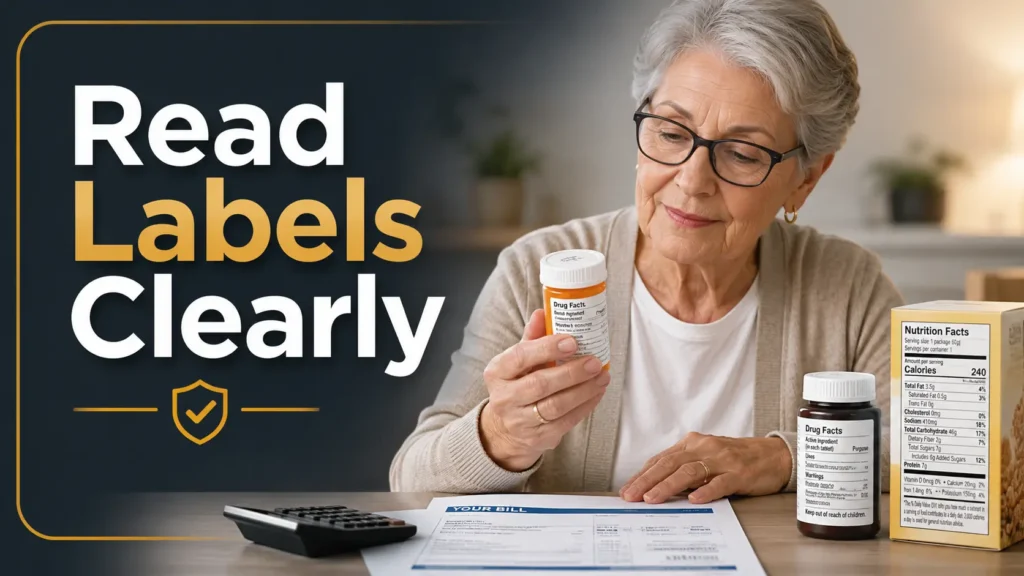
Reading Glasses for Seniors: Clearer Bills, Labels, and Medication Bottles
A pair of reading glasses can look wonderfully sharp beneath pharmacy lights and become strangely unhelpful beside a dim kitchen counter. The problem is rarely just the number printed on the temple. Reading distance, lens size, lighting, frame stability, and the kind of print being read all matter.
Bills are usually scanned at a desk. Food labels may be turned sideways under a cabinet light. Medication bottles are held closer, rotated repeatedly, and often read when the reader is tired. One pair can sometimes handle all three jobs, but only when it is chosen using real tasks rather than an age chart or a giant sample sentence.
This guide shows seniors and caregivers how to compare over-the-counter readers safely, recognize when stronger magnification is working against them, and build a simple reading setup that makes critical print easier to verify.
Choose with less guesswork
Test neighboring powers with the actual bills, labels, and bottles used at home.
Avoid false sharpness
Learn why the strongest lens can look impressive briefly while shrinking the useful reading zone.
Protect medication accuracy
Create a brighter, steadier place to confirm names, strengths, directions, and warnings.
The goal is not microscopic super-vision. It is comfortable, repeatable clarity at the distance where life actually happens. 🔎
Snapshot
This article is for older adults with otherwise useful distance vision and caregivers helping with bills, groceries, and prescriptions. You will learn how to test magnification at home, compare lens styles and budget tiers, spot unsafe buying mistakes, and decide when an eye exam or pharmacist’s help is the better next step.
Safety / Before You Act
This guide offers general shopping and home-setup information. It cannot determine an individual prescription or rule out cataracts, glaucoma, macular disease, astigmatism, unequal vision, medication effects, or other eye conditions.
Never guess at a medicine name, strength, dose, or timing from partially readable print. Ask the pharmacist to confirm the wording, request accessible labeling when available, or use a trusted person or assistive tool. Sudden blur, flashes, a curtain-like shadow, new double vision, eye pain, or missing areas of vision require prompt professional attention. :contentReference[oaicite:0]{index=0}
Table of Contents
Who Reading Glasses Help, and Who Should Skip the Drugstore Rack
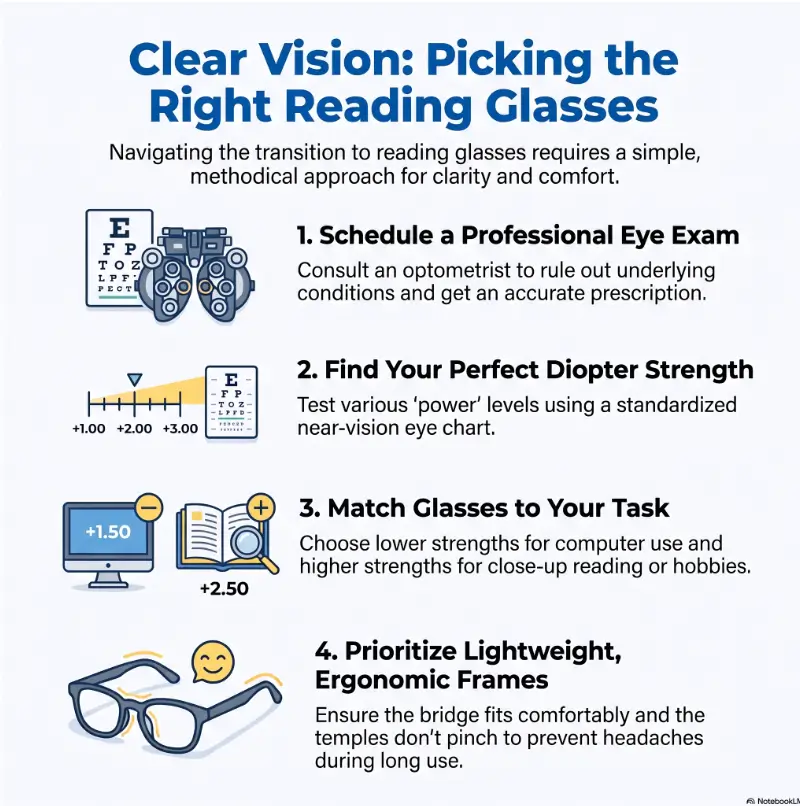
Best fit: distance looks clear, but nearby print has begun to drift away
Over-the-counter reading glasses are designed primarily for presbyopia, the gradual loss of near focusing ability that commonly develops with age. The familiar signs include holding print farther away, needing brighter light, and finding small text tiring even though objects across the room still look reasonably clear.
For someone with similar vision in both eyes and no major distance prescription, a ready-made pair may be a practical, inexpensive solution for mail, menus, recipes, price tags, and brief household tasks. The National Eye Institute notes that over-the-counter readers can help with presbyopia, while regular eye examinations remain important for checking overall eye health.
A caregiver can also use this guide to create a more dependable setup for a parent who manages household paperwork or several prescriptions. The aim is not to take over. It is to remove tiny points of friction before they become expensive, exhausting, or unsafe.
A poor fit: one eye is blurrier, letters distort, or vision is unclear at every distance
Ready-made readers place the same magnification in front of both eyes. They do not correct meaningful differences between the eyes, astigmatism, prism needs, or a distance prescription. They also cannot treat eye disease.
Skip the trial-and-error shopping routine and arrange an eye examination when any of the following is true:
- One eye consistently sees smaller, darker, blurrier, or more distorted words than the other.
- Straight lines look bent, broken, rippled, or partly missing.
- Print remains blurry even after changing distance, lighting, and reader strength.
- Reading triggers recurring double vision, nausea, significant headache, or eye pain.
- Distance vision has also changed.
- Diabetes, glaucoma, macular disease, previous eye surgery, or a significant eye injury is part of the medical history.
Readers who suspect unequal prescriptions may find this guide to reading glasses and astigmatism useful before deciding what to ask at an appointment.
Key takeaway
Drugstore readers are most suitable when the problem is uncomplicated near blur and both eyes need roughly the same help. Persistent distortion, unequal vision, or blur at multiple distances changes the decision.
The Print-Distance Test Most Shoppers Never Perform
Bills live farther away than medication bottles
Many shoppers test readers by holding a store card wherever the chosen lens happens to focus. That proves the lens can magnify something. It does not prove the glasses will work at a desk, beside a medicine organizer, or in the supermarket aisle.
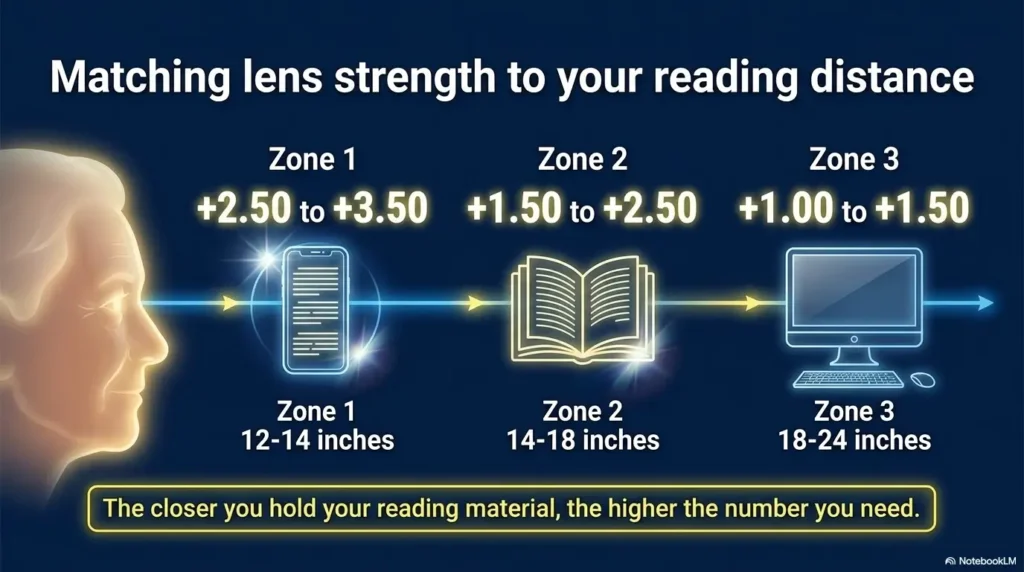
A bill may sit 16 to 20 inches from the eyes. A medication bottle might be held 10 to 14 inches away. A phone can drift closer when the user is tired. Each distance asks the lens to do a slightly different job.
Before comparing powers, observe the distance that feels natural without glasses. Do not force the item unusually close or extend the arms like a human selfie stick. Measure from the bridge of the nose to the print, then repeat the measurement for each common task.
Test numbers, punctuation, and dense lines, not a cheerful sample word
Large black words on a white retail card are the visual equivalent of a friendly handshake. Bills and medicine labels are less accommodating. They contain decimal points, account numbers, abbreviations, pale ink, curved surfaces, and lines packed close together.
A useful test set includes:
- A utility bill showing an amount due, account number, and payment date.
- A food package showing serving size, sodium, sugar, and an expiration date.
- A medicine bottle showing the drug name, strength, directions, pharmacy number, and refill information.
- A handwritten note or calendar entry, if handwriting is part of daily life.
For more help with household paperwork, see this practical system for organizing mail for seniors. Clear glasses help, but a calmer paper system prevents the desk from becoming a small forest of urgent envelopes.
A simple working-distance scorecard
| Task | Usual distance | Print challenge | What a good result feels like |
|---|---|---|---|
| Bills and statements | Farther near range | Long lines, columns, pale print | The whole row stays readable without leaning forward |
| Food labels | Variable | Small type, glossy packaging, curved surfaces | Numbers remain distinct while the package is turned |
| Medication bottles | Closer near range | Critical text on a curved label | Name, strength, and directions can be verified separately |
| Phone | Close to medium | Small icons, glare, changing font size | Text is clear without bringing the screen toward the nose |
How to Choose Reading-Glasses Strength Without Guessing
Start with the lowest power that makes critical print comfortably clear
The best strength is not the one that makes one word look largest. It is the weakest power that keeps the needed print clear at a comfortable, repeatable distance.
Begin with a modest strength and compare it with the next neighboring power. Keep the print at its normal distance. Read for at least a minute, scan across a full line, look from the top to the bottom of a bill, and then try a second item.
A suitable pair should not require constant page movement. The head and shoulders should remain relaxed. The reader should be able to locate the next line without feeling as though the useful focus area has collapsed into a keyhole.
Why age charts are only rough starting points
Magnification charts based on age can suggest a place to begin, but they cannot account for arm length, existing prescriptions, task distance, pupil size, lighting, cataracts, or differences between the eyes. Two people of the same age may prefer different strengths for the same label.
Use an age chart as a shelf locator, not a verdict. Real print should make the final decision.
The hidden clues that the power is wrong
| What happens | Possible explanation | What to try |
|---|---|---|
| The item must be pulled very close | The power may be stronger than the task requires | Compare the next lower strength at the normal distance |
| The item keeps moving in and out | The clear zone may be too narrow or unstable | Reduce power, improve lighting, or test a wider lens |
| One eye feels strained | The eyes may need different correction | Stop comparing ready-made pairs and arrange an exam |
| Print is clear in the center but hard to scan | Lens shape, fit, or excessive power may be limiting the usable area | Try a larger full-lens design and a neighboring power |
| Clarity disappears in the evening | Lighting, glare, dry eye, or another vision issue may be contributing | Add task lighting and discuss persistent symptoms with an eye professional |
Key takeaway
Choose clarity at the task’s normal distance. A lens that forces the page closer may be producing impressive magnification but poor everyday usability.
Show me the nerdy details
Reader strength is measured in positive diopters. In simple optical terms, increasing the diopter value increases focusing power and moves the lens’s focal distance closer. That is why stronger readers often require the object to be held nearer.
The calculation is not a home prescription tool. A person’s remaining focusing ability, distance prescription, lens position, eye health, and preferred task distance all affect the result.
The practical lesson is wonderfully ordinary: test the glasses where the print naturally belongs. Diopters are useful numbers, but posture and working distance expose whether those numbers suit the job.
Medication Labels Change the Buying Rules
Read the name, strength, directions, and warnings as separate tasks
A medication label should not receive a vague “I can mostly see it” grade. Break it into four checkpoints and verify each one deliberately:
- Name: Confirm the medicine name, including any extended-release or formulation wording.
- Strength: Distinguish the number and unit, such as mg, mcg, mL, or percentage.
- Directions: Read how much to take, how often, and any timing or food instructions.
- Warnings: Check storage instructions, caution labels, and special restrictions.
The FDA advises older adults to use medicines as directed and to raise questions with a healthcare professional. Pharmacists can also help when someone has trouble reading labels, opening bottles, or remembering instructions.
For a broader medication routine, pair clear readers with a large-print medication schedule. The schedule should support the pharmacy label, never replace it.
Choose lenses that reveal an entire instruction line
A very strong lens may make individual letters large while displaying only a short piece of the sentence clearly. That can encourage accidental skipping, especially when directions wrap around a narrow bottle.
Full-lens readers with a generous lens area often make label scanning easier than tiny folding readers. The ideal pair allows the eyes to move across the instruction while the head and bottle remain relatively steady.
When the bottle’s curve distorts the label, rotate it slowly and read one section at a time. Place a finger or a removable bookmark strip beneath the current line. Do not cover warning stickers or apply permanent markings over pharmacy information.
Lighting is part of the medication-reading system
More magnification cannot rescue a label buried in shadow. Use a bright, adjustable task light positioned above and slightly to the side of the reading area. The light should illuminate the label without throwing a white reflection directly back into the eyes.
Matte trays, pale neutral work surfaces, and uncluttered counters can improve contrast. Glossy black counters tend to collect reflections like small theatrical spotlights, none of which were invited.
Key takeaway
A medication pair must do more than enlarge letters. It should support accurate line-by-line verification under consistent lighting, without forcing the bottle into an awkward position.
Short Story: The glasses were fine, the setup was not
Marian kept replacing her readers because prescription labels became difficult every evening. Each new pair seemed better beneath the store lights. At home, the improvement vanished.
Her daughter watched her read one night. Marian stood beneath a ceiling fixture, held the bottle close to her chest, and tilted it until the label caught a narrow strip of light. The glasses were not the only problem. The counter was dim, the bottle was curved, and the strongest pair forced the print too close.
They placed a small adjustable lamp beside the medication tray, tested the next lower strength, and added a large-print schedule for timing. Marian could now hold the bottle farther away and read a full direction line.
The lesson was modest but important: better vision sometimes begins with changing the room, not buying another pair.
Lens Shape, Frame Stability, and Twenty-Minute Comfort
Full-lens readers versus half-eye readers
Full-lens readers provide magnification across most or all of the lens. They are usually the easier choice for sustained close work, including bills, forms, recipe cards, and medication review.
Half-eye readers sit lower on the nose, allowing the user to look over the top for distance. They can be convenient for someone who repeatedly switches between a close document and a person across the room. They may be less stable for a user who frequently bends, turns, or adjusts the frame.
Compact folding readers are useful backups. Their smaller lenses and hinges may be less comfortable for long sessions, so they are better treated as emergency umbrellas than the roof of the house.
Frame details seniors notice after twenty minutes
- Spring hinges: Helpful when ordinary temples feel tight, but they should not allow the frame to wobble.
- Low-slip temples: Useful when glasses slide during downward reading.
- Comfortable nose support: The frame should sit level without leaving painful pressure marks.
- Moderate weight: Extremely light frames can feel pleasant, provided they remain stable.
- Generous lens height: More vertical room can make line-to-line scanning easier.
- Visible frame color: A contrasting color can make misplaced glasses easier to spot on furniture.
Lens coatings: useful upgrade or expensive decoration?
An anti-reflective treatment may improve comfort for some users under bright indoor lighting or screens, but it does not correct the wrong strength or an unrecognized eye condition. Scratch-resistant treatments can be useful for frequently handled pairs, though no lens is truly scratch-proof.
Blue-light filtering is not a substitute for appropriate magnification, task lighting, screen settings, or breaks. When the main problem is tiny print on paper, prioritize optical clarity, fit, lens size, and clean surfaces before paying for fashionable extras.
Feature comparison for common senior reading tasks
| Reader style | Best use | Main advantage | Possible drawback |
|---|---|---|---|
| Full-lens, medium or large frame | Bills, forms, medication review | Wider near-viewing area | Distance becomes blurry while worn |
| Half-eye reader | Frequent near-to-distance switching | Look over the frame for distance | Can slide or encourage awkward head angles |
| Compact folding reader | Receipts, restaurants, emergency backup | Highly portable | Small lenses and hinges may reduce comfort |
| Prescription reading glasses | Unequal eyes, astigmatism, demanding close work | Correction can be individualized | Higher cost and requires professional fitting |
| Stand or handheld magnifier | Exceptionally small print or spot reading | Extra magnification without replacing glasses | May occupy a hand or show a smaller area |
Readers deciding between wearable magnification and a separate tool can review this comparison of reading glasses versus magnifiers.
Reading-Glasses Buying Mistakes That Create More Blur
Mistake one: buying the strongest pair that looks sharp
Higher magnification can create an immediate “That’s clearer!” response. The celebration may last ten seconds. Then the reader discovers that the page must be held unusually close and only a small area remains comfortable.
Excessive power can make scanning a bill slower, encourage neck flexion, and increase the amount of repositioning required. Read more about the signs that reading glasses may be too strong.
Mistake two: testing only under bright retail lighting
Store lighting can flatter a mediocre match. Test again at home in the chair, kitchen, desk, or medication area where the glasses will be used. Keep the receipt and packaging until the pair passes the real-print test in normal evening light.
Mistake three: choosing frame style before usable lens area
Narrow frames can look neat and weigh less, but they may require more precise head positioning. A slightly larger lens is often kinder to someone scanning columns, instructions, or ingredient lists.
Mistake four: wearing readers while walking or using stairs
Ordinary readers blur distance vision. Looking through them while walking can make floors, steps, and obstacles harder to judge. Remove them before standing, walking, or using stairs unless an eye professional has specifically prescribed a lens design for those activities.
Keep the glasses on the table rather than balancing them on top of the head, where they can become both unstable and mysteriously invisible five minutes later.
The Clear-Print Decision Flow
1. Measure
Find the natural distance for bills, food labels, and bottles.
2. Compare
Test two neighboring strengths without moving the print closer.
3. Scan
Read complete lines, numbers, punctuation, and warnings.
4. Retest
Use the pair at home for several minutes in ordinary lighting.
One Pair Everywhere, or Several Task-Specific Pairs?
When one basic pair is enough
A single pair may be perfectly adequate when most reading occurs at a similar distance, the glasses are easy to locate, and the user does not need a different power for exceptionally small print.
This approach suits a budget-conscious reader who mainly handles mail at one desk or reads briefly during the day. Add a protective case and assign the pair a permanent home.
When several pairs reduce daily friction
Multiple inexpensive pairs can be useful when the same strength works across tasks but glasses are constantly carried from room to room. A desk pair, kitchen pair, medication-station pair, and portable backup can save time and reduce the temptation to read without adequate help.
The placement should be deliberate. Avoid leaving readers on stairs, at the edge of counters, beneath loose papers, or in direct heat. This guide to the best places to keep reading glasses offers room-by-room ideas.
Good, Better, Best: a budget-aware setup
| Setup | What it includes | Best for | Worth paying for | Skip the expense when |
|---|---|---|---|---|
| Good | One correctly powered full-lens pair and a bright reading lamp | One primary reading location | Stable frame, clear lenses, adequate lens size | Extra coatings do not solve a known problem |
| Better | Two or three matched pairs placed at key stations | Busy homes and readers who misplace glasses | Durable hinges, visible frames, protective cases | Different powers have not been tested at real distances |
| Best for complex needs | Professional eye exam plus prescription or low-vision options | Unequal vision, astigmatism, distortion, or demanding tasks | Individualized correction and professional fitting | Simple presbyopia is working well with an inexpensive pair |
Price alone does not predict usefulness. A modest pair with the correct strength and a generous lens may outperform an expensive frame chosen for appearance. Spend first on fit, stability, optical clarity, lighting, and an appropriate eye examination schedule.
Caregiver placement checklist
- Ask where reading actually happens rather than choosing locations for the person.
- Use a tray or case that contrasts with the furniture.
- Label cases by task, such as “Desk,” “Kitchen,” or “Medicine.”
- Keep the medication pair beside the reading lamp, not mixed into a drawer.
- Replace pairs with loose hinges, deep scratches, cloudiness, or tilted lenses.
- Do not change strengths silently. Explain and test any replacement together.
When Reading Trouble Is Not Just Presbyopia
Seek prompt help for sudden or alarming changes
Reading glasses should never become a way to explain away a sudden change. New flashes, a shower of floaters, a dark curtain or shadow, sudden loss of vision, severe eye pain, or abrupt double vision needs prompt professional assessment.
Call the appropriate eye-care service or urgent medical service based on the severity and local instructions. Do not drive yourself when vision is suddenly impaired.
Schedule an eye exam for persistent distortion, headaches, or fading contrast
Book a routine or timely appointment when brighter light and reasonable reader strengths no longer solve the problem, colors seem duller, glare has increased, or reading causes recurring strain.
Cataracts, dry eye, astigmatism, macular changes, glaucoma, medication effects, and other conditions can alter reading comfort. For a clearer comparison of common age-related concerns, review presbyopia versus cataracts.
Ask the pharmacist when medication wording remains uncertain
A pharmacist may be able to clarify instructions, review medicine use, and discuss available label accommodations. The FDA notes that pharmacists may be able to provide prescription labels in larger type when standard labels are difficult to read.
Possible questions include:
- Can this label be printed in larger type?
- Is an accessible, duplicate, or flat-format label available?
- Can you read the complete directions aloud and confirm the medicine’s purpose?
- Does the bottle have any auxiliary warning labels I should review?
- Could the pharmacy synchronize refills or simplify packaging without hiding essential information?
Caregivers can prepare for the conversation with this guide to handling medication labels that are too small for seniors.
Key takeaway
A stronger pair should not be the automatic response to sudden blur, distortion, unequal vision, or fading contrast. Those changes deserve an eye-health check, not another spin through the pharmacy rack.
The Five-Minute Real-Print Test
Gather one bill, one food label, and one medication bottle
Use current household items rather than a downloaded eye chart. Remove or cover private account details if testing in a store. Keep the medication in its original labeled container and do not mix pills for the test.
Place each item where it is normally read. Turn on the usual lighting first, then add a task light if needed. This separates the lens problem from the room problem.
Compare two neighboring strengths without chasing the focus
- Put on the lower-strength pair.
- Hold the item at its measured natural distance.
- Read a complete line, including numbers and punctuation.
- Scan from the first line to the last without moving the item repeatedly.
- Repeat with the next higher strength.
- Choose the lower power when both are equally clear and comfortable.
Do not judge from the first second. Read for at least a minute with each pair. Notice neck position, brow tension, line skipping, dizziness, and whether the item gradually creeps closer.
Score the pair before removing the tag
| Question | Pass | Needs another test |
|---|---|---|
| Can I read at my normal distance? | Yes, without leaning | The object must move much closer |
| Can I scan a full line? | Yes, with small eye movements | I keep turning my head or losing the line |
| Are numbers and punctuation distinct? | Decimal points and units are clear | Similar digits still merge |
| Does the frame stay level? | It remains stable | It slides, twists, or pinches |
| Can I read for several minutes? | Comfort remains steady | Strain, nausea, or headache develops |
Give glossy and curved food packaging a fair test
Nutrition labels introduce glare, low contrast, and curved surfaces. Rotate the package rather than bending the neck. Adjust the light so reflections move away from the line being read.
For more task-specific help, see these food-label reading tips for seniors.
Frequently Asked Questions
How can a senior choose magnification without an eye chart?
Measure the normal reading distance and compare two neighboring powers using actual bills, labels, and medicine bottles. Choose the weakest strength that keeps complete lines comfortably clear without moving the item closer. An eye chart can offer a starting point, but real tasks provide the more useful test.
What is the difference between ready-made readers and prescription glasses?
Ready-made readers usually provide equal magnification in both lenses. Prescription glasses can correct different needs in each eye, astigmatism, distance vision, and other measured requirements. Prescription options may be worth considering when one eye is blurrier, reading remains uncomfortable, or the user needs individualized working distances.
Can someone use different strengths for bills and medication bottles?
Yes, different task distances can sometimes work better with different powers. Label the cases clearly and keep each pair at its assigned station. When the difference between powers is large or causes confusion, ask an eye-care professional to check the correction and recommend a safer system.
Does blue-light filtering make small print easier to read?
Blue-light filtering does not replace correct magnification, clean lenses, good contrast, or suitable lighting. A coating may affect comfort for some screen users, but paper-label clarity depends more directly on reader strength, lens quality, working distance, and glare control.
Can reading glasses be worn over contacts or used with bifocals?
Some contact-lens users may use readers for close work, but the appropriate power depends on the contact-lens correction. Wearing ready-made readers over bifocals or progressives is generally not a sensible improvisation unless an eye professional has advised it. Combining lenses can produce blur, distortion, or an awkward focal distance.
How often should reading glasses be cleaned or replaced?
Clean frequently handled lenses whenever fingerprints, dust, or haze reduce contrast. Use a clean microfiber cloth and an appropriate lens cleaner or the frame maker’s recommended method. Replace a pair when scratches cross the central viewing area, the frame sits crooked, hinges loosen repeatedly, or clarity has changed despite cleaning.
How can caregivers help a parent who keeps misplacing glasses?
Create fixed reading stations with contrasting trays or cases. Use a visible frame color and keep matched pairs at the desk, kitchen, and medication area. Avoid scolding or constantly moving the glasses to a “better” place. A location only works when the person using it can remember and reach it naturally.
Why do reading glasses sometimes seem to stop working?
The near-vision need may have changed, but dirty lenses, dim lighting, dry eyes, an altered reading distance, a bent frame, or an eye-health issue can also contribute. Work through this guide to why reading glasses may stop working before automatically buying a much stronger pair.
Optional video: Open the video on YouTube (external site).
Build a Safer Reading Station in Fifteen Minutes
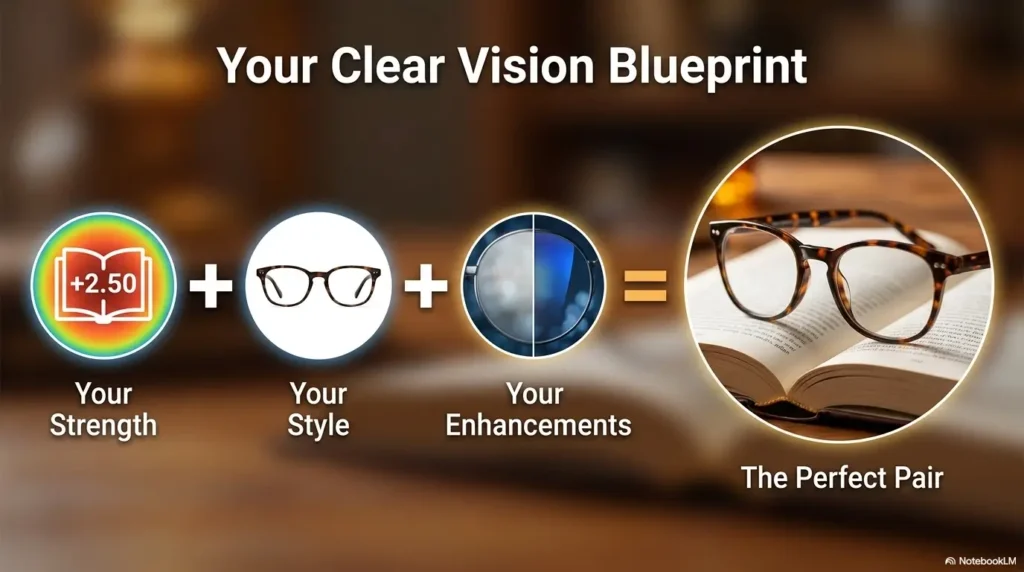
Clear reading is not produced by lenses alone. It emerges from a small system: the right power, the right distance, steady light, uncluttered space, and a reliable place to return the glasses.
Choose the location where the most important close-up task happens. For many households, that is the medication counter or bill-paying desk. Then complete this fifteen-minute reset:
- Remove unrelated papers, empty containers, and reflective clutter.
- Place an adjustable light above and slightly beside the reading area.
- Add a matte, contrasting tray for the current document or bottle.
- Set down the tested pair of readers in a visible case.
- Keep a magnifier or phone accessibility tool nearby for unusually small print.
- Write the pharmacist’s number or eye clinic contact in large print.
- Test one bill, one label, and one medication instruction before declaring the station finished.
The best next step is simple: take one pair of readers, one real medication bottle, and one bill to the intended reading area today. Test clarity at the normal distance for five uninterrupted minutes. When every critical line remains comfortably readable, the pair has earned its place.
The final rule
Do not buy magnification for the shelf card. Choose comfortable clarity for the exact distance, print, light, and responsibility waiting at home.
Last reviewed: 2026-08
PUT THIS GUIDE TO WORK · INTERACTIVE WORKSHEET
Reading-glasses task card
Use this worksheet alongside the article: Reading Glasses for Seniors: Clearer Bills, Labels, and Medication Bottles. Use the fields provided to organize your notes and next actions, then save your worksheet.
Your entries stay in this page and are cleared when you reload. No account is needed. Saved files are downloaded only to your device.
This card organizes a discussion or task. It does not provide diagnosis, treatment, medication timing, driving clearance, or professional approval. Copy clinical instructions exactly and ask the professional about uncertainty.
How to use your result
Save the worksheet before leaving this page. Recheck any quote, date, or instruction with the relevant provider, pharmacist, manufacturer, or official organization. A completed checklist means you recorded the steps, not that an outcome is guaranteed.
Worksheet added October 20, 2026. Read the article above for context and its stated review scope.