
Organize your questions and next steps, then save your worksheet.
Summary and next steps
Medicare retinal imaging coverage depends on whether the test is diagnostic or screening. See Part B costs, ABN rules, and what to ask before you pay.
Editorial maintenance: October 24, 2026. Summary layout, related links and technical metadata updated. This is not a full clinical review.
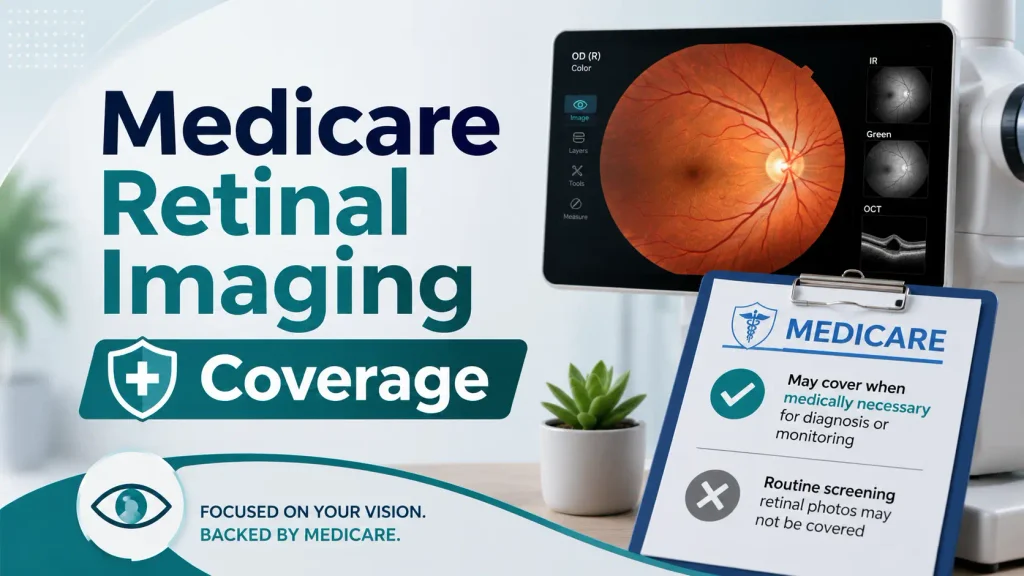
Yes, Medicare can cover retinal imaging, but coverage usually depends on why the image is being taken. Original Medicare Part B may cover diagnostic retinal imaging, including tests such as optical coherence tomography (OCT) or fundus photography, when a treating provider considers the test medically necessary to diagnose, evaluate, or monitor an eye condition and Medicare’s coverage requirements are met.
The key distinction is diagnostic imaging versus routine screening. An image used to manage suspected or known retinal disease may qualify for Part B coverage. An optional retinal photograph offered simply as a screening add-on during a routine vision visit may not. Before agreeing to the test, ask the eye clinic: “Is this being billed to Medicare as medically necessary diagnostic imaging, or is it a non-covered screening service?”
New flashes, many new floaters, or a curtain in vision need urgent assessment. A sudden increase in floaters, flashes of light, or a dark shadow across your sight can signal a retinal tear or detachment. The National Eye Institute advises seeing an eye doctor or going to the emergency room right away. Do not wait for an optional screening-photo appointment or postpone assessment while checking benefits. Describe when the change began and which eye is affected. A clinician should decide what examination and imaging are needed; a billing label cannot determine whether an urgent problem is present.
Table of Contents

The Reason for the Retinal Image Usually Decides Medicare Coverage
Medicare does not treat every picture of the retina the same way. The technology may look identical from the patient’s side of the camera, but the medical purpose behind the test can change the coverage result.
| Situation | Likely Medicare Position | What to Verify |
|---|---|---|
| Imaging to investigate symptoms or an abnormal eye finding | May be covered under Part B when medically necessary | Diagnosis, provider order, and how the result will affect care |
| Imaging to monitor known retinal disease | May be covered when Medicare’s medical-necessity criteria are met | Condition being monitored and required testing frequency |
| Optional retinal photograph during a routine glasses exam | Often not covered by Original Medicare when performed only as screening | Whether the clinic considers it screening rather than diagnostic |
| Annual diabetic retinopathy eye exam | Part B provides specific coverage for eligible people with diabetes | Whether the imaging itself is part of the covered exam and how it is billed |
| Retinal imaging under a Medicare Advantage plan | Original Medicare coverage applies, but plan rules and extra vision benefits may change your cost | Network, copay, authorization, and supplemental vision benefits |
Medicare Part B generally covers diagnostic tests ordered to evaluate or treat a medical problem. That broad principle is important because “retinal imaging” is not one single benefit. It is a family of diagnostic techniques used for different clinical purposes.
What Counts as Retinal Imaging?
Eye clinics may use “retinal imaging” as a convenient umbrella term. The actual service may be digital fundus photography, optical coherence tomography, angiographic imaging, or another ophthalmic diagnostic technique.
For Medicare purposes, the name on the clinic brochure matters less than the medical record and billing circumstances. A diagnostic test generally needs a legitimate medical purpose, appropriate documentation, and use in managing the patient’s condition.
That is why two Medicare beneficiaries can undergo what appears to be the same retinal scan yet receive different coverage results. One scan may be documenting progression of macular disease; the other may simply be a screening photograph offered to everyone who walks through the door.
Routine Retinal Screening Is Different From Diagnostic Imaging
Original Medicare generally does not cover routine eye examinations for obtaining eyeglass or contact-lens prescriptions. Medicare explains its rule for routine eye exams and refractions separately from medically necessary eye care.
A retinal photograph does not become Medicare-covered simply because an eye clinic has sophisticated imaging equipment. If the service is performed only as routine screening and there is no covered medical reason for the test, the patient may be responsible for the charge.
This distinction deserves attention at optometry offices that offer a digital retinal photo as an optional alternative or addition to dilation. The convenience or usefulness of the image does not, by itself, determine Medicare coverage.
Retinal imaging also should not automatically be treated as interchangeable with a dilated examination. If your eye doctor recommends dilation, this guide to preparing for a dilated eye exam can help you plan the visit rather than assuming a photograph replaces every part of the examination.

Diagnostic Imaging Must Still Meet Medicare Requirements
A documented need to evaluate or manage a medical condition is part of the coverage assessment for diagnostic retinal imaging. It does not by itself establish that Original Medicare will pay the claim.
Examples can include evaluating or monitoring retinal disorders, macular disease, glaucoma-related structures, diabetic eye disease, or another documented abnormality. The clinician determines whether the test is medically appropriate. Medicare or the Medicare contractor determines whether the submitted service meets coverage and payment rules.
Those are separate decisions. A doctor can reasonably believe a test is helpful while Medicare still determines that the particular claim does not meet its payment requirements, perhaps because of documentation, frequency, diagnosis, coding, or local coverage criteria.
Diabetes Creates a Specific Medicare Eye Exam Benefit
If you have diabetes, Medicare Part B covers an eye exam for diabetic retinopathy once a year when the eligibility and provider requirements are met. Medicare describes the benefit in its official diabetic retinopathy eye exam coverage.
Do not translate that rule into “Medicare pays for every retinal photo once a year.” The covered benefit is the qualifying diabetic eye examination. Whether a particular imaging service is separately payable still depends on how and why it is performed and billed.
If diabetes is the reason for your appointment, ask the clinic whether the proposed retinal imaging is part of the covered diabetic eye evaluation, a separately billed diagnostic test, or an optional screening service. That one question can prevent an unpleasant surprise at checkout.
How Much Could Retinal Imaging Cost With Original Medicare?
For many Medicare-covered Part B diagnostic services, you first satisfy the Part B deductible and then generally owe 20% of the Medicare-approved amount, not necessarily 20% of whatever price appears on the provider’s standard charge list.
For 2026, the Original Medicare Part B deductible is $283. Medicare publishes the current figure with its official Part B cost information.
Illustrative example: deductible already met
Assume a covered retinal diagnostic test has a Medicare-approved amount of $150 and you have already met your Part B deductible for the year.
- Medicare-approved amount: $150
- Your 20% coinsurance: $30
- Medicare’s portion: $120
This simplified example assumes the service is covered, the provider accepts Medicare assignment, you have no secondary coverage changing your responsibility, and the service is provided in a setting without additional facility cost-sharing.
Illustrative example: $100 of your deductible remains
Using the same $150 Medicare-approved amount, suppose you still have $100 of your Part B deductible left.
- First $100: applied to your remaining deductible
- Amount remaining after deductible: $50
- 20% coinsurance on that $50: $10
- Illustrative patient responsibility: $110
A hospital outpatient service can produce different cost-sharing, and Medicare Advantage plans use their own plan-specific copays or coinsurance. Medigap or other secondary insurance may also reduce what you ultimately owe.
Medicare Advantage Can Change the Retinal Imaging Bill
A Medicare Advantage plan must cover the Medicare-covered services included under Original Medicare, but the practical path to receiving them can differ. Your plan may use provider networks, copayments, referrals, prior authorization rules, or other utilization requirements.
Many Medicare Advantage plans also offer vision benefits beyond Original Medicare. Those supplemental benefits may include routine eye care, but the existence of a vision benefit does not automatically mean every retinal imaging service is free.
Before the appointment, ask the plan or clinic to distinguish between the medical benefit and the supplemental routine vision benefit. Retinal imaging related to disease may be processed differently from an optional screening photograph during a routine vision appointment.
Your Five-Minute Retinal Imaging Coverage Check
Before paying for an image you assumed Medicare would cover, work through these questions. You do not need to become your own medical coder; you simply need enough information to identify which coverage lane the test is entering.
- Ask for the exact test name. Is it OCT, fundus photography, or another retinal imaging service?
- Ask why it is being performed. Is the provider diagnosing or monitoring a medical condition, or is the image offered as routine screening?
- Ask whether the clinic plans to bill Medicare. “Do you expect Original Medicare to consider this medically necessary?” is more useful than simply asking, “Do you take Medicare?”
- Ask what diagnosis supports the test. You do not need to interpret the code yourself. You are checking that the test is linked to a documented medical reason rather than an optional wellness photograph.
- Ask for your estimated responsibility. Find out whether the estimate assumes your Part B deductible has already been met.
- If coverage is uncertain, ask about a written notice before the test. With Original Medicare, an Advance Beneficiary Notice of Non-coverage may be used in circumstances where the provider believes Medicare may not pay.
Preparing test names, medication lists, and billing questions in advance can help you follow the visit. This eye doctor visit checklist for seniors provides a simple structure for the visit.
What an Advance Beneficiary Notice Means Before Retinal Imaging
If you have Original Medicare and the provider believes Medicare may deny an item or service that could otherwise be covered under some circumstances, you may receive an Advance Beneficiary Notice of Non-coverage, commonly called an ABN.
An ABN is not the same thing as Medicare already denying the claim. It explains why the provider expects Medicare may not pay, gives an estimated cost, and lets you choose how you want to proceed. Medicare explains these choices under its beneficiary protections and ABN rules.
Read the reason, estimated charge, and selection boxes before signing. If you want the service submitted to Medicare so you retain the possibility of appealing a denial, make sure you understand which ABN option accomplishes that.
For something Medicare categorically never covers, a provider may not be required to issue an ABN. That is another reason to ask whether the retinal image is being treated as a potentially covered diagnostic service or a routine non-covered screening service.
What to Check If Medicare Denies the Retinal Imaging Claim
A denial does not automatically mean the test was unnecessary or that you must immediately pay whatever amount appears on the first bill. First identify why Medicare denied the claim.
- Was the service classified as routine or screening?
- Was medical necessity not established?
- Was the service performed more frequently than the applicable coverage criteria allow?
- Is a diagnosis, billing code, or documentation issue involved?
- Was the claim processed by the correct insurer?
Compare the provider’s bill with your Medicare Summary Notice rather than relying on the bill alone. If small print or unfamiliar terminology makes that difficult, this guide to reading Medicare notices for seniors can make the paperwork easier to sort before you call the office.
If the test was genuinely diagnostic and the denial appears inconsistent with the provider’s documentation, ask the billing office whether the claim needs correction. If Medicare made a coverage determination you disagree with, your Medicare notice explains your appeal rights and deadline.
Questions to Ask the Eye Clinic Before You Agree to the Scan
A vague question such as “Does Medicare cover this?” often produces a vague answer. A clinic cannot guarantee how Medicare will adjudicate every claim, but it can tell you much more about what it intends to submit.
- “What is the exact name of the retinal imaging test?”
- “What condition or finding is this test evaluating?”
- “Is it diagnostic, or is it an optional screening image?”
- “Are you billing this test to Medicare Part B?”
- “What Medicare-approved or estimated patient amount do you expect?”
- “Has Medicare covered this test previously for this condition and testing frequency?”
- “If you expect Medicare may deny it, should I receive an ABN before the test?”
The phrase worth remembering is not simply retinal imaging. It is retinal imaging for what medical purpose? That is the hinge on which much of the coverage question turns.

Retinal Imaging and Medicare FAQ
Does Medicare cover OCT scans?
Original Medicare Part B can cover optical coherence tomography when it is medically necessary for diagnosing or managing an eye condition and applicable Medicare requirements are satisfied. An OCT scan is not automatically covered merely because it is available during an eye examination.
Can an eye doctor charge me for a retinal photograph if Medicare does not cover it?
Yes. You may be responsible for a legitimately non-covered service, such as an optional screening image. If the service is one Medicare might otherwise cover but the provider expects Medicare to deny in your particular circumstances, Original Medicare’s ABN rules may apply. Ask about your expected responsibility before agreeing to the test.
Does Medigap make non-covered retinal imaging free?
Generally, Medigap is designed to help with certain cost-sharing for services Original Medicare covers. It ordinarily does not turn a service that Original Medicare excludes into a covered Medicare service. Your particular policy terms still control.
What if my retinal imaging was done at a hospital outpatient department?
Your cost can differ from the familiar physician-office Part B calculation because hospital outpatient services may involve additional facility cost-sharing. Check both the professional and facility portions of the claim before assuming the amount is an error.
Optional video: Open the video on YouTube (external site).
The One Check Worth Doing Before You Pay
Take five minutes and ask the billing office for three pieces of information: the exact retinal imaging service, the medical reason it was performed, and whether the clinic expects it to be processed as a Medicare-covered diagnostic service or a non-covered screening service.
If it is diagnostic, ask for the expected Medicare patient responsibility and whether your deductible is included in that estimate. If it is screening, ask for the cash price before the image is taken. If the office is unsure Medicare will pay, ask whether an ABN applies.
That small distinction can turn a blurry coverage question into a much cleaner one: not “Does Medicare cover retinal imaging?” in the abstract, but “Does Medicare cover this retinal image, for this medical reason, under my coverage?” That is the question worth getting answered before the camera flashes.
Last reviewed: 2026-10
Targeted review: October 17, 2026. Added retinal emergency symptoms and clarified that diagnostic purpose alone does not guarantee payment. Other sections retain their stated review scope.
PUT THIS GUIDE TO WORK · INTERACTIVE WORKSHEET
Eye-test quote and appointment planner
Use this worksheet alongside the article: Does Medicare Cover Retinal Imaging?. Use the fields provided to organize your notes and next actions, then save your worksheet.
Your entries stay in this page and are cleared when you reload. No account is needed. Saved files are downloaded only to your device.
This worksheet does not establish coverage or eligibility. Use the Part B model only after the provider confirms a covered service and accepts assignment. It uses deductible applied + 20% of the remaining approved amount + extra charges. Medigap, Medicaid, other insurance, facility charges, excess charges, and plan-specific rules are not modeled. A plan quote is entered directly rather than applying the Part B formula.
Verify Medicare’s current costs and assignment rules · Worksheet rules checked October 20, 2026.
How to use your result
Save the worksheet before leaving this page. Recheck any quote, date, or instruction with the relevant provider, pharmacist, manufacturer, or official organization. A completed checklist means you recorded the steps, not that an outcome is guaranteed.
Worksheet added October 20, 2026. Read the article above for context and its stated review scope.