


Medicare Advantage plans generally cover medically necessary glaucoma care because they must cover the Medicare Part A and Part B services that Original Medicare covers. That includes Medicare’s glaucoma screening benefit for eligible people at high risk, as well as qualifying medical evaluation and treatment after glaucoma is suspected or diagnosed.
The important catch is that Medicare Advantage does not necessarily use Original Medicare’s exact cost-sharing or access rules. Your plan may have its own copay or coinsurance, provider network, specialist-referral rules, or prior authorization requirements. If your plan includes Part D drug coverage, glaucoma eye drops can also be subject to a separate formulary, tier, prior authorization, or step-therapy rule.
There is another distinction worth making immediately: medical glaucoma care is not the same thing as a routine vision benefit. Some Medicare Advantage plans add routine eye exams, eyeglass allowances, or other vision benefits, but those extras are separate from the Medicare-covered medical services used to detect, diagnose, monitor, and treat glaucoma.
Table of Contents
The Quick Answer: What Glaucoma Services Can Medicare Advantage Cover?
| Eye-care service | Medicare baseline | What to check with your Advantage plan |
|---|---|---|
| Preventive glaucoma screening | Covered once every 12 months for people who meet Medicare’s high-risk criteria | Network, copay or coinsurance, and provider requirements |
| Evaluation of suspected glaucoma | May be covered as medically necessary Part B care | Specialist referral, network, and authorization rules |
| Glaucoma monitoring | Medically necessary physician services and testing may be covered | Whether the test requires authorization and what cost-sharing applies |
| Prescription glaucoma eye drops | Usually handled through prescription-drug coverage rather than the preventive screening benefit | Formulary, drug tier, prior authorization, step therapy, and pharmacy network |
| Laser treatment or glaucoma surgery | Medically necessary procedures can fall under Medicare-covered medical care | Authorization, surgeon and facility network, and procedure cost-sharing |
| Routine exam for new glasses | Original Medicare generally does not cover routine refraction | Whether your plan provides a supplemental routine vision benefit |
Medicare’s official Original Medicare and Medicare Advantage comparison explains the basic framework: Medicare Advantage plans must cover medically necessary services that Original Medicare covers, but plans may use networks, different cost-sharing, referrals, and prior authorization for certain care.
Medicare’s Glaucoma Screening Benefit Still Matters in Medicare Advantage
Original Medicare Part B has a specific preventive glaucoma screening benefit. Because Medicare Advantage must provide the Medicare-covered Part A and Part B benefits, an Advantage plan must also provide access to this covered benefit for eligible members, although the way you obtain the service and what you pay can depend on the plan.
According to Medicare’s official glaucoma screening rules, Part B covers a glaucoma screening once every 12 months when you are considered at high risk because at least one of the following applies:
- You have diabetes.
- You have a family history of glaucoma.
- You are African American and age 50 or older.
- You are Hispanic and age 65 or older.
The screening must be done or supervised by an eye doctor who is legally allowed to perform glaucoma testing in your state.
If diabetes is the reason you qualify, the site’s more focused guide to Medicare glaucoma screening for people with diabetes explains how the glaucoma benefit can overlap with other diabetes-related eye care without making every service in the appointment part of one preventive screening.
A Screening Is Not the Same as Ongoing Glaucoma Care
This distinction is the hinge on which much of Medicare glaucoma coverage turns.
A screening looks for glaucoma in someone who has not necessarily been diagnosed with the disease. Medicare’s specific preventive benefit has its own eligibility and frequency rules.
Once an eye doctor suspects or diagnoses glaucoma, future appointments may instead involve medically necessary evaluation, diagnostic testing, monitoring, or treatment. Those services are not simply repeated versions of the once-every-12-month screening benefit.
For example, a person with established glaucoma may need follow-up examinations, eye-pressure measurements, visual-field testing, optic-nerve assessment, imaging, medication management, or treatment. Whether a particular service is covered depends on the medical reason for it, applicable Medicare coverage rules, documentation, frequency, and the Medicare Advantage plan’s administrative requirements.
If the broader Medicare distinction between routine and medical eye visits is still fuzzy, see the site’s guide to Medicare eye exam coverage. It explains why two appointments that look similar from the examination chair can produce very different insurance results.

Medical Risk and Medicare Screening Eligibility Are Not Identical
Do not use Medicare’s four screening categories as a complete list of everyone who can develop glaucoma.
The National Eye Institute describes glaucoma as a group of diseases that damage the optic nerve and notes that it often begins without obvious symptoms. Its glaucoma guidance discusses broader clinical risk factors and explains that diagnosis can involve a comprehensive dilated eye examination and visual-field testing.
In other words, Medicare’s preventive-benefit eligibility rules answer an insurance question. Your ophthalmologist or optometrist answers the clinical question of whether you need examination, diagnostic testing, or follow-up based on your individual eye health.
If you do not meet Medicare’s listed preventive-screening categories but have symptoms, suspicious findings, or a known eye condition, do not assume that Medicare Advantage therefore excludes all glaucoma-related care. A medically necessary evaluation can be a different coverage pathway from preventive screening.
Does Medicare Advantage Cover Glaucoma Tests Such as Visual Fields or Imaging?
Potentially, yes, when a test is medically necessary and satisfies the applicable coverage rules. But the phrase “glaucoma test” covers several different services, and Medicare does not automatically pay for every test merely because glaucoma appears somewhere in your medical record.
An eye doctor may use different methods to examine the optic nerve, measure eye pressure, evaluate the drainage angle, assess the cornea, test peripheral vision, or document structural changes. The exact combination depends on your condition and clinical findings.
For Medicare Advantage members, ask the eye practice to identify the specific tests being ordered rather than asking only whether “the glaucoma visit” is covered. Then verify whether your plan has any network or authorization requirement for those services.
This service-by-service approach also matters when a medical examination includes a glasses prescription. Original Medicare generally excludes routine refraction for eyeglasses or contacts even when another portion of the same encounter may be medical. The site’s Medicare refraction coverage guide explains that billing split in more detail.
Does Medicare Advantage Cover Glaucoma Eye Drops?
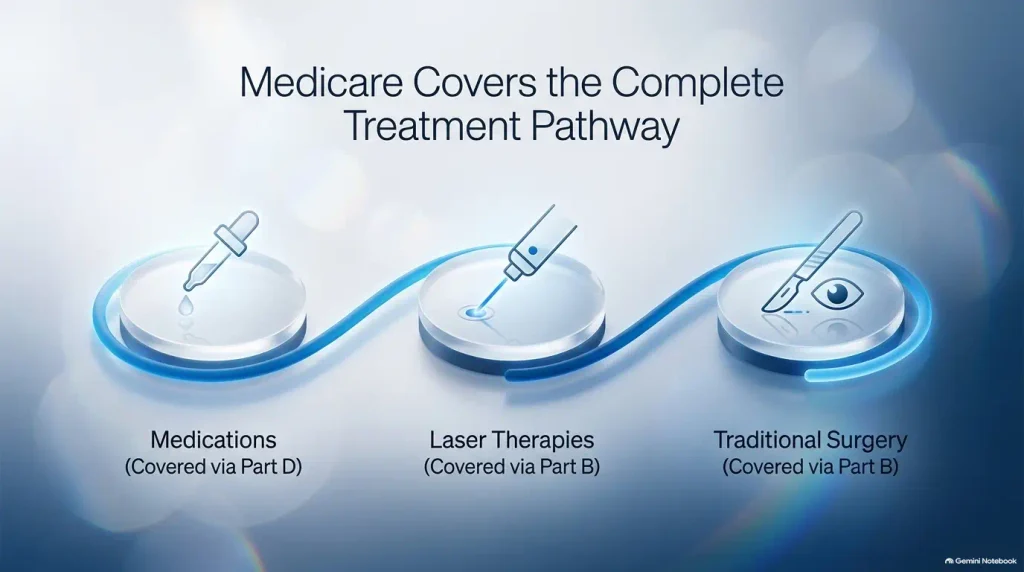
Many Medicare Advantage plans include Medicare Part D prescription-drug coverage. When they do, outpatient glaucoma medications such as prescription eye drops are generally handled through that drug benefit rather than through the preventive glaucoma screening benefit.
The National Eye Institute notes that prescription eye drops are a common glaucoma treatment. The exact medication depends on the patient’s condition, treatment response, side effects, and other medical factors.
Your insurance question is therefore not simply, “Does Medicare Advantage cover glaucoma medicine?” A better set of questions is:
- Is my exact medication on the plan’s formulary?
- What drug tier is it on?
- Does it require prior authorization?
- Does step therapy apply?
- Is there a quantity limit?
- Do I need to use a preferred or in-network pharmacy for the lowest cost?
Medicare’s drug-plan rules explain that Medicare drug plans can use prior authorization, step therapy, and quantity limits, and that members or their prescribers can request exceptions in qualifying circumstances.
What About Laser Treatment and Glaucoma Surgery?
Glaucoma treatment can extend beyond medication. The National Eye Institute describes medicines, laser treatment, and surgery as established treatment categories, with the appropriate approach depending on the type and severity of glaucoma and how the eye responds to treatment.
When glaucoma laser treatment or surgery qualifies as a medically necessary Medicare-covered service, Medicare Advantage plans must provide the applicable Medicare benefit. The administrative path, however, may be different from Original Medicare.
Before scheduling a procedure, verify all of the moving parts rather than only the surgeon:
- Is the ophthalmologist in network?
- Is the facility in network?
- Does the procedure require prior authorization?
- What is your copay or coinsurance for the surgeon?
- Is there separate facility cost-sharing?
- Will anesthesia or another clinician bill separately?
If you are trying to determine whether your specialist visit itself is covered, the site’s guide to Medicare coverage for ophthalmologist visits provides a useful bridge between ordinary vision care and disease-related medical care.
Routine Vision Coverage Is a Separate Layer
One of Medicare Advantage’s attractions is that many plans offer supplemental benefits that Original Medicare does not provide, including some routine vision services. But a routine vision allowance should not be confused with glaucoma medical coverage.
Medicare states that Original Medicare generally does not cover routine eye exams or refractions performed for eyeglasses or contact lenses. Some Medicare Advantage plans add those services as extra benefits.
That can create two insurance lanes inside the same eye practice:
- Medical eye care: glaucoma evaluation, disease monitoring, medically necessary testing, and treatment.
- Routine vision care: prescription checks, routine refraction, and possibly glasses or contact-lens benefits supplied as plan extras.
The site’s broader Medicare vision coverage guide is useful if you also need to sort out routine exams, diabetic eye care, cataract-related benefits, or eyewear coverage.
For the federal baseline, Medicare’s routine eye exam coverage page confirms that Original Medicare does not generally cover refractions for ordinary eyeglasses or contact lenses and notes that Medicare Advantage plans may provide additional vision benefits.
What Will Glaucoma Care Cost With Medicare Advantage in 2026?
There is no single national Medicare Advantage copay for glaucoma care.
For comparison, Original Medicare’s glaucoma screening benefit generally leaves the beneficiary responsible for 20% of the Medicare-approved amount after the Part B deductible, with an additional copayment possible in a hospital outpatient setting. CMS set the 2026 Part B deductible at $283.
Medicare Advantage plans can structure member cost-sharing differently. Medicare’s comparison guidance states that out-of-pocket costs vary by plan, and Medicare Advantage plans also have annual limits on what members pay for covered Medicare services.
So do not estimate your Medicare Advantage glaucoma bill by simply taking 20% of an eye doctor’s charge. Check the plan’s current Evidence of Coverage or contact member services for the actual benefit category and cost-sharing that applies to your service.
When comparing 2026 figures with Original Medicare, CMS’s 2026 Medicare Part A and Part B premium and deductible announcement is the appropriate source for the federal Part B deductible. It does not establish your individual Medicare Advantage copay.
The Five Questions to Ask Before a Glaucoma Appointment
You do not need to become fluent in Medicare billing codes. You need to identify the service, the provider, and the benefit that will pay for it.
- “Is this appointment being billed as glaucoma screening, medical glaucoma care, or routine vision care?”
- “Is this ophthalmologist or optometrist in network for my exact Medicare Advantage plan?”
- “Do I need a referral or prior authorization for the visit, test, laser procedure, or surgery?”
- “Will a refraction or another non-covered service be billed separately?”
- “What will I owe for each planned service under my 2026 benefits?”
For prescription drops, make a separate check using the exact drug name, dosage, and pharmacy. The medical benefit and the prescription-drug benefit are related, but they are not interchangeable billing systems.
If Your Plan Says a Glaucoma Service Is Not Covered
Start by finding out why. “Not covered” can describe several different problems: the service may be outside the benefit, the provider may be out of network, authorization may be missing, the plan may want additional medical documentation, or a prescription may face a formulary rule.
Ask the plan and provider for the exact service or medication involved and the reason coverage is being limited. That gives you something concrete to compare with your plan documents and Medicare’s applicable coverage rules.
Do not postpone urgent eye care merely to finish an insurance dispute. The National Eye Institute warns that angle-closure glaucoma can cause sudden intense eye pain, red eye, blurry vision, and nausea and requires immediate medical attention.
Frequently Asked Questions
Does Medicare Advantage cover an annual glaucoma test?
It covers the Medicare glaucoma screening benefit for members who meet Medicare’s high-risk eligibility requirements, with the federal benefit available once every 12 months. Your Advantage plan can have its own network and cost-sharing rules. If you already have glaucoma, medically necessary monitoring is a different coverage issue and is not limited simply to one preventive screening each year.
Is glaucoma screening free with Medicare Advantage?
Do not assume so. Original Medicare’s glaucoma screening benefit is not one of the services for which Medicare.gov lists universal zero-dollar patient cost-sharing. Medicare Advantage cost-sharing varies by plan, so check your specific benefits before the appointment.
Does Medicare Advantage cover OCT or visual-field testing for glaucoma?
Such testing may be covered when it is medically necessary and meets applicable Medicare and plan requirements. Coverage should not be assumed solely from the name of the test. Ask why it is being ordered, whether the provider is in network, whether authorization is required, and what your plan says you will owe.
Does Medicare Advantage cover glaucoma eye drops?
Most Medicare Advantage plans include Part D prescription-drug coverage, but coverage for a particular glaucoma medication depends on the plan’s current formulary and drug rules. Check the exact medication for its tier, copay or coinsurance, prior authorization, step therapy, quantity limits, and pharmacy requirements.
Do I need an ophthalmologist for Medicare-covered glaucoma care?
The answer depends on the service, state scope-of-practice rules, and your plan. Medicare’s preventive glaucoma screening must be performed or supervised by an eye doctor legally permitted to perform the test in your state. A Medicare Advantage HMO or other plan may also require you to use an in-network specialist or obtain a referral.
Bottom Line
Medicare Advantage generally covers Medicare-covered glaucoma screening and medically necessary glaucoma care, but your exact access and cost can depend on the plan. The most useful step is to identify which coverage lane you are using before the appointment: preventive glaucoma screening, medical diagnosis or treatment, Part D prescription coverage, or a supplemental routine vision benefit.
Once you know that, verify your provider’s network status, any referral or authorization requirement, your expected cost-sharing, and whether extra services such as refraction will be billed separately. That turns the vague question “Does my plan cover glaucoma?” into a set of answers you can actually use.