
Organize your questions and next steps, then save your worksheet.
Summary and next steps
Start with what changed, when it started and what task it affects; medical vocabulary is optional.
- Write a brief timeline before the visit.
- Describe the visual effect without guessing a diagnosis.
- Call for urgent assessment of sudden vision loss rather than completing a log first.
Editorial maintenance: October 24, 2026. Summary layout, related links and technical metadata updated. This is not a full clinical review.
Eye appointment prep
How to Explain Vision Changes to an Eye Doctor
Without Forgetting the Clue That Matters
Vision changes have a sneaky way of becoming foggy the moment you sit in the exam chair. At home, the symptom feels obvious: the letters smear, the headlight glare blooms, the little specks drift across the wall. Under fluorescent lights, with a technician waiting and your pupils about to be dilated, the story can scatter like pocket change.
This guide helps you turn “my vision feels weird” into a clear, doctor-friendly symptom note. You do not need medical vocabulary. You need the right ordinary words: which eye, when it started, what it looks like, whether it comes and goes, and whether any urgent warning signs are present.
Whether you are a contact lens wearer, a screen-heavy worker, a caregiver preparing for a parent’s visit, or someone suddenly worried about flashes, floaters, glare, or double vision, the goal is the same: preserve the useful clues before the appointment swallows them whole.
Say it clearly
Use a 30-second script your eye doctor can act on quickly.
Catch red flags
Separate routine changes from symptoms that deserve faster care.
Bring better evidence
Know which glasses, contacts, notes, and medication details matter.
Best move: write a one-minute vision note before you go, because memory is a terrible receptionist when anxiety is holding the clipboard. 👁️
Snapshot
This article is for adults preparing for an optometrist or ophthalmologist visit, caregivers helping an older parent explain symptoms, and anyone worried about blurry vision, floaters, flashes, glare, eye pain, or one-eye changes. By the end, you will have a clear symptom script, a red-flag checklist, a packing list, and a one-minute note template you can copy before your appointment.
Table of Contents
Before You Sort Symptoms, Know What This Guide Can and Cannot Do
This guide helps you prepare for an eye appointment. It does not diagnose your condition, tell you whether symptoms are harmless, or replace urgent care.
That distinction matters. Some vision changes are routine prescription changes, dry eye, contact lens irritation, or screen strain. Others need faster attention because the eye is not a place where “let’s see what happens next week” always ages well.
Before you act
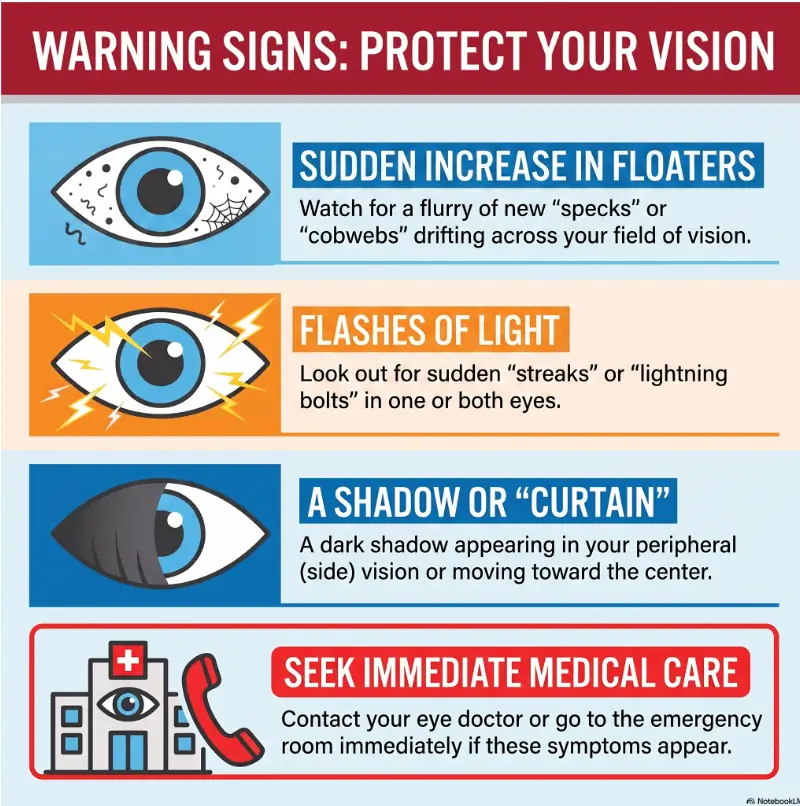
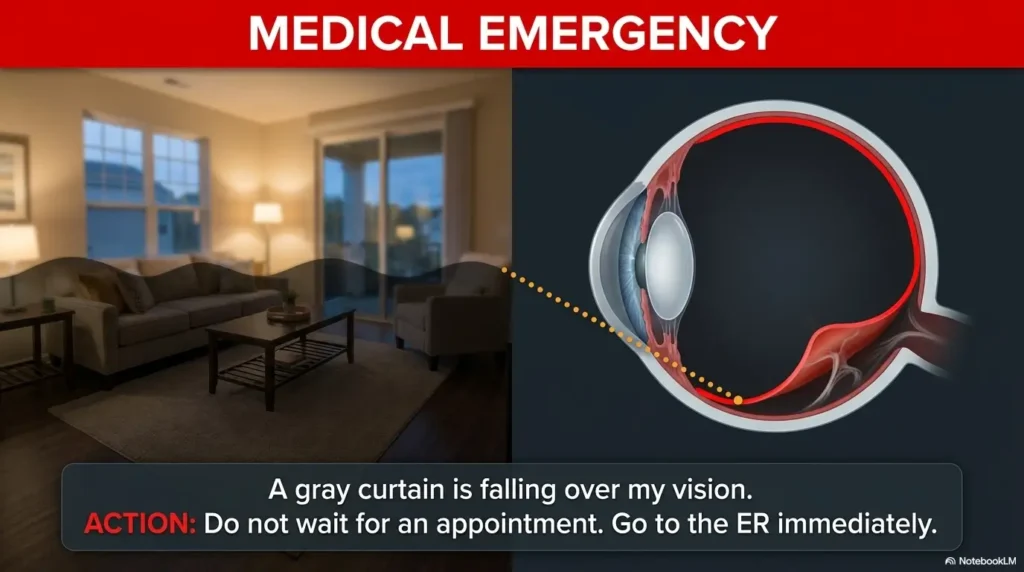
If you have sudden vision loss, a curtain or shadow over vision, new flashes, many new floaters, severe eye pain, eye trauma, new double vision, or vision changes with severe headache, weakness, trouble speaking, or numbness, seek urgent medical help. Do not use a blog article as your waiting room.
Use This as Appointment Prep, Not Self-Diagnosis
Your job before the visit is not to identify the disease. Your job is to preserve the clues.
Eye doctors are trained to sort vague symptoms into useful exam decisions. A careful note about timing, affected eye, pattern, and warning signs can help them decide what to check, what to dilate, what to image, and how urgently to respond.
Routine Visit and Urgent Care Are Not the Same Door
A routine eye exam is useful for gradual prescription changes, stable near-vision trouble, mild dryness, and glasses questions. A same-day call or urgent evaluation is more appropriate for sudden or severe symptoms.
When in doubt, call the eye clinic and describe the symptom plainly. Ask, “Should this be seen today?” That one sentence can save you from politely booking the wrong kind of appointment.
Key takeaway
You do not need perfect medical language. You need accurate ordinary details: what changed, which eye, when it started, how long it lasts, and whether urgent warning signs are present.
The five-clue vision note
1. Eye
Left, right, or both
2. Symptom
Blurry, wavy, dim, double, shadowed
3. Timing
Sudden, gradual, constant, recurring
4. Triggers
Screens, contacts, driving, blinking, light
5. Red flags
Pain, flashes, floaters, curtain, double vision
The First Sentence Your Eye Doctor Needs
The best first sentence is not your full medical history. It is the headline of the change.
Think of it as the opening line of a detective report: short, specific, and pointed toward the clue that matters.
Copy this sentence
“I noticed [symptom] in [left eye/right eye/both eyes] starting [time/date], and it has been [constant/intermittent/worsening].”
Start With the Change, Not the Backstory
Backstory has a place. The first breath should still go to the change.
Instead of starting with “I’ve always had bad eyes,” try, “My right eye became hazy yesterday afternoon and has not cleared.” That gives the doctor a useful triage signal before the conversation wanders into old prescriptions, family stories, and the tragic drawer where unused glasses go to retire.
Name the Eye Like a Witness
“My vision changed” is too broad. “My left eye changed” is sharper.
One-eye symptoms and both-eye symptoms can point the exam in different directions. If you are not sure which eye is affected, cover one eye at a time in a safe setting and look at the same object. Do not test while driving, walking, or climbing stairs.
The Tiny Detail That Changes Everything
Say whether the change was sudden, gradual, recurring, or linked to a specific event.
Useful triggers include an eye injury, new medication, recent surgery, new contact lenses, overwearing contacts, a migraine pattern, blood sugar changes, a long screen day, or waking up with symptoms.
| If you say this | Make it more useful by adding |
|---|---|
| “My vision is blurry.” | “It is blurry in my right eye when reading, and it clears after blinking.” |
| “I see spots.” | “They move when my eye moves, and I first noticed several new ones this morning.” |
| “Lights bother me.” | “Headlights have halos at night, worse in both eyes, especially after contact lens wear.” |
| “I see double.” | “The double image goes away when I cover one eye.” |
Describe the Symptom Without Saying Only “Blurry”
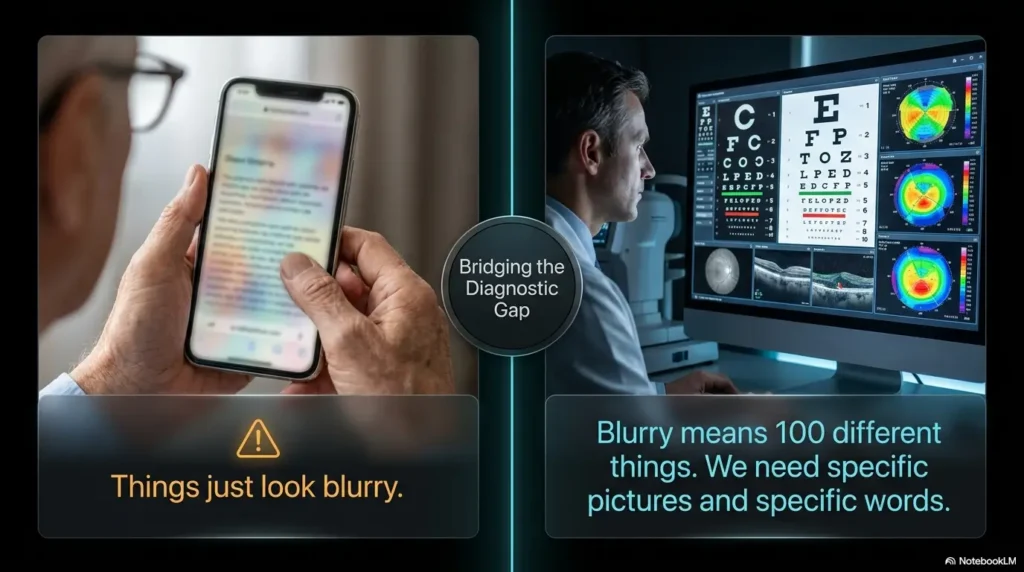
“Blurry” is a bucket. The doctor needs to know what kind of blur fell into it.
Two people can use the same word for completely different experiences. One means letters smear after laptop work. Another means the center of the page looks warped. Another means everything looks dim, as if the room turned down its own volume.
“Blurry” Needs a Last Name
Give blurry vision a last name: blurry at night, blurry in one eye, blurry up close, blurry after screens, blurry with glare, blurry that clears after blinking, or blurry with pain.
That small addition can separate dry eye patterns, glasses issues, contact lens problems, neurologic symptoms, retinal concerns, or corneal irritation. It does not diagnose the cause, but it gives the exam a compass.
Use Shape, Texture, and Light Words
Try describing the visual texture. Is it cloudy, smeared, doubled, wavy, dim, shadowed, tunnel-like, patchy, shimmering, glittery, glare-heavy, or hard to focus?
If you struggle to find the word, compare it to a familiar scene: looking through a dirty windshield, steamed glass, a wet camera lens, a folded page, or a dim hallway. Plain comparisons are welcome. The eye clinic is not grading your poetry.
Where the Problem Shows Up First
Say whether the change affects distance, reading, screens, night driving, bright rooms, dim restaurants, grocery labels, stairs, faces, subtitles, or phone text.
This is especially helpful for older adults and caregivers. “Dad can read large TV subtitles but cannot read medication labels anymore” is more useful than “his eyes are worse.”
Key takeaway
Do not stop at “blurry.” Add where, when, and what it looks like: “blurry after screens,” “wavy in the center,” “dim in one eye,” or “halos around headlights.”
Short Story: Margaret and the Menu
Margaret told her daughter, “My glasses stopped working.” That was the whole report. Neat, ordinary, and not very helpful.
At lunch, her daughter noticed something else. Margaret could read the big sign across the restaurant, but the menu looked gray and slippery. She tilted it toward the window, then away from the window. She closed one eye. Then she gave up and ordered soup.
Before the appointment, they wrote three lines: “Reading is harder than distance. Glossy menus are worse. Better with brighter side light, not overhead glare.”
The visit became calmer. The doctor still needed to examine her eyes, but the symptom was no longer a fog. It had edges. A small note turned a vague complaint into a usable trail.
The Timeline Clue Most People Forget
Timing is one of the most important details in an eye appointment. It is also the first thing memory smudges.
Write the timeline down before the visit. Not a novel. A timestamp with a few honest words is enough.
When Did It Start, Exactly?
Use the closest accurate version: “this morning,” “three days ago,” “after work yesterday,” “after changing contact lens solution,” or “right after I bumped my eye.”
If you cannot remember the exact day, anchor it to something ordinary. “The day after the long drive,” “during Sunday church,” or “after I started the new allergy medicine” can still help.
Better, Worse, or Just Different?
Tell the doctor whether the symptom is stable, improving, worsening, or changing character.
“It was a few floaters last week, but today there are many more” is different from “I have had the same small floater for years.” “Night glare has slowly worsened over months” is different from “one eye went dim during breakfast.”
The 24-Hour Movie Reel
Run through a normal day and notice when the symptom appears.
- Worse when you wake up?
- Worse after reading or laptop work?
- Worse after wearing contacts for several hours?
- Worse while driving at night?
- Worse after exercise, bending, coughing, or headache?
- Better after blinking, artificial tears, rest, or removing contacts?
Patterns do not prove a cause. They do help the doctor ask better questions.
| Timeline pattern | How to say it in the exam room | Why it helps |
|---|---|---|
| Sudden | “It started all at once around 8 a.m.” | May change urgency and exam priorities. |
| Gradual | “It has slowly worsened over about six months.” | Helps separate long-term changes from acute symptoms. |
| Intermittent | “It comes and goes, usually after two hours of computer work.” | Shows pattern, triggers, and duration. |
| Progressive | “It began mildly, but I notice it more each day.” | Signals that follow-up timing may matter. |
| Event-linked | “It began after I slept in my contacts.” | Points to habits or exposures worth discussing. |
Red Flags: Do Not Wait on These Vision Symptoms
Some symptoms deserve faster care than a routine appointment. Calmly naming them is not fearmongering. It is traffic control.
If a symptom is sudden, severe, one-sided, linked to injury, or paired with neurologic symptoms, call an eye specialist or seek urgent medical care. When a clinic asks what is happening, use the direct words below.
Sudden Vision Loss or a Dark Curtain
A curtain, veil, dark shadow, missing side vision, or sudden vision loss should not be saved for a routine exam. Use those words when calling.
Say, “I have a curtain-like shadow in my vision,” or “I suddenly lost part of my vision in one eye.” It may feel dramatic, but it is clearer than “something is off.”
New Flashes or a Shower of Floaters
Floaters can be common, especially with age, but a sudden increase in floaters, new flashes, or floaters with reduced vision deserves prompt attention.
Describe whether you see one new spot, many small specks, cobweb shapes, sparks, lightning streaks, or flashes in the side of vision.
Eye Pain, Double Vision, Severe Headache, or Trauma
Severe eye pain, a painful red eye, chemical exposure, eye trauma, sudden double vision, or vision changes with a severe headache should be treated seriously.
If double vision disappears when one eye is covered, mention that. If it remains even with one eye covered, mention that too. Do not try to interpret it yourself. Just report what happens.
Key takeaway
For urgent symptoms, do not soften your language. “Sudden vision loss,” “new flashes,” “many new floaters,” “curtain shadow,” “severe eye pain,” and “new double vision” are the words that help staff triage you correctly.
The Symptom Map: Location, Shape, and Movement
Your eye doctor may ask where the change appears in your vision. The answer does not need to be perfect. A rough map is better than a shrug.
Try describing the symptom like you are pointing to a spot on a window.
Center, Side, Top, Bottom, or Everywhere?
Say whether the change is central, peripheral, one-sided, patchy, top-field, bottom-field, or across everything.
Examples: “The center of words is missing,” “the right side seems dim,” “the top corner has a shadow,” or “everything looks hazy in both eyes.” These details help guide the exam even when you cannot name the condition.
Fixed Spot or Floating Shape?
A spot that moves when your eye moves feels different from a fixed missing area. Tell the doctor which one you notice.
Floaters often drift. A fixed blind spot or patch may feel anchored. A shimmering zigzag may expand or move. These are not diagnoses, but they are useful observations.
Wavy Lines, Halos, Shadows, Specks
Use concrete words: wavy lines, halos around lights, sparkles, cobwebs, smoke, gray patch, dark shadow, missing letters, glare, dimness, or washed-out color.
If straight lines look bent, mention that. If headlights bloom into rings, mention that. If you lose your place while reading because part of the word disappears, mention that too.
| What you notice | Helpful wording |
|---|---|
| Letters look bent | “Straight lines look wavy near the center.” |
| Lights have rings | “I see halos around headlights at night.” |
| Spots drift | “The specks float and move when I move my eye.” |
| One area is missing | “There is a fixed patch where letters disappear.” |
| Vision seems darker | “My right eye looks dimmer than my left.” |
| Side vision feels blocked | “There is a shadow on the edge of my vision.” |
Contacts, Medications, and Health Details That Change the Visit
Eye symptoms do not live in a sealed glass jar. Contact lens habits, medications, surgery history, and health conditions may matter.
This is where many appointments lose valuable time. People mention the blur but forget the new medication. They mention dryness but leave out that they slept in contacts. They mention glare but forget recent cataract surgery.
Contact Lens Habits to Say Out Loud
Be honest about contact lens wear. The exam room is not a courtroom. It is a repair shop for the truth.
- Do you sleep or nap in contacts?
- Do you wear them longer than recommended?
- Do you swim or shower in lenses?
- Do you reuse old solution?
- Did you recently switch brands, solution, or lens type?
- Do symptoms improve after removing lenses?
Bring the contact lens box or take a clear photo of the label. Brand, material, prescription, base curve, diameter, and replacement schedule can all matter.
Medications, Drops, and Supplements
Bring a medication list that includes prescription drugs, over-the-counter medicines, eye drops, allergy medicines, sleep aids, supplements, and recent changes.
Do not assume a medication is irrelevant because it is “not for the eyes.” Some systemic medications can affect dryness, focusing, pressure risk, dizziness, or visual symptoms. Your doctor can decide what matters.
Health Conditions That Belong in the Note
Mention diabetes, high blood pressure, autoimmune disease, migraine history, stroke history, pregnancy, recent infection, recent surgery, cancer treatment, eye injury, glaucoma, macular degeneration, retinal disease, and family history of serious eye disease.
For caregivers, this is where a one-page medication list can save the day. If your parent cannot remember names or doses, bring the list or a photo of the bottles.
Show me the nerdy details
Eye doctors often sort symptoms by pattern: monocular or binocular, sudden or gradual, painful or painless, central or peripheral, constant or intermittent, linked or unlinked to triggers. Those categories help guide whether the issue may involve the ocular surface, cornea, lens, retina, optic nerve, eye alignment, medication effects, migraine pattern, or a broader medical concern. You do not need to know those categories before the visit. But when you report the raw facts clearly, you give the clinician better ingredients to work with.
What to Bring, What to Track, and What May Cost Extra
A good eye appointment is part conversation, part exam, part evidence gathering. The evidence does not need to be fancy.
Bring the objects that show how your eyes actually live: glasses, contacts, drops, medication list, symptom note, and any relevant photos or screenshots.
Bring Every Pair You Actually Use
Bring distance glasses, reading glasses, computer glasses, sunglasses, backup pairs, and the cheap readers hiding in the car console if you use them often.
Old glasses can help the doctor compare prescriptions and habits. They can also reveal a practical mismatch: maybe your desk setup, reading distance, or progressive lens zone is fighting you more than your eyes are.
Screenshots Can Help, But Do Not Over-Perform
A phone photo of redness, swelling, discharge, eyelid change, or a medication label can help. A symptom note can help more.
You do not need to arrive with a courtroom exhibit, a binder, and the emotional energy of a tax audit. Bring simple proof where useful. Focus on clarity.
Free vs Paid Tools and Services: What Is Worth Considering?
Most symptom preparation is free. Your phone’s Notes app, calendar, camera, and medication list are enough for many people.
Paid help may be worth considering when vision changes affect medication safety, driving, reading, fall risk, work tasks, or daily independence. That might mean a low-vision evaluation, occupational therapy referral, magnification tools, prescription updates, specialty lenses, dry eye treatment, or additional testing. Ask what is medically necessary, what is optional, and what insurance may or may not cover.
| Option | Best for | Budget note | What to ask before paying |
|---|---|---|---|
| Free symptom note | Any appointment | No cost | “What should I track after today?” |
| Basic glasses or contact lens review | Blur tied to reading, screens, distance, or lens wear | Costs vary by exam type and coverage | “Is this a prescription issue, an eye health issue, or both?” |
| Additional imaging or testing | New, worsening, or unexplained symptoms | Ask about medical vs routine billing | “Why is this test recommended, and what decision will it help make?” |
| Low-vision or occupational therapy support | Daily tasks affected by vision loss | Coverage and referral rules vary | “Which home tasks should we prioritize first?” |
| Assistive devices or premium lenses | Glare, reading, work tasks, hobbies, or mobility challenges | Compare return policies and trial periods | “Can I test this in the situation where I actually struggle?” |
Money-smart appointment tip
Before agreeing to extra services, ask what problem the test or product is meant to solve, whether it is urgent or optional, whether insurance may treat it as medical or routine, and whether there is a simpler first step.
The Doctor-Friendly Script You Can Use in the Room
When you are nervous, scripts are kindness in advance. They keep the important details from slipping behind the furniture.
Use the short version if your symptom is simple. Use the longer version if you have multiple symptoms, medical conditions, medications, recent surgery, or contact lens habits that may matter.
The 30-Second Version
Say this
“I’m here because my vision changed in [eye]. It started [when]. It feels like [description]. It happens [frequency], lasts [duration], and is worse with [trigger]. I’m also noticing [red flags or none].”
Example: “I’m here because my right eye became cloudy two days ago. It is constant, worse when reading, and does not clear after blinking. I do not have pain, flashes, or new floaters.”
Another example: “I started seeing several new floaters and flashes in my left eye this morning. I also notice a shadow on the side of my vision.” That one should be treated as urgent language when calling.
The Longer Version for Complex Symptoms
Add recent illness, injury, surgery, medication changes, contact lens use, diabetes, headaches, pregnancy, family history, or previous eye disease.
Example: “This started after I wore contacts for 14 hours two days in a row. My left eye is red and light-sensitive. I used lubricating drops, but it still hurts.”
That short history gives the doctor a tighter starting point than “contacts bother me sometimes.”
What If You Forget Half of It?
You might. That is normal.
Write the script in your Notes app and hand the phone to the technician or doctor if needed. If you are helping a parent, print the note in large type or keep it on one page.
Key takeaway
A short, imperfect note beats a perfect memory that vanishes the moment someone asks, “So what brings you in today?”
Questions to Ask Before You Leave
The end of an appointment can feel like an airport gate: papers, instructions, bright lights, and suddenly everyone is moving.
Before you leave, slow the scene down. Ask the questions that turn the exam into a plan.
“What Do You Think Is Most Likely Causing This?”
Ask for a plain-language explanation. You are not asking for a guarantee. You are asking for the working impression.
A useful answer should help you understand whether the concern appears related to prescription, dryness, contact lens wear, eye alignment, cataract changes, retina, optic nerve, migraine pattern, or something that needs another medical evaluation.
“What Symptoms Mean I Should Call Urgently?”
Do not leave with only “call if it gets worse.” Ask what “worse” means for your situation.
Try: “If I notice more floaters, more flashes, pain, redness, or a change in side vision, what should I do and how fast?”
“What Should I Track After Today?”
Depending on the exam, you may be asked to track vision, pain, redness, floaters, flashes, headaches, blood sugar, blood pressure, screen time, contact lens wear, or response to drops.
Ask for specific instructions. “Track symptoms” is a cloud. “Write down whether flashes increase and call if you see a curtain shadow” is an umbrella.
“When Should I Follow Up?”
Ask for a timeframe, not just a feeling.
Examples: “Should I come back in two weeks, six months, or only if symptoms change?” and “If I start the drops today, when should I expect to know whether they help?”
| Question | Why it matters | Good follow-up phrase |
|---|---|---|
| What is most likely causing this? | Clarifies the working explanation. | “Can you say that in plain English?” |
| What warning signs should I watch for? | Prevents vague guessing later. | “Which symptoms mean same-day care?” |
| What should I track? | Turns worry into useful observation. | “How often should I write it down?” |
| When should I follow up? | Creates a clear next step. | “What date range is appropriate?” |
| What costs might not be covered? | Helps avoid surprise bills. | “Is this routine vision billing or medical billing?” |
When to Seek Help: Same Day, Prompt, or Routine
Not every symptom belongs in the emergency lane. Not every symptom belongs in the routine lane either.
Use the categories below as practical language for deciding what to ask when you call. When symptoms are sudden, severe, or unusual for you, err on the side of faster professional guidance.
Same Day or Emergency Care
- Sudden vision loss
- A curtain, veil, or shadow over vision
- Sudden flashes of light
- Many new floaters or a sudden shower of floaters
- Eye trauma or chemical exposure
- Severe eye pain or painful red eye
- New double vision
- Vision changes with severe headache, weakness, numbness, confusion, or trouble speaking
When calling, state the strongest symptom first. “I have sudden flashes and new floaters” is more useful than “I think I need an appointment.”
Prompt Appointment
- New blurry vision that persists
- Worsening night vision or new halos
- Persistent floaters without sudden increase
- Eye redness with discomfort
- Vision changes that interfere with driving, reading, work, or daily tasks
- New symptoms after starting a medication
- Contact lens discomfort that does not settle after removing lenses
Prompt does not always mean panic. It means the symptom deserves attention soon enough that you should not let the calendar drift.
Routine Visit
- Gradual prescription changes
- Mild dryness that improves with usual care
- Screen-related strain without red flags
- Stable near-vision problems
- Questions about reading glasses, computer glasses, or lighting
Routine symptoms still deserve clear notes. A routine appointment can be more useful when you arrive with examples, triggers, and the glasses you actually use.
FAQ
How do I describe blurry vision to an eye doctor?
Use specific words such as cloudy, smeared, doubled, hazy, dim, wavy, glare-sensitive, shadowed, or hard to focus. Then add when it happens: reading, distance, screens, night driving, bright light, or after contact lens wear.
Should I mention symptoms that come and go?
Yes. Intermittent symptoms still matter. Tell the doctor how often they happen, how long they last, what seems to trigger them, and whether they are becoming more frequent or intense.
Is it important to say which eye changed?
Yes. One-eye symptoms and both-eye symptoms can lead to different questions and exam priorities. If you are unsure, safely cover one eye at a time while looking at the same object and note what you observe.
Should I bring my old glasses?
Yes. Bring every pair you actually use, including distance glasses, readers, computer glasses, sunglasses, and backup pairs. Old glasses can help compare prescriptions and reveal real-life habits.
What if I only notice vision changes at night?
Mention night driving, halos, glare, dim rooms, headlights, and whether blinking or drops help. Night-only symptoms can still affect safety, especially for driving or stairs.
Should I tell the doctor about headaches?
Yes. Mention headaches, migraine history, nausea, light sensitivity, severe headache, and any neurologic symptoms such as weakness, numbness, confusion, or trouble speaking. Sudden or severe combinations deserve urgent medical attention.
Can screen time cause vision changes?
Screen time can contribute to eye strain or dryness for some people, but do not assume screens explain every new symptom. If the change is sudden, one-sided, painful, worsening, or paired with flashes, floaters, shadows, or double vision, seek professional guidance promptly.
What should I write down before the appointment?
Write down onset, affected eye, symptom type, duration, triggers, red flags, medications, eye history, contact lens habits, and your main question. Keep it short enough to read in under one minute.
Optional video: Open the video on YouTube (external site).
Your 15-Minute Next Step: Make a One-Minute Vision Note
The best next step is beautifully unglamorous: write the note now.
Do not wait until you are in the exam room with dilating drops, a chin rest, and a nervous brain humming like an old refrigerator. Use the template below and fill in what you know.
Copy this before your appointment
Vision change:
Eye affected:
Started:
Feels like:
Constant or comes and goes:
Triggers:
Pain, redness, headache:
Flashes, floaters, shadow:
Glasses, contacts, drops used:
Medical conditions and medications:
My main question:
For a routine visit, this note makes the appointment more useful. For a concerning symptom, it helps you call with the right words. For a caregiver, it turns scattered observations into a single page the clinic can understand.
Here is the quiet truth: you do not have to be the perfect patient. You only have to bring the clue before it gets lost.
Last reviewed: 2026-08
PUT THIS GUIDE TO WORK · INTERACTIVE WORKSHEET
Turn vision changes into an appointment note
Use this worksheet alongside the article: How to Explain Vision Changes to an Eye Doctor Without Forgetting the Clue That Matters. Use the fields provided to organize your notes and next actions, then save your worksheet.
Your entries stay in this page and are cleared when you reload. No account is needed. Saved files are downloaded only to your device.
This card organizes a discussion or task. It does not provide diagnosis, treatment, medication timing, driving clearance, or professional approval. Copy clinical instructions exactly and ask the professional about uncertainty.
How to use your result
Save the worksheet before leaving this page. Recheck any quote, date, or instruction with the relevant provider, pharmacist, manufacturer, or official organization. A completed checklist means you recorded the steps, not that an outcome is guaranteed.
Worksheet added October 20, 2026. Read the article above for context and its stated review scope.