

Organize your questions and next steps, then save your worksheet.
Summary and next steps
Medicare Advantage vision benefits vary by plan. See how exams, glasses, contacts, networks and medical eye care may be covered before you pay a bill.
Editorial maintenance: October 24, 2026. Summary layout, related links and technical metadata updated. This is not a full clinical review.

Medicare Advantage Vision Benefits Explained:
What Your Plan May Cover Before You Pay
A Medicare Advantage card that says “vision” does not automatically mean every eye exam, pair of glasses, lens upgrade, or eye specialist visit is free. The benefit may contain several separate pieces, each with its own network, frequency, copay, allowance, and billing rules.
The most useful question is not simply, “Do I have vision coverage?” It is, “Is this routine vision care, eyewear, or medically necessary eye care?” Those categories can be paid under different parts of the same Medicare Advantage plan.
This guide shows you how to separate those benefits, verify your real out-of-pocket cost before an appointment, and decide whether a stronger vision benefit is actually worth prioritizing when comparing plans.
The best first step costs nothing: verify the benefit before the eye exam or eyewear order. 👓
Snapshot
This guide is for Medicare Advantage members, people comparing plans, and family members helping with eye-care bills. You will learn what “vision benefits” can mean, how they differ from Medicare-covered medical eye care, and how to verify the provider, exam, glasses, and expected cost before spending money.
Table of Contents
Medicare Advantage Vision Benefits in 30 Seconds
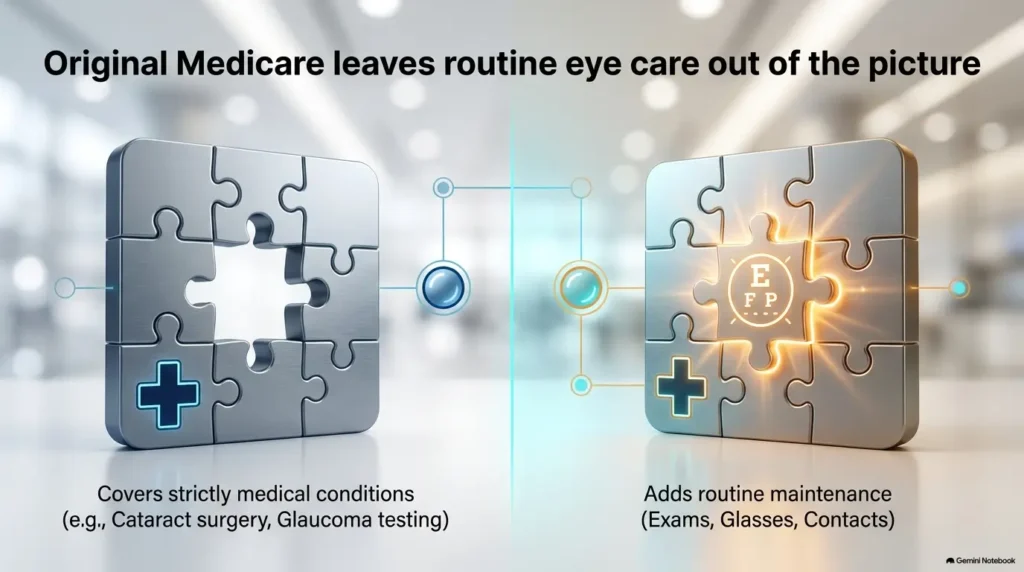
Medicare Advantage plans must cover the medically necessary services that Original Medicare covers, and many plans also offer extra benefits that Original Medicare does not routinely cover, including vision services. Routine eye exams for prescription glasses are generally not covered by Original Medicare, which is why a Medicare Advantage routine-vision benefit can be valuable.
But there is no single nationwide Medicare Advantage vision package. Your plan decides the details of its supplemental benefit.
- A routine eye exam may be covered on the plan’s schedule.
- Refraction may be included, separately charged, or subject to specific benefit rules.
- Frames or lenses may receive an allowance, copay, discount, or other plan-defined benefit.
- Contacts may be covered differently from glasses.
- Lens upgrades can produce additional charges even when basic eyewear is covered.
- You may need to use a participating vision provider or eyewear retailer.
- Medically necessary treatment for cataracts, glaucoma, retinal disease, or other eye conditions belongs in a different coverage category.
Key takeaway
Do not ask only whether your Medicare Advantage plan has “vision.” Ask what it covers for the exam, the refraction, the frames, the lenses, and the provider you intend to use.
Before You Act
This article can help you interpret common Medicare vision-benefit structures, but it cannot determine your personal coverage. Your plan determines supplemental benefits and payment rules; an eye-care professional determines what examination or treatment is medically appropriate. Confirm benefits with your plan and provider before relying on a quoted cost.
Routine Vision vs. Medically Necessary Eye Care: The Distinction That Prevents Billing Surprises
A single appointment at an eye clinic can contain services from more than one coverage bucket. That is the source of a remarkable amount of confusion.
Bucket 1: Routine vision
Routine vision generally concerns checking vision and obtaining or updating a prescription for glasses or contacts. Original Medicare does not generally cover routine eye exams for eyeglasses or contact lenses. Some Medicare Advantage plans fill that gap with an extra vision benefit.
If the confusing line on your bill says “refraction,” read our guide to the Medicare refraction fee and why it may be billed separately.
Bucket 2: Eyewear
This can include frames, basic lenses, contact lenses, or an allowance toward eligible eyewear. The exact mechanism matters. An allowance is not necessarily the same thing as “free glasses.”
A frame may fit inside the plan benefit while premium lens materials, coatings, specialty designs, or other upgrades create an additional balance.
Bucket 3: Medical eye care
If you are being evaluated or treated for an eye disease, injury, cataract, diabetic eye disease, macular degeneration, or another medical problem, the visit may fall under the plan’s Medicare Part B medical coverage rather than its routine vision allowance.
Medicare Advantage plans must provide at least the Medicare-covered medical services required under Parts A and B, although network, referral, authorization, and cost-sharing rules may differ from Original Medicare.
| What you are getting | Likely coverage bucket | What to verify |
|---|---|---|
| Routine vision check and glasses prescription | Supplemental vision benefit | Exam frequency, copay, refraction, network |
| Frames or lenses | Supplemental eyewear benefit | Allowance, eligible retailers, upgrades, frequency |
| Eye disease evaluation | Medical benefit | Specialist network, copay, referral, authorization |
| Covered cataract-related eyewear | Medicare Part B benefit administered through the MA plan | Supplier rules, standard coverage, upgrade charges |
Which benefit bucket are you using?
Check supplemental vision rules, frequency and refraction.
Check allowance, retailer network and upgrade charges.
Check the medical benefit, specialist network and authorization rules.
What Medicare Advantage Vision Benefits May Include
The word “vision” can hide several separate benefits. When reading a Summary of Benefits or Evidence of Coverage, look for each component individually.
Routine eye examinations
A plan may offer routine eye examinations that Original Medicare would not normally cover. Check how often you can use the benefit and whether the exam must be performed through a specific vision network.
Refraction
Refraction determines the prescription used for corrective lenses. Do not assume that paying an eye-exam copay automatically makes every part of the appointment covered.
Before the visit, ask the clinic, “Does my plan’s routine vision benefit include refraction, and will I owe a separate charge?” That twelve-second question can be more useful than twenty minutes spent decoding the receipt afterward.
Frames, lenses, and contact lenses
Plans may provide a defined eyewear benefit, but the structure varies. It may work through an allowance, fixed copay, covered selection, discount arrangement, or some combination of these.
- How often can I receive new frames?
- How often can I receive new lenses?
- Do contacts use the same benefit as glasses?
- Does choosing contacts eliminate or reduce the glasses benefit for that period?
- Which retailers or optical offices are eligible?
- Are online eyewear purchases eligible?
- What happens if the total exceeds the allowance?
- Do unused benefits carry forward? Do not assume they do.
Key takeaway
A strong-looking eyewear allowance can be weak in practice if your preferred eye doctor or optical shop is outside the network, or if the lenses you actually need carry substantial upgrade charges.
The 10-Minute Medicare Advantage Vision Benefit Check
You usually do not need a broker, spreadsheet, or magnifying glass worthy of Sherlock Holmes to answer the immediate question. Start with your member card and plan documents.
Step 1: Write down exactly what you need
- Routine eye exam?
- Refraction?
- New frames?
- New lenses?
- Contact lenses?
- Medical evaluation of an eye problem?
This prevents the plan representative from answering “yes, you have vision coverage” when you actually need to know whether a particular pair of progressive lenses is covered.
Step 2: Find the Evidence of Coverage
The Evidence of Coverage, or EOC, is the detailed plan document explaining what your plan covers and what you may pay. Medicare says plans provide an EOC each year, generally around the fall enrollment cycle.
See Medicare’s explanation of the Evidence of Coverage.
Search the document for terms such as vision, routine eye exam, eyewear, lenses, frames, contacts, refraction, supplemental benefits, and network.
Step 3: Call both the plan and the provider
Ask the plan:
- Is this provider currently in network for my routine vision benefit?
- What routine exam benefit do I have?
- Is refraction included?
- What eyewear benefit remains available to me right now?
- When does my benefit reset?
- Are contacts and glasses separate benefits or alternatives?
- Does the optical retailer need to submit the claim directly?
- Are there restrictions on where I buy the glasses?
Then call the eye clinic or optical shop and ask whether it participates in your exact Medicare Advantage plan and vision network. Give the complete plan name from the card, not merely the insurance company’s name.
Before-You-Call Checklist
Have these five things in front of you:
- Medicare Advantage member card
- Provider or optical shop name
- Exact service you need
- Evidence of Coverage or member portal
- Pen and paper for a reference number and representative’s name
If reading insurance documents is itself becoming the obstacle, the guide to organizing and reading Medicare notices can make the paper trail easier to manage.
Match the benefit document to the year and plan actually covering the order. Medicare explains that the annual Evidence of Coverage details benefits and member costs. A 2027 brochure is not proof of your remaining 2026 allowance, and a 2026 receipt does not establish next year’s benefit. Record the exact plan, coverage dates, document year, remaining allowance, and reset rule.
If you order eyewear near year-end, ask the plan which event counts as using the benefit—such as the order, dispensing, or another plan-defined date. Confirm that date before choosing a seller or assuming an unused allowance will apply after a plan change. Do not infer the rule from when the credit-card charge appears.
Why “Covered” Can Still Cost Money
Coverage is not a synonym for zero cost. A service can be covered while still requiring a copay, coinsurance, payment above an allowance, or an upgrade charge.
| What the plan says | What it may mean in practice | Question to ask |
|---|---|---|
| Routine exam covered | You may still have a copay or network requirement | What is my exact cost at this provider? |
| Eyewear allowance | The plan pays up to its defined benefit under its rules | What happens above the allowance? |
| Frames covered | Only certain frames or benefit amounts may qualify | Which frames qualify without extra cost? |
| Lenses covered | Basic lenses may differ from optional upgrades | Which lens features create an added charge? |
| Out-of-network benefit | Reimbursement or cost-sharing may differ | Must I submit a claim myself? |
The provider network can matter as much as the allowance
A generous eyewear benefit at a provider you cannot conveniently use may be less valuable than a smaller benefit accepted by the eye clinic and optical shop you already trust.
This is especially important with Medicare Advantage because plans may use provider networks and may require approval for some services. Medicare advises beneficiaries to check provider and plan rules when comparing Original Medicare and Medicare Advantage.
The exam and the glasses may run through different systems
Do not be surprised if the medical office recognizes the Medicare Advantage plan but the attached optical department participates through a separate vision network. Verify both parts.
Show me the nerdy details
Medicare Advantage combines two different ideas that are easy to blur together. First, the plan administers Medicare-covered Part A and Part B services. Second, it may add supplemental benefits that Original Medicare does not normally cover, such as routine vision.
That distinction affects billing. A medically necessary ophthalmology service may be processed under the plan’s medical benefit, while a routine refraction or pair of glasses may be processed under a supplemental vision arrangement. The same person, clinic, and day can therefore produce services governed by different benefit rules.
When reviewing a bill, identify the service first and the coverage bucket second. Starting with the dollar amount is often backwards.
Before Paying for Glasses or Contacts, Run This Free Check
Eyewear is where a useful insurance benefit can quietly turn into a surprisingly large retail purchase. The free fix is simple: separate what improves vision from what merely upgrades the product.
Ask for a basic covered configuration first
Before discussing premium options, ask the optical staff what the glasses would cost using only the plan-covered or allowance-eligible configuration that meets the prescription.
Then add optional features one by one. That gives you a clean baseline.
- Frame upgrade
- Lens material upgrade
- Progressive or specialty lens design
- Photochromic treatment
- Coatings
- Other optional lens features
Some upgrades may be useful for a particular prescription or daily task, while others may be preference-driven. Ask the eye-care professional which features are clinically relevant and ask the optical seller which charges are optional.
Money check
Before agreeing to an eyewear total, ask for three numbers: retail price, plan benefit applied, and your final amount due. Then ask which part of the balance comes from optional upgrades. For a hypothetical eligible order totaling $420 with a confirmed $200 plan benefit applied and no other adjustments, your balance is $220. If $80 of upgrades is already included in that $420 total, do not add the $80 a second time. Ask the seller to show the itemized total and actual benefit applied; these figures are an example, not an advertised allowance or a quote for your plan.
Do not accidentally use the wrong benefit
If you recently had cataract surgery, stop before automatically using a routine eyewear allowance. Medicare Part B has a specific benefit for certain corrective lenses following covered cataract surgery that implants an intraocular lens. Medicare states that Part B covers one pair of eyeglasses with standard frames, or one set of contact lenses, after each such cataract surgery.
For the practical details, see the Medicare cataract surgery glasses rule before ordering post-surgery eyewear.
When the Vision Benefit Still Does Not Work
If you verified that the plan includes vision coverage but the benefit is not being applied as expected, identify the failure mode before paying the bill and hoping to untangle it later.
What went wrong?
If the provider says you are not covered
→ Confirm the exact plan and vision network, then call the plan while you are still at the office if practical.
If the benefit was already used
→ Ask for the prior service date, benefit-reset date, and whether frames and lenses have separate frequencies.
If the eyewear costs far more than expected
→ Ask for a line-by-line distinction between covered/basic components and optional upgrades.
If the plan refuses coverage you believe should apply
→ Request the reason in writing and review the plan’s coverage-decision or appeal process.
If you disagree with a Medicare health plan’s coverage or payment decision, Medicare provides an appeal process.
Review Medicare’s official claims, appeals, and complaints guidance.
Keep the Explanation of Benefits, provider invoice, plan representative’s reference number, and the relevant EOC language together. Insurance disagreements become much easier to discuss when the facts are sitting on one page instead of scattered across three portals and a kitchen drawer.
How to Compare Medicare Advantage Vision Benefits Without Being Distracted by One Big Number
Vision coverage can be commercially attractive, but it should rarely be judged by an eyewear allowance alone. A plan that looks generous in an advertisement may fit poorly if your ophthalmologist is outside its medical network or your preferred optical shop cannot use the supplemental vision benefit.
Medicare Advantage plans can change coverage, costs, networks, and other terms from year to year. Medicare says members receive an Annual Notice of Change describing changes that take effect the following January, so recheck the benefit even if it worked perfectly this year.
| Comparison level | What to compare | Best fit | Watch out for |
|---|---|---|---|
| Basic | Routine exam access | Someone who mainly wants periodic vision checks | Ignoring refraction or provider-network rules |
| Stronger vision fit | Exam + usable eyewear benefit + convenient network | Regular glasses or contact users | Judging value only by the advertised allowance |
| Whole-plan fit | Vision plus medical network, prescriptions, premiums and other health costs | Anyone choosing between Medicare Advantage plans | Choosing a health plan mainly because the glasses benefit looks generous |
Five questions worth asking before choosing a plan
- Is my current ophthalmologist or optometrist in the appropriate network?
- Can I use my preferred optical retailer?
- How often can I use the routine exam and eyewear benefits?
- What lens or contact-lens costs would I realistically pay?
- Does the rest of the health plan still fit my doctors, medications, and expected medical care?
Key takeaway
Do not switch a comprehensive health plan to save a modest amount on glasses without comparing the medical network, drug coverage, total costs, and other benefits that matter more over the year.
You can also use Medicare’s official explanation of Original Medicare versus Medicare Advantage as a broader comparison framework.
Do Not Overlook Medicare-Covered Eye Care Beyond Routine Vision
One of the costliest misunderstandings is assuming that “Medicare does not cover eye exams” means Medicare never covers eye care. That is incorrect.
Routine exams for prescribing glasses are generally excluded from Original Medicare, but Part B covers or may cover certain eye-related examinations, testing, treatment, and post-cataract eyewear when Medicare’s requirements are met. Medicare Advantage plans must administer the corresponding Medicare-covered benefits, subject to the plan’s rules.
Diabetic retinopathy examinations
Medicare Part B covers an eye exam for diabetic retinopathy once a year for eligible people with diabetes, with applicable Part B cost sharing under Original Medicare. Medicare Advantage cost-sharing and network rules can differ.
If diabetes is the reason for the appointment, a routine-vision allowance is not the whole story. Our Medicare diabetic eye exam cost guide explains the distinction in more detail.
Glaucoma screening for eligible high-risk patients
Part B covers glaucoma screening once every 12 months for eligible people at high risk, including people who meet Medicare’s specified risk criteria. Applicable cost sharing can apply.
Macular degeneration tests and treatment
Part B may cover certain diagnostic tests and treatments for age-related macular degeneration, including certain injectable drugs when coverage requirements are met.
If your appointment concerns new distortion, central vision changes, sudden loss of vision, flashes, a sudden increase in floaters, eye injury, severe eye pain, or another concerning symptom, do not reduce the decision to whether you have a routine glasses benefit. Contact an appropriate eye-care professional promptly and let the clinical need determine the next step.
Three layers to keep separate
What you can do: verify the provider, benefit category, plan documents, and expected cost.
What the eye-care professional decides: what examination, diagnosis, monitoring, or treatment is medically appropriate.
What the plan decides: whether plan coverage requirements are met and what cost-sharing or supplemental benefit applies.

Frequently Asked Questions
Does every Medicare Advantage plan cover glasses?
No. Medicare Advantage plans may offer extra vision benefits, but the specific benefit varies by plan. Verify frames, lenses, contacts, frequency, allowance or copay, and provider-network rules in your own plan documents.
Is a routine eye exam automatically free with Medicare Advantage?
Not necessarily. A plan may cover a routine exam while still applying a copay, frequency limit, network requirement, or separate rule for refraction. Ask for the exact member cost before the appointment.
Can I buy glasses anywhere and use my Medicare Advantage vision allowance?
Do not assume so. Some benefits are tied to participating providers, optical retailers, claims procedures, or reimbursement rules. Confirm the seller’s eligibility before ordering, especially when purchasing eyewear online or outside the plan’s usual network.
Does Medicare Advantage cover eye disease treatment?
Medicare Advantage plans must cover medically necessary services that Original Medicare covers. Eye-disease evaluation and treatment may therefore fall under the plan’s medical benefit rather than its supplemental routine-vision benefit. Plan networks, referrals, authorization requirements, and cost sharing can apply.
Why did the eye doctor charge me for refraction?
Original Medicare generally does not cover routine refraction for prescribing glasses. A Medicare Advantage supplemental vision benefit may cover it differently. Ask whether the charge was submitted under your routine vision benefit and whether the provider participates in that benefit’s network.
What if my Medicare Advantage plan denies a vision service I thought was covered?
First verify the service code or description, provider network, benefit frequency, and whether the claim was submitted under the correct benefit. If you still disagree with the plan’s coverage or payment decision, request the reason and follow the plan’s appeal instructions.
Should I choose a Medicare Advantage plan mainly for its vision allowance?
Usually, vision should be one part of the comparison rather than the deciding factor. Also compare your doctors, hospitals, prescriptions, medical cost sharing, plan premium, authorization rules, and other benefits you are likely to use.
Optional video: Open the video on YouTube (external site).
Your Next 15 Minutes: Verify the Benefit Before the Next Eye-Care Bill
Take out your Medicare Advantage card and write one sentence describing what you need: “routine exam and new glasses,” “contact lens exam,” “glasses after cataract surgery,” or “medical evaluation for an eye condition.”
- Open your Evidence of Coverage or member portal.
- Search for vision, eyewear, refraction, frames, lenses, and contacts.
- Write down the benefit frequency and any copay or allowance.
- Confirm your eye doctor and optical seller are eligible for that benefit.
- Ask what you will owe before services or eyewear are provided.
- Record the representative’s name and confirmation number when available.
For the appointment itself, the eye doctor visit checklist for seniors can help organize symptoms, questions, medications, and practical concerns before you leave home.
The decision rule worth keeping
First identify what service you are receiving. Then identify which coverage bucket pays for it. Only after that should you decide whether the remaining price is worth paying.
Last reviewed: 2026-09
Targeted review: October 17, 2026. The addition checks benefit-year documents, order timing, and the hypothetical eyewear arithmetic below. Other sections retain their stated review scope.
PUT THIS GUIDE TO WORK · INTERACTIVE WORKSHEET
Vision benefit comparison worksheet
Use this worksheet alongside the article: Medicare Advantage Vision Benefits Explained: What Your Plan May Cover Before You Pay. Use the fields provided to organize your notes and next actions, then save your worksheet.
Your entries stay in this page and are cleared when you reload. No account is needed. Saved files are downloaded only to your device.
How to use your result
Save the worksheet before leaving this page. Recheck any quote, date, or instruction with the relevant provider, pharmacist, manufacturer, or official organization. A completed checklist means you recorded the steps, not that an outcome is guaranteed.
Worksheet added October 20, 2026. Read the article above for context and its stated review scope.