
Organize your questions and next steps, then save your worksheet.
Summary and next steps
Medicare OCT eye test coverage depends on medical necessity. See when Part B may pay, what you could owe, and what to check before your scan.
Editorial maintenance: October 24, 2026. Summary layout, related links and technical metadata updated. This is not a full clinical review.
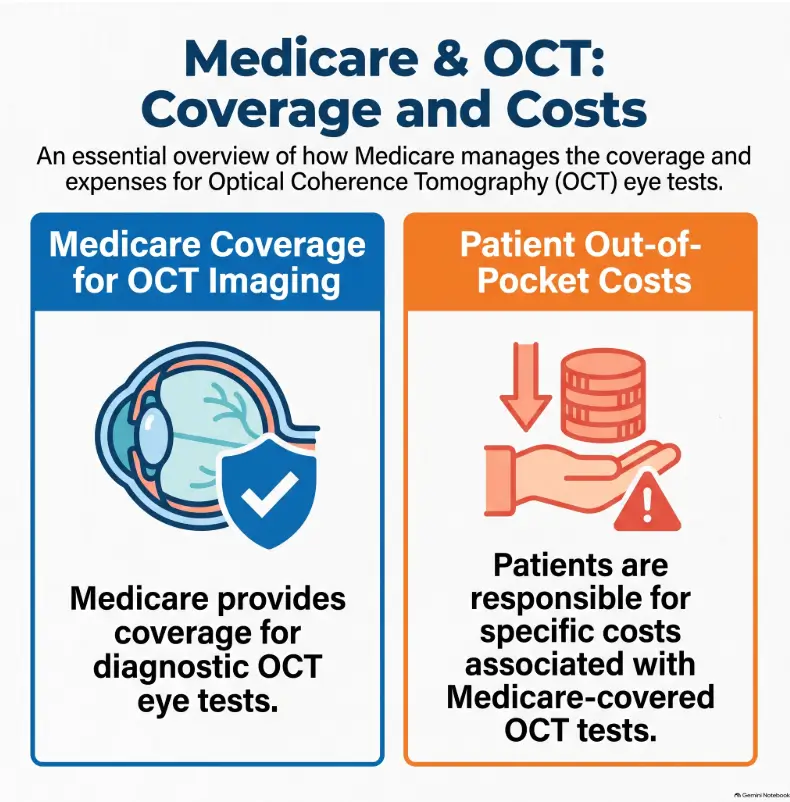
Yes, Medicare Part B can cover an OCT eye test when it is medically necessary to diagnose, evaluate, or monitor an eye condition. Coverage is not automatic simply because an eye doctor recommends an OCT scan. The key question is why the test is being performed. OCT used to monitor macular degeneration, retinal disease, glaucoma, or another documented medical problem may qualify, while an OCT performed only as routine screening may not.
Before the scan, ask the eye clinic what diagnosis is supporting the OCT and whether it expects Medicare to cover the test. If you have Original Medicare, also ask whether the clinic accepts Medicare assignment and whether it expects you to receive an Advance Beneficiary Notice if coverage is uncertain.
Table of Contents
When Medicare Covers an OCT Eye Test
Medicare generally treats a medically necessary OCT as a diagnostic service rather than ordinary vision care. Part B covers medically necessary services used to diagnose or treat medical conditions, and Medicare specifically covers diagnostic non-laboratory testing when a provider orders it to investigate or manage a medical problem. Medicare’s diagnostic testing rules explain the general Part B cost-sharing framework.
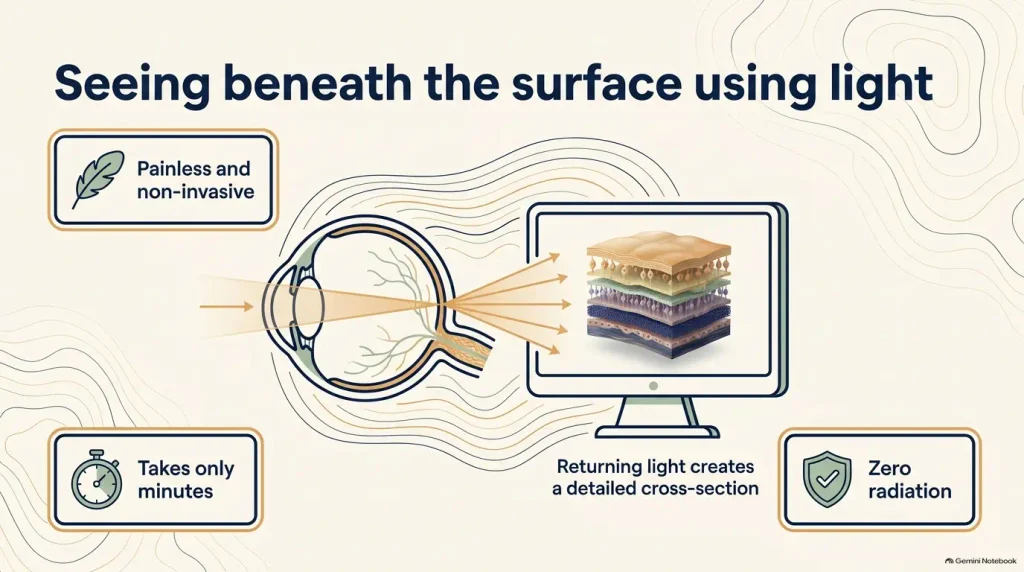
OCT, short for optical coherence tomography, creates detailed cross-sectional images of structures inside the eye. Depending on the type of scan, an ophthalmologist or optometrist may use it to evaluate the retina, macula, optic nerve, or other structures.
| Why the OCT is being done | Medicare position | What matters most |
|---|---|---|
| Monitoring diagnosed macular degeneration | May be covered | Medical necessity and documentation |
| Evaluating retinal swelling or another retinal disorder | May be covered | Diagnosis and reason for the scan |
| Monitoring glaucoma or a glaucoma suspect | May be covered | Clinical indication and local coverage rules |
| Investigating a new medically significant eye finding | May be covered | Provider documentation |
| Routine scan with no medical indication | May not be covered | Whether the service is medically necessary |
| Optional screening added to a routine vision visit | Often patient-paid if no covered indication exists | Why the test was ordered |
This distinction matters because Original Medicare does not cover routine eye exams for eyeglasses or contact lenses. A medical eye service can be covered even though routine vision care is not, but the claim needs a covered medical reason.
The Name “OCT” Alone Does Not Determine Coverage
One source of confusion is that patients may hear several versions of the same general term: retinal OCT, macular OCT, optic nerve OCT, OCT imaging, or simply “the scan.” Medicare claims are more specific.
Two common billing codes are 92134, commonly associated with posterior-segment retinal imaging, and 92133, commonly associated with optic-nerve imaging. CMS classifies these services within scanning computerized ophthalmic diagnostic imaging, often abbreviated SCODI. CMS coverage documents address their use in conditions involving the retina and glaucoma.
This is why asking “Does Medicare cover OCT?” sometimes produces an unsatisfying answer. The more useful question is:
What OCT is being performed, what medical condition is it evaluating, and does the documentation support Medicare’s medical-necessity requirements?
Medicare coverage can also be influenced by local rules administered by Medicare Administrative Contractors. CMS explains that Original Medicare coverage may depend on federal law, national coverage decisions, and local coverage decisions. The CMS Medicare Coverage Database is where those local policies and related billing articles can be checked.
What You May Pay for a Covered OCT Under Original Medicare
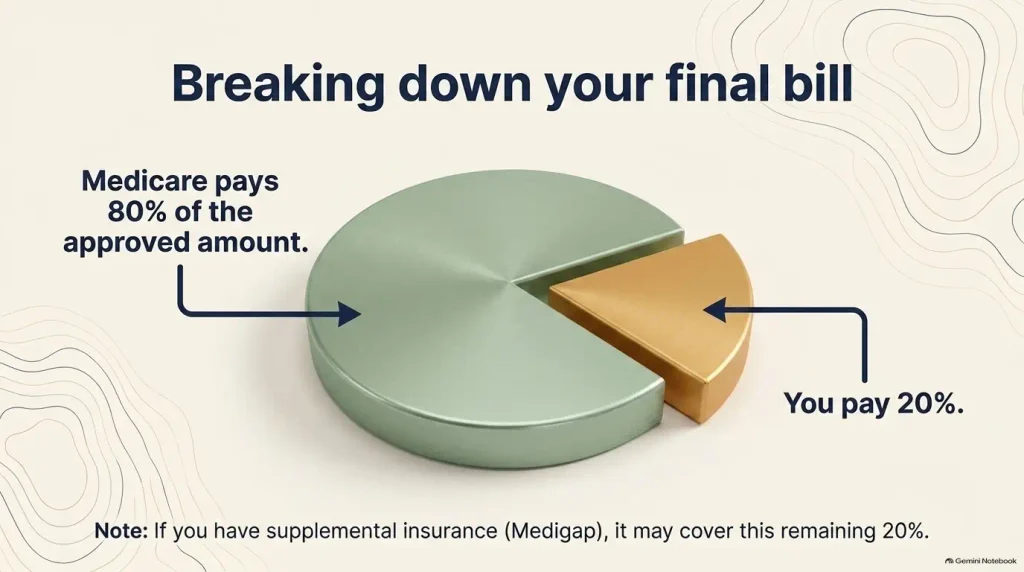
For 2026, the Medicare Part B annual deductible is $283. For many covered Part B diagnostic services performed in a doctor’s office, after the deductible is satisfied, the beneficiary generally pays 20% of the Medicare-approved amount rather than 20% of whatever price appears on the provider’s original charge. CMS published the current deductible in its 2026 Medicare Part B cost announcement.
Illustrative example: your deductible is already met
Suppose the Medicare-approved amount for a covered OCT is $100. This is only an illustration, not a prediction of an actual OCT price.
- Medicare-approved amount: $100
- Part B deductible: already satisfied
- Your 20% coinsurance: $20
- Medicare portion: generally $80
The important base is the Medicare-approved amount, not an arbitrary retail or billed charge.
Illustrative example: $40 of your deductible remains
Using the same hypothetical $100 Medicare-approved amount, you would first be responsible for the remaining $40 deductible. The remaining $60 would then be subject to the usual 20% coinsurance.
- Remaining deductible: $40
- Amount left after deductible: $60
- 20% of $60: $12
- Illustrative total responsibility: $52
Your actual amount can differ because of the Medicare-approved amount, how much deductible remains, supplemental insurance, and where the service is performed. Hospital outpatient testing can involve additional facility cost sharing.
Ask whether the OCT estimate includes one eye or both. Posterior-segment OCT codes 92133 and 92134 describe a study of one or both eyes; the CMS-hosted SCODI contractor response explains this unilateral-or-bilateral wording. Do not simply double an estimated OCT copayment because both eyes are scanned. Ask the billing office which code and units the estimate uses, whether interpretation is included, and which visit or facility charges are separate.
For example, if the Medicare-approved amount for the covered OCT service is $100 including both eyes, and your Part B deductible is met, 20% is $20 for that service—not $20 per eye. This is a hypothetical estimate assuming assignment and no other charges; it is not a quoted Medicare rate.
Medicare Advantage Changes the Cost and Verification Process
If you have Medicare Advantage rather than Original Medicare, a medically necessary OCT that Original Medicare covers generally remains within the plan’s Medicare-covered benefits. Your route to coverage can be different, however. The plan may use its own provider network, copayment structure, referral rules, or prior-authorization requirements for certain services.
Do not assume that the Original Medicare “20% after the Part B deductible” calculation describes your Medicare Advantage bill. Check the plan’s Evidence of Coverage or call the member-services number on your insurance card and ask specifically about outpatient OCT or ophthalmic diagnostic imaging.
Have the clinic’s proposed billing code available if possible. “Do you cover OCT?” is a broad question. “What is my cost for CPT 92134 at this in-network ophthalmologist for medically necessary retinal monitoring?” gives the plan far less room for ambiguity.
Why Medicare May Deny an OCT That Your Eye Doctor Wanted
A doctor’s clinical decision to perform an OCT and Medicare’s decision to pay the claim are related, but they are not the same decision.
Your eye doctor decides whether the scan is useful for your care. Medicare or your Medicare Advantage plan determines whether the submitted service satisfies its coverage and payment rules.
Common trouble spots include:
- No covered medical indication is documented. A scan performed as general screening may not satisfy the medical-necessity standard.
- The diagnosis submitted does not support the billed OCT service. Medicare contractors maintain diagnosis and billing requirements for ophthalmic diagnostic imaging.
- The test is repeated more frequently than the applicable policy considers reasonable. Some local Medicare policies include utilization limits or require additional justification for more frequent imaging.
- The claim information is incomplete or inconsistent. A coding or documentation problem can produce a denial even when the underlying clinical service was reasonable.
- A Medicare Advantage plan requirement was missed. Network or authorization rules can create a separate coverage problem.
Frequency is especially easy to misunderstand. OCT does not come with a universal “Medicare pays once every year” rule. A patient undergoing active retinal treatment may have a very different medically appropriate imaging schedule from a stable patient being monitored for another condition. CMS local coverage policies can impose condition-specific utilization requirements.
Diabetes and Glaucoma Do Not Make Every OCT Automatically Covered
Medicare Part B covers an annual eye exam for diabetic retinopathy for eligible beneficiaries with diabetes. That does not mean every additional imaging service performed during the visit automatically becomes a preventive benefit. An OCT may still need its own medical justification. Medicare says the covered diabetic eye exam is generally subject to the Part B deductible and 20% coinsurance.
If diabetes is the reason for your visit, the separate guide on Medicare diabetic eye exam costs can help you distinguish the annual exam from additional diagnostic services.
Glaucoma creates a similar distinction. Medicare has a specific glaucoma-screening benefit for certain high-risk beneficiaries, but OCT used to diagnose or monitor glaucoma is a diagnostic imaging question rather than simply an automatic annual screening benefit. Medicare’s high-risk categories and the medical reason for the imaging are separate issues.
If glaucoma risk is the issue, see what high risk for glaucoma means under Medicare before assuming that every test at the visit has identical coverage.
Your Five-Minute OCT Coverage Check Before the Appointment
You do not need to decode Medicare policy from scratch. Call the eye clinic and work through these questions in order:
- Why is the OCT being ordered? Ask for the medical condition or finding the doctor is evaluating or monitoring.
- Which OCT will be billed? Ask whether the clinic expects to use code 92134, 92133, or another code.
- Does the clinic expect Medicare to cover it? “We do this for everyone” is not the same answer as “we expect Medicare coverage because it is medically necessary for your condition.”
- Does the provider accept Medicare assignment? This affects how Original Medicare’s approved amount is handled.
- What is my estimated patient responsibility? Ask the clinic to distinguish the OCT charge from the office visit, refraction, photographs, injections, or other services performed on the same day.
- If Medicare may deny it, what notice will I receive before the test? This is particularly important if the clinic believes the service may be considered medically unnecessary or too frequent.
For Original Medicare, a provider may use an Advance Beneficiary Notice of Non-coverage when it expects Medicare may not pay for a service. An ABN describes the service, why payment may be denied, and your potential financial responsibility. It is a warning about possible noncoverage, not Medicare’s final claim decision.
What to Do If Medicare Denies the OCT Claim
Do not start by assuming the denial proves the scan was never covered. First identify what Medicare actually denied and why.
- Find the OCT or ophthalmic imaging line on your Medicare Summary Notice.
- Check the service date and whether the claim identifies the test separately from the eye examination.
- Read Medicare’s explanation for why payment was denied or reduced.
- Ask the provider’s billing office whether the diagnosis and procedure code were submitted correctly.
- If the claim was correctly submitted but Medicare says the service was not medically necessary, ask the doctor whether the medical record supports an appeal.
If the unfamiliar codes and payment columns are the problem, this guide to reading Medicare notices can help you organize the claim information before calling the clinic.
For Medicare Advantage, use the plan’s denial notice rather than the Original Medicare Summary Notice process. Ask whether the problem involves medical necessity, authorization, network status, or claim coding before deciding what to challenge.
Frequently Asked Questions About Medicare and OCT
Does Medicare cover OCT for macular degeneration?
Medicare Part B may cover medically necessary diagnostic testing for age-related macular degeneration. OCT is commonly used clinically to evaluate retinal and macular changes, but payment still depends on medical necessity, documentation, and applicable Medicare coverage rules rather than the diagnosis name alone. Medicare specifically states that Part B may cover diagnostic tests for age-related macular degeneration.
Does Medicare cover OCT for glaucoma?
It can. CMS local coverage documents recognize scanning ophthalmic diagnostic imaging in the evaluation and management of glaucoma and glaucoma suspects. The exact medical-necessity, diagnosis, documentation, and frequency requirements can depend on the Medicare contractor handling claims in your area.
Will Medicare pay for an OCT once every year?
There is no universal annual OCT entitlement. The appropriate frequency depends on why the scan is being performed and the applicable coverage policy. Do not confuse OCT with Medicare benefits that do have explicit annual screening intervals, such as certain eligible glaucoma screenings or diabetic retinopathy eye exams.
Can I be charged if Medicare does not cover the OCT?
Potentially, but the circumstances matter. With Original Medicare, if a provider expects Medicare to deny a service for reasons that can transfer financial liability to you, an ABN may be required before the service. Review any notice carefully before signing it. A service that Medicare categorically does not cover is handled differently from a service that might otherwise be covered but fails medical-necessity requirements.
Optional video: Open the video on YouTube (external site).
The One Check Worth Doing Today
Before paying for or declining an OCT, call the clinic and ask one compact question: “What diagnosis and billing code are you using for my OCT, and do you expect my Medicare coverage to pay for it?”
If you have Original Medicare and the clinic expects a denial, ask whether you should receive an ABN before the test. If you have Medicare Advantage, call your plan with the procedure code and provider name and verify your network, authorization, and cost-sharing requirements.
That five-minute check separates three very different situations: a medically necessary covered OCT, a covered test with ordinary cost sharing, and an optional or unsupported scan that may leave you paying the full charge.
Last reviewed: 2026-10
Targeted review: October 17, 2026. The addition above checks the one-eye/both-eyes estimate and its hypothetical cost calculation. Other sections retain their stated review scope.
PUT THIS GUIDE TO WORK · INTERACTIVE WORKSHEET
Eye-test quote and appointment planner
Use this worksheet alongside the article: Does Medicare Cover OCT Eye Tests?. Use the fields provided to organize your notes and next actions, then save your worksheet.
Your entries stay in this page and are cleared when you reload. No account is needed. Saved files are downloaded only to your device.
This worksheet does not establish coverage or eligibility. Use the Part B model only after the provider confirms a covered service and accepts assignment. It uses deductible applied + 20% of the remaining approved amount + extra charges. Medigap, Medicaid, other insurance, facility charges, excess charges, and plan-specific rules are not modeled. A plan quote is entered directly rather than applying the Part B formula.
Verify Medicare’s current costs and assignment rules · Worksheet rules checked October 20, 2026.
How to use your result
Save the worksheet before leaving this page. Recheck any quote, date, or instruction with the relevant provider, pharmacist, manufacturer, or official organization. A completed checklist means you recorded the steps, not that an outcome is guaranteed.
Worksheet added October 20, 2026. Read the article above for context and its stated review scope.