

Organize your questions and next steps, then save your worksheet.
Summary and next steps
Medicare eye exam vs medical eye exam: see what Original Medicare covers, why refraction may cost extra, and what to ask before your appointment.
Editorial maintenance: October 24, 2026. Summary layout, related links and technical metadata updated. This is not a full clinical review.

MEDICARE + EYE CARE
Medicare Eye Exam vs Medical Eye Exam:
What Is Actually Covered?
You book an eye appointment, hand over your Medicare card, and then discover that one part of the visit is covered while another part is not. The difference is rarely the examination chair, the dilation drops, or even the doctor.
The important distinction is why the eye service is being performed. Original Medicare generally does not cover a routine eye exam or refraction performed to prescribe eyeglasses or contact lenses. Part B can cover medically necessary physician services and certain specific eye screenings, diagnostic services, and treatments.
This guide helps you sort out that boundary before the appointment, including the sneaky little billing wrinkle called a refraction fee.
Routine vision care vs medically necessary eye care
Separate exam, refraction, testing, and eyewear charges
Check Medicare Advantage rules, networks, and copays
👁️ The question to ask is not simply “Does Medicare cover eye exams?” Ask: “What is this visit being billed for?”
Snapshot
Who this is for: Medicare beneficiaries, spouses, and caregivers trying to determine whether an upcoming eye visit will be covered. What it solves: the confusing difference between routine vision care, refraction, medically necessary eye care, and plan-specific vision benefits. After reading: you should know what to ask the eye doctor’s office and your plan before the bill arrives.
Table of Contents
Before You Act
This article explains Medicare coverage structure, not whether your individual symptoms qualify for a particular diagnosis, test, or claim. Your eye-care professional determines what evaluation is medically appropriate. Medicare, a Medicare Advantage plan, and its claims contractors determine payment under the applicable coverage rules. Confirm coverage with the provider and your plan when the cost matters.

The Short Answer: Routine and Medical Eye Exams Are Not the Same for Medicare
Original Medicare generally does not cover a routine eye exam or refraction performed for prescription eyeglasses or contact lenses. Medicare Part B does, however, cover medically necessary doctor services and provides specific coverage for certain eye-related screenings, tests, and treatments.
This is why two people can walk into the same eye clinic and have very different Medicare bills.
| Reason for visit | Likely Medicare issue | Best question to ask |
|---|---|---|
| “I need a new glasses prescription.” | Routine refraction is generally not covered by Original Medicare. | “What is your self-pay refraction fee?” |
| “My vision suddenly changed.” | The visit may involve medically necessary diagnostic services. | “Will this be billed to Medicare as evaluation of a medical problem?” |
| “I have diabetes and need my retinal exam.” | Part B has specific diabetic retinopathy eye-exam coverage. | “Does this visit meet Medicare’s diabetic eye-exam requirements?” |
| “I am being monitored for macular degeneration.” | Certain diagnostic tests and treatments may be covered. | “Which tests are medically necessary and which charges are separate?” |
| “I have a Medicare Advantage vision benefit.” | The plan may offer routine vision benefits beyond Original Medicare. | “Is this provider in network, and what does my vision benefit include?” |
Key takeaway: The label “eye exam” tells you surprisingly little about coverage. The reason for the visit, the services performed, your diagnosis or risk category, and your type of Medicare coverage matter much more.
What Makes an Eye Exam Routine or Medical?
“Medical eye exam” is useful everyday shorthand, but it is better to think in terms of purpose and medical necessity rather than imagining two completely different kinds of appointments.
A routine vision visit is mainly about seeing more clearly
A routine visit commonly focuses on visual acuity and whether your eyeglass or contact-lens prescription should change. Medicare specifically states that Original Medicare does not cover routine eye exams, sometimes described as eye refractions, for eyeglasses or contact lenses.
A medical visit investigates or manages a health problem
A visit may move into medical territory when the doctor is evaluating symptoms, following an eye disease, checking complications of another disease, or performing diagnostic testing that is reasonable and necessary. Part B generally covers medically necessary doctor services, subject to Medicare’s coverage rules.
Examples may include evaluating certain new visual symptoms, following glaucoma or retinal disease, managing cataracts, or monitoring diabetes-related eye disease. Coverage is not automatic merely because a condition is mentioned. Documentation, medical necessity, frequency limits, provider requirements, and the particular service still matter.
The doctor type does not magically change the category
Booking an ophthalmologist does not automatically make a glasses exam Medicare-covered. Likewise, an eye-care visit that begins with blurry vision can require medical evaluation rather than simply a stronger pair of readers.
Why are you having the eye visit?
Routine refraction is generally not covered by Original Medicare.
Medically necessary evaluation or testing may qualify under Part B rules.
Check whether you meet a specific Medicare benefit, such as glaucoma screening eligibility.
Check your Medicare Advantage plan’s network, allowance, frequency, and copay.
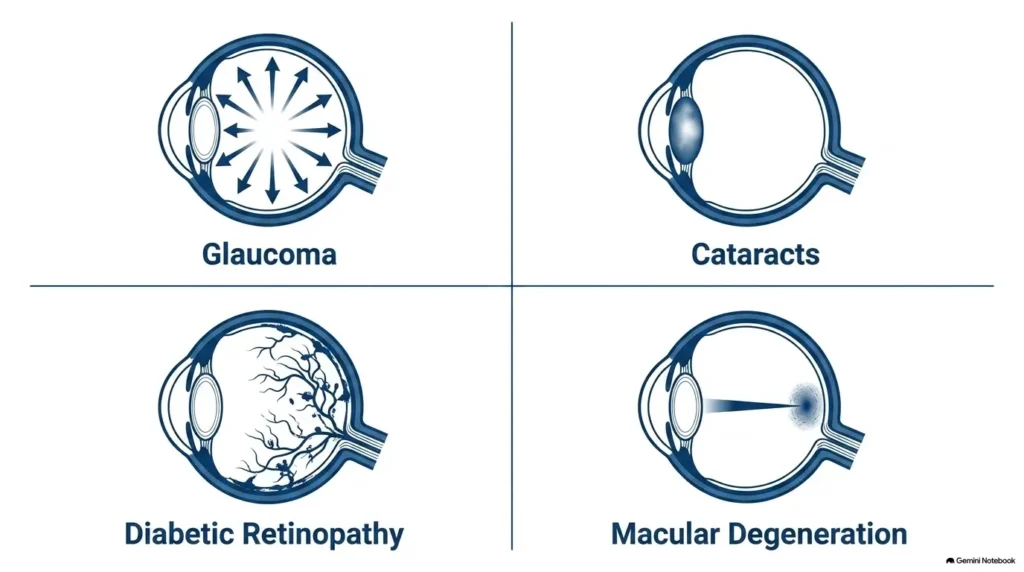
Which Eye Services Can Original Medicare Cover?
Original Medicare is not routine vision insurance, but “Medicare does not cover eye care” is also too broad. Several important eye services fall within Part B coverage when the requirements are met.
Diabetic retinopathy eye exams
Medicare Part B covers an eye exam for diabetic retinopathy for beneficiaries with diabetes, generally once a year. After the Part B deductible, Medicare states that the beneficiary generally pays 20% of the Medicare-approved amount, with other costs possible depending on the setting and circumstances.
Glaucoma screening for people at high risk
Part B covers glaucoma screening once every 12 months for people who meet Medicare’s high-risk criteria. Medicare currently lists diabetes, a family history of glaucoma, being African American and age 50 or older, or being Hispanic and age 65 or older among the qualifying risk categories.
Age-related macular degeneration testing and treatment
Part B may cover certain diagnostic tests and treatments for age-related macular degeneration, including certain injectable drug treatments when coverage requirements are met.
Corrective lenses after certain cataract surgery
Medicare does not usually cover ordinary eyeglasses or contacts. One notable exception is that Part B covers one pair of eyeglasses with standard frames, or one set of contact lenses, after each cataract surgery that implants an intraocular lens. Medicare-approved supplier requirements apply, and upgraded frames can create additional costs.
Check the official rule: Medicare’s coverage pages are the best place to verify whether an eye service has its own eligibility or frequency requirements.
Review Medicare’s routine eye exam coverageShow me the nerdy details
The exclusion and the medical benefit can coexist during the same encounter. Medicare’s coverage framework generally excludes eye examinations or refractions performed for prescribing or changing eyeglasses while separately covering medically necessary physician services. CMS guidance also recognizes medical-necessity requirements for specialized ophthalmic testing. That is why billing often depends on the service actually performed rather than the fact that everything happened during one appointment. :contentReference[oaicite:9]{index=9}
Why You Can Have a Covered Visit and Still Get a Refraction Bill
This is the part that catches people.
Suppose you see an eye doctor because you are being monitored for a medically necessary condition. The medical evaluation may be submitted to Medicare. If the doctor also performs a refraction to determine your eyeglass prescription, Original Medicare’s routine refraction exclusion can still leave that portion as your responsibility.
In plain English: a covered medical eye visit does not automatically make every service performed that day covered.
| Possible charge | Why it may appear | What to verify |
|---|---|---|
| Medical examination | Evaluation or management of a health complaint or eye condition | Is the service being submitted to Medicare? |
| Refraction | Determines eyeglass or contact-lens prescription | Is there a separate self-pay charge? |
| Diagnostic testing | Imaging, measurements, visual-field testing, or other evaluation | Why is the test medically necessary? |
| Eyeglasses | Frames and corrective lenses | Does a cataract-surgery exception or plan vision benefit apply? |
| Facility charge | Some outpatient hospital services involve separate facility cost sharing | Is this office hospital-based? |
Money-saving question: Before the refraction, ask, “Is this part covered by my Medicare coverage, and if not, what will I owe?” A ten-second question can turn a mysterious charge into an informed choice.
Your 10-Minute Before-the-Appointment Checklist
You do not need to decode Medicare billing manuals before scheduling an eye appointment. You need six pieces of information.
- Write down the actual reason for the visit. “Need glasses” and “new distortion in my right eye” are very different starting points.
- Know whether you have Original Medicare or Medicare Advantage. Do not assume the rules are identical.
- Call the eye doctor’s office. Ask whether it participates in Medicare or is in your Medicare Advantage network, as applicable.
- Ask whether a refraction is planned. If yes, ask whether there is a separate charge.
- Ask whether additional testing is expected. If the office already knows, ask whether it expects those tests to be billed medically.
- If you have Medicare Advantage, call the plan. Confirm routine eye-exam frequency, network requirements, copay, eyewear allowance, and any authorization or referral rules.
Use this exact call script
“I have Medicare and I am coming in because of [reason]. Will the visit be billed as routine vision care or as a medical eye visit? Will you perform a refraction, and is that a separate non-covered charge? Are there any tests you expect me to pay for separately?”
If you have Medicare Advantage, add: “Are you in network for both the medical benefit and the routine vision benefit?”
That last question matters because a plan can administer routine vision benefits differently from medical services covered under Part B.
What Will a Medicare Eye Visit Cost?
There is no single useful dollar figure for “a Medicare eye exam.” Your out-of-pocket amount depends on what services are performed and what coverage you have.
For many Part B-covered physician services, beneficiaries generally pay 20% of the Medicare-approved amount after meeting the Part B deductible. Medicare’s eye-specific coverage pages use the same structure for covered diabetic retinopathy exams, glaucoma screenings, and certain macular degeneration services, while hospital outpatient settings can involve additional facility cost sharing.
Routine refractions and ordinary eyeglasses generally sit outside Original Medicare coverage, except for specific situations such as covered corrective lenses following qualifying cataract surgery.
The five cost questions that matter more than an online price estimate
- Is the service covered by Original Medicare or by an extra Medicare Advantage vision benefit?
- Has the Part B deductible been met?
- Does the provider accept Medicare assignment?
- Is a separate refraction charge being added?
- Will you receive services in a hospital outpatient department rather than a freestanding office?
Bad-value warning: Do not pay extra for a “Medicare eye exam package” simply because the wording sounds official. Ask for the individual services and charges. Coverage belongs to services and benefit rules, not marketing labels.
Original Medicare vs Medicare Advantage vs Medigap
The same pair of eyes can have three very different benefit situations depending on how Medicare coverage is arranged.
| Coverage | Routine vision exam | Medical eye care | What to check |
|---|---|---|---|
| Original Medicare | Routine refraction for glasses or contacts generally not covered | Part B covers medically necessary services and specified eye benefits when requirements are met | Assignment, deductible, coinsurance, medical necessity, separate refraction charge |
| Medicare Advantage | Many plans offer extra vision benefits, but details vary | Must cover medically necessary services covered by Original Medicare, subject to the plan’s rules | Network, copay, frequency, allowance, referral, authorization, benefit vendor |
| Medigap with Original Medicare | Generally not a substitute for routine vision insurance | May help with eligible Original Medicare cost sharing according to the Medigap policy | Do not assume it pays for a service simply because Original Medicare excludes it |
Medicare states that Medicare Advantage plans must cover medically necessary services covered by Original Medicare and may provide extra benefits that Original Medicare does not, including vision benefits. Those extra benefits are plan-specific.
Medigap works differently. Medicare says Medigap policies generally do not cover routine vision care or glasses, so it should not be assumed to fill the routine-eye-exam gap.
Comparing coverage? Check Medicare’s official explanation of Original Medicare and Medicare Advantage before relying on a clinic’s shorthand description of your benefits.
Compare Original Medicare and Medicare AdvantageWhen a Vision Problem Should Be Treated as Medical
Coverage is not the first question when a potentially urgent eye problem appears. The first question is how quickly it should be evaluated.
The National Eye Institute advises immediate evaluation for symptoms associated with retinal detachment, including a sudden increase in floaters, flashes of light, or a dark curtain or shadow over part of the vision. Retinal detachment is a medical emergency.
NEI also describes sudden intense eye pain with nausea, red eye, and blurry vision as possible symptoms of acute angle-closure glaucoma, another condition requiring immediate medical attention.
Which path fits the problem?
Schedule appropriate eye care and ask whether the purpose is routine refraction or medical evaluation.
Tell the office about the symptom when booking so it can advise on timing and evaluation.
Seek prompt medical assessment rather than waiting for a routine glasses appointment.
A common mistake is silently booking a “routine annual exam” when the real reason for the appointment is a new symptom. Tell the office what changed.
If the difficulty is more gradual, such as trouble reading labels or close-up text, our guides to near-vision problems in seniors and presbyopia vs cataracts can help you organize the questions to bring to an eye professional.
Eye symptom reference: The National Eye Institute provides patient guidance on eye diseases, symptoms, testing, and treatment.
Visit the National Eye InstituteWhat to Do If the Office Says Medicare Will Not Cover the Visit
“Medicare won’t cover it” may be correct, but it is not specific enough to make a good financial decision.
First, identify what “it” means
- The entire visit?
- Only the refraction?
- A particular diagnostic test?
- Eyeglasses?
- A provider who is outside your Medicare Advantage network?
- A service performed more frequently than the benefit allows?
Medicare itself warns that a clinician may recommend a service Medicare does not cover or may recommend it more frequently than Medicare covers. The beneficiary should ask why the service is being recommended and what Medicare will actually cover.
Then separate three decisions
| What you can do now | What the professional decides | What Medicare or the plan decides |
|---|---|---|
| Describe symptoms accurately, ask for itemized expected charges, confirm network status, and bring plan information. | Which examination, diagnosis, or testing is clinically appropriate. | Whether the submitted service meets coverage and payment rules under your benefit. |
Real-world example
Illustrative scenario: A Medicare beneficiary calls an eye clinic because road signs have become harder to read. The appointment is booked as a routine vision exam, and a refraction is performed to update the glasses prescription.
During the visit, the patient also mentions a new distorted area in one eye. The doctor decides further medical evaluation is needed.
The mistake would be assuming that every charge now becomes covered because a medical problem was discovered. The better approach is to ask which services are being submitted to Medicare, which remain routine or non-covered, and whether additional diagnostic testing has its own cost sharing.
For an upcoming appointment, the eye doctor visit checklist for seniors can help organize medications, symptoms, glasses, and questions. If describing a visual change is difficult, use the guide to explaining vision changes to an eye doctor.

Frequently Asked Questions
Does Medicare pay for an annual eye exam?
Original Medicare does not provide a general annual routine eye-exam benefit for eyeglass or contact-lens refraction. It does provide particular eye-related benefits, such as annual diabetic retinopathy eye exams for eligible beneficiaries with diabetes and glaucoma screening once every 12 months for people meeting Medicare’s high-risk criteria. Medicare Advantage plans may offer additional routine vision benefits.
Does Medicare cover an ophthalmologist visit?
It can, when covered, medically necessary services are being provided and Medicare’s requirements are met. Simply visiting an ophthalmologist does not transform a routine glasses refraction into a covered service. Part B generally covers medically necessary physician services, while routine refraction for glasses or contacts remains excluded by Original Medicare.
Why did my eye doctor charge me for refraction?
Refraction measures the prescription needed to correct refractive error. Original Medicare specifically excludes routine eye refractions for prescription eyeglasses or contact lenses, so a separate patient charge can appear even when another part of the visit is covered.
Does Medicare cover glasses?
Original Medicare generally does not cover ordinary eyeglasses or contact lenses. Part B provides a specific exception for one pair of standard-frame eyeglasses or one set of contact lenses after each cataract surgery that implants an intraocular lens, subject to Medicare requirements.
Does Medicare Advantage cover routine eye exams?
Some Medicare Advantage plans provide extra vision benefits that Original Medicare does not. Coverage details can differ by plan, so verify the network, exam frequency, copay, eyewear allowance, and any applicable plan rules before scheduling.
Should I buy stronger reading glasses instead of seeing an eye doctor?
If the problem is simply stable near-focus difficulty and you have already been appropriately evaluated, inexpensive readers may sometimes solve the practical problem. But changing glasses should not be used to explain away new, unequal, sudden, painful, distorted, or otherwise concerning vision changes. If readers are no longer working well, see why reading glasses may stop working before simply increasing the strength.
Optional video: Open the video on YouTube (external site).
Your Next 15 Minutes
Take out your Medicare card, your Medicare Advantage card if you have one, and the appointment information.
- Write one sentence describing why you need the appointment.
- Call the office and ask whether the visit is expected to be routine vision care, medical eye care, or a combination.
- Ask whether refraction has a separate charge.
- Ask whether any additional tests are expected.
- If you have Medicare Advantage, confirm the provider’s network status and routine vision benefit directly with the plan.
Do not try to turn a medical problem into a routine appointment to save money, and do not assume every eye-related service becomes covered simply because Medicare covers part of the visit.
The useful rule to remember: glasses prescription, medical evaluation, diagnostic testing, and eyewear are separate pieces of the puzzle. Ask about each piece before you pay for the whole box.
Last reviewed: 2026-09
PUT THIS GUIDE TO WORK · INTERACTIVE WORKSHEET
Routine vs medical eye-visit planner
Use this worksheet alongside the article: Medicare Eye Exam vs Medical Eye Exam: What Is Actually Covered?. Use the fields provided to organize your notes and next actions, then save your worksheet.
Your entries stay in this page and are cleared when you reload. No account is needed. Saved files are downloaded only to your device.
This worksheet does not establish coverage or eligibility. Use the Part B model only after the provider confirms a covered service and accepts assignment. It uses deductible applied + 20% of the remaining approved amount + extra charges. Medigap, Medicaid, other insurance, facility charges, excess charges, and plan-specific rules are not modeled. A plan quote is entered directly rather than applying the Part B formula.
Verify Medicare’s current costs and assignment rules · Worksheet rules checked October 20, 2026.
How to use your result
Save the worksheet before leaving this page. Recheck any quote, date, or instruction with the relevant provider, pharmacist, manufacturer, or official organization. A completed checklist means you recorded the steps, not that an outcome is guaranteed.
Worksheet added October 20, 2026. Read the article above for context and its stated review scope.