
Organize your questions and next steps, then save your worksheet.
Summary and next steps
Medicare visual field test coverage depends on medical necessity. See when Part B pays, what you may owe, and what to check before the test.
Editorial maintenance: October 24, 2026. Summary layout, related links and technical metadata updated. This is not a full clinical review.
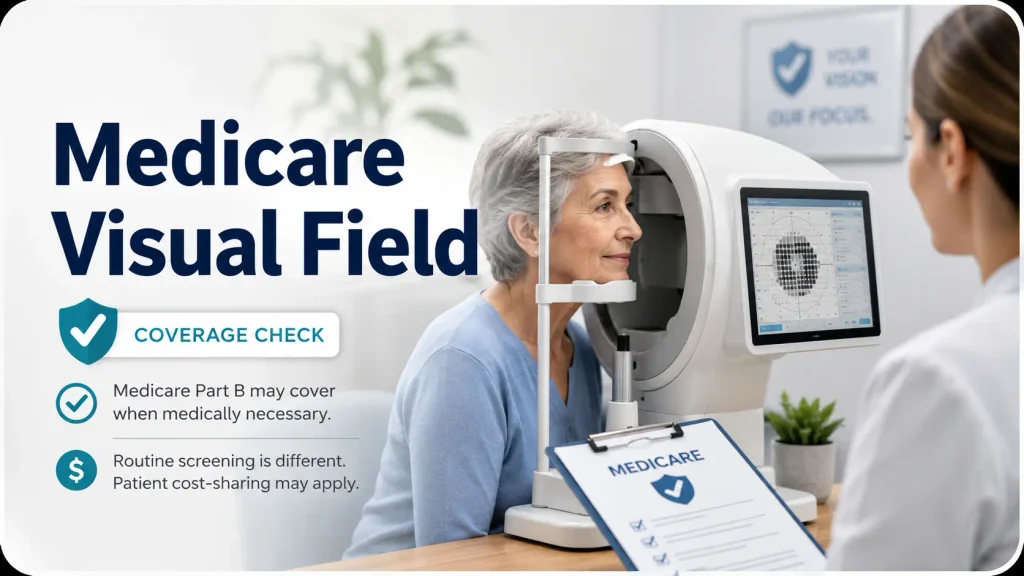
Yes. Medicare Part B can cover visual field testing when the test is medically necessary to diagnose or monitor an eye, optic nerve, or neurologic condition. The most important distinction is why the test is being performed. A visual field test ordered because of glaucoma, suspected glaucoma, an existing field defect, certain neurologic problems, or another documented medical indication may qualify for coverage. A test performed only as part of routine vision screening may not.
Your best first step is simple: before the appointment, ask the eye clinic whether the test is being billed to Medicare as a medically necessary diagnostic test and what diagnosis or symptom supports it. With Original Medicare, your Part B deductible and coinsurance may still apply even when the test is covered.
Table of Contents
When Medicare Covers a Visual Field Test
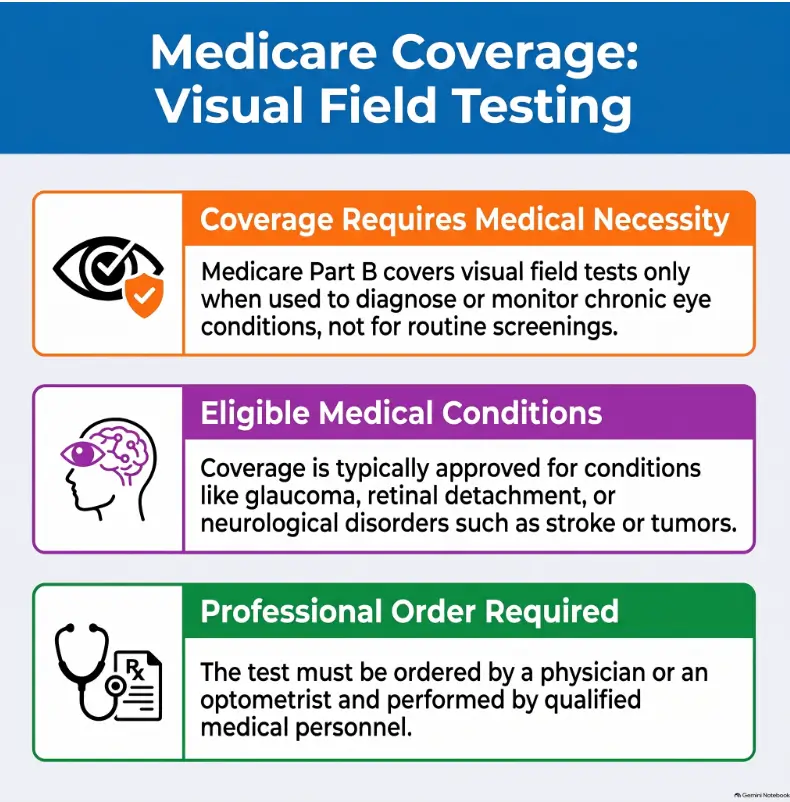
Medicare treats medically necessary visual field testing as diagnostic care rather than ordinary vision correction. CMS specifically recognizes computer-enhanced perimetry as a covered diagnostic service when used to assess visual fields in patients with glaucoma or other neuropathologic defects.
You can review the federal rule in the CMS national coverage determination for computer-enhanced perimetry.
Depending on the clinical situation and the Medicare Administrative Contractor responsible for claims in your area, medically necessary testing may also be supported by findings such as a suspected visual field defect, signs suggesting glaucoma, an eyelid disorder that may obstruct vision, or a neurologic condition affecting the visual pathway.
This does not mean every person with one of these conditions automatically receives unlimited covered testing. The treating clinician decides whether the test is clinically appropriate, while Medicare or the Medicare contractor determines whether the submitted service meets coverage and documentation requirements.
| Situation | Likely Medicare issue | What to verify |
|---|---|---|
| Diagnosed glaucoma | Diagnostic monitoring may be covered | Medical necessity and testing frequency |
| Doctor suspects glaucoma | Testing may be covered when supported by findings | Diagnosis or signs documented in the record |
| Known visual field loss or neurologic problem | Diagnostic testing may qualify | Reason the test is needed |
| Drooping eyelid affecting vision | May qualify when function is being evaluated | Applicable local coverage criteria |
| No symptoms or medical indication | Routine screening may not qualify | Whether another Medicare preventive benefit applies |
Routine Eye Exams and Visual Field Testing Are Not the Same Medicare Benefit
One of the easiest ways to misunderstand the bill is to assume that anything performed during an eye appointment follows the same coverage rule. It does not.
Original Medicare generally does not cover routine eye examinations for eyeglasses or contact lenses. Medicare explains this separately under its routine eye exam coverage rules. A refraction used to determine an eyeglass prescription can therefore appear as a non-covered charge even when medical portions of the same visit are covered.
If that distinction appears on your bill, see the site’s guide to the Medicare refraction fee. A covered glaucoma evaluation, visual field test, and non-covered refraction can all occur during one appointment without contradicting each other.
A Glaucoma Screening Benefit Does Not Mean Unlimited Visual Field Tests
Medicare Part B has a separate preventive glaucoma screening benefit for beneficiaries who meet its high-risk criteria. Eligible people can receive a glaucoma screening once every 12 months.
That preventive benefit should not be interpreted as an automatic annual entitlement to every type of visual field test. A diagnostic visual field examination used to investigate or monitor disease is evaluated according to its own medical-necessity circumstances.
If you are being tested because you are considered high risk but have not been diagnosed with glaucoma, compare the appointment with Medicare’s official glaucoma screening eligibility rules. The distinction matters because “glaucoma screening” and “visual field testing” may sound interchangeable at the front desk while representing different coverage questions.
What You May Pay for a Covered Visual Field Test in 2026
Under Original Medicare, medically necessary diagnostic services generally fall under Part B cost sharing. In 2026, the annual Part B deductible is $283. After the applicable deductible has been met, you generally pay 20% of the Medicare-approved amount for covered Part B physician services.
The percentage applies to the Medicare-approved amount, not automatically to the amount printed at the top of the provider’s retail bill. Medicare’s current cost information lists the 2026 Part B amounts.
Illustrative example when the deductible is already met
Assume the Medicare-approved amount for the covered service is $120, the provider accepts assignment, and your Part B deductible has already been satisfied.
- Medicare-approved amount: $120
- Your 20% coinsurance: $24
- Medicare’s portion: $96
A provider’s original charge could be higher than $120 without changing this calculation base. Your actual responsibility can also change because of other insurance, Medigap coverage, provider participation, where the service is performed, and other services provided during the appointment.
If part of your deductible remains
Suppose $100 of your Part B deductible remains and the Medicare-approved amount is $120. Under this simplified example, the first $100 would satisfy the remaining deductible. The 20% coinsurance would then apply to the remaining $20, producing another $4 of cost sharing.
Your responsibility in that simplified example would therefore be $104. This is an illustration of how the deductible and coinsurance interact, not a prediction of what a particular clinic will charge.
Why Medicare Can Deny a Visual Field Test That Seems Medically Relevant
A diagnosis alone does not guarantee payment. Medicare contractors can review whether the test was reasonable and necessary on the date it was performed and whether the medical record supports the claim.
Common points worth checking include:
- The reason for testing: the record should connect the test to an abnormal sign, symptom, diagnosed disease, injury, or other covered medical purpose.
- The ordering practitioner: Medicare diagnostic-testing rules require the test to be ordered appropriately by the treating physician or other qualified treating practitioner.
- Testing frequency: repeating a test more often than is reasonable for management of the condition can create a coverage problem.
- Claim information: an incorrect or incomplete diagnosis submitted with the claim can produce a denial even when the medical record would support coverage.
- Local policy: Medicare Administrative Contractors may maintain local coverage requirements that add detail to the national rule.
This is why “Medicare covers visual field testing” and “Medicare will pay this particular visual field claim” are not identical statements.
Your Five-Minute Coverage Check Before the Test
You do not need to decode Medicare billing policy from scratch. Call the eye clinic and ask four targeted questions before the test:
- Why is the visual field test being ordered? Ask whether it is diagnostic, disease monitoring, pre-surgical functional testing, or routine screening.
- Will you bill Medicare Part B for it? A clinic that routinely performs the test should be able to tell you whether it expects Medicare coverage.
- What diagnosis or clinical finding supports the test? You do not need to choose a billing code yourself. You are checking that a medical reason exists and has been documented.
- Do you accept Medicare assignment, and what do you expect me to owe? This helps separate the provider’s charge from the Medicare-approved amount and your expected cost sharing.
If the office says Medicare may not cover the test, ask why. “Medicare never covers visual field tests” is very different from “Medicare may not cover this test because there is no documented medical indication” or “your plan requires another step first.”
Original Medicare and Medicare Advantage Can Produce Different Bills
Medicare Advantage plans must cover the medically necessary services Original Medicare covers, but the path to that coverage can differ. A plan may use provider networks, referrals, prior authorization, or its own copayment and coinsurance structure.
That means the Original Medicare 20% example above should not be used to predict what a Medicare Advantage enrollee will owe. Check the plan’s Evidence of Coverage or call the number on the membership card and ask specifically about outpatient diagnostic ophthalmology testing.
Some Medicare Advantage plans also include routine vision benefits beyond Original Medicare. Those supplemental benefits should be kept separate from medically necessary Part B diagnostic coverage when you are trying to understand a claim.
What to Check If Medicare Denied the Claim
Check the denial reason and record the appeal deadline at the same time. A billing correction may resolve missing or incorrect claim information, but do not assume waiting for a correction extends your appeal deadline.
- Compare the clinic’s bill with your Medicare Summary Notice.
- Identify the visual field service and the amount Medicare approved, denied, or assigned to you.
- Ask the provider whether the correct diagnosis and documentation were submitted.
- If information was submitted incorrectly, ask whether the provider can correct and resubmit the claim.
- If the claim information is correct and you still disagree with Medicare’s determination, review your appeal rights.
If Medicare paperwork itself is difficult to interpret, the guide to reading Medicare notices can help you organize the numbers before calling the provider.
For Original Medicare, the Medicare Summary Notice states the deadline and instructions for challenging the decision. Medicare also provides the official Original Medicare appeal process. Before appealing a medical-necessity denial, ask the treating office for documentation explaining why the test was required.

Protect the appeal deadline while the billing office checks the claim. For an Original Medicare claim, record the filing date and submission instructions on the Medicare Summary Notice (MSN) when you first review the denial. Medicare’s Original Medicare appeal instructions explain how to request a redetermination. Calling the clinic or asking for a corrected claim is different from filing that appeal; do not assume an informal inquiry extends the date on your notice.
Keep the test date, denied line, reason, itemized statement, and provider’s response together. Ask whether the clinic is correcting submitted information or whether you need to challenge an actual coverage decision, and retain proof of anything formally submitted. For Medicare Advantage, use the plan’s denial notice and its own appeal instructions rather than applying the Original Medicare process.
Frequently Asked Questions About Medicare and Visual Field Testing
Does Medicare cover visual field testing before eyelid surgery?
It can, when the test is medically necessary to document whether an eyelid condition is obstructing the visual field and applicable Medicare requirements are satisfied. Coverage of the test does not by itself guarantee coverage of eyelid surgery. The surgeon’s documentation and the relevant Medicare contractor policy still matter.
Will Medicare pay for a visual field test every year?
There is no universal once-a-year entitlement for diagnostic visual field testing. The appropriate frequency depends on the condition being evaluated, changes in the disease, treatment, and medical necessity. Medicare’s separate high-risk glaucoma screening benefit has its own once-every-12-month rule.
Can an optometrist perform a Medicare-covered visual field test?
Potentially. Medicare Part B can cover qualifying services furnished by optometrists when they are legally authorized to provide the service and Medicare requirements are met. The practitioner, service, medical necessity, and billing arrangement all have to qualify.
Can Medigap help pay for the visual field test?
If Original Medicare covers the test, a Medigap policy may help with eligible Medicare cost sharing according to the specific supplement plan. Medigap does not turn a non-covered service into a Medicare-covered service, and it cannot be used to cover Medicare Advantage cost sharing.
Optional video: Open the video on YouTube (external site).
The One Check Worth Doing Before Your Appointment
Call the eye clinic and ask one sentence: “Is my visual field test being ordered as a medically necessary diagnostic test, and do you expect Medicare to cover it?”
If the answer is yes, ask for the expected Medicare-approved patient responsibility and whether your Part B deductible has been considered. If the answer is uncertain, ask what medical indication supports the test before agreeing to an unexpected self-pay charge.
That short conversation separates three things that often arrive tangled together on an eye-clinic bill: medical necessity, Medicare coverage, and the amount you personally owe.
Last reviewed: 2026-10
Targeted review: October 17, 2026. Clarified billing correction versus a formal appeal and added deadline-preservation steps. Other sections retain their stated review scope.
PUT THIS GUIDE TO WORK · INTERACTIVE WORKSHEET
Eye-test quote and appointment planner
Use this worksheet alongside the article: Does Medicare Cover Visual Field Testing?. Use the fields provided to organize your notes and next actions, then save your worksheet.
Your entries stay in this page and are cleared when you reload. No account is needed. Saved files are downloaded only to your device.
This worksheet does not establish coverage or eligibility. Use the Part B model only after the provider confirms a covered service and accepts assignment. It uses deductible applied + 20% of the remaining approved amount + extra charges. Medigap, Medicaid, other insurance, facility charges, excess charges, and plan-specific rules are not modeled. A plan quote is entered directly rather than applying the Part B formula.
Verify Medicare’s current costs and assignment rules · Worksheet rules checked October 20, 2026.
How to use your result
Save the worksheet before leaving this page. Recheck any quote, date, or instruction with the relevant provider, pharmacist, manufacturer, or official organization. A completed checklist means you recorded the steps, not that an outcome is guaranteed.
Worksheet added October 20, 2026. Read the article above for context and its stated review scope.