

Organize your questions and next steps, then save your worksheet.
Summary and next steps
Does Medicare cover optometrist visits? See when Part B may pay, why routine refraction may not be covered, and what to ask before booking an eye exam.
Editorial maintenance: October 24, 2026. Summary layout, related links and technical metadata updated. This is not a full clinical review.

Does Medicare Cover an Optometrist Visit?
When Part B Pays and When It Doesn’t
You can make an appointment with an optometrist, hand over your Medicare card, and still discover that one part of the visit is covered while another part is entirely your responsibility. The confusing part is usually not the word optometrist. It is the reason for the visit.
Original Medicare generally does not cover a routine eye exam or refraction performed simply to prescribe eyeglasses or contact lenses. Medicare Part B can, however, cover medically necessary eye care and certain specific eye screenings or services when Medicare’s requirements are met.
This guide shows you how to tell those visits apart, what to ask before the appointment, how Medicare Advantage changes the picture, and which seemingly small add-on can create a surprise bill.
Best first move: Ask the office whether your appointment is being scheduled as a routine vision exam or a medical eye visit before discussing glasses. 👁️
Snapshot
For: U.S. Medicare beneficiaries and family members trying to understand an optometrist bill or book an eye appointment. Problem solved: whether Medicare may cover the visit, which services may remain out of pocket, and what to verify beforehand. After reading: you should be able to call the eye doctor’s office and ask the right coverage questions in about 10 minutes.
Table of Contents
Before you act
This article explains general Medicare coverage rules, not whether a particular claim will be approved. Your eye-care professional determines what medical evaluation or treatment you need; Medicare or your Medicare Advantage plan determines coverage and payment under its rules. If you suddenly develop many new floaters, flashes of light, or a dark curtain or shadow over your vision, seek prompt eye care rather than delaying treatment to research insurance. The National Eye Institute identifies these as possible retinal-detachment symptoms requiring immediate evaluation.

When Medicare Covers an Optometrist Visit
The short answer is yes, sometimes. Medicare does not exclude an appointment merely because the clinician is an optometrist. Medicare Part B covers medically necessary services from doctors and other eligible health professionals, and Medicare specifically recognizes optometrists in certain circumstances.
The decisive question is usually: Why are you seeing the optometrist, and what service is actually being billed?
| Reason for the visit | Original Medicare | What to verify |
|---|---|---|
| You want a new glasses prescription | Routine exam/refraction generally not covered | Cash price and whether refraction is a separate charge |
| You have an eye symptom or diagnosed condition | Part B may cover medically necessary evaluation or treatment | Whether the service is Medicare-covered and the provider participates |
| You have diabetes | Part B covers an eligible diabetic-retinopathy eye exam once a year | Provider requirements and your Part B cost-sharing |
| You qualify as high risk for glaucoma | Part B covers an eligible glaucoma screening once every 12 months | Whether you meet Medicare’s risk criteria |
| You have Medicare Advantage | Original Medicare benefits remain covered; extra routine vision benefits may be available | Network, copay, allowance and plan rules |
Key takeaway: Do not ask only, “Do you take Medicare?” Ask, “Is the service I am scheduling covered by Medicare for my reason for visiting?” A practice can accept Medicare and still provide routine vision services that Original Medicare does not cover.
If preparing for eye appointments tends to become a small paperwork expedition, use this eye doctor visit checklist for seniors to organize medications, symptoms and questions before you go.
What you can do now
Describe the reason for the visit, confirm your Medicare type, ask about separate refraction charges and request an estimate.
What the eye professional decides
Which examination, diagnostic testing, monitoring or treatment is medically appropriate.
What Medicare decides
Whether the billed service meets Medicare coverage requirements and what approved amount and cost-sharing apply.
The Test That Changes the Bill: Routine Refraction vs. Medical Eye Care
This distinction causes more confusion than almost anything else in Medicare eye care.
A routine vision visit is usually about correcting sight
You may be seeing well at distance but struggling with menus, medication bottles or a laptop. You book an optometrist to find out whether your glasses prescription has changed.
That sounds medically sensible, but Original Medicare generally does not cover routine eye exams or eye refractions performed for eyeglasses or contact lenses. Medicare.gov states that the beneficiary pays the costs of these non-covered routine services.
If the unfamiliar word on your bill is refraction, see the separate guide to the Medicare refraction fee. That single line item often explains why a visit that seemed “covered by Medicare” still produced a patient balance.
A medical eye visit starts with a health problem
Now change the reason for the appointment. Perhaps you have new blurry vision, an eye condition that is being monitored, or a symptom that needs evaluation. The visit may involve medically necessary examination or testing rather than simply determining a glasses prescription.
Part B can cover medically necessary doctor and eligible provider services. Coverage still depends on the service, medical necessity, Medicare rules and the professional’s scope of practice. A medical visit is therefore not automatically covered merely because the office labels it “medical.”
Example scenario: one appointment, two different charges
Consider an illustrative example. A beneficiary schedules an optometrist appointment because vision has become blurry. The optometrist evaluates the symptom and performs a medically necessary examination. During the same visit, the patient also asks, “Since I’m here, can you update my glasses prescription?”
The medical portion and the refraction do not necessarily share the same Medicare coverage status.
The medical evaluation may qualify for Part B coverage if Medicare’s requirements are satisfied. The refraction for corrective lenses can remain a non-covered service. The patient then sees a Medicare claim for part of the appointment and a separate charge for the refraction.
Nothing mysterious happened. Two different services occurred in the same room.
Key takeaway: Before dilation drops, machines and alphabet charts begin doing their choreography, ask whether a refraction is included and whether Medicare is expected to pay for it.
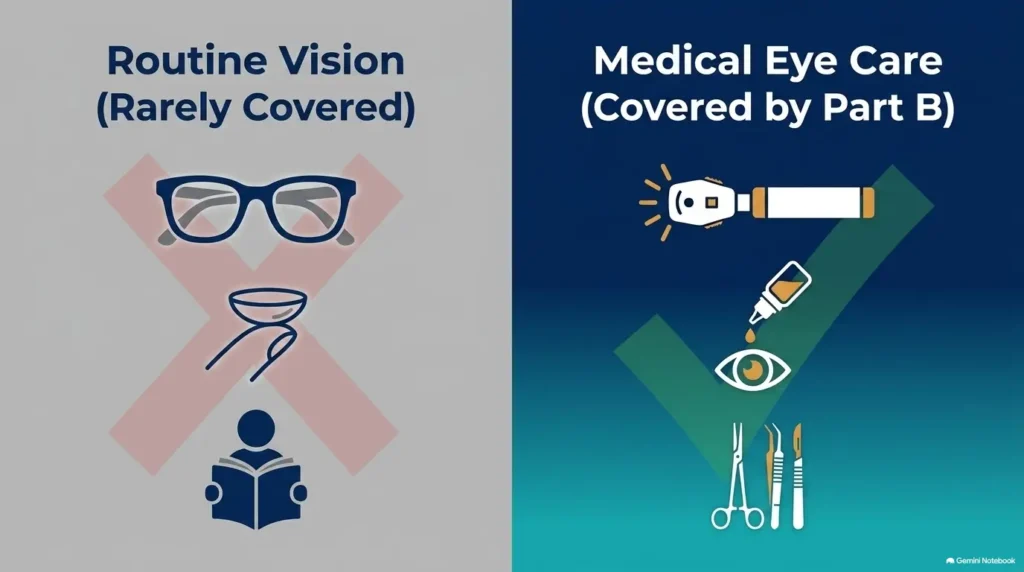
Medicare-Covered Eye Situations to Know
Original Medicare’s routine-vision exclusion is real, but it does not mean Medicare ignores eye disease. Several important eye-care situations have specific Part B coverage rules.
Diabetic retinopathy eye exams
If you have diabetes, Medicare Part B covers an eye exam for diabetic retinopathy once a year when Medicare’s eligibility and provider requirements are met. After the Part B deductible, the Medicare.gov coverage page currently states that the beneficiary generally pays 20% of the Medicare-approved amount, with other costs possible depending on the setting and circumstances.
If diabetes is the reason you are booking, do not describe the appointment to the front desk merely as “my annual eye exam.” Tell them you have diabetes and are asking about the Medicare-covered diabetic eye examination. For a deeper cost discussion, see what Medicare diabetic eye exams may cost.
Glaucoma screening for people at high risk
Part B covers a glaucoma screening once every 12 months for beneficiaries who qualify as high risk. Medicare currently lists diabetes, a family history of glaucoma, African American beneficiaries age 50 or older, and Hispanic beneficiaries age 65 or older among its qualifying categories. After the Part B deductible, 20% of the Medicare-approved amount generally applies.
If diabetes is also part of the picture, this guide to Medicare glaucoma screening for people with diabetes can help you separate the screening benefit from routine vision care.
Macular degeneration diagnosis and treatment
Medicare Part B may cover certain diagnostic tests and treatments for age-related macular degeneration when coverage requirements are satisfied. The point is useful beyond AMD itself: Medicare’s eye benefits are often tied to diagnosing or treating disease, not to purchasing clearer everyday vision through a new glasses prescription.
Eyewear after cataract surgery has a special rule
Original Medicare does not usually cover ordinary eyeglasses or contact lenses. There is an important exception: Part B covers one pair of eyeglasses with standard frames, or one set of contact lenses, after each covered cataract surgery that implants an intraocular lens.
Special-rule alert: Do not assume the ordinary “Medicare doesn’t cover glasses” rule tells the whole story after cataract surgery. The post-surgery benefit has its own conditions. Review the Medicare cataract-surgery glasses rule before ordering eyewear.
The Medicare eye-visit decision flow
1. REASON
Are you seeking new glasses, or evaluation of a symptom, disease or covered screening?
2. SERVICE
Ask which exam, refraction, imaging or testing will actually be billed.
3. PLAN
Original Medicare and Medicare Advantage can have different routine-vision rules and provider networks.
4. PRICE
Get an estimate for anything expected to be non-covered before agreeing to it.
Your 10-Minute Before-You-Book Coverage Check
You do not need to decode the Medicare billing universe before making an eye appointment. You need five pieces of information.
Step 1: Write down why you are actually going
- New glasses or contact-lens prescription only
- New or changing eye symptom
- Follow-up for a diagnosed eye condition
- Diabetic eye examination
- Glaucoma screening
- Care related to cataract surgery
“Eye exam” is too broad. Coverage can change with the answer.
Step 2: Call the office and ask these five questions
- Do you accept my type of Medicare coverage?
- For the reason I described, is this being scheduled as a routine vision exam or a medical eye visit?
- Will a refraction be performed, and is there a separate patient charge for it?
- If I have Original Medicare, do you accept Medicare assignment for the covered service?
- What services could be non-covered, and what is the estimated patient price?
If you are enrolled in Medicare Advantage, add: “Are you in network for my exact plan, and does my plan require a referral, authorization or specific vision-benefit provider?”
Step 3: Verify the provider instead of relying on the office name
A sign saying “Eye Center” tells you almost nothing about Medicare participation. For Original Medicare, you can use Medicare’s Care Compare provider search as one verification step.
For Medicare Advantage, verify the individual clinician or location through the plan’s current directory or member service line. A practice that accepts Original Medicare is not automatically in network for every Medicare Advantage plan.
A useful phone script
“I have Medicare and I’m coming because of [symptom, condition, diabetes screening, glaucoma risk, or glasses prescription]. Before I book, can you tell me whether this is expected to be billed as a Medicare-covered medical service or a routine vision service? Also, will there be a separate refraction or other non-covered charge?”
This is the free-first step. Do it before comparing eyeglass packages, paying for a membership, or assuming you need a different type of insurance.
How Much You May Pay for an Optometrist Visit
There is no single “Medicare optometrist copay” that applies to every appointment.
For most Part B-covered doctor or other eligible provider services, Medicare states that after the Part B deductible you generally pay 20% of the Medicare-approved amount. Other insurance, the provider’s Medicare status, the setting and the services performed can affect your final responsibility.
| Visit type | What may happen with Original Medicare | Best question before paying |
|---|---|---|
| Routine glasses exam/refraction | You generally pay the non-covered service cost | “What is your self-pay price for the exam and refraction?” |
| Medically necessary eye visit | Part B cost-sharing may apply if the service is covered | “Do you accept Medicare assignment?” |
| Covered preventive eye service | Service-specific Medicare rules and cost-sharing apply | “Do I meet the Medicare eligibility rules for this screening?” |
| Medicare Advantage routine vision | Plan-specific copay, allowance, network or frequency limits may apply | “What is my plan benefit at this exact location?” |
| Extra test or non-covered add-on | You may owe a separate amount | “Is this required for my medical care, and what will I owe if Medicare does not pay?” |
Why the office’s retail price still matters
If the entire reason for the appointment is an updated glasses prescription, Original Medicare’s lack of routine vision coverage means the cash price becomes relevant immediately. Comparing self-pay exam fees can make more sense than trying to make a non-covered service fit inside a medical benefit.
Medicare Advantage changes the comparison
Medicare Advantage plans must cover medically necessary services covered by Original Medicare and may offer extra benefits that Original Medicare does not, including routine vision care. The exact benefit can vary by plan, so check the current plan rules rather than assuming “Medicare Advantage covers eye exams.”
Key takeaway: A generous-sounding vision allowance can still be poor value if your preferred optometrist is out of network, the exam benefit is limited by frequency, or the allowance applies to frames rather than the medical service you actually need.
Show me the nerdy details
A Medicare eye-care bill is easier to understand when you stop treating “the appointment” as one indivisible product. Medicare processes billed services according to coverage rules, medical necessity and the clinician’s eligibility to provide the particular service.
That is why a medically necessary eye evaluation and a routine refraction performed during the same encounter can lead to different payment results.
With Original Medicare, a provider may give you an Advance Beneficiary Notice of Noncoverage when they believe Medicare may not pay for a service that can sometimes be covered. Medicare notes that providers are not required to issue an ABN for services Medicare never covers. An ABN is not itself a Medicare claim denial.
Optometrist vs. Ophthalmologist: Which Should You Book?
Medicare coverage should not be the only reason you choose one type of eye professional over another. Start with the care you need.
| Need | Optometrist may be a good starting point | Ophthalmologist may be needed |
|---|---|---|
| Routine vision correction | Often, yes | Usually not necessary solely for routine glasses |
| Primary evaluation of many eye symptoms | Often appropriate within the clinician’s scope of practice | May be appropriate depending on symptoms and condition |
| Ongoing eye disease management | May provide care depending on condition and state scope | Frequently involved for complex disease |
| Eye surgery | May evaluate and refer | Medical doctor who performs eye surgery |
| Urgent retinal or surgical problem | May identify the problem and arrange referral | Specialist or emergency eye care may be required promptly |
State laws affect what optometrists may diagnose, treat and prescribe. Medicare coverage cannot extend a clinician’s legal scope of practice, and a service does not become covered simply because a professional is legally permitted to provide it.
If describing the problem is harder than deciding which professional to call, use this guide on how to explain vision changes to an eye doctor. “Blurry” can mean near, distance, intermittent, one eye, both eyes, glare-related or something else entirely. Specificity helps the office route you appropriately.
When the Free Coverage Check Is Not Enough
Most billing uncertainty can be reduced with one phone call. Sometimes the remaining problem is not really an insurance problem at all.
If this is the main problem, do this next
You only need new glasses
Compare the self-pay routine exam/refraction price or check your Medicare Advantage routine-vision benefit.
You have a new symptom
Describe the symptom when booking and ask whether a medical eye evaluation is appropriate.
The office cannot confirm your plan
Verify coverage with Medicare or your Medicare Advantage plan before relying on the provider’s estimate.
Symptoms are sudden or alarming
Prioritize timely medical evaluation. Billing questions can follow urgent eye care.
If you are given an ABN
With Original Medicare, an Advance Beneficiary Notice of Noncoverage can tell you that the provider expects Medicare may not pay for an item or service and can show an estimated cost. Medicare explains that an ABN is not an official denial. Depending on the option you choose, you may be able to have the claim submitted and appeal if Medicare denies payment.
Read the notice before signing. Ask which exact service is in question and why the office expects Medicare may not pay.
If you have Medicare Advantage
Do not use Original Medicare’s provider rules as a substitute for your plan’s network rules. Confirm the office, clinician, service and any required authorization directly with your plan when the cost matters.
You can review the official Original Medicare versus Medicare Advantage comparison if the distinction itself is causing confusion.
Mistakes That Can Create a Surprise Eye-Care Bill
Mistake 1: Asking only whether the office “takes Medicare”
The answer may be yes while the particular service you want remains non-covered. Separate provider participation from service coverage.
Mistake 2: Assuming every test done during a covered visit is covered
Ask whether any refraction, imaging, test or add-on is expected to be billed separately and whether the office expects Medicare to cover it.
Mistake 3: Treating Medicare Advantage like Original Medicare with a different card
Medicare Advantage plans can have provider networks and additional benefit rules. A routine vision benefit can also have its own participating providers and limits.
Mistake 4: Shopping for frames before understanding the medical problem
If vision has changed unexpectedly, an updated pair of glasses may not be the whole answer. Have the change appropriately evaluated rather than treating every loss of clarity as a shopping problem.
Before spending money: Confirm the reason for the vision change, the service being billed, your coverage type, the provider’s status and the non-covered estimate. If all five are clear, most of the financial fog has already lifted.
Frequently Asked Questions
Does Original Medicare pay for a yearly optometrist eye exam?
Not simply because it is a yearly eye exam. Original Medicare generally does not cover routine eye exams or refractions for eyeglasses or contact lenses. Specific preventive eye benefits, such as eligible diabetic-retinopathy exams and glaucoma screenings for qualifying beneficiaries, have separate rules.
Can Medicare cover an optometrist if I have blurry vision?
Potentially. Part B can cover medically necessary services from eligible providers when Medicare requirements are met. Coverage depends on what is medically evaluated or treated and which services are billed, not merely on the symptom “blurry vision.”
Does Medicare pay for refraction during a covered medical eye exam?
Original Medicare generally does not cover routine refraction for determining a glasses or contact-lens prescription. This can create a separate out-of-pocket charge even when another part of the appointment is covered.
Does Medicare Advantage cover optometrist visits?
Medicare Advantage plans cover the medically necessary services Original Medicare covers and may add routine vision benefits. Coverage, copays, provider networks, eyewear allowances and frequency limits can differ by plan. Verify your specific plan before the appointment.
Do I need an ophthalmologist instead of an optometrist for Medicare to pay?
Not automatically. Medicare recognizes certain covered services from optometrists. The right professional depends on the care you need, the optometrist’s state-authorized scope of practice and Medicare’s rules for the particular service.
Does the Welcome to Medicare visit include a full eye exam?
No. Medicare’s Welcome to Medicare preventive visit can include a simple vision test, but that is not the same thing as Medicare coverage for a routine comprehensive eye exam or refraction for glasses.
What should I do if my Medicare eye-care claim is denied?
First identify the exact denied service rather than assuming the entire appointment was rejected. Compare the claim or Medicare Summary Notice with the services you received, ask the provider how the item was billed, and review your Medicare appeal rights if you believe a covered service was denied incorrectly.
Optional video: Open the video on YouTube (external site).
Your Next 15 Minutes: Make the Coverage Call Before the Appointment
Take out your Medicare card, your appointment information and one piece of paper.
- Write one sentence describing why you need the eye appointment.
- Circle whether you have Original Medicare or Medicare Advantage.
- Call the optometrist and ask whether the appointment is routine vision care or medical eye care.
- Ask whether a refraction will be performed and what it costs if Medicare does not pay.
- Verify the provider through Medicare or your Medicare Advantage plan if coverage is important to your decision.
If the answer is “This is routine vision care,” you now know to compare the self-pay price or your plan’s extra vision benefit. If the answer is “This is medical eye care,” ask which Part B cost-sharing and non-covered services could remain. If the answer is vague, keep asking until the service and estimated patient responsibility are clear.
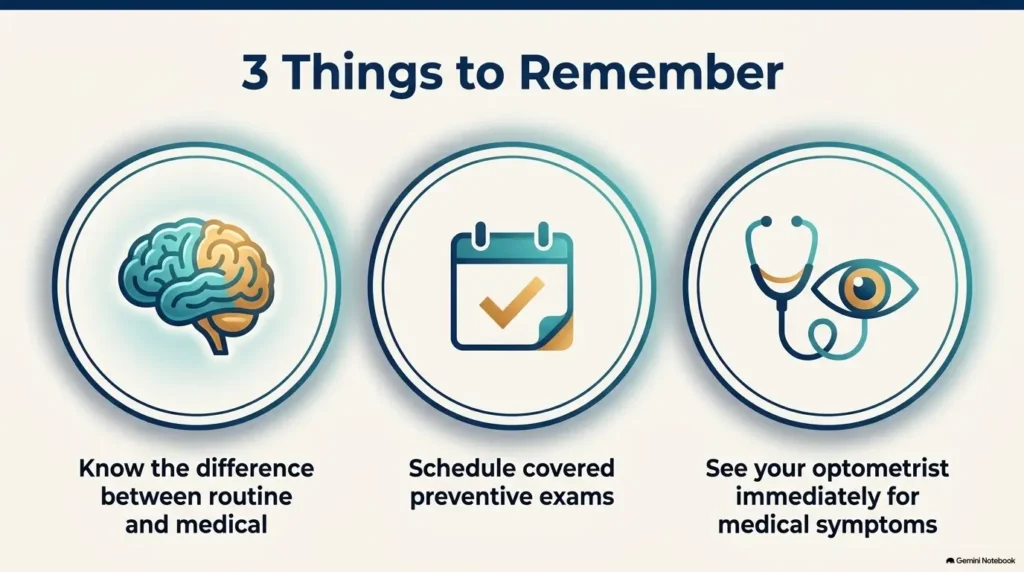
That distinction, routine vision correction versus medically necessary eye care, is the hinge on which most Medicare optometrist questions turn. Once you know which side of the hinge your appointment sits on, the bill becomes much easier to anticipate.
One final check
If your vision problem is primarily about reading, everyday near vision or whether ordinary reading glasses are still appropriate, the next question may no longer be about Medicare. It may be about the right vision correction. This guide to reading glasses for seniors continues that decision without assuming a purchase is necessary.
Last reviewed: 2026-09
PUT THIS GUIDE TO WORK · INTERACTIVE WORKSHEET
Eye-care out-of-pocket cost planner
Use this worksheet alongside the article: Does Medicare Cover an Optometrist Visit? When Part B Pays and When It Doesn’t. Use the fields provided to organize your notes and next actions, then save your worksheet.
Your entries stay in this page and are cleared when you reload. No account is needed. Saved files are downloaded only to your device.
This worksheet does not establish coverage or eligibility. Use the Part B model only after the provider confirms a covered service and accepts assignment. It uses deductible applied + 20% of the remaining approved amount + extra charges. Medigap, Medicaid, other insurance, facility charges, excess charges, and plan-specific rules are not modeled. A plan quote is entered directly rather than applying the Part B formula.
Verify Medicare’s current costs and assignment rules · Worksheet rules checked October 20, 2026.
How to use your result
Save the worksheet before leaving this page. Recheck any quote, date, or instruction with the relevant provider, pharmacist, manufacturer, or official organization. A completed checklist means you recorded the steps, not that an outcome is guaranteed.
Worksheet added October 20, 2026. Read the article above for context and its stated review scope.