


There is no single Medicare Advantage eye exam copay that applies nationwide in 2026. Your cost depends on your specific plan, why you are seeing the eye doctor, whether the provider is in network, and whether the visit is being processed as a supplemental routine-vision benefit or as Medicare-covered medical eye care.
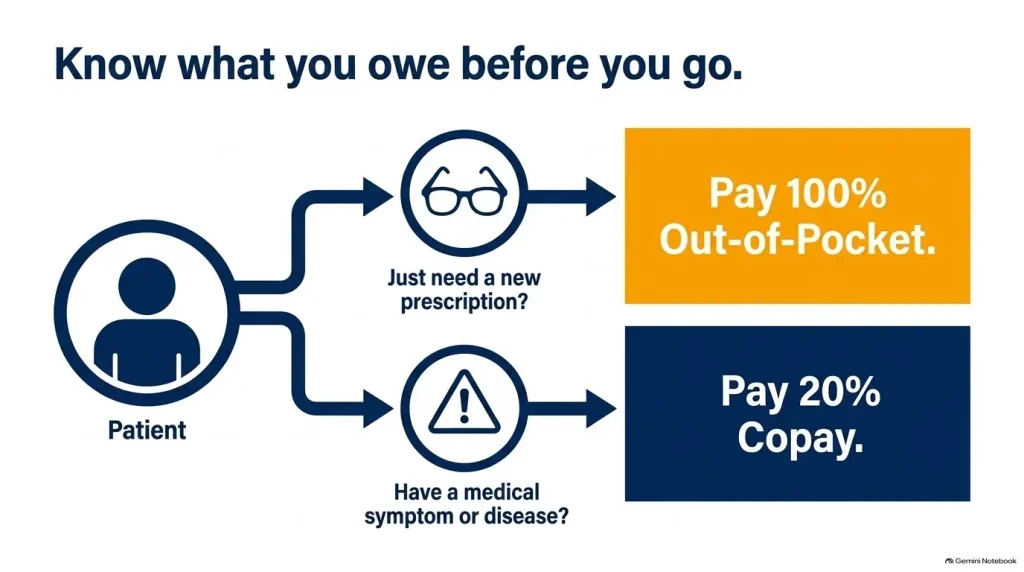
A plan may offer a low or even $0 copay for an in-network routine vision exam while applying a different copay or coinsurance to an ophthalmology visit for glaucoma, cataracts, diabetic eye disease, retinal problems, or new vision symptoms. Out-of-network care can cost more or may not be covered under the supplemental vision benefit at all.
The most important step is therefore not finding an internet-wide average. It is identifying which type of eye exam you are actually having and checking that service in your current plan documents.
If you are still sorting out what Medicare considers a routine exam versus medical eye care, start with this guide to Medicare eye exam coverage. That distinction is the hinge on which much of the billing turns.
Table of Contents

Why Medicare Advantage Eye Exam Copays Vary
Medicare Advantage, also called Medicare Part C, is offered by private insurers approved by Medicare. Medicare explains that these plans must cover the medically necessary services Original Medicare covers, while plans may also provide extra benefits such as routine vision, hearing, and dental services. The details of those extra benefits are plan-specific.
You can review the basic distinction on Medicare’s Original Medicare versus Medicare Advantage comparison.
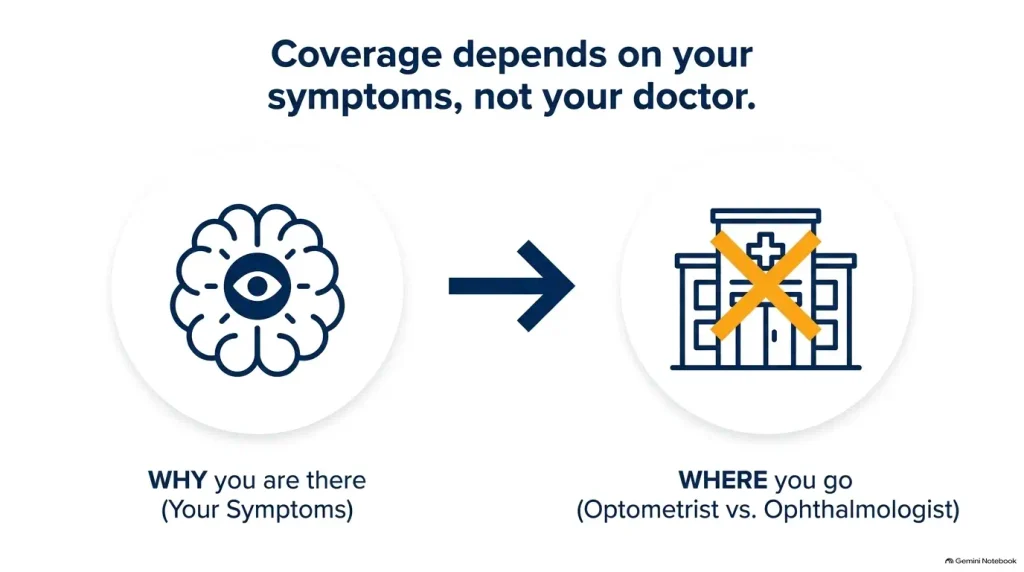
That creates two overlapping vision-benefit lanes inside many Medicare Advantage plans:
- Medicare-covered medical eye care: services the plan must cover because they are Medicare benefits, subject to the plan’s applicable cost-sharing and coverage rules.
- Supplemental routine vision: extra services such as a routine prescription exam or eyewear benefit that Original Medicare generally does not cover.
The copay for those two lanes does not have to be the same. That is why simply asking, “What is my eye exam copay?” may produce an incomplete answer.
Routine Eye Exam Copay vs. Medical Eye Exam Copay
| Reason for the visit | How it may be handled | What to verify |
|---|---|---|
| Routine exam for a new glasses prescription | Supplemental Medicare Advantage vision benefit, if offered | Exam copay, frequency, vision network, refraction coverage |
| New blurry vision or another symptom | Medical eye-care benefit when coverage requirements are met | Medical copay or coinsurance, network, authorization |
| Known glaucoma or another eye disease | Medical evaluation and treatment | Specialist cost sharing and separate diagnostic-test charges |
| Diabetic retinopathy exam | Medicare-covered service when eligibility requirements are met | Plan-specific cost sharing and provider requirements |
| High-risk glaucoma screening | Medicare-covered preventive service for eligible beneficiaries | Eligibility, frequency and plan cost sharing |
| Refraction during a medical appointment | May be treated separately from the medical examination | Whether your supplemental vision benefit covers the refraction |
Original Medicare generally does not cover routine eye examinations or refractions performed to prescribe eyeglasses or contact lenses. Medicare’s routine eye exam coverage guidance specifically tells beneficiaries that some Medicare Advantage plans may provide these services as additional benefits.
A Medicare Advantage member can therefore have routine coverage that someone using Original Medicare does not have. But “vision included” still does not tell you the copay, frequency limit, provider network, or whether refraction is included.
Refraction deserves special attention because it can generate its own charge. If that is the part of the bill you are concerned about, see the more focused explanation of Medicare refraction coverage.
Does Medicare Advantage Have a Standard $0 Eye Exam Copay?
No federal rule gives every Medicare Advantage member a universal $0 routine eye exam copay. Some plans can offer a $0 in-network routine vision examination as a supplemental benefit, while another plan may use different cost sharing, frequency limits, or network requirements.
Medicare states that deductibles, copayments, and coinsurance under Medicare Advantage vary by plan. Plans set their own cost-sharing structures within Medicare’s rules, and those amounts can change from one plan year to another.
This is why a friend saying, “My Medicare eye exam was free,” does not establish what you will pay. They may have a different insurer, plan contract, county, provider network, or type of appointment.
For a broader explanation of how the vision benefit fits together, including routine care and medical eye care, see Medicare vision coverage.
Your Medical Eye Exam May Have a Different Copay
Suppose your Medicare Advantage plan advertises a routine vision exam with little or no cost sharing. That does not necessarily mean every visit to an optometrist or ophthalmologist has that same copay.
If the doctor is evaluating an eye disease, injury, new symptom, or another medically necessary problem, the visit may be processed under the plan’s medical benefits rather than its supplemental routine-vision benefit.
Your Evidence of Coverage may classify that appointment similarly to an outpatient physician or specialist service. Diagnostic testing performed during the visit may also have its own benefit rules.
So a “$0 vision exam” advertisement should never be read as “$0 for every ophthalmology appointment, test, and treatment.”
Diabetic Eye Exams Can Follow Different Rules
Medicare Part B covers an eye exam for diabetic retinopathy once a year for people with diabetes when Medicare’s provider requirements are met. Under Original Medicare, the beneficiary generally pays 20% of the Medicare-approved amount after the Part B deductible, with an additional copayment possible in a hospital outpatient setting.
You can verify the underlying Medicare benefit on the official diabetic eye exam coverage page.
With Medicare Advantage, however, you should look at your plan’s specific cost-sharing rules rather than automatically applying Original Medicare’s 20% figure to your bill. Medicare Advantage plans can use their own approved cost-sharing structure for covered services.
If diabetes is the reason for the appointment, the site’s Medicare diabetic eye exam cost guide goes deeper into the deductible, coinsurance, medical-versus-routine distinction, and possible additional services.
What About Glaucoma Screening?
Medicare Part B covers a glaucoma screening once every 12 months for people Medicare considers at high risk. Medicare currently lists people with diabetes, people with a family history of glaucoma, African Americans age 50 or older, and Hispanic beneficiaries age 65 or older among the qualifying groups.
Under Original Medicare, the official glaucoma screening benefit generally involves the Part B deductible and 20% coinsurance rather than automatically being free.
A Medicare Advantage enrollee should check the plan’s own benefit chart for the actual copay or coinsurance. Do not assume that the routine vision exam copay and the glaucoma screening copay are identical merely because both happen at an eye doctor’s office.
The Same Appointment Can Produce More Than One Charge
This is one of the easiest Medicare vision billing traps to miss. An appointment is not necessarily processed as one indivisible service.
You could have a medical eye examination and then receive a refraction, retinal image, visual-field test, OCT scan, or another diagnostic service. Different line items can follow different coverage and cost-sharing rules.
- The office visit may have a medical specialist copay.
- A routine refraction may be processed through a supplemental vision benefit or remain your responsibility.
- A diagnostic test may have separate cost sharing.
- Eyeglasses or contact lenses may use an allowance or benefit completely separate from the examination.
- Optional frame, lens, coating, or contact-lens upgrades can create additional charges.
The useful question is therefore, “What will I pay for each expected service?” rather than simply, “What is the copay for the appointment?”
In-Network Status Can Change the Bill Dramatically
Medicare advises Medicare Advantage members to check whether a doctor or provider participates in their plan’s network. Some plans permit out-of-network care but charge the member more, while other benefit structures are more restrictive.
Medicare’s guidance on getting services with Medicare Advantage specifically recommends checking network status with your plan before receiving care.
For vision benefits, ask a slightly more precise question:
“Is this provider in network for my exact Medicare Advantage plan, and are they in network for the benefit that will be used for this particular eye exam?”
That extra sentence matters because a plan may administer supplemental routine vision differently from Medicare-covered medical services. Confirm rather than assuming the eye office’s general statement that it “takes your insurance” settles every part of the visit.
Copay vs. Coinsurance: Do Not Treat Them as the Same Number
A copay is generally a fixed dollar amount specified by the plan for a covered service. Coinsurance is generally a percentage of the allowed or approved cost.
That distinction can matter when you are comparing plans or trying to estimate the final bill. A fixed copay can usually be understood immediately from the benefit document. A percentage-based coinsurance amount cannot be converted into an exact dollar total until you know the amount to which the percentage applies.
Also remember that “covered” does not automatically mean “$0.” A service can be fully recognized as a plan benefit and still require copayment, coinsurance, or deductible-related cost sharing.
How to Find Your Exact Medicare Advantage Eye Exam Copay
The fastest reliable answer usually lives in your own plan documents, not in a national price list.
1. Find your current Evidence of Coverage
Medicare says plans generally send members an Evidence of Coverage each year. It explains what the plan covers, what you pay, and other benefit rules. Medicare provides additional information about this document on its Evidence of Coverage page.
Make sure you are reading the document for the current plan year. A 2025 copay should not be assumed to remain the same in 2026.
2. Search for more than the word “vision”
Useful search terms can include:
- Vision services
- Routine eye exam
- Eye examination
- Ophthalmologist
- Optometrist
- Glaucoma screening
- Diabetic retinopathy
- Specialist visit
- Refraction
- Eyewear
The purpose is to find both the supplemental routine benefit and the medical eye-care benefit. Reading only one can leave half the bill in the shadows.
3. Check the frequency limit
A routine vision benefit may be limited by how often it can be used. Do not interpret a listed exam copay as permission to receive unlimited exams at that price.
4. Confirm the provider before booking
Use the plan’s current directory or contact member services to verify the individual provider and location. Network status can change, so confirmation close to the appointment is more useful than relying on an old directory printout.
5. Ask whether refraction is included
An eye office can perform a medically necessary examination and a prescription refraction during the same appointment. Ask whether your plan covers the refraction or whether the office expects you to pay for it separately.
A Phone Script That Gets a Better Answer
When you call the plan, use the actual reason for the appointment rather than saying only, “I need an eye exam.”
“I have an eye appointment for [routine glasses prescription / diabetes / glaucoma screening / cataract follow-up / new vision symptoms]. What will my copay or coinsurance be with this provider? Is the service being covered under my routine vision benefit or my medical benefit, and is refraction included?”
Then ask the representative to confirm:
- The provider and location are in network.
- The applicable exam copay or coinsurance.
- Whether a deductible applies.
- The permitted frequency.
- Whether a referral or prior authorization is required.
- Whether refraction is included.
- Whether diagnostic testing has separate cost sharing.
- Whether eyewear is a separate benefit.
Write down the date of the call and the answer you received. It does not guarantee how every claim will process, but it creates a useful record if the eventual Explanation of Benefits does not match what you expected.
Do Not Compare Medicare Advantage Plans on the Eye Exam Copay Alone
A low routine eye exam copay can look attractive, but it is only one small tile in a much larger Medicare mosaic.
If you are comparing plans, also consider the monthly premium, medical provider network, prescription coverage, hospital and specialist cost sharing, maximum out-of-pocket limit for covered Medicare services, prior-authorization requirements, eyewear allowance, and whether the doctors you already use participate in the plan.
Medicare notes that Medicare Advantage plans have an annual limit on what members pay for covered Medicare services. The existence of that limit is valuable, but it should not be confused with a promise that every supplemental vision purchase or optional eyewear upgrade counts toward it in the same way. Check the plan’s documents for the benefit you are using.
If your immediate concern is simply estimating what an eye appointment might cost under different Medicare situations, the site’s Medicare eye exam cost guide for seniors provides a broader cost framework.
What to Do Before Your Next Eye Appointment
Before the visit, identify the reason for the appointment in one sentence. Then check the matching benefit in your 2026 Evidence of Coverage and verify the provider with the plan.
If it is a routine glasses exam, ask about the supplemental vision benefit, refraction, frequency limit, and eyewear rules. If it is for diabetes, glaucoma, cataracts, an eye disease, or a new symptom, ask about your medical eye-care cost sharing instead.
The practical rule is simple: the words “eye exam” are not enough to predict your Medicare Advantage copay. Identify the service, identify which benefit is paying for it, verify the network, and then confirm the cost sharing for your exact plan.
If you experience sudden vision loss, a new curtain or shadow in your vision, a major burst of flashes or floaters, severe eye pain, or another urgent visual change, seek appropriate medical care rather than delaying treatment while trying to determine the copay.