


Medicare Routine Eye Exam Coverage Explained
Why the Reason for the Exam Can Change the Bill
You can sit in the same eye doctor’s chair, have several of the same tests, and still face very different Medicare coverage depending on why the visit is happening. That is where routine vision care becomes surprisingly slippery.
Under Original Medicare, an eye exam performed mainly to determine a prescription for eyeglasses or contact lenses is generally not covered. But Medicare Part B can cover medically necessary eye care and specific eye screenings when the applicable requirements are met.
The useful question, then, is not simply, “Does Medicare cover eye exams?” It is, “What is this appointment being done for, which parts are covered, and is a non-covered refraction being added?” Answer those before the visit and the bill becomes much easier to anticipate.
See why two similar-looking eye appointments can be billed differently.
Use a short call script before the appointment instead of guessing.
Know what to verify before paying for routine vision care or extra benefits.
The goal is not to memorize Medicare billing. It is to ask the right question before your eyes are dilated and the receipt is printed. 👓
Snapshot
Who this is for: People with Medicare, caregivers, or family members trying to understand whether an upcoming eye exam will be covered.
The problem: Original Medicare treats routine prescription-focused eye care differently from medically necessary eye care and certain covered screenings.
After reading: You will know what Medicare commonly covers, what it normally excludes, what to ask the eye doctor’s office, and when Medicare Advantage may change the answer.
Table of Contents
Does Medicare Cover Routine Eye Exams? The Short Answer
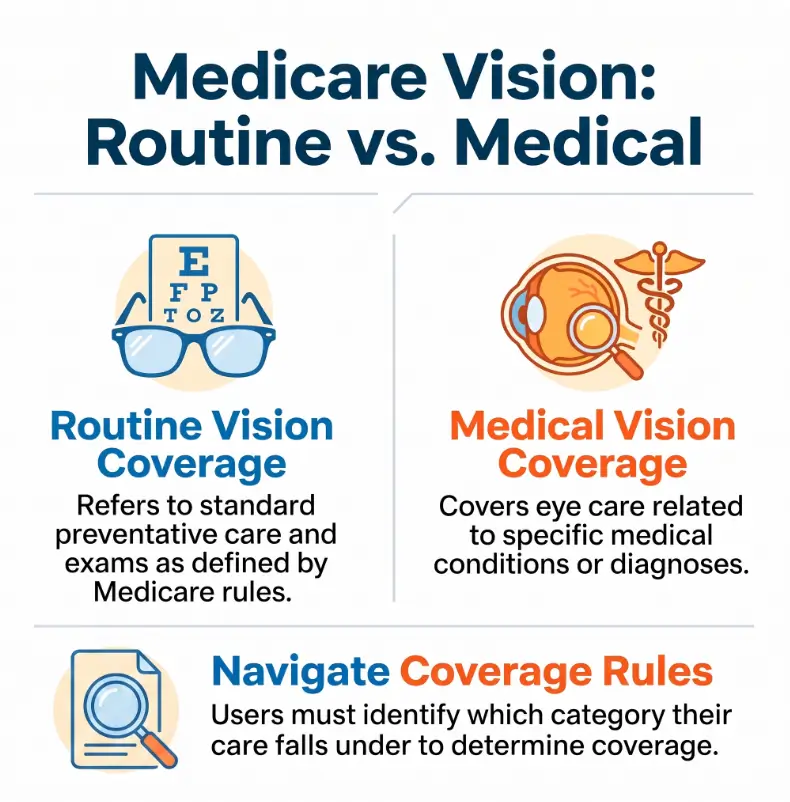
Original Medicare generally does not cover routine eye exams performed for eyeglasses or contact lenses. Medicare describes these as routine eye exams or eye refractions, and the beneficiary generally pays the cost of a non-covered service.
That does not mean Medicare never pays for an eye doctor visit.
Part B covers medically necessary doctor services, which can include services from an optometrist in appropriate circumstances. It also has specific benefits for certain eye screenings, tests, treatments, and post-cataract corrective lenses.
Key takeaway
Do not ask only, “Do you take Medicare?” Ask whether your reason for the visit is being billed as routine vision care or medically necessary eye care, and whether a separate refraction fee is expected.
A glasses prescription is the classic dividing line
If the purpose of the appointment is simply to check your prescription so you can buy new glasses or contacts, Original Medicare’s routine vision exclusion is likely to matter.
If, instead, you are being evaluated or followed for an eye disease, a concerning symptom, or another medically necessary reason, some services may fall under Part B coverage rules.
Even then, do not assume every service performed during the visit is covered. A refraction may remain a separate non-covered item even when another part of the visit qualifies for Medicare payment.
The word “annual” does not create coverage
An office may call an appointment an annual eye exam because that is how often the patient comes in. Medicare coverage does not automatically follow from that label.
The purpose of the service, eligibility requirements, medical necessity, provider rules, and the individual services billed are what matter.
Before you act
This article explains Medicare coverage structure, not whether a particular eye condition is present or whether a specific claim must be paid.
Your eye professional determines what care is medically appropriate. Medicare, a Medicare Advantage plan, and the providers involved determine coverage and claim processing under the applicable rules. Confirm the details for your own appointment before relying on a cost estimate.
Routine vs. Medical Eye Exams: The Distinction That Changes the Bill
The easiest way to understand Medicare eye exam coverage is to separate three questions that often get bundled together.
Three Questions, Three Different Decisions
Routine vision care
Routine vision care typically includes the type of examination a person schedules because their glasses feel weak, reading has become harder, or they want an updated prescription despite having no medical complaint requiring evaluation.
Someone who mainly needs stronger near correction may also find it useful to review the practical differences between reading glasses options for older adults before automatically assuming the problem requires an expensive eyewear change.
Medically necessary eye care
A medical eye visit is focused on diagnosing, monitoring, or treating a health problem rather than simply measuring how much lens correction you need.
Examples can include evaluation and management of diagnosed eye disease or symptoms that require medical assessment. Part B’s broader doctor-service benefit covers medically necessary services when Medicare’s requirements are satisfied.
Why a refraction can appear as a separate charge
A refraction is the part of an eye examination used to determine the lens prescription needed to correct vision.
This creates a common surprise: the doctor may evaluate a covered medical condition during the appointment, while the prescription-measuring portion remains outside Original Medicare’s routine vision coverage.
Before the visit, ask the office whether refraction is included, separately billed, optional for your situation, and what the self-pay amount would be if Medicare does not cover it.
| Appointment situation | Coverage question to ask | Possible friction |
|---|---|---|
| “I just need my glasses prescription updated.” | Is this being treated as a routine refraction? | Original Medicare generally does not cover routine prescription eye exams. |
| “My doctor is monitoring an eye condition.” | Which services are medically necessary and being submitted to Part B? | A refraction or other excluded service may still be separate. |
| “I qualify for a Medicare eye screening.” | Does this visit meet the eligibility and frequency rules? | Extra testing beyond the covered benefit can change the bill. |
| “I have Medicare Advantage.” | What routine vision benefit does my specific plan include? | Network, frequency, copay, allowance, and authorization rules may differ. |
Eye Care Medicare Part B May Cover Even Though Routine Exams Are Excluded
The routine-eye-exam exclusion is only one piece of Medicare’s vision rules. Several important eye services can fall under Part B.
Diabetic retinopathy eye exams
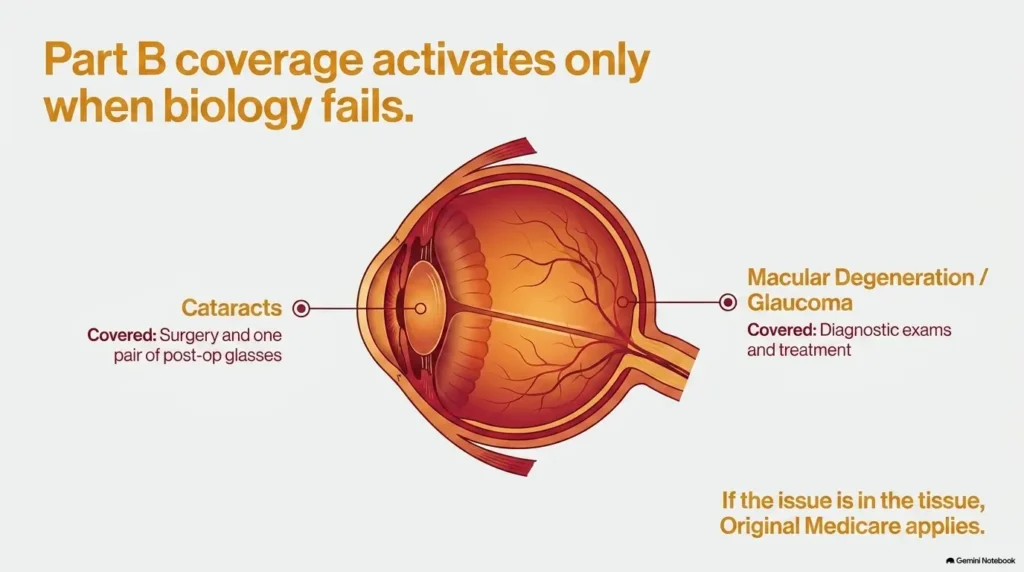
For people with diabetes, Part B covers an eye exam for diabetic retinopathy once a year when the eligibility and provider requirements are satisfied. After the Part B deductible, the beneficiary generally pays 20% of the Medicare-approved amount for the doctor’s services, with possible additional costs in a hospital outpatient setting.
Glaucoma screening for people at high risk
Part B covers glaucoma screening once every 12 months for eligible people at high risk. Medicare currently identifies qualifying risk categories that include diabetes, a family history of glaucoma, African Americans age 50 or older, and Hispanic beneficiaries age 65 or older. The Part B deductible and 20% coinsurance generally apply.
Macular degeneration tests and treatment
Part B may cover certain diagnostic tests and treatments for age-related macular degeneration, including certain injectable drug treatments. In most cases, the Part B deductible and 20% coinsurance apply to covered doctor services and drugs, with additional facility cost-sharing possible in a hospital outpatient setting.
The important distinction remains the same: Medicare is paying under a disease-related medical benefit, not creating a blanket annual routine vision benefit.
Corrective lenses after cataract surgery
Part B also has a specific corrective-lens benefit after covered cataract surgery that implants an intraocular lens. Medicare covers one pair of eyeglasses with standard frames or one set of contact lenses after each qualifying surgery. The Part B deductible and coinsurance rules apply, and upgrades can create additional out-of-pocket costs.
If vision feels unbalanced after cataract treatment, the coverage question should be kept separate from the clinical question. For example, readers dealing with a large prescription difference between the two eyes may find the explanation of anisometropia after cataract surgery useful when preparing questions for their eye professional.
Key takeaway
Medicare can pay for important eye care without paying for routine prescription testing. Coverage follows the medical reason and benefit rules, not simply the fact that an eye doctor performed the examination.
Show me the nerdy details
Medicare coverage is often service-specific rather than appointment-specific. One encounter can contain a covered evaluation, a covered diagnostic test, and a service Medicare excludes.
That is why asking whether an “eye exam” is covered can produce an unsatisfying answer. The office may need to know the diagnosis, the reason for the encounter, the tests planned, whether the provider participates in Medicare, and whether a separate refraction will be performed.
For the patient, the practical translation is wonderfully low-tech: ask for the expected services and expected patient responsibility before the appointment whenever possible.
What You May Pay: Separate the Exam, Refraction, Tests, and Eyewear
Trying to find one universal “Medicare eye exam cost” is usually the wrong approach. The bill can contain several different pieces with different coverage rules.
| Cost component | Original Medicare position | What to verify |
|---|---|---|
| Routine prescription eye exam / refraction | Generally not covered | Office self-pay fee and whether refraction is separately charged |
| Medically necessary doctor service | May be covered under Part B | Medical reason, provider participation, deductible and coinsurance |
| Covered glaucoma screening | Part B benefit for eligible high-risk patients | Eligibility and 12-month frequency rule |
| Diabetic retinopathy exam | Part B benefit for people with diabetes | Provider requirements and annual frequency |
| Most ordinary glasses or contacts | Generally not covered | Any Medicare Advantage or separate vision benefit |
| Qualifying post-cataract lenses | Specific Part B coverage available | Participating supplier, standard benefit, upgrade charges |
Why Medicare’s 20% figure is not your complete price quote
For many covered Part B eye services, Medicare states that after the deductible you generally pay 20% of the Medicare-approved amount. That does not tell you the final dollar figure in advance.
Your responsibility can also depend on the service provided, where you receive it, whether the provider accepts assignment, other coverage you have, and whether non-covered services are added.
Do not confuse “accepts Medicare” with “everything is covered”
An eye doctor’s office can participate in Medicare and still provide you with services that Medicare does not cover.
That is why the most productive pre-appointment question is not, “Do you accept Medicare?” Stop one sentence later and ask, “Which parts of this appointment do you expect Medicare to cover, and which parts would be self-pay?”
Before paying extra for glasses, confirm the real problem
Not every reading problem means the current lenses need replacing. A prescription can be wrong for the task, a pair can be too strong, or near vision can change in a way that deserves a proper examination.
If readers are deciding whether ordinary readers are still appropriate, the guides to what to check when reading glasses stop working and signs reading glasses may be too strong provide useful next-step checks without assuming that buying a new pair is the answer.
The 10-Minute Coverage Check to Do Before an Eye Appointment
This is the centerpiece of the whole article. You do not need to understand billing codes. You need a short list of questions that forces the fuzzy word “eye exam” into specific services.
Step 1: Write down why you are going
- Routine glasses or contact lens prescription update
- New or changing vision symptom
- Follow-up for an existing eye condition
- Diabetic eye examination
- Glaucoma screening
- Post-cataract follow-up or corrective lenses
Do not choose the category you think will produce coverage. Describe the real reason for the appointment. The clinician decides what evaluation is medically appropriate.
Step 2: Call the eye doctor’s office
Use this before-you-call script
“I have Medicare and I’m coming in because [brief reason]. Do you expect the visit to be billed as routine vision care or medically necessary eye care?”
“Will you perform a refraction for a glasses or contact lens prescription, and is there a separate charge for it?”
“Which services do you expect Medicare to cover, and which services should I expect to pay for myself?”
“If I have Medicare Advantage, are you in my plan’s vision and medical networks, if those are different?”
Step 3: Ask your plan when the answer is still fuzzy
- Describe the reason for the visit.
- Give the provider’s name.
- Ask whether the service requires an in-network provider.
- Ask about copays, deductibles, coinsurance, frequency limits, and routine vision allowances.
- Record the date of the call and any reference number offered.
Step 4: Bring your actual vision problem with you
Coverage paperwork should not swallow the clinical conversation. Write down what has changed, which eye is affected, when it started, and which real-world tasks have become harder.
The eye doctor visit checklist for seniors can help organize the appointment, while this guide to explaining vision changes to an eye doctor is useful when “my vision is worse” feels too vague.
Key takeaway
The cheapest coverage check is a phone call. Ask about the reason for the visit, medical versus routine billing, refraction, network status, and expected self-pay charges before you arrive.
How Medicare Advantage Can Change Routine Eye Exam Coverage
Medicare Advantage is the major reason two Medicare beneficiaries can give completely different answers to the question, “Does Medicare cover my annual eye exam?”
Medicare.gov states that Medicare Advantage plans may offer extra benefits that Original Medicare does not cover, including vision benefits. The details depend on the individual plan.
Do not stop at “vision included”
A plan can advertise routine vision benefits while still placing limits on how the benefit works. Before scheduling, verify the pieces that affect actual spending.
- How often is a routine eye exam covered?
- Is there a copay?
- Must you use an in-network vision provider?
- Is refraction included?
- Is there an eyewear allowance?
- Does the allowance apply separately to frames and lenses?
- Are contacts handled differently?
- Are premium lens options outside the allowance?
- Does medical eye care use the same provider network as the routine vision benefit?
Original Medicare, Medicare Advantage, and self-pay routine care
| Path | Best fit | What to compare | Watch out for |
|---|---|---|---|
| Original Medicare | Medical eye care that meets Part B coverage rules | Medical necessity, deductible, coinsurance, provider participation | Routine refraction and ordinary eyewear are generally excluded |
| Medicare Advantage | People whose plan includes useful routine vision extras | Network, copay, frequency, eyewear allowance, restrictions | “Vision included” does not mean unlimited services |
| Self-pay routine eye care | People who need an uncomplicated prescription exam not covered by Original Medicare | Total exam and refraction fee before booking | Do not ignore medical symptoms merely to keep the visit “routine” |
When paying for extra vision coverage may be poor value
Do not judge a vision benefit by the size of an eyewear allowance alone.
Compare the annual cost of the coverage, exam copays, network limitations, frequency rules, what you realistically spend on glasses, and whether the stores or doctors you prefer participate. A generous-looking benefit that pushes you toward higher-priced eyewear or an inconvenient network can still be a weak fit.
Conversely, someone who regularly buys prescription lenses and values a particular included exam benefit may reach a different conclusion. The useful comparison is total expected annual spending, not the loudest benefit printed on the summary page.
Got an Unexpected Eye Exam Bill? Diagnose the Charge Before Paying or Appealing
A denied eye claim does not automatically mean the doctor’s office made a mistake, and it does not automatically mean the charge is correct. Start by identifying what Medicare actually denied.
If the charge says refraction
Ask whether that was the prescription-measuring portion of the examination. If so, Original Medicare’s routine-eye-exam exclusion may explain why it became your responsibility.
If a medical eye service was denied
Ask the provider which service was submitted, why it was medically necessary, and whether there was a coding, eligibility, frequency, documentation, or provider-participation issue. Then compare that explanation with your Medicare Summary Notice or plan Explanation of Benefits.
If you have Medicare Advantage
Determine whether the claim involved the plan’s medical benefit or its supplemental routine vision benefit. The networks, copays, claim pathways, and benefit limits may not be identical.
Unexpected Bill: Follow the Charge, Not the Guess
Which service or test was denied?
Routine refraction, covered screening, medical care, or eyewear?
Check the office bill against the Medicare notice or plan EOB.
Ask the provider or plan what rule produced the patient balance.
Example scenario: one appointment, two different payment rules
Illustrative example: A Medicare beneficiary with an established eye condition schedules a follow-up because the doctor wants to monitor the condition. During the same visit, the patient also says the current glasses are no longer comfortable for reading.
The doctor performs the medically appropriate examination and also measures a new glasses prescription.
The patient later sees Medicare payment associated with the medical portion but a separate patient-responsibility charge for the prescription refraction.
Nothing about the physical room changed. The payment rules changed because the services served different purposes. That is why asking about refraction before the appointment is so useful.
Do not turn a medical symptom into a coverage experiment
If vision changes suddenly, the priority shifts from routine benefits to getting appropriate medical care. A sudden increase in floaters, flashes of light, or a curtain-like shadow in the field of vision can be symptoms of retinal detachment, which the National Eye Institute advises should be evaluated right away.
Cost questions matter, but they should not delay urgent evaluation of a potentially serious vision problem.

Frequently Asked Questions
Does Medicare pay for one routine eye exam every year after age 65?
Original Medicare does not create a general annual routine eye exam benefit simply because someone is 65 or older. It generally excludes routine eye exams for eyeglasses or contact lenses. Separate Part B benefits may apply for particular medical services and qualifying screenings.
Does Medicare cover an eye exam if my vision suddenly becomes blurry?
Part B covers medically necessary doctor services, so an evaluation for a medical problem can fall under different coverage rules from a routine prescription exam. Whether a particular service is covered depends on the medical situation, services performed, provider, and Medicare requirements.
New symptoms should be described accurately to the eye professional rather than relabeled as routine or medical in an attempt to influence coverage.
Does Medicare cover an eye exam for diabetes?
Part B covers an eye exam for diabetic retinopathy once a year for people with diabetes when Medicare’s requirements are met. The Part B deductible and coinsurance rules generally apply.
Does Medicare cover glaucoma testing?
Part B covers glaucoma screening once every 12 months for eligible people considered at high risk under Medicare’s criteria.
Does the Welcome to Medicare visit include an eye exam?
The one-time Welcome to Medicare preventive visit includes a simple vision test, but that should not be confused with a comprehensive routine eye examination for an eyeglasses prescription. Medicare describes the Welcome visit as a preventive check-up rather than a comprehensive physical exam.
Will Medicare pay for my new glasses?
Original Medicare generally does not cover ordinary eyeglasses or contacts. A notable exception is the Part B benefit for one pair of standard-frame eyeglasses or one set of contact lenses after each covered cataract surgery that implants an intraocular lens.
Should I buy separate vision coverage just for routine exams?
Compare the full annual cost rather than focusing only on the advertised exam benefit. Include premiums or membership costs, copays, provider restrictions, eyewear allowances, how frequently you replace lenses, and what you would otherwise pay out of pocket.
If the coverage costs more than the routine care you realistically use, paying directly may be simpler. If you regularly use the included exam and eyewear benefits and the network works for you, the calculation may favor coverage instead.
Your Next 15 Minutes: Find Out What Your Eye Visit Is Really For
Take the appointment reminder, your Medicare or Medicare Advantage card, and a sheet of paper.
- Write one sentence explaining why the eye appointment was scheduled.
- Call the office and ask whether the visit is expected to be routine or medically necessary.
- Ask whether a refraction will be performed and whether it carries a separate patient charge.
- If you have Medicare Advantage, confirm the provider’s network status and your routine vision benefit with the plan.
- Write down any new vision symptoms or real-world tasks that have become harder so the clinical conversation does not get lost in the insurance conversation.
That small exercise separates three things Medicare patients are often forced to untangle after the fact: what your eyes need, what the doctor provides, and what the payer covers.
If the real issue turns out to be ordinary near-vision difficulty rather than an insurance dispute, the next useful step may be understanding common near-vision problems in older adults. If you are preparing for an appointment, keep the focus narrower and use the questions to ask an eye doctor about reading glasses.
The rule worth remembering
With Medicare eye care, the useful question is rarely just “Is an eye exam covered?” Ask why the exam is being performed and which individual services will be billed. That one distinction can prevent a surprising amount of paperwork, confusion, and unnecessary spending.
Last reviewed: 2026-09