
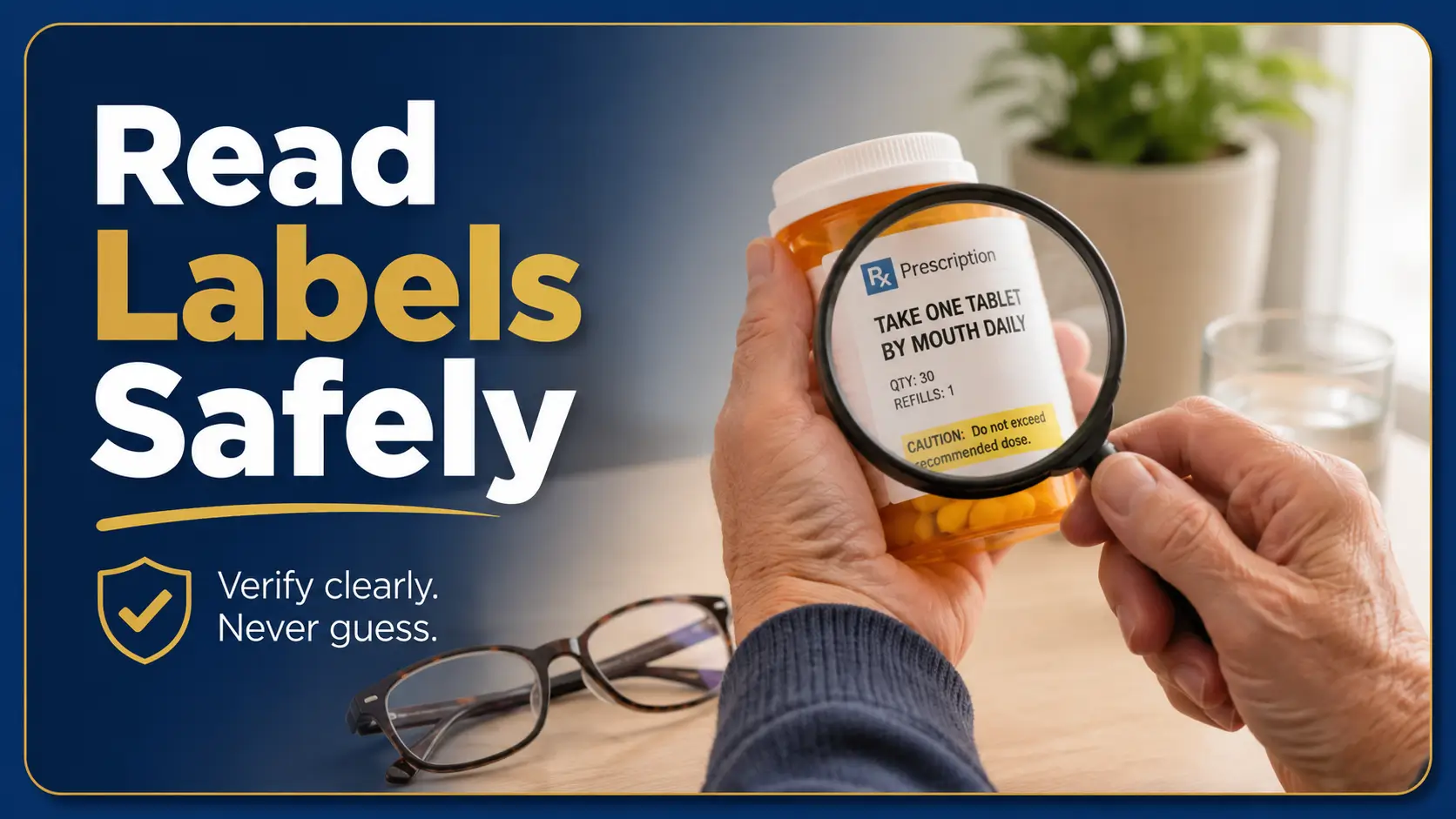
Organize your questions and next steps, then save your worksheet.
Summary and next steps
If any critical medicine detail remains unclear, ask the pharmacist before taking or preparing the dose.
- Use light and the usual reading correction.
- Compare the official label with the current pharmacist-verified list.
- Request an accessible label for any detail you cannot confirm.
Editorial maintenance: October 24, 2026. Summary layout, related links and technical metadata updated. This is not a full clinical review.

Medication Safety for Aging Eyes
How Seniors with Presbyopia Can
Read Medication Labels Safely
A prescription label should be a quiet source of certainty. Yet when the print is tiny, the bottle is curved, and the kitchen light throws a silver streak across the directions, a routine dose can become a small guessing game with unusually high stakes.
Presbyopia usually makes close focusing harder with age. It does not mean a person is careless, confused, or unable to manage medication. It does mean that reading glasses, distance, lighting, contrast, magnification, and pharmacy support need to work together rather than taking turns failing.
This guide gives seniors and caregivers a repeatable label-checking routine, practical tool comparisons, smartphone safeguards, accessible-label options, and clear signals for when to stop reading and call a pharmacist instead.
Check the right details
Verify the patient, medicine, strength, dose, timing, warnings, and date.
Choose useful tools
Compare reading correction, magnifiers, phone features, and accessible labels.
Know when to pause
Never guess at a number, abbreviation, warning, or unfamiliar tablet.
The safest label is not the one you can eventually decipher. It is the one you can verify without doubt. 🔎
Snapshot
Who it is for: seniors with age-related near-vision difficulty and the relatives, aides, or caregivers who help manage medication. What it solves: unclear labels, similar bottles, missed warnings, and unreliable reading setups. What comes next: a 30-second verification routine and one pharmacy request you can make today.
Table of Contents

Safety Before You Read: Know When a Magnifier Is Not Enough
Safety / Disclaimer
This article provides general vision-accessibility and medication-safety information. It cannot confirm a personal dose, identify a tablet, diagnose a vision problem, or replace advice from a pharmacist, prescriber, eye-care professional, poison center, or emergency service. Never guess at an unclear direction, change a dose, stop prescribed medication, or combine medicines without qualified guidance.
Who can safely use this reading routine?
This routine is most appropriate for someone whose near vision becomes clear and stable with the correct glasses, lighting, working distance, or magnification. The person should also be able to understand the directions, compare them with a current medication list, and notice when something does not match.
It can also help a family caregiver who manages several prescription and over-the-counter bottles. The routine is especially useful when medications arrive from different pharmacies, refill labels look slightly different, or one household contains medicines for more than one person.
When independent label reading is no longer reliably safe
A stronger pair of readers is not the answer to every medication problem. Repeated mix-ups, memory changes, inability to follow multistep directions, severe low vision, sudden visual distortion, or difficulty distinguishing bottles may require a broader medication-management plan.
- The label remains unclear after using the usual correction and lighting.
- The person often takes a dose and then wonders whether it was correct.
- New prescriptions are added without updating the medication list.
- Several bottles have similar names, shapes, or label designs.
- A caregiver frequently finds unexplained missing or extra tablets.
- Directions from the bottle, discharge paperwork, and medication list conflict.
At that point, the goal is not to remove independence unnecessarily. It is to redesign the task so independence is supported by accessible information, consistent organization, and a dependable second check.
Key Takeaway
A magnifier helps when the problem is visual size. It does not correct an outdated label, a conflicting dose, an unfamiliar pill, or confusion about what the instructions mean.
The 30-Second Label Scan Before the Cap Opens
The safest routine begins before a tablet reaches the hand. Place one bottle in the reading area, keep the cap closed, and verify the label in the same order every time. A fixed sequence reduces the chance that the eye will jump directly to one familiar word and ignore the rest.
1. Check the patient, medicine, and strength
Start with the patient’s full name. This matters even in a one-person home because an old prescription, a visiting relative’s bottle, or a pet medication can quietly share the same cabinet.
Next, read the complete medication name and strength. Do not stop when the first few letters look familiar. A medication can come in more than one strength, and similar names can belong to very different drugs.
2. Read the dose as one complete instruction
Read the entire direction aloud or silently as a sentence: how much, how often, when, and under what conditions. “Take one tablet” is incomplete until the timing and other instructions are included.
This protects against partial-reading errors such as confusing “one tablet twice daily” with “two tablets once daily,” or focusing on the number while missing “as needed,” “at bedtime,” or “with food.”
3. Find warnings, storage directions, and the date
Read auxiliary warnings that apply to driving, alcohol, sunlight, food, refrigeration, shaking, crushing, or drowsiness. Then check the expiration or discard date and confirm that the directions match the current medication plan.
Expiration dates can be especially difficult when they are printed near a bottle seam or in faint ink. The related guide on reading expiration dates with presbyopia explains how to improve contrast and avoid confusing a fill date with a discard date.
Use the seven-point check
- Correct patient
- Correct medication name
- Correct strength
- Correct amount per dose
- Correct timing and frequency
- Relevant warnings or special directions
- Current date, refill status, and medication list match
Anything unfamiliar, incomplete, or contradictory should be confirmed before the cap opens. The bottle is not a crossword puzzle. No prize is awarded for solving it alone.
The Label Safety Path
1. Prepare
Glasses, even light, clean surface, one bottle.
2. Identify
Patient, medicine name, and strength.
3. Read
Dose, timing, warnings, storage, and date.
4. Compare
Match the current medication list and plan.
5. Pause
Call the pharmacy when anything is uncertain.
Why Small Print Becomes a Medication Risk
Presbyopia is a focusing problem, not simply “weak eyesight”
Presbyopia is the age-related loss of flexibility used to focus clearly at close distances. A person may see the television, road signs, and faces quite well while struggling with a medicine label held at the usual reading distance.
The correct near-vision correction often helps, but the useful distance may change. Holding the bottle closer does not always make it clearer. With some reading glasses, moving the label slightly farther away produces a sharper image.
For a plain-language explanation of how near focusing changes with age, see the National Eye Institute’s presbyopia overview.
Glare, curvature, and low contrast quietly erase information
Prescription labels wrap around cylindrical bottles. As the bottle turns, some letters move out of focus while others catch reflections. Glossy laminate, pale ink, small spacing, and shadows from the hand can make a technically readable label functionally unreadable.
This is why “just use bigger print” is only part of the solution. Large type still becomes difficult when glare covers the dose, the bottle curves away from the eye, or the lighting is bright but badly positioned.
Medication labels punish tiny number errors
Many everyday reading mistakes are harmless. Reading 8:30 as 8:38 on an old receipt is annoying. Misreading 0.5 as 5, overlooking “half tablet,” or confusing morning with evening can change how medication is taken.
Numbers deserve a separate pause. Trace each digit from left to right, look for decimal points and fractions, and confirm the unit. If the instruction includes liquid measurements, injections, tapers, alternating doses, or different directions on different days, ask the pharmacist for a clearer written schedule.
Show me the nerdy details
Magnification changes both apparent size and usable field of view. A stronger magnifier may make each letter larger while showing fewer words at once. That can cause the reader to lose the beginning of an instruction before reaching the end.
Working distance matters too. Stronger reading lenses generally require the material to be held within a narrower distance range. A curved bottle makes that harder because the center and edges are not equally far from the eye.
Phone text recognition adds another layer. It estimates characters from an image, so glare, blur, label seams, decorative pharmacy logos, and tiny decimal points can produce confident-looking errors. Enlargement is helpful; automated interpretation still needs human verification.

Build a Label-Reading Station That Removes Guesswork
A good medication-reading area does not need to look clinical. It needs to be consistent. Choose one location where glasses, light, magnification, the current medication list, and a phone are already within reach.
Choose one controlled location
A kitchen counter may work if it is uncluttered and away from food preparation. A small desk, side table, or medication cabinet shelf can be better when household traffic is high.
- Use a stable chair or standing position.
- Keep the surface dry and free of loose tablets.
- Remove unrelated bottles before starting.
- Place only one medication in the checking area at a time.
- Keep children and pets away during preparation.
Position the light, not the glare
Use bright, even task lighting that falls across the label without shining directly into the eyes or bouncing back from the bottle. A lamp placed slightly behind and to the side of the reading shoulder often works better than a ceiling fixture alone.
Rotate the bottle slowly while keeping the head still. When a reflection appears, change the bottle angle before adding more light. More brightness poured onto a glare spot simply creates a brighter glare spot.
Add contrast and preserve order
A plain dark mat can help pale bottles and light-colored tablets stand out. A light mat may be better for dark containers. Avoid patterned towels, granite with busy markings, or decorative trays that make dropped tablets difficult to find.
Read first, dispense second, and return the bottle immediately after use. This simple order prevents two open containers from sharing the same work surface.
Five-minute station readiness checklist
| Check | Ready when | Fix when |
|---|---|---|
| Reading correction | The label becomes clear at a comfortable distance | Glasses are missing, scratched, or no longer adequate |
| Lighting | Print is evenly lit without reflection | A bright streak crosses the directions |
| Surface | Clean, dry, plain, and uncluttered | Several bottles or loose tablets are present |
| Medication list | Current and easy to compare | Old doses or discontinued medicines remain |
| Help option | Pharmacy number and caregiver contact are available | The person must search for help during uncertainty |
A printable or large-format schedule can reduce repeated bottle reading during the day. See this guide to creating a large-print medication schedule for seniors, then have the finished schedule checked against the pharmacy labels.
Key Takeaway
Consistency is a safety tool. The same place, same light, same order, and same seven checks leave fewer openings for a hurried decision.
Compare Reading Tools, Accessible Labels, and Paid Help
The best medication-label reading setup is not automatically the most expensive one. It is the least complicated setup that makes every important detail reliably readable.
Reading glasses versus magnifiers
Reading glasses correct near focusing across a relatively broad area. A magnifier enlarges the image but may require careful positioning. Some people use both, although combining strong readers and a magnifier without guidance can create an awkward working distance or a very small field of view.
Handheld magnifiers are portable but require one hand and steady positioning. Stand magnifiers rest over the material and may suit someone with tremor, arthritis, weakness, or difficulty holding a lens at the correct height.
For a side-by-side explanation, read reading glasses versus magnifiers for senior near vision.
Good, Better, Best: match support to the actual risk
| Setup | What it includes | Best for | Budget character |
|---|---|---|---|
| Good | Correct reading glasses, task light, plain mat, updated medication list | Clear presbyopia with simple, stable prescriptions | Low cost if correction is already available |
| Better | Good setup plus stand magnifier, large-print instructions, organized storage | Small labels, mild hand tremor, several daily medications | Moderate one-time equipment cost |
| Best supported | Accessible pharmacy labels, audio or digital access, verified schedule, caregiver or pharmacist review | Low vision, complex dosing, repeated uncertainty, many prescriptions | May involve service, device, or professional costs |
“Best supported” does not mean replacing the senior’s role. It means placing more reliable information around the task. The person may still open, organize, and take medication independently while using audio labels or a verified schedule for confirmation.
Ask the pharmacy for accessible labels before buying more equipment
Depending on the pharmacy and dispensing system, accessible options may include large-print labels or instructions, Braille, audio labels, talking-label technology, electronic access, or a printed medication summary.
Availability varies. Ask what the pharmacy offers, whether the preference can be recorded in the patient profile, whether it applies automatically to refills, and whether mail-order prescriptions use the same accessible format.
The site’s guide to requesting large-print prescription labels can help you prepare a clear pharmacy request without turning the counter conversation into a small administrative opera.
Questions to ask before paying for a tool or service
- Can the user read an entire direction without constantly moving the device?
- Does it work with curved prescription bottles, flat leaflets, and blister packs?
- Can it be operated with arthritis, tremor, or reduced hand strength?
- Does it create glare or require an uncomfortable viewing angle?
- Will the user remember to charge, find, or activate it?
- Can a pharmacist demonstrate the accessible-label option before enrollment?
- Does the service continue after changing branches or using mail order?
- Who updates the information after a dose change?
Short Story: The Refill That Looked Familiar
Margaret kept her morning tablets in one row and evening tablets in another. The system had worked for years, and the newest refill landed exactly where the old bottle had been.
The tablet looked different, but the bottle shape and pharmacy label felt familiar. Under the ceiling light, she could read the drug name but not the smaller strength line. She nearly decided the manufacturer had simply changed the color again.
Her daughter moved the bottle to the reading lamp and compared it with the medication list. The name matched. The strength did not. A phone call confirmed that a higher strength had been dispensed after a recent appointment, but the new instructions had not been understood.
No one had made a dramatic mistake. That was the lesson. Familiar packaging, an incomplete glance, and an undocumented change had quietly lined up. Afterward, Margaret requested large-print instructions and began checking every refill before placing it in the cabinet.
Use Smartphone Zoom Without Trusting It Blindly
A phone camera can turn a curved, tiny label into a large flat image. It is often the quickest no-cost magnification tool already in the room. The risk appears when enlargement is mistaken for verification.
Photograph the whole label before zooming
Take several overlapping images around the bottle rather than cropping immediately to the dose. Include the patient name, medication name, strength, directions, warning labels, dates, and pharmacy information.
Then zoom into one section at a time. Keeping a full-label image prevents the reader from enlarging “take one tablet” while accidentally excluding “every other day” from the frame.
Improve focus before increasing magnification
- Clean the phone lens.
- Rest the phone or elbows on a stable surface.
- Tap the label text on the screen to focus.
- Turn off direct flash if it creates glare.
- Move the lamp or bottle until the print is evenly lit.
- Take more than one image when a decimal point or small digit is involved.
Treat text recognition as a helper, not a final authority
Text-to-speech and optical character recognition can read printed labels aloud, but they may misread abbreviations, decimals, pharmacy codes, or text that curves away from the camera. Confirm every number against the visible label or accessible pharmacy information.
Before listening to a scanned instruction, confirm that the correct bottle is in hand. Otherwise, clear audio can deliver the wrong information with impressive confidence.
Prevent old medication photos from becoming new instructions
Delete or clearly archive label photos after a medication is discontinued, replaced, or given new directions. Include the date in the photo album title and never rely on a saved image when a current bottle is available.
A phone photograph is a reading aid, not the prescription record. The current pharmacy label and confirmed medication plan remain the reference points.
Key Takeaway
Use the phone to enlarge what is truly on the label. Do not let cropping, old photographs, or automatic text recognition create a new version of the instructions.
Seven Label-Reading Mistakes That Deserve a Red Flag
1. Identifying medication by color, bottle, or tablet appearance
Bottle color, cap style, label design, and pill appearance are not dependable identifiers. A pharmacy may change suppliers, a generic tablet may look different, or two unrelated medicines may appear surprisingly similar.
If a refill looks different, compare the label and call the pharmacy before taking it. The guide to handling similar-looking pills safely offers additional organization ideas without relying on color alone.
2. Reading only the drug name or one line of the dose
A familiar medication name can create a false sense of completion. The strength may have changed while the name stayed the same. The dose may be temporary, tapered, alternating, or limited to certain symptoms.
3. Using an old label after a dose change
Do not place a new medication into an old bottle merely because the old print is easier to read. The label may show an outdated strength, date, prescriber, tablet description, warning, or refill number.
Ask the pharmacy how to obtain a corrected label or new container. When a prescriber changes the dose without issuing a new prescription, request clear written instructions and document who confirmed the change.
4. Taking the medicine first and verifying later
Medication should remain in the container until the label is verified. Once tablets are removed, it becomes harder to reconstruct what was taken, particularly when several medicines are prepared together.
The remaining mistakes, paired with safer alternatives
| Risky shortcut | Why it fails | Safer alternative |
|---|---|---|
| 5. Depending on memory | Names, strengths, and schedules blur when several medicines are involved | Compare with an updated one-page list |
| 6. Transferring medicine to an unlabeled container | Identity, warnings, and refill information are separated from the tablets | Keep the pharmacy container or use a verified organizer system |
| 7. Letting a helper reorganize medication without documentation | The senior may not know what changed or why | Record every change and review the finished setup together |
A concise one-page medication list template can make the memory problem smaller. Include prescription medicines, over-the-counter drugs, vitamins, supplements, strengths, purposes, and current directions.
When to Stop Reading and Get Human Help
Good medication management includes an escalation rule. The reader should not have to decide from scratch whether a blurry word is important enough to call about.
Call the pharmacist before taking the dose when:
- Any word, number, decimal point, abbreviation, or warning is unclear.
- The pill looks different from the previous refill.
- The bottle directions conflict with the medication list or prescriber’s message.
- The label appears damaged, incomplete, covered, or printed too faintly.
- The medication was transferred, mixed, or found outside its original container.
- A dose was recently changed and the current label does not reflect it.
- The person is unsure whether a dose was already taken.
The low-vision pharmacy help script provides simple wording for requesting clearer directions, accessible labels, and a medication review.
Arrange an eye examination when near vision keeps worsening
Reading glasses that once worked may become inadequate. However, persistent blur, distortion, glare sensitivity, double vision, missing areas of vision, or difficulty that affects only one eye should not automatically be blamed on presbyopia.
Regular eye examinations can check whether the prescription has changed and whether another condition is affecting vision. Bring the actual medication bottle or a sample label to the appointment so the clinician understands the real reading task.
Seek prompt or emergency assistance when:
- Vision changes suddenly or rapidly.
- There is sudden vision loss, a curtain-like shadow, new flashes, or many new floaters.
- A person may have taken the wrong medicine, wrong strength, or wrong amount.
- Severe symptoms develop after a dose.
- The person becomes unusually drowsy, confused, weak, short of breath, or difficult to wake.
For a suspected medication error, contact the pharmacist, local poison center, emergency service, or other appropriate medical resource based on the symptoms and urgency. Do not wait for symptoms when a potentially serious overdose or mix-up is suspected.
Key Takeaway
The rule is simple: uncertainty comes before ingestion. Call while the medicine is still in the bottle, not after the question has become a symptom.
Medication-Label FAQ for Seniors and Caregivers
Can a pharmacist print prescription labels in larger type?
Some pharmacies can provide large-print labels, enlarged instructions, or a separate large-print medication summary. Options vary by pharmacy system and location. Ask whether the request can be recorded in the patient profile and applied to future refills.
Are audio or talking prescription labels available in the United States?
Some pharmacies support audio labels, talking-label devices, electronic access, or smartphone-based systems. Ask how the information is created, how it is updated after a dose change, whether equipment is required, and whether the option works with mail-order prescriptions.
What information should be checked every time?
Confirm the patient, medication name, strength, amount per dose, timing, frequency, special instructions, relevant warnings, and date. Compare the directions with the current medication list, especially after appointments, hospital visits, or refill changes.
Is it safe to use a smartphone camera to enlarge a label?
Yes, as a magnification aid. Photograph the complete label, improve focus and lighting, and verify numbers manually. Do not treat automatic text recognition or saved photographs as replacements for the current label and pharmacist-confirmed directions.
What should I do when a refill pill looks different?
Do not assume it is correct or incorrect based on appearance alone. Keep the tablets in the container and contact the pharmacy. A manufacturer may have changed, but the medication name, strength, and directions still need confirmation.
Can drugstore reading glasses be used for medication labels?
They may help some people with uncomplicated presbyopia when both eyes need similar correction. They may be less suitable when the eyes require different strengths, astigmatism correction, prism, or treatment for another vision condition. An eye-care professional can recommend appropriate correction when over-the-counter readers do not provide clear, comfortable vision.
How can caregivers organize bottles without covering warnings?
Use an external shelf label, bin divider, storage tray, or removable marker placed away from the pharmacy text. Do not cover the patient name, drug name, strength, dose, barcode, warnings, dates, refill information, or tablet description.
Should prescription medicine be moved into a larger container?
Do not transfer prescription medication casually. A different container can separate the medicine from critical information and may affect child resistance, storage, light protection, moisture control, or legal identification. Ask the pharmacist whether a larger labeled container or another accessible format is appropriate.
What if the bottle label and medication list disagree?
Pause the dose and contact the pharmacist or prescriber for clarification. Do not decide which source is correct based on which one is newer-looking. Record who confirmed the directions, when the confirmation occurred, and how the medication list will be corrected.
Optional video: Open the video on YouTube (external site).
Make One Pharmacy Request in the Next 15 Minutes
The most useful next step is not buying a drawer full of magnifiers. It is asking the pharmacy to make the information easier to access at the source.
Use this pharmacy request
A simple script
“I have difficulty reading standard prescription print. Please tell me which large-print, audio, Braille, digital, or other accessible-label options this pharmacy offers. Can you add my preferred format to my patient profile and confirm whether it will apply to every refill?”
Then ask the pharmacist to review the medication name, strength, directions, major warnings, and any recent changes. Bring the medication list and every current bottle if several prescribers or pharmacies are involved.
Complete the 15-minute reset
- Choose the permanent label-reading location.
- Place the correct glasses, lamp, and magnifier there.
- Print or update the one-page medication list.
- Save the pharmacy number and an emergency contact.
- Make the accessible-label request before the next refill.
Medication safety rarely improves through concentration alone. It improves when the room, label, tools, records, and people all tell the same story. Once that system is in place, the tiny print loses much of its power to create doubt.
Last reviewed: 2026-08
PUT THIS GUIDE TO WORK · INTERACTIVE WORKSHEET
Medication-label reading checklist
Use this worksheet alongside the article: How Seniors with Presbyopia Can Read Medication Labels Safely. Use the fields provided to organize your notes and next actions, then save your worksheet.
Your entries stay in this page and are cleared when you reload. No account is needed. Saved files are downloaded only to your device.
How to use your result
Save the worksheet before leaving this page. Recheck any quote, date, or instruction with the relevant provider, pharmacist, manufacturer, or official organization. A completed checklist means you recorded the steps, not that an outcome is guaranteed.
Worksheet added October 20, 2026. Read the article above for context and its stated review scope.