

Organize your questions and next steps, then save your worksheet.
Summary and next steps
Build a patch record from the exact product instructions; do not invent a replacement schedule.
- Ask the pharmacist what to record for this specific patch.
- Record confirmed application, removal and next-change details.
- Ask what to do if timing, adhesion or the number of patches is uncertain.
Editorial maintenance: October 24, 2026. Summary layout, related links and technical metadata updated. This is not a full clinical review.

Senior medication safety, made visible
How to Track Medication Patches for Seniors
Who Forget Change Times
A medication patch looks simple. A square on the skin, a date on the box, a tiny promise that medicine will arrive quietly over time. But for a senior who forgets whether Tuesday is patch day, that little square can turn into a fog machine: one old patch hiding under clothing, one new patch added too soon, one caregiver assuming someone else checked.
The best patch-tracking system is not fancy. It is visible, boring in the best way, and hard to misunderstand. It should answer four questions in seconds: what patch is being used, when it changes, where it is on the body, and whether the old patch came off first.
This guide helps family caregivers, spouses, adult children, and home-care aides build a patch-change routine that survives real life: sleepy mornings, substitute caregivers, phone silencing, poor eyesight, and that one kitchen drawer where all good intentions go to nap.
Stop double-patching
Use an “old patch removed?” checkpoint before any new patch goes on.
Make reminders tougher
Layer paper, phone, shared calendar, and caregiver backup alerts.
Protect dignity
Track location, skin comfort, and handoffs without turning care into interrogation.
One simple patch card can do what memory alone cannot: keep the medicine routine visible. 🧭
Snapshot
This article is for caregivers helping older adults remember medication patch changes at home. You will learn how to build a simple patch log, avoid common patch mistakes, compare low-tech and app-based reminder tools, prepare caregiver handoffs, and create a first patch card in about 15 minutes.
Table of Contents

Before You Act: Patch Tracking Is Organization, Not Medical Advice
Medication patches are not stickers with a medical hobby. They are drug-delivery systems. Some release medicine slowly over hours or days, and some may still contain active medication after removal.
A patch tracker can help prevent missed changes, duplicate patches, unclear handoffs, and “wait, did we already do that?” moments. It cannot decide whether a dose is correct, whether a patch should be restarted, or whether a side effect is safe to ignore.
When the schedule is unclear, the patch falls off early, the senior seems unusually sleepy or confused, or two caregivers disagree about what happened, stop and contact the prescriber, pharmacist, home-health nurse, or urgent medical service as appropriate.
Before you act
Use this guide to organize the routine, not to change the medication plan. Do not cut patches, add extra patches, wear patches longer than directed, apply heat over a patch, or restart a missed patch without checking the label or a qualified clinician. For suspected poisoning or accidental exposure in the U.S., contact Poison Help at 1-800-222-1222 or emergency services.
Who this system fits best
This system is most useful when the senior understands why the patch matters but forgets the day, the time, or the last body location. That is a common caregiving gray zone: the person is not fully unsafe, but memory alone has become a wobbly shelf.
It also works well for adult children managing care from another home, spouses who are tired of being the only calendar, and home-care aides who need a clean handoff from the family.
When a tracker is not enough
A better checklist is not the right answer if the senior has new confusion, severe sleepiness, slowed breathing, fainting, repeated falls, chest pain, sudden weakness, or signs of accidental overdose. Those moments need medical help, not prettier handwriting.
Repeatedly missed or doubled patches may also be a sign that independent medication management needs to be reassessed. A medication review with the prescriber or pharmacist can help determine whether the regimen is too complex, the patch is not suitable, or caregiver oversight should increase.
The Patch Clock: Why “Every 3 Days” Gets Slippery Fast
Patch schedules sound simple until they meet ordinary life. “Every 3 days” is not the same as “Monday, Thursday, Sunday at 8 AM” in a tired caregiver’s brain. The first phrase is a math problem. The second is a routine.
For seniors who forget change times, the goal is to remove mental arithmetic. A patch routine should be written as a plain next action: “Change patch Tuesday at 8 AM. Remove old patch first. New location: right upper back.”
Calendar days are not always medication days
Some patches are changed daily. Others are changed every few days, weekly, or according to a specific label schedule. The tricky part is that real calendars have weekends, appointments, travel days, and family visits that blur the pattern.
If the medication label says to change a patch every set number of hours or days, write the next exact date and time after each change. Do not rely on the senior or caregiver to count forward later.
Anchors beat vague reminders
“Change patch today” is too vague. It can be ignored at breakfast, remembered at lunch, doubted at dinner, and rediscovered at bedtime with a small thundercloud over the medicine cabinet.
A stronger reminder connects the patch to an existing anchor: morning coffee, after toothbrushing, before the home-care aide leaves, or right after the Sunday family call. The anchor does not change the medical schedule. It simply gives the schedule a place to land.
A patch schedule needs a witness
The witness does not need to be dramatic. It can be a spouse, a shared calendar, a checked box, a home-care note, or a phone photo of the completed log. What matters is that the system creates evidence outside one person’s memory.
For high-risk medications, the witness step matters even more. The routine should confirm three things: the old patch was removed, the new patch was applied as directed, and the next change time was recorded immediately.
Short Story: The Thursday Patch That Was Still Tuesday
Marian’s daughter set a phone reminder for Thursday morning. It chimed while Marian was making tea, then vanished into the polite little graveyard where dismissed alerts go.
By noon, Marian was sure the patch had been changed. Her husband was sure it had not. The home-care aide found the answer on the calendar: Tuesday’s body location was listed as “left shoulder,” but Thursday’s line was blank.
They did not argue. They called the pharmacist, followed the instructions they were given, and rebuilt the system. The new rule was simple: no patch change was considered complete until the old patch was removed, the new location was written down, and the next date was added.
The lesson was not that Marian needed more scolding. She needed a routine that remembered for her.
Key takeaway
A good patch schedule should name the exact next change date, exact time, and exact body location. Anything vaguer invites confusion.
Build a Two-Minute Patch Change Log That Actually Gets Used
A patch log should be short enough to use when everyone is tired. If it feels like a medical chart, it will slowly migrate under a stack of grocery coupons and become decorative paper.
The best log captures only what prevents the most common mistakes: what patch, what dose or strength, when changed, where placed, whether the old patch came off, and who confirmed it.
What to write in the log
Use the medication label as your starting point. Copy the medication name and strength exactly, then add the schedule in plain English. If the label is hard to read, ask the pharmacy whether large-print labels, easy-open packaging when appropriate, or caregiver-friendly printouts are available.
For older adults with low vision, pair the patch log with a large-print medication schedule or a larger medication label strategy. The tracker only works if the senior and caregiver can actually read it under normal home lighting.
- Medication name
- Strength or dose from the label
- Change schedule from the label or clinician instructions
- Date and time applied
- Body location
- Old patch removed: yes or no
- Skin issue noticed: yes or no
- Initials of the person who checked
- Next change date and time
Plain English beats medical shorthand
Caregivers often write quick notes that make sense in the moment and become mysterious later. “LUB” may mean left upper back to one person and left upper buttock to another. This is not the place for secret-code elegance.
Write location notes the way a substitute caregiver would understand them: “right upper arm,” “left upper back,” “behind left ear,” or “lower right abdomen,” depending on the medication instructions. If a patch has a required location, follow the label, not a homemade rotation chart.
Keep the log where patch changes happen
The patch log belongs near the medication storage spot or care station, not in a noble binder two rooms away. A log that requires a treasure hunt will lose to chaos.
Good places include a medicine cabinet door, a clipboard near the care basket, a whiteboard in a private medicine area, or a folder stored with the patch packaging. Avoid public display if visitors, privacy, or dignity are concerns.
Simple patch log template
| Log field | Example entry | Why it matters |
|---|---|---|
| Medication | Patch name and strength from label | Prevents mix-ups when more than one patch is used |
| Date and time applied | Tuesday, July 14, 8:00 AM | Turns “every few days” into a real clock |
| Body location | Right upper back | Supports rotation and helps find the old patch |
| Old patch removed? | Yes, checked by A.M. | Reduces risk of duplicate exposure |
| Skin check | Mild redness, no broken skin | Creates a pattern to discuss with clinician |
| Next change | Friday, July 17, 8:00 AM | Prevents counting mistakes later |
Key takeaway
The most important box in the log is not the date. It is “old patch removed?” That checkbox is the tiny gatekeeper.
The Old-Patch Trap and the Body Map Fix
The old-patch trap is simple: a caregiver applies the new patch before finding and removing the old one. It can happen because the old patch is hidden under clothing, placed on the back, covered by hair, or forgotten during a rushed morning.
The safer habit is also simple: find, remove, and document the old patch before opening the new package. Make that sequence the household law.
Count visible patches during each change
Before applying a new patch, check the prior body location listed in the log. If the patch is not there, calmly check likely areas based on the medication instructions and previous locations. Do not turn it into a blame ceremony.
If you cannot find the old patch, or you are unsure whether it fell off or was removed earlier, call the pharmacist or prescriber for instructions. Guessing is where the floorboards creak.
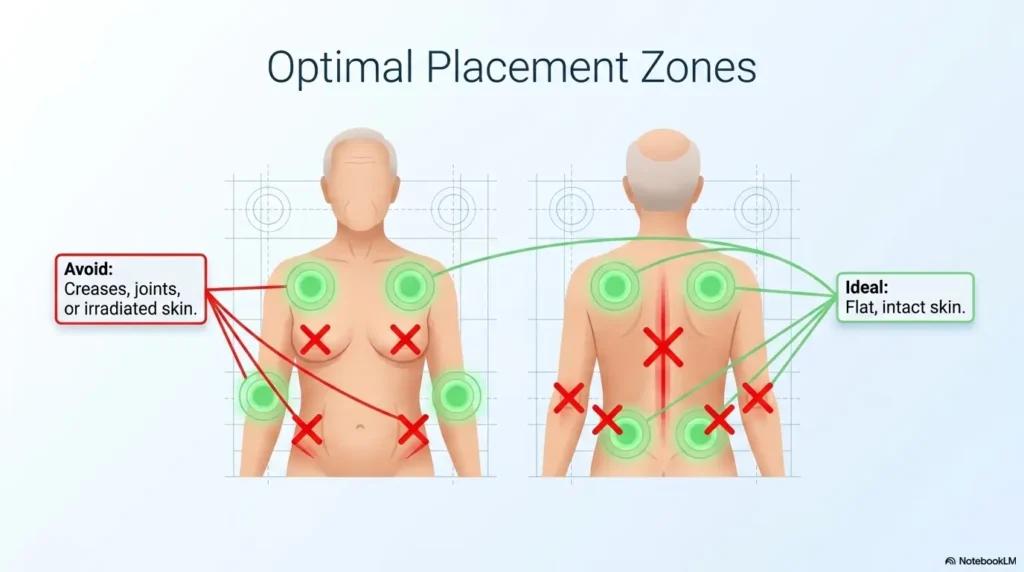
Create a body map rotation without freelancing the label
A body map is a simple drawing or list of approved placement areas. It helps caregivers avoid using the same spot repeatedly and makes the old patch easier to find next time.
Important: the medication label wins. Some patches must be applied to specific areas. Others may allow several areas. Do not invent locations because the chart looks tidy.
- Use only body areas allowed by the medication instructions.
- Write locations in plain English.
- Mark irritated, broken, hairy, recently shaved, or sensitive skin as “do not use.”
- Track patches that lift, curl, or fall off.
- Ask the pharmacist what to do if adhesion becomes a repeated problem.
Protect privacy and dignity while tracking
Some caregivers photograph patch locations. That can be useful in specific situations, but it should never become casual surveillance. If photos are used, protect the senior’s consent, privacy, and dignity. Avoid sensitive body areas and delete images when they are no longer needed.
Often, a written location is enough. The question is not “Can technology do this?” The question is “Will this help without making the person feel managed like an object?”
Patch-change flow
The safe sequence is a small train. Keep the cars in order.
Read the next change date, time, and last location.
Locate the old patch before opening the new one.
Remove and secure the used patch right away.
Check skin comfort and avoid irritated areas.
Apply the new patch exactly as directed.
Write the new location and next change time.
Show me the nerdy details
Transdermal patches are designed to deliver medication through the skin over a set period. The amount released can depend on the product design, skin contact, adhesion, heat exposure, and whether the patch is used as directed. That is why tracking is different from pill reminders. A pill is usually swallowed and gone from view. A patch stays on the body, may contain remaining medication after removal, and can create risk if an old patch is left in place while a new one is applied. The tracker is not just a reminder system. It is a dose-control, location-control, and handoff-control system.
The Reminder Stack: One Alarm Is Too Fragile
One alarm is a paper umbrella in a rainstorm. It helps until it doesn’t. Seniors may silence an alert, misread it, forget to mark completion, or hear it while away from the medication area.
A stronger patch tracker uses a reminder stack: one reminder for the senior, one for the caregiver, and one visible record that shows whether the job was done.
Phone reminder for the senior
The senior’s reminder should be specific. Instead of “Patch,” write “Change patch now: remove old patch first, then mark the log.” Specific wording reduces the chance that the alert is dismissed without action.
For older adults with vision difficulty, make the text large and consider a sound that is not used for ordinary messages. If the phone is already crowded with alerts, the patch reminder needs a different bell in the orchestra.
Shared calendar alert for the caregiver
A shared calendar is useful when adult children live elsewhere or when several family members rotate care. The caregiver alert should include the same wording every time: medication name, change time, last known location, and “confirm old patch removed.”
Do not let every caregiver create separate reminders. One shared calendar is safer than three personal calendars quietly disagreeing with each other.
Smart speaker plus whiteboard
A smart speaker can help when the senior starts the day in the same room. It is especially useful for “Tuesday at 8 AM” routines. Still, spoken reminders disappear into the air. Pair them with a written log or whiteboard.
A whiteboard by the medicine area may not win a design award, but it wins the morning. Write: “Next patch change: Friday 8 AM. Last location: right upper back. Remove old patch first.”
The backup reminder is the real reminder
In caregiver systems, the backup reminder often does the actual safety work. The senior’s reminder starts the action. The caregiver reminder confirms completion.
If the caregiver cannot confirm, the next step should be planned in advance: call the senior, check the home-care note, ask the spouse, or contact the aide. A missed confirmation should not become a mystery novel at 9 PM.
Key takeaway
Use at least two reminders and one visible completion record. The alert says “do it.” The log proves it was done.
Low-Tech vs App-Based Patch Tracking: Compare Before You Pay
The best medication patch tracker is not always the most advanced one. It is the one the senior, caregiver, and backup caregiver will actually use on a Tuesday morning when the kettle is whistling and someone cannot find their glasses.
Free tools are often enough for one patch and one caregiver. Paid tools, medication reminder apps, smart devices, or professional care coordination may be worth considering when there are multiple medications, multiple caregivers, memory changes, low vision, or repeated missed doses.
Good, better, best patch tracking setup
| Setup | Best for | Typical cost | Watch-outs |
|---|---|---|---|
| Good: paper calendar plus patch card | One patch, one primary caregiver, senior likes paper | Low or free | Can fail if nobody checks completion |
| Better: paper log plus shared phone calendar | Adult children, spouse, or aide sharing responsibility | Low or free | Needs one agreed owner for updates |
| Best: shared log, reminders, body map, pharmacist review | Multiple patches, low vision, memory changes, repeated confusion | Low to moderate, depending on tools or services | Still requires human confirmation |
When paper is better than an app
Paper is better when the senior uses a wall calendar, has trouble unlocking a phone, dislikes apps, or needs a large visual cue. A large-print patch calendar can be more useful than a beautifully designed app that nobody opens.
Paper also helps substitute caregivers. A clipboard near the medicine area tells a visiting aide what happened without requiring access to a family member’s phone.
When an app may be worth it
A medication reminder app may be worth comparing if the senior takes many medications, multiple family members need alerts, or completion history matters. Before paying, check whether the app allows custom wording, caregiver notifications, missed-dose alerts, exportable history, and large readable text.
Do not pay for a tool simply because it looks polished. The app must answer the patch-specific questions: where is the patch, was the old one removed, and who confirmed the change?
Questions to ask before buying a reminder tool or service
- Can it record body location, not just medication time?
- Can it include an “old patch removed?” checkbox?
- Can more than one caregiver see the same record?
- Can reminders repeat if not confirmed?
- Is the text large enough for the senior?
- Can the senior use it without frustration?
- Can the log be printed or shared with a pharmacist or doctor?
- Does it protect privacy with sensible account access?
Common Patch Mistakes and When to Seek Help
Most patch-tracking problems are not caused by laziness. They are caused by invisible systems. A patch hides under clothing. A reminder lacks a completion step. A caregiver assumes the pharmacy label is clear enough. A senior tries to “fix” adhesion with tape or heat.
The solution is to name the common mistakes before they happen. A written rule is kinder than a crisis lecture.
Patch mistakes checklist
| Risky mistake | Safer alternative | Who to ask if unsure |
|---|---|---|
| Applying a new patch before finding the old one | Find and remove the old patch first | Pharmacist or prescriber |
| Cutting, folding, trimming, or altering a patch | Use only as directed by the label or clinician | Pharmacist |
| Using heat over a patch | Avoid heating pads, hot packs, or extra heat unless specifically approved | Prescriber or pharmacist |
| Using vague alerts like “patch today” | Use exact date, time, location, and removal reminder | Caregiver lead |
| Two caregivers keeping separate logs | Use one shared source of truth | Family care coordinator |
| Assuming “still stuck on” means “safe to keep wearing” | Follow the prescribed change schedule | Prescriber or pharmacist |
If the patch falls off early
Do not guess. Different patches have different instructions. Some labels explain what to do if a patch falls off, while others require clinician or pharmacist guidance.
Write down when the patch was found loose or missing, where it was supposed to be, and whether anyone may have touched it. Then call the pharmacy or prescriber. This gives them useful details instead of a foggy “something happened.”
Warning signs that need urgent attention
Seek urgent help if the senior has slowed breathing, severe sleepiness, fainting, chest pain, sudden confusion, a fall with injury, or overdose concerns. For accidental exposure involving children, pets, or visitors, treat it seriously and contact Poison Control or emergency services.
For opioid patches, especially fentanyl patches, storage and disposal are safety steps, not afterthoughts. Used patches can still be dangerous if handled incorrectly or accessed by children or pets.
Real-world example: the missed confirmation
A son receives a calendar alert at 8 AM that his father’s patch should be changed. At 10 AM, the shared log still has no update. Instead of assuming the change happened, he follows the family rule: call Dad, then call the aide if Dad does not answer, then check the medicine-area whiteboard during the next visit.
The point is not to create surveillance. It is to define the next step before worry takes the wheel.
Key takeaway
A missed confirmation deserves a calm script, not panic. Decide in advance who checks, who calls, and when to contact a clinician.
Caregiver Handoff: Make Patch Changes Survive Real Life
Patch tracking becomes harder when care changes hands. A daughter covers weekends. A spouse handles mornings. A paid aide comes three afternoons a week. A neighbor helps during a doctor visit. Every handoff is a little bridge, and little bridges need railings.
The safest handoff is short, specific, and written where the next caregiver can see it.
Use a one-sentence handoff
A good patch handoff sounds like this: “Next change is Tuesday at 8 AM, current patch is on the right shoulder, and the old patch must be removed before the new one goes on.”
That sentence can go on a whiteboard, shared calendar note, home-care binder, or text message. Use the same order every time: next time, current location, removal rule.
Add a missed-change script
Caregivers need a script for uncertainty. Without one, people improvise. Improvisation is lovely in jazz and less lovely with medication patches.
- Do not apply another patch until the old patch status is checked.
- Check the log and last known body location.
- Ask the senior what happened without blaming.
- Call the pharmacist or prescriber if timing is unclear.
- Document the advice received and the next change time.
The vacation test
Ask this: could a substitute caregiver understand the patch routine in 60 seconds?
If the answer is no, simplify. The patch card should include the medication name, schedule, current patch location, next change time, pharmacy phone number, prescriber phone number, and the old-patch checkbox.
If low vision is part of the challenge, consider pairing the patch card with a low-vision medication tracker printable or a broader low-vision medication safety setup. The easier the routine is to see, the easier it is to trust.
Patch Disposal: The Step Many Trackers Forget
Disposal is not cleanup. It is part of medication safety. Some used patches may still contain active medication, and certain patches can be dangerous if a child, pet, or visitor touches, chews, or sticks them to the skin.
That is why the patch-change log should include disposal as a completion step. The change is not finished when the new patch goes on. It is finished when the old patch is secured according to the medication’s instructions.
Disposal varies by medication
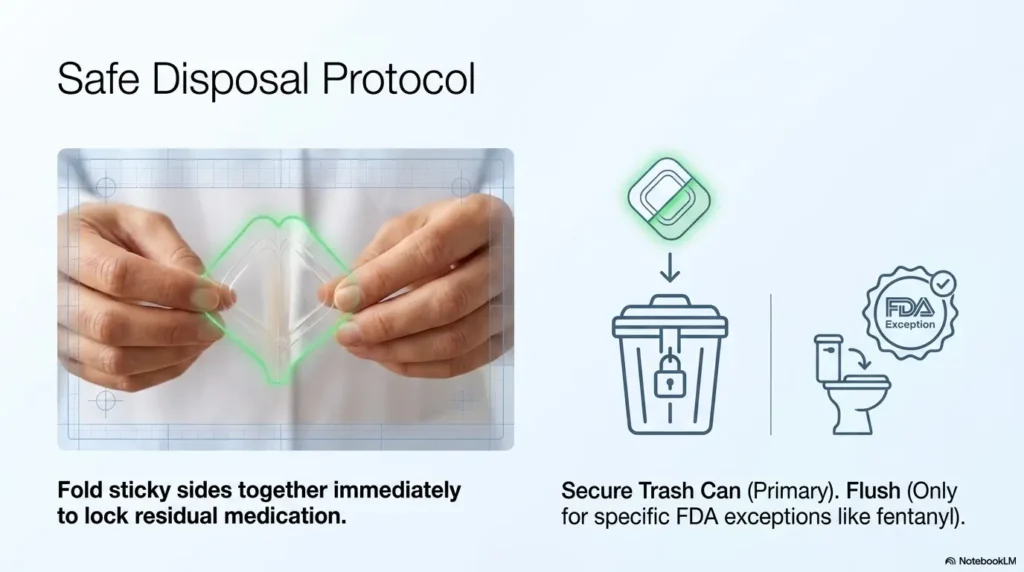
Do not assume all patches are disposed of the same way. Some medication instructions may say to fold the used patch with the sticky sides together before disposal. Some high-risk medicines have specific disposal instructions, including FDA flush-list guidance when take-back is not readily available.
The safest habit is to ask the pharmacist exactly what to do with that specific patch, then write the disposal instruction on the patch card in plain English.
Keep used and unused patches away from children, pets, and visitors
Unused patches should be stored securely. Used patches should be handled immediately after removal, not left on a counter, nightstand, tissue, or trash lid.
If grandchildren visit, if a pet climbs furniture, or if outside caregivers rotate through the home, patch storage and disposal need special attention. Small objects have a way of becoming adventures for the wrong audience.
Patch disposal checklist
- Read the medication-specific disposal instructions.
- Remove the old patch before opening the new one.
- Fold or secure the used patch only as directed.
- Keep used patches away from children and pets immediately.
- Use take-back options when appropriate and available.
- Ask the pharmacist whether the patch is on special disposal guidance.
- Write the disposal instruction on the patch card.
Key takeaway
A patch change has three verbs: remove, replace, record. For many patches, add a fourth: secure disposal immediately.
FAQ
How do I remind an elderly parent to change a medication patch?
Use two reminders and one written record. Set a phone or smart-speaker reminder for your parent, set a shared calendar alert for the caregiver, and keep a patch log near the medication storage spot. The reminder should say exactly what to do: “Remove old patch first, apply new patch, mark the log.”
What should I write in a medication patch log?
Write the medication name, strength, date and time applied, body location, whether the old patch was removed, any skin concern, initials of the person who checked, and the next change date and time. Keep it short enough to complete in two minutes.
Can a caregiver put the patch change schedule on a shared calendar?
Yes, a shared calendar can be helpful, especially when adult children or multiple caregivers are involved. Use one shared schedule rather than separate personal reminders. The calendar alert should include the next change time, current body location, and “confirm old patch removed.”
What happens if a senior forgets to remove the old patch?
Do not apply another patch or guess what to do next. Check the log, look for the old patch, and contact the pharmacist or prescriber if there is any uncertainty. If there are overdose symptoms, severe sleepiness, slowed breathing, fainting, or sudden confusion, seek urgent help.
Should I track where each patch was placed on the body?
Yes. Tracking the body location helps caregivers find the old patch, rotate approved areas when appropriate, and notice skin irritation. Use plain English location labels such as “left upper back” instead of abbreviations that another caregiver may misunderstand.
What should I do if a medication patch falls off early?
Follow the medication label if it gives specific instructions. If not, call the pharmacist or prescriber before replacing it. Write down when it fell off, where it was located, and whether anyone may have touched it.
Is it safe to use tape to keep a medication patch on?
Do not tape over, cover, or alter a patch unless the medication instructions or clinician says it is safe. Some patches have specific adhesion instructions. Ask the pharmacist what to do if the patch keeps lifting or falling off.
How do I dispose of used medication patches safely?
Disposal depends on the medication. Read the product instructions and ask the pharmacist for patch-specific guidance. Used patches should be secured immediately and kept away from children, pets, and visitors. For some high-risk patches, official disposal guidance may be different from ordinary household trash disposal.
Optional video: Open the video on YouTube (external site).
Make the First Patch Card in 15 Minutes
The first patch card is the small practical step that turns this article from good intentions into a safer morning routine. You do not need a perfect binder, a paid app, or a laminated masterpiece. Start with one index card, one pen, and the medication package.
Write the card in large, plain lettering. Put it near the medication storage spot. Then set two reminders: one for the senior and one for the caregiver. The goal is not elegance. The goal is less guessing.
The 15-minute patch card
- Copy the medication name and strength from the label.
- Write the exact change schedule from the label or clinician instructions.
- Write the next change date and time.
- Write the current body location.
- Add a checkbox: “Old patch removed?”
- Add a checkbox: “Used patch secured?”
- Write the pharmacy phone number.
- Write the prescriber phone number.
- Add the caregiver backup contact.
- Bring the card to the next pharmacy or doctor visit for review.
Final check before you tape it up
Ask one person who is not the main caregiver to read the card. If they can understand the next patch change in under one minute, the system is working. If they ask three questions, rewrite the card.
A medication patch tracker should feel like a porch light, not a courtroom. It helps everyone see the next safe step without blame, panic, or midnight detective work.
Last reviewed: 2026-08
PUT THIS GUIDE TO WORK · INTERACTIVE WORKSHEET
Create a patch-record handoff card
Use this worksheet alongside the article: How to Track Medication Patches for Seniors Who Forget Change Times. Use the fields provided to organize your notes and next actions, then save your worksheet.
Your entries stay in this page and are cleared when you reload. No account is needed. Saved files are downloaded only to your device.
This card organizes a discussion or task. It does not provide diagnosis, treatment, medication timing, driving clearance, or professional approval. Copy clinical instructions exactly and ask the professional about uncertainty.
How to use your result
Save the worksheet before leaving this page. Recheck any quote, date, or instruction with the relevant provider, pharmacist, manufacturer, or official organization. A completed checklist means you recorded the steps, not that an outcome is guaranteed.
Worksheet added October 20, 2026. Read the article above for context and its stated review scope.