

Organize your questions and next steps, then save your worksheet.
Summary and next steps
Confirm the prescribed schedule first; AM/PM labels and alarms do not prove that a dose was taken.
- Ask the pharmacist to reconcile unclear timing instructions.
- Agree who fills or checks the system.
- Use one current record and seek advice about any uncertain dose.
Editorial maintenance: October 24, 2026. Summary layout, related links and technical metadata updated. This is not a full clinical review.

A safer rhythm for every dose
How to Stop Seniors from Mixing UpMorning and Evening Pills
A pill organizer can look reassuringly orderly, yet still leave one dangerous question hanging in the air: “Was that compartment empty because the medicine was taken, or because someone removed it earlier?” Morning and evening pill mix-ups rarely come from carelessness alone. They grow from look-alike bottles, dim rooms, changing routines, crowded counters, and two well-meaning caregivers working from different assumptions.
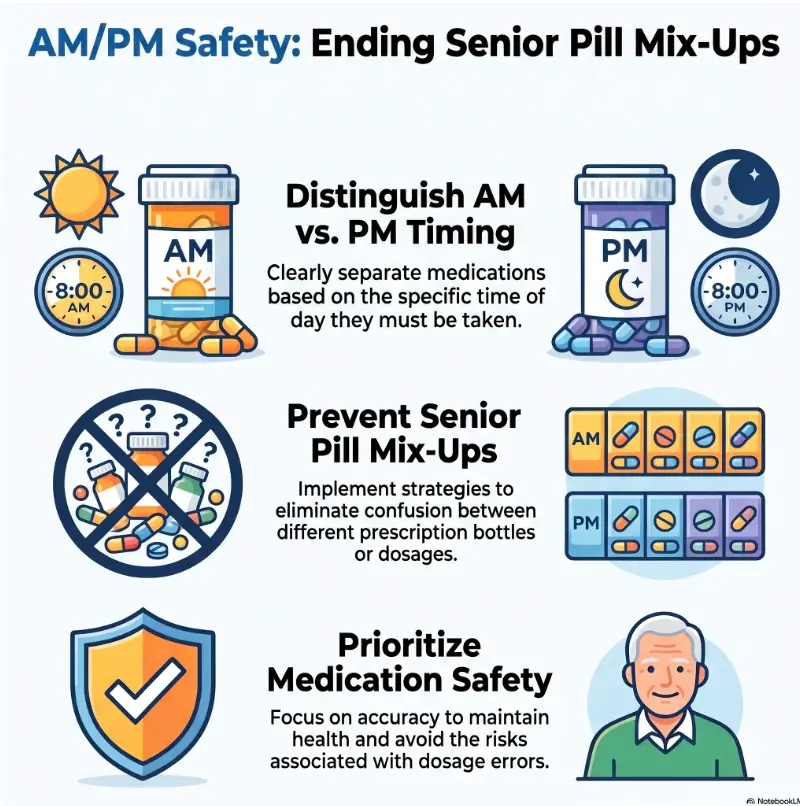
The safest system does not ask an older adult to remember harder. It makes the correct action easier to see, touch, verify, and record. That means separating AM and PM doses physically, using words and symbols together, keeping one current medication list, and giving one person clear responsibility for filling or supervising the organizer.
This guide will help independent seniors, family caregivers, and home-care workers build that system without turning the kitchen into a miniature pharmacy warehouse. It also explains when a simple weekly pillbox is no longer enough and what to do when a dose may have been missed, repeated, or swapped.
Separate the doses
Create unmistakable morning and evening medication zones.
Verify every action
Connect reminders to a visible dose record, not memory alone.
Know when to escalate
Recognize when pharmacist review or direct supervision is needed.
The goal is not a prettier pillbox. It is a system that can answer, with evidence, which dose was taken and when. 🌅
Snapshot
Who it is for: Older adults, relatives, and paid caregivers managing morning and evening medicines at home. What it solves: Swapped, missed, repeated, and undocumented doses. What you will do next: Choose the right level of support, install layered AM/PM cues, and create a clear response plan for uncertain doses.
Table of Contents
Before You Act: Verify the Schedule and the Emergency Path
Safety and scope
This article explains household organization and caregiver workflow. It cannot determine whether a particular medicine should be moved into a pill organizer, taken with food, skipped after a missed dose, or combined with another medicine. Confirm those details with the dispensing pharmacist or prescriber. If a dose may have been taken incorrectly, do not invent a correction schedule.
Confirm Each Medicine Before Reorganizing It
A weekly AM/PM organizer is useful only after the medication schedule has been verified. Some medicines have special storage, packaging, spacing, food, or handling instructions. Others may look nearly identical despite having very different purposes.
Ask the pharmacist which medicines may be placed together, which should remain in their original packaging, and what wording should appear on the household schedule. A caregiver should not translate “take twice daily” into specific clock times without confirming what the prescriber intended.
Create One Current Medication List
The list should include prescription medicines, over-the-counter products, vitamins, supplements, inhalers, drops, patches, creams, and injections. Record the medicine name, strength, purpose, dose, timing, prescriber, pharmacy, and any important instructions.
A printable one-page medication list template can make this easier. Keep one copy near the medication station and another in a wallet, phone, or emergency folder. Update both whenever the regimen changes.
Know Who to Call Before You Need Help
For a possible wrong, extra, or repeated dose in the United States, contact Poison Control at 1-800-222-1222 or use webPOISONCONTROL. Call 911 if the person collapses, has a seizure, has trouble breathing, or cannot be awakened.
For non-emergency questions about whether to take the next scheduled dose, call the dispensing pharmacy or prescriber. Missed-dose instructions vary by medicine, so “take two later” is never a safe universal rule.
Key takeaway
Before changing containers or labels, verify the regimen. Organization should clarify professional instructions, not quietly rewrite them.
Choose the Right Support Level Before Buying Another Pillbox
Light Support for Occasional Timing Confusion
A simple AM/PM organizer may be appropriate when the older adult can identify the medicines, understand the written schedule, notice an unusual pill, and seek help when something seems wrong.
In this situation, the main problem may be environmental: poor lighting, tiny labels, an interrupted routine, or morning and evening bottles stored together. A few strong cues can restore clarity without removing independence.
Shared Support for Multiple Caregivers
Families often assume that more helpers automatically mean greater safety. Without a shared record, however, two attentive people can each administer the same dose.
A multi-caregiver household needs one named medication owner, one dose log, and a handoff procedure. Text messages scattered across three phones are not a reliable administration record, especially during busy mornings.
Direct Supervision for Repeated Errors
A standard pillbox may no longer be sufficient when the person repeatedly forgets whether a dose was taken, opens future compartments early, cannot identify medicines, takes pills from loose pockets or cups, or changes the schedule without checking.
Those signs call for a pharmacist-led medication review and a conversation with the healthcare team. Options may include pharmacy-prepared adherence packaging, a locked dispenser, direct administration by a caregiver, home-health support, or a broader cognitive and functional assessment.
| Support level | May fit when | Typical system | Main safeguard |
|---|---|---|---|
| Good | Occasional AM/PM confusion with otherwise reliable self-management | Large-print schedule plus basic AM/PM organizer | Clear placement and daily checkoff |
| Better | Several medicines, low vision, or more than one caregiver | Pharmacist-verified organizer, dose log, refill owner, layered cues | Documented administration and handoffs |
| Best for higher risk | Repeated errors, cognitive decline, or unsafe access to future doses | Locked dispenser, pharmacy packaging, or direct supervision | Controlled access and professional review |
The “best” medication organizer for an older adult is not necessarily the device with the most features. It is the least complicated system that reliably prevents access, timing, identification, and communication errors.

Why AM/PM Mix-Ups Often Begin Before the Bottle Opens
Look-Alike Bottles Remove the Time Boundary
Pharmacy containers are designed to carry essential information, not to create an obvious morning-versus-evening visual system. When six amber bottles stand in one row, the brain must stop, read, interpret, and remember. That is a heavy sequence for anyone who is tired, hurried, or unable to see the label clearly.
Similar tablets add another layer of risk. A guide to managing similar-looking pills can help families understand why color and shape alone are weak identifiers. The pharmacy label and verified medication list remain the controlling sources.
Routine Changes Break Automatic Habits
A habit that works beautifully on ordinary weekdays may wobble during a medical appointment, weekend visit, late breakfast, afternoon nap, vacation, hospital discharge, or daylight-saving change.
This is why “Mom always remembers after breakfast” is not a complete system. What happens when breakfast is skipped, eaten in the car, or served by a different caregiver? The dose needs a second anchor beyond the meal.
Morning and Evening Can Feel Surprisingly Alike
In winter, both dose times may occur in darkness. A person who wakes from a long nap may briefly mistake 6 p.m. for 6 a.m. Digital clocks without clear AM/PM indicators can make the confusion worse.
The room itself therefore becomes part of medication safety. Lighting, clock visibility, storage height, container position, and nearby objects all either strengthen or blur the time-of-day signal.
Short Story: Two Helpful Hands and One Empty Compartment
On Monday morning, Elena gave her father his pills before leaving for work. She placed the empty medicine cup beside the sink but forgot to mark the paper log.
An hour later, her brother arrived. He saw that the Monday morning compartment was empty, but he also knew their father sometimes moved pills into his shirt pocket. When asked whether he had taken them, their father replied, “I think so.”
The brother did not give another dose. He called Elena, checked the cup, and confirmed what had happened. That evening, the family changed the system. The caregiver now initials the log immediately, and the medicine cup is returned to a marked tray after each dose.
The lesson was small but durable: an empty compartment is a clue, not proof. A completed record closes the gap that memory leaves open.
Key takeaway
Medication errors are often system errors wearing the mask of forgetfulness. Fix the counter, lighting, handoff, and record before asking someone to “try harder.”
Build Two Medication Zones Instead of One Crowded Counter
Give Morning Medicines a Clear Home
Place the morning organizer in a well-lit, secure location associated with a stable activity, such as sitting at the breakfast table. The location should be visible to the person taking the medicine but inaccessible to children, visitors who may become confused, and pets.
Use a large label that says MORNING, paired with a sunrise symbol. Add a second line such as “After breakfast” only when that wording has been confirmed for the medicines involved.
Make Evening Visibly Different
The evening dose should not sit directly beside the morning dose in an identical container. Place it on a different shelf, inside a distinct tray, or in the opposite side of a clearly divided medication station.
Label it EVENING with a moon symbol. Position matters because it continues working when color memory, reading ability, or room lighting is imperfect.
Separate Active, Backup, and Discontinued Medicines
The daily dosing zone should contain only the current system and the materials needed to verify it. Backup bottles can be stored in a secure refill bin nearby, but they should not invite someone to take pills directly from the bottle after already using the organizer.
Discontinued medicines require a separate container marked “Do not use” until disposal instructions are confirmed. Leaving an old prescription beside the current one is an invitation for yesterday’s schedule to wander back into today.
Separate Each Household Member’s Medicine
Spouses may use the same pharmacy bottles, the same kitchen drawer, and even medicines with similar names. Give each person an individually labeled bin and a separate organizer. Avoid sharing one large tray with a vague left-side/right-side arrangement.
The AM/PM Safety Loop
1. VERIFY
Confirm the current schedule with the pharmacist and medication list.
2. SEPARATE
Create distinct morning, evening, household-member, and refill zones.
3. RECORD
Mark every administered, refused, held, or uncertain dose immediately.
4. REVIEW
Check the system after schedule changes, errors, or new confusion.
Layer Visual, Tactile, and Routine Cues
Use Words, Symbols, and Position Together
A strong label communicates the same instruction in several ways. “MORNING” appears in large type, a sunrise symbol reinforces it, and the organizer always occupies the morning position.
Evening receives the same treatment with different wording, a moon symbol, and a separate location. If one cue becomes weak, the others remain available.
Make Text Readable Without Searching for Glasses
Use large, bold, high-contrast text on a matte surface. Avoid condensed fonts, decorative scripts, glossy tape, and pale gray lettering. The schedule should be readable from the normal seated or standing position, not only when held six inches from the face.
For a practical layout, see this guide to creating a large-print medication schedule. Families dealing with tiny pharmacy text may also benefit from strategies for when prescription labels are too small to read comfortably.
Add Tactile Cues Carefully
A raised dot, textured band, or tactile tape can distinguish one container from another for someone with low vision. For example, one raised marker may identify morning, while two identify evening.
Place tactile markers where they will not cover the patient name, medicine name, strength, instructions, warnings, expiration information, or barcode. The guide to safe tactile marker placement on pill bottles explains how to preserve access to the pharmacy label.
Use Color Only as a Backup
Color can be useful, but it should never carry the full instruction. Blue does not naturally mean evening to every person, and color distinctions can disappear under warm lamps or reduced vision.
Key takeaway
Use at least three independent cues: readable words, a familiar symbol, and a consistent physical position. Color is the garnish, not the meal.
Choose a Pill Organizer That Matches the Real Schedule
Basic AM/PM Organizers
A two-compartment-per-day organizer is often enough for a stable twice-daily schedule. Look for large lettering, lids that are easy to open but do not pop open accidentally, and compartments large enough to hold the verified dose.
Check usability before buying several weeks’ worth. Arthritis, tremor, neuropathy, reduced grip strength, and low vision can turn a bargain organizer into a daily wrestling match.
Four-Times-Daily and Removable Dose Boxes
A more detailed organizer may suit a regimen involving breakfast, lunch, dinner, and bedtime. It may also create more opportunities to open the wrong compartment.
Removable daily boxes are convenient for appointments and travel, but each one must retain the person’s name and clear time labels. Loose cups without identification can quickly become mystery containers.
Alarmed and Locked Dispensers
An alarmed organizer can remind someone that a dose is due. It cannot prove the dose was swallowed, and an alarm that continues without a verification step may become part of the room’s background soundtrack.
A locked automatic dispenser may be worth comparing when future compartments are opened early or repeated dosing is a concern. Before paying, ask what happens during a power outage, internet interruption, missed alarm, travel day, device jam, or caregiver setup error.
Pharmacy-Prepared Adherence Packaging
Some pharmacies offer medicines grouped into labeled packets or blister cards by date and time. Availability, eligible medicines, lead times, and fees vary.
Ask whether the pharmacy synchronizes refills, how medication changes are handled mid-cycle, which products cannot be packaged, and whether supplements or as-needed medicines remain separate.
| Option | Cost pattern | Best suited to | What to verify before choosing |
|---|---|---|---|
| Basic weekly AM/PM box | Low one-time cost | Stable schedules and reliable self-management | Label size, lid strength, compartment size, grip comfort |
| Alarmed organizer | Moderate one-time or app-related cost | People who need reminders but can still verify doses | Alarm volume, battery backup, setup burden, false alerts |
| Locked automatic dispenser | Higher purchase or subscription cost | Early opening, repeated doses, or remote caregiver oversight | Access controls, outage plan, notifications, return policy, support |
| Pharmacy adherence packaging | May include packaging or service fees | Complex stable regimens and synchronized refills | Change process, excluded medicines, delivery timing, total fees |
| Direct caregiver administration | Ongoing care cost or family time | Repeated confusion or inability to self-manage safely | Training, documentation, backup coverage, professional guidance |
Show me the nerdy details
A dependable medication system needs four kinds of evidence:
- Identity evidence: Which person and which medicine?
- Time evidence: Which scheduled dose is due?
- Action evidence: Was the medicine actually administered, refused, dropped, or held?
- Change evidence: Has the prescriber or pharmacist updated the regimen?
A device that supplies only reminders addresses time evidence. A complete household workflow must also address identity, action, and change.
Use the One-Owner Rule for Filling and Handoffs
Assign One Person to Fill the Organizer
Choose one named person to refill the organizer or supervise the refill. That person should work from the current medication list and pharmacy labels in a quiet, well-lit space.
Television, phone calls, pets, conversations, and “while I’m here” chores should pause. Medication setup deserves the same uninterrupted attention people give to online banking, perhaps more.
Use a Refill Check
After filling, compare each compartment against the verified schedule. Photograph the completed organizer if the image will be stored securely and used only as a visual reference.
A photograph cannot replace pharmacy identification, but it can reveal that Wednesday evening was accidentally left empty or that an unfamiliar tablet appeared after a refill.
Record Every Dose Immediately
The record should show the date, scheduled time, actual administration time, caregiver initials, and any exception. Useful exception labels include refused, held per instruction, dropped, vomited, and uncertain.
A paper large-print medication tracker may be easier than an app when several caregivers need one visible source of truth.
Make Handoffs Explicit
The outgoing caregiver should state what was given, what was not given, and what remains uncertain. The incoming caregiver should check the log before touching the organizer.
- Confirm the last administered dose and time.
- Identify any refused, held, spilled, or uncertain medicine.
- Report new prescriptions, discontinued medicines, or label changes.
- Check whether the organizer was refilled and by whom.
- Note symptoms or concerns that need pharmacist or clinician review.
A sentence that prevents double dosing
“The 8 a.m. dose was given at 8:12 and recorded. The noon dose has not been given.” Specific words beat “Everything is handled.”
What to Do After a Missed, Doubled, or Swapped Dose
Do Not Try to “Balance It Out”
Do not automatically skip the next dose, take an extra dose, split a tablet, drink extra water, eat a large meal, or induce vomiting. The correct response depends on the medicine, amount, timing, age, health conditions, and symptoms.
An online discussion about someone else’s prescription cannot safely answer a specific exposure question. Use the dispensing pharmacy for routine next-dose uncertainty and Poison Control for a possible wrong or extra dose.
Preserve the Evidence
Keep the organizer, bottles, packets, and medication list nearby. Do not tidy the scene before gathering the facts. A dropped pill, open compartment, or remaining tablet may help clarify what happened.
- Identify the person’s age, approximate weight, and current symptoms.
- Gather the medicine name, strength, label, and packaging.
- Estimate what may have been taken and at what time.
- Check the organizer and administration log.
- Call the appropriate professional and follow the instructions given.
Call 911 for Severe Symptoms
Call 911 when the person collapses, has a seizure, has trouble breathing, cannot be awakened, or develops another severe or rapidly worsening symptom. Do not delay emergency care while searching for a perfect medication history.
Contact Poison Control for a Possible Error
Poison Control advises that medication errors can include taking the wrong medicine, taking too much, giving a medicine twice, or confusing one medicine with another. Help is available in the United States by phone at 1-800-222-1222 and through webPOISONCONTROL.
Key takeaway
When the dose is uncertain, uncertainty itself is information. Record it, preserve the containers, and ask for case-specific guidance rather than creating a home remedy.
When a Basic Pillbox Is No Longer Enough
Watch for Repeated System Failures
One mix-up may reveal a correctable design problem. Repeated mix-ups suggest that the level of support needs to change.
- Future compartments are opened before the scheduled day.
- The person cannot explain what the medicines are for.
- Pills are found in pockets, cups, drawers, bedding, or on the floor.
- The organizer is refilled inconsistently or from an outdated list.
- The person repeats doses after forgetting an earlier dose.
- Caregivers frequently disagree about what was administered.
- New confusion appears suddenly or worsens noticeably.
Request a Medication Review
Bring the current list, bottles, supplements, recent discharge instructions, organizer, and dose log to the pharmacist or healthcare appointment. Ask whether the schedule can be simplified, refills synchronized, packaging changed, or unnecessary duplication reviewed.
A prepared script can make these conversations less stressful. The pharmacy help script for older adults with low vision includes practical questions about labels, packaging, and accessible instructions.
Consider Cognitive and Functional Assessment
New or worsening medication confusion should not be dismissed as an inevitable part of aging. Vision changes, hearing loss, illness, sleep disruption, medication effects, depression, delirium, and cognitive impairment can all interfere with safe self-management.
The National Institute on Aging advises people living with memory and thinking changes to discuss medication support and other safety needs with trusted helpers and healthcare professionals. Review its guidance on living safely with early-stage dementia when cognitive concerns are part of the picture.
Change the Support, Not the Person’s Worth
Taking over part of medication administration can feel like a loss of independence. Explain the change in concrete terms: “We are using a locked dispenser because the Tuesday compartments were opened early,” rather than “You cannot be trusted.”
Preserve choices wherever possible. The older adult may still choose the medication station location, label wording, reminder sound, or which caregiver assists. Safety and dignity can occupy the same room.

FAQ: Morning and Evening Pill Safety
Should Morning and Evening Pills Be Stored Separately?
Visible separation can reduce timing errors, provided both locations meet the medicines’ storage instructions and remain secure. Separation may mean different organizer sections, trays, shelves, or locked compartments. It does not necessarily mean placing medicines in two distant rooms.
Is an AM/PM Organizer Safe for Every Prescription?
No. Some medicines may require original packaging, special storage, limited exposure to moisture or light, or timing that does not fit a basic organizer. Ask the pharmacist before moving a medicine out of its labeled container.
What If My Parent Cannot Remember Whether a Dose Was Taken?
Check the administration log, organizer, pharmacy packaging, caregiver handoff, and any device record. Do not rely on the empty compartment alone. Contact the pharmacist if the question concerns the next routine dose, or Poison Control if a repeated or wrong dose may have occurred.
Can Pharmacies Package Morning and Evening Medicines Separately?
Some pharmacies provide adherence packets or blister cards labeled by date and dose time. Ask about availability, fees, delivery, refill synchronization, medication changes, and which medicines cannot be included.
Are Automatic Pill Dispensers Better Than Weekly Pillboxes?
They offer more access control and may provide alarms or remote notifications, but they require accurate setup and a backup plan. A basic organizer may be better for a reliable user with a simple schedule. A locked dispenser may be more appropriate when future doses are opened early or double dosing has occurred.
How Should Several Caregivers Manage the Same Medication Schedule?
Assign one refill owner, use one shared administration record, and require every caregiver to review the last entry before giving medicine. Record the dose immediately after administration, not at the end of the shift.
What If the Senior Refuses the Organizer?
Ask what feels wrong about it. The lids may hurt, the print may be unreadable, the device may feel childish, or the person may fear losing control. Try to solve the specific usability or dignity problem rather than framing resistance as stubbornness.
When Should a Caregiver Take Over Medication Administration?
Direct supervision should be discussed when errors repeat, medicines cannot be identified, future doses are accessed early, unsafe improvisation occurs, or a clinician recommends greater oversight. The transition should include a clear written plan and backup coverage.
Optional video: Open the video on YouTube (external site).
Run a 15-Minute Medication Safety Reset
You do not need to rebuild the entire medication routine tonight. Begin by removing the most dangerous ambiguity: the inability to tell whether the next dose is truly due.
Minutes 0 to 5: Gather
- Collect current prescriptions, over-the-counter medicines, supplements, drops, inhalers, patches, and injections.
- Bring together the organizer, medication list, discharge papers, and caregiver notes.
- Set discontinued or uncertain medicines aside without discarding them yet.
Minutes 5 to 10: Compare
- Check that every active medicine appears on the current list.
- Circle conflicting instructions, duplicate products, and unclear dose times.
- Identify which medicines still need pharmacist confirmation before entering the organizer.
Minutes 10 to 15: Install One Safeguard
Create two clearly separated positions labeled MORNING and EVENING. Place a dose log beside them and write the name of the person responsible for filling the organizer.
Then make one pharmacist call with the unresolved questions. That small act turns a collection of bottles into the beginning of a verified system.
The quiet promise of a good system
Tomorrow morning, no one should have to stare at an empty compartment and guess. The label, organizer, log, and caregiver handoff should all tell the same story.
Last reviewed: 2026-08
PUT THIS GUIDE TO WORK · INTERACTIVE WORKSHEET
Morning and evening medicine review checklist
Use this worksheet alongside the article: How to Stop Seniors from Mixing Up Morning and Evening Pills. Use the fields provided to organize your notes and next actions, then save your worksheet.
Your entries stay in this page and are cleared when you reload. No account is needed. Saved files are downloaded only to your device.
How to use your result
Save the worksheet before leaving this page. Recheck any quote, date, or instruction with the relevant provider, pharmacist, manufacturer, or official organization. A completed checklist means you recorded the steps, not that an outcome is guaranteed.
Worksheet added October 20, 2026. Read the article above for context and its stated review scope.